
The primary criterion used to analyze the desirability of outcomes in Economics is
a. sustainability
b. equity.
c. predictability.
d. efficiency.
In the indifference curve-budget line model of labor supply,
a. labor is measured along the horizontal axis and leisure is measured along the vertical
axis.
b. labor is measured along the horizontal axis and consumption is measured along the
vertical axis.
c. consumption is measured along the horizontal axis and labor is measured along the
vertical axis.
d. consumption is measured along the horizontal axis and leisure is measured along the
vertical axis.
Economic models start with the assumption of
a. exogenous prices.

b. the laws of supply and demand.
c. equilibrium.
d. rational behavior.
Consider a portfolio with three stocks, each with the same value. The three stocks have
expected returns of 15%, 25%, and 50%. The expected return of this portfolio is
a. 25%.
b. 30%.
c. 50%.
d. 90%.
Suppose a firm hires labor in a competitive labor market. When will hiring more labor
increase the firm’s profit?
a. When the marginal revenue product of labor exceeds the wage rate.
b. When the marginal product of labor is positive.
c. When the marginal labor cost is falling.

d. When the wage rate is less than the firm’s marginal cost of production.
Given a long-run total cost curve for a firm, the firm’s decision about what quantity to
produce will be
a. to produce at the quantity where long-run total cost is at a minimum.
b. to produce at some quantity where the long-run total cost curve exhibits only
increasing returns to scale.
c. determined only after a specific plant size is chosen.
d. determined only after information about revenues is also available.
Monopoly Problem. Consider a monopoly with constant marginal costs of $20.
Consumers in the market for this monopoly’s product have demand of Q = 100 – 2P.
This monopoly will receive producer surplus of
a. $0
b. $225
c. $450
d. $900

When observing people making choices that do not at first appear to be rational, an
economist will ask,
a. “How might a psychologist explain this behavior?”
b. “Why do we economists keep believing that people behave rationally?”
c. “How might such behavior be serving someone’s purposes?”
d. “What is wrong with these people?”
Suppose there are only two goods: guns and roses. In Los Angeles, the absolute price of
roses is 50 dollars per dozen. If the relative price of roses in terms of guns is 1 guns per
dozen roses, then the absolute price of guns is
a. 5 dollars per gun.
b. 2 cents per gun.
c. 50 dollars per gun.
d. 50 cents per gun.

If the demand curve for gasoline is relatively steep, then
a. higher gasoline prices would cause a large number of people to stop driving.
b. the law of demand does not hold for gasoline.
c. shifts in the supply curve for gasoline will have relatively little effect on the price of
gasoline.
d. the price of gasoline has relatively little effect on drivers’ decision to buy gasoline.
When making a purchase, it is least costly to
a. pay cash.
b. put it on a credit card and pay off the balance plus interest in one year.
c. put it on a credit card and pay off the balance at the end of the month before interest
accrues.
d. it doesn’t matter because all three have the same present value.
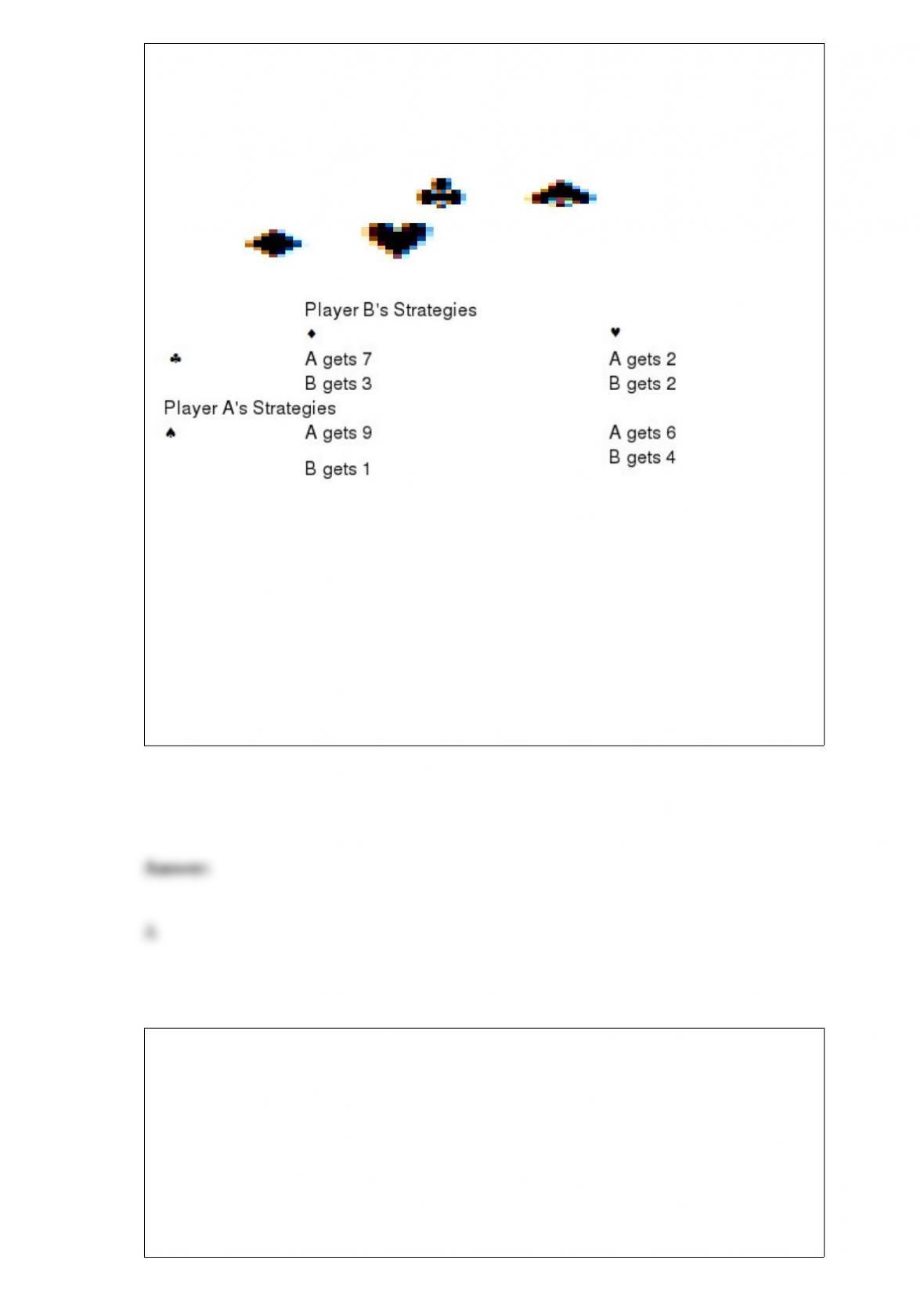
Game Matrix I
The following questions refer to the game matrix below.
Player A can play the strategies and , and Player B can play the
strategies and .
Refer to Game Matrix I. If this game is played sequentially with Player A choosing first,
the Stackelberg equilibrium is
a. the upper left-hand corner.
b. the upper right-hand corner.
c. the lower left-hand corner.
d. the lower right-hand corner.
If the demand for baseballs falls and all other relevant factors remain unchanged, then,
a. the supply for baseballs will fall.
b. the quantity supplied of baseballs will fall.
c. the supply for baseballs will rise.
d. the quantity supplied of baseballs will rise.

Suppose a price index is formed to measure changes in the price level between 1989 to
1995. If the price index focuses on the year-to-year costs of the typical market basket
purchased in 1989, then the reported price changes
a. seem worse for consumers than they really are.
b. seem better for consumers than they really are.
c. accurately reflect changes in people’s levels of satisfaction.
d. may overestimate or underestimate the effects of price changes, depending on
whether consumers’ indifference curves are relatively flat or steep.
Goods X and Y
For the following questions, assume that good X is on the horizontal axis and good Y is
on the vertical axis in the consumer-choice diagram. PX denotes the price of good X, PY
is the price of good Y, and I is the consumer’s income. Unless otherwise stated, the
consumer’s preferences are assumed to satisfy the standard assumptions.
How would a budget line be affected if income and both prices all simultaneously
doubled?
a. It would shift out so that all quantities are doubled.
b. It would shift in so that all quantities are halved.

c. It would not be affected.
d. The slope would be doubled.
The shapes of the total product and marginal product curves are related because
a. an increase in total product pulls marginal product up.
b. marginal product gives the slope of total product.
c. marginal product increases as total product increases.
d. the marginal product curve lies above the total product curve.
Someone who is deemed irrational from an economic standpoint is someone who
a. voluntarily partakes in actions contrary to his personal preferences.
b. voluntarily partakes in actions contrary to what society deems acceptable.
c. voluntarily partakes in actions that the majority of consumers would not.
d. sets prices at ninety-nine cents.

An upward-sloping Engel curve indicates that
a. the good is normal.
b. the good is inferior.
c. demand for this good is elastic.
d. demand for this good is inelastic.
The area beneath a consumer’s demand curve out to the quantity purchased represents
a. consumer’s surplus.
b. the region of mutual advantage.
c. the total value of the consumer’s purchases.
d. the marginal value placed on the last unit consumed.

How does a per-unit subsidy affect the simple monopoly equilibrium?
a. The subsidy does not affect marginal cost and thus does not affect the monopoly
equilibrium.
b. The subsidy lowers the price charged by the monopoly, but it also lowers social gain.
c. The subsidy increases the monopoly’s profit but does not improve social gain.
d. The subsidy causes both monopoly output and social gain to increase.
According to Pigovian analysis, when is a tax necessary to improve the market’s
economic efficiency?
a. When high transactions costs prevent private bargaining.
b. When the social marginal cost of production exceeds the private marginal cost.
c. When consumption of the good creates external benefits for others.
d. When at the competitive equilibrium, the social marginal benefit of the good equals
its social marginal cost.
Common Property II
The following questions refer to the accompanying diagram, which shows the benefits
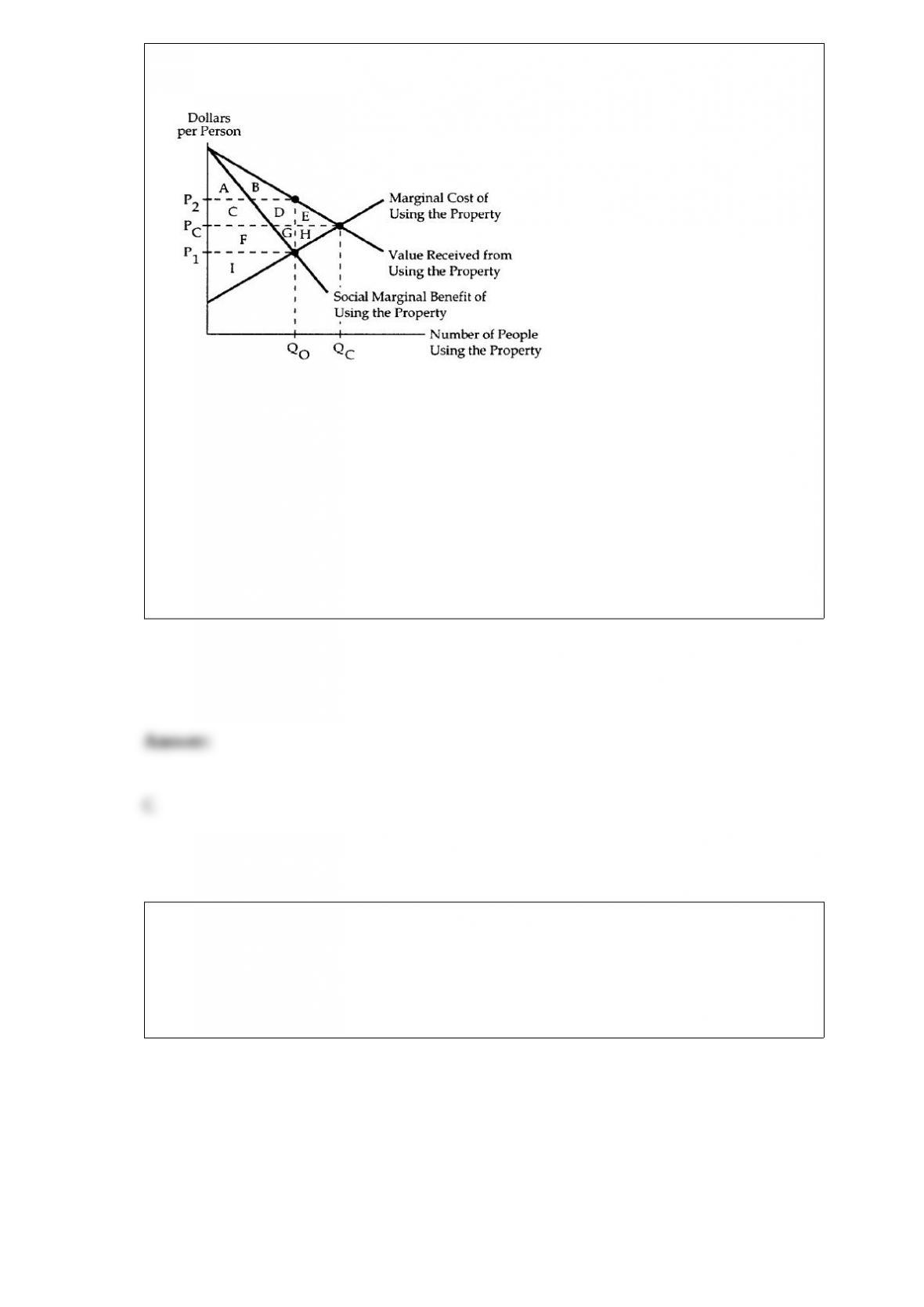
and costs associated with the use of a common property.
If the common property is privately owned, the owner earns revenue equal to
a. Area C + D.
b. Area F + G.
c. Area C + D + F + G.
d. zero.
Common Property I
The following questions refer to the accompanying diagram, which shows the benefits
and costs associated with the use of a common property.
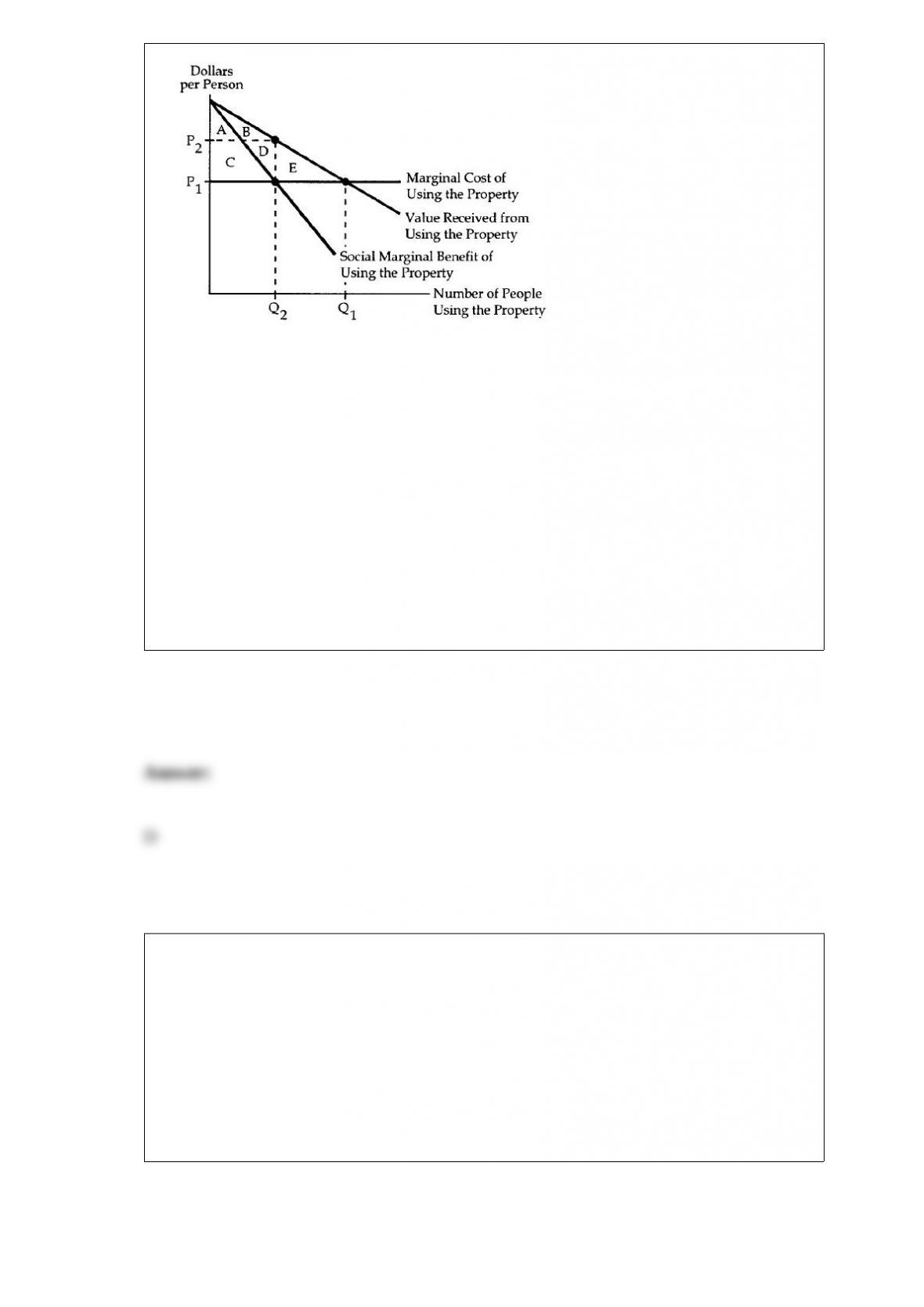
Suppose the common property becomes privately owned. The owner behaves
competitively and charges people an entrance fee for the right to use the property. In
this situation, how are the gains from trade divided between the owner and the users of
the property?
a. The owner receives area C + D, and the users receive area A + B.
b. The owner receives area C, and the users receive area D.
c. The owner receives area E, and the users receive area A + B + C + D.
d. The owner receives area C + D, and the users receive zero.
The cross elasticity of demand between DVDs and DVD players is likely to be
a. zero.
b. positive.
c. negative.
d. undefined.

The demand curve for hotel rooms is Q = 1100 – 2P. If the price of a hotel room is $50,
then the price elasticity of demand for hotel rooms is
a. -0.1
b. -1.0
c. -10
d. zero
It is unlikely that players will attain the Stackelberg equilibrium if
a. both players have a dominant strategy.
b. the Stackelberg equilibrium is Pareto preferred to the Nash equilibrium.
c. the second player cannot be assured that the first player is committed to his strategy.
d. there is an advantage to being the second player.
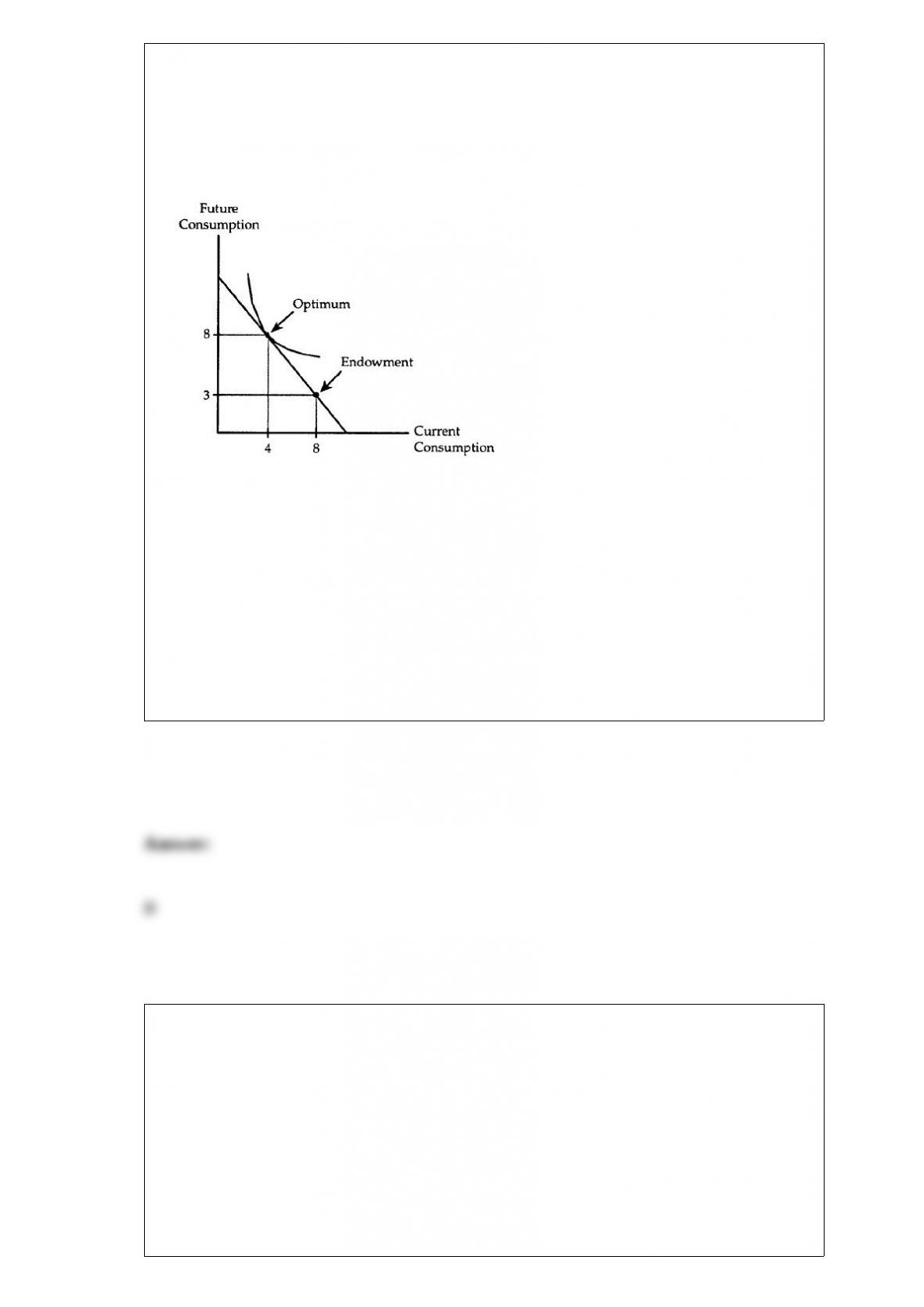
Current and Future Consumption
The following questions refer to the accompanying diagram, which shows a consumer’s
choice between current and future consumption.
This consumer can lend and borrow at an interest rate of
a. 8%.
b. 25%.
c. 64%.
d. 100%.
Consumers tend to buy from retailers rather than wholesalers because
a. wholesalers tend to charge higher prices than retailers.
b. wholesalers refuse to deal directly with consumers.
c. consumers are too lazy to find the best price.
d. retailers reduce the cost of finding the goods consumers want compared to the
consumers doing the searching for themselves.

A Negative Externality Problem
Demand for a good is given by Q = 100 – P. The private marginal cost of production is
MCP = 10 + Q. There is a $10 per unit negative production externality in this situation.
Suppose there is no attempt to internalize the externality. Pigovian analysis indicates
that the externality creates a deadweight loss equal to
a. $0
b. $25
c. $50
d. $100
In France, two qualities of wines are produced – table wine sold in bulk (bring your own
bottle) and a higher quality of wine. Suppose that the English import all their wine from
France. Then, we would we expect to find, on average that
a. the English drink more of the higher quality of wine, because transportation costs
will lower the relative price of high-quality wine relative to table quality wine.
b. the English will drink more table quality wine, because transportation costs will raise
the relative price of table quality wine to high-quality wine.
c. the French will drink more of the high quality wine because transportation costs

reduce demand for wine in England.
d. the French will drink more of the high quality wine because the wine is produced
there.
Economists are skeptical about the degree to which predatory pricing is used because
a. “price wars” are rarely observed in actual markets.
b. when used as a warning to potential rivals, predation has minimal value.
c. buy-outs are less costly than predation and have no offsetting disadvantages.
d. firms can easily counter predation by “laying low” or borrowing funds.
Different firms in a competitive industry will have differing shutdown points when
a. they have different cost curves.
b. they are charging different prices.
c. they entered the industry at different times.
d. they all have identical cost curves.
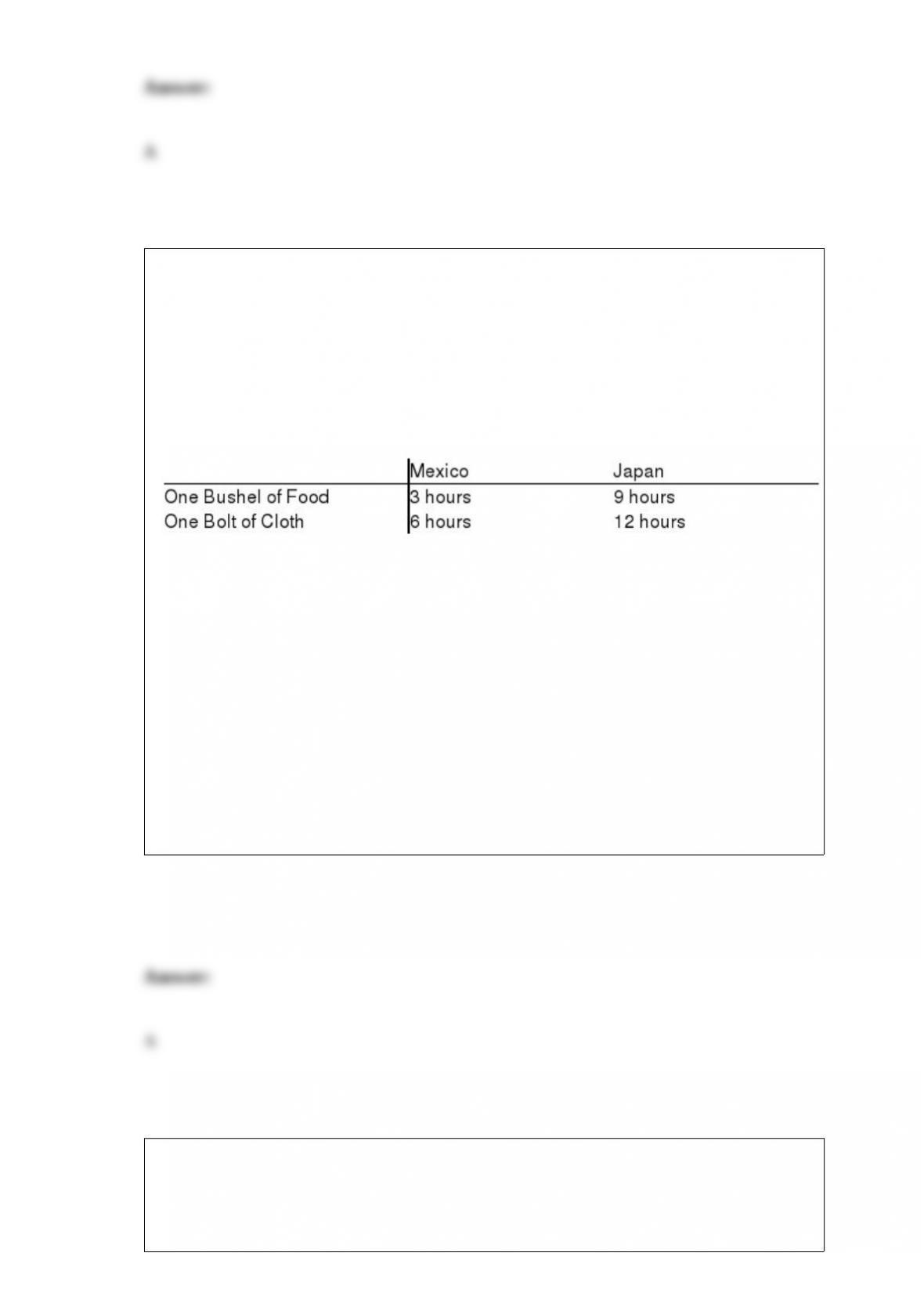
Mexico and Japan
The following questions refer to the following table which shows the abilities of
Mexico and Japan to produce food and cloth. Food and cloth are the only two
commodities in the world and their production requires only labor. The amounts of
labor required to produce one unit of each of these commodities in the two countries are
shown in the table below.
Which country is the more efficient food producer, and which country is the more
efficient cloth producer?
a. Mexico is the more efficient food producer, and Japan is the more efficient cloth
producer.
b. Japan is the more efficient food producer, and Mexico is the more efficient cloth
producer.
c. Mexico is the more efficient producer of both goods.
d. Japan is the more efficient producer of both goods.
Any cost of negotiating or enforcing a contract is
a. an external cost.

b. a private cost.
c. a transactions cost.
d. a side payment.
A market failure occurs when the government steps in and failingly attempts to allieve
the tragedy of the commons.
Of two baskets with identical standard deviations, a risk-averse person will prefer the
basket with the higher expected value.
Firms are so diverse in size and organization that it is not possible to make any general
statements about their behavior.
Attending college can be seen as an individual’s attempt to raise their level of human
capital.
Consider the following:
Define the term price discrimination. What conditions must hold for a firm to be able to
practice price discrimination? How are consumers affected by price discrimination?
The concept of Nash Equilibrium is an important solution concept because it helps
make predictions.

A rise in absolute prices guarantees that relative prices will rise as well.
To deal with the problem of adverse selection, insurance companies may limit the
amount of insurance that can be purchased at the most favorable odds.
For an outcome to be Pareto optimal, the players’ total payoff must be as large as
possible.

In a competitive constant-cost industry, all firms have the same break-even price.
Consumers will be better off when the government imposes minimum quality standards.
Fair trade refers to the fact that retailers are free to set their price in the absence of
resale price maintenance.
Firms are more likely to exhibit risk-neutral behavior than are individuals.
When absolute prices are measured in terms of dollars, the term dollar refers to
currency.
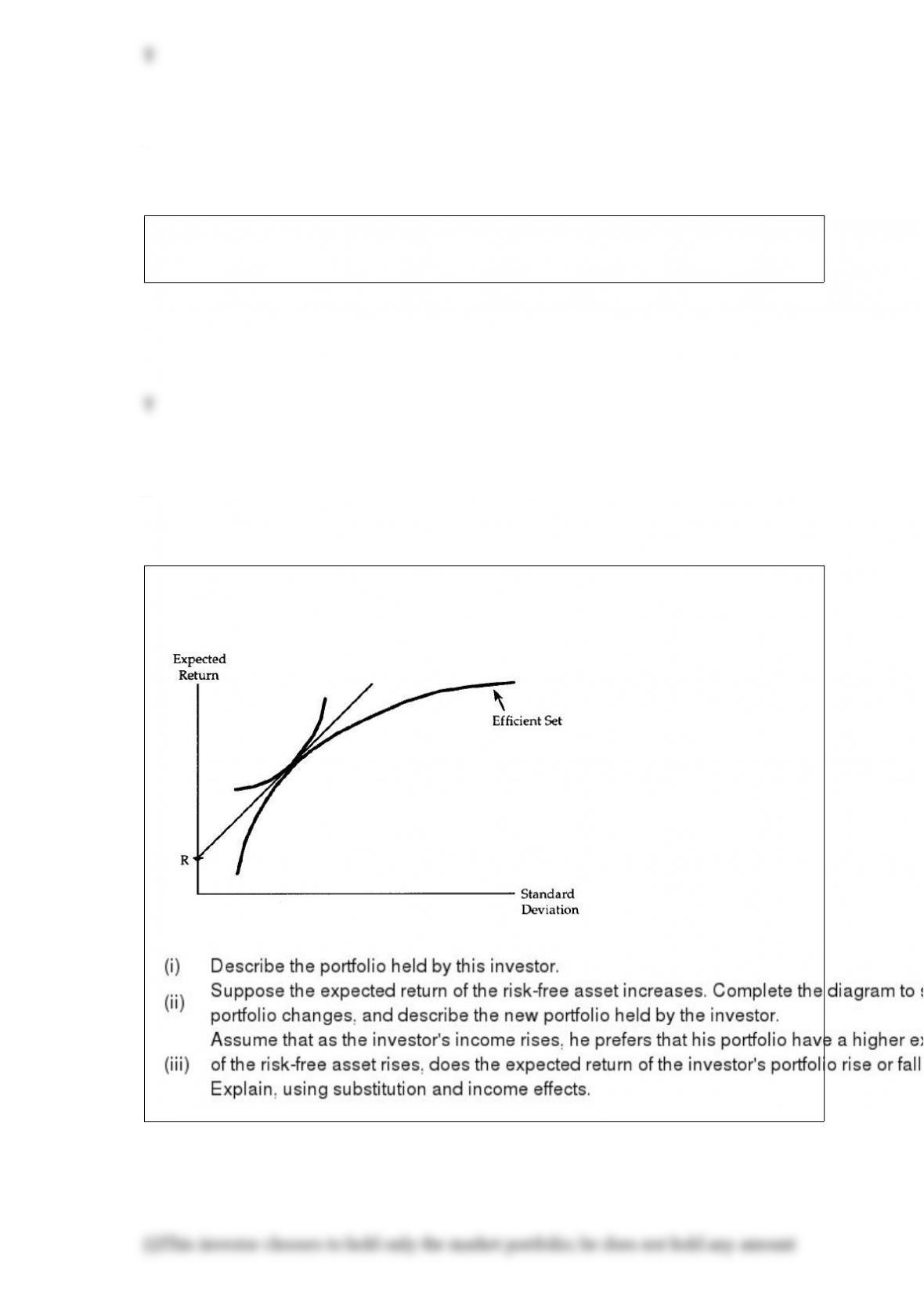
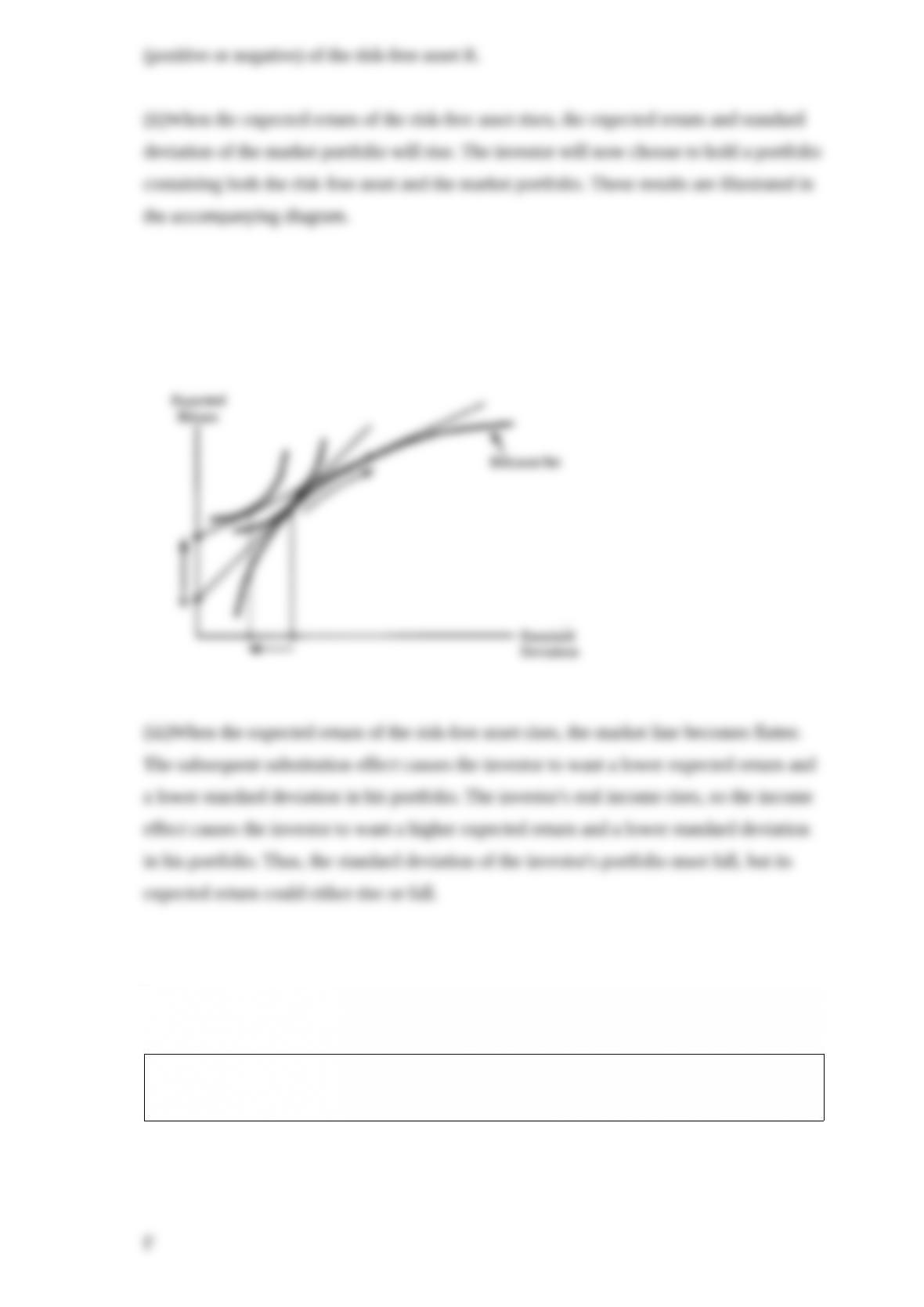
Consider the accompanying diagram, which shows an investor who can choose to hold
the risky assets on the efficient set and/or the risk-free asset labeled R.
There are three types of decision makers in a market economy, consumers, firms and
resource suppliers.
In both competition and monopolistic competition, free entry and exit guarantee that the
industry’s output is produced at the least possible cost.
Explain how incomplete information causes each of the following situations: