
1) Table 7-6
For each of three potential buyers of apples, the table displays the willingness to pay for
the first three apples of the day. Assume Xavier, Yadier, and Zavi are the only three
buyers of apples, and only three apples can be supplied per day.
If the market price of an apple increases from $1.40 to $1.60, then consumer surplus
a.decreases by $0.15.
b.decreases by $0.30.
c.decreases by $0.45.
d.increases by $0.15.
2) Almost all variation in living standards is attributable to differences in countries’
a.population growth rates.
b.productivity.
c.systems of public education.
d.taxes.
3) The terms equality and efficiency are similar in that they both refer to benefits to
society. However they are different in that
a.equality refers to uniform distribution of those benefits and efficiency refers to
maximizing benefits from scarce resources.
b.equality refers to maximizing benefits from scarce resources and efficiency refers to
uniform distribution of those benefits.
c.equality refers to everyone facing identical tradeoffs and efficiency refers to the
opportunity cost of the benefits.
d.equality refers to the opportunity cost of the benefits and efficiency refers to everyone
facing identical tradeoffs.
4) Consider the labor market for short-order cooks. A labor-augmenting technological
change such as a faster food processor will cause
a.both equilibrium wages and equilibrium employment to increase.
b.both equilibrium wages and equilibrium employment to decrease.

c.equilibrium wages to increase and equilibrium employment to decrease.
d.equilibrium wages to decrease and equilibrium employment to increase.
5) Free trade allows firms to realize economies of scale, resulting in higher costs of
production.
a.True
b.False
6) Which of the following programs would be opposed by philosopher John Rawls?
a.a negative income tax
b.the Supplemental Security Income (SSI) program
c.a tax plan creating a perfectly egalitarian income distribution
d.Rawls would oppose all of the programs.
7) Evidence of differences in the average wages of black workers compared to white
workers
a.does not alone provide conclusive evidence of discrimination.
b.clearly indicates differences in productivity between races.
c.is seldom used to provide evidence of discriminatory bias.
d.clearly indicates discrimination on the basis of race.
8) If the value of the marginal product of labor exceeds the wage, then the firm could
a.increase profit by hiring additional labor.
b.increase profit by reducing the amount of labor hired.
c.increase revenue by lowering output.
d.reduce total cost by hiring additional workers.
9) Let L represent the number of workers hired by a firm, and let Q represent that firm’s
quantity of output. Assume two points on the firm’s production function are (L = 5, Q =
125) and (L = 6, Q = 152). Then the marginal product of the 6th worker is
a.25 units of output.
b.27 units of output.
c.37 units of output.
d.162 units of output.
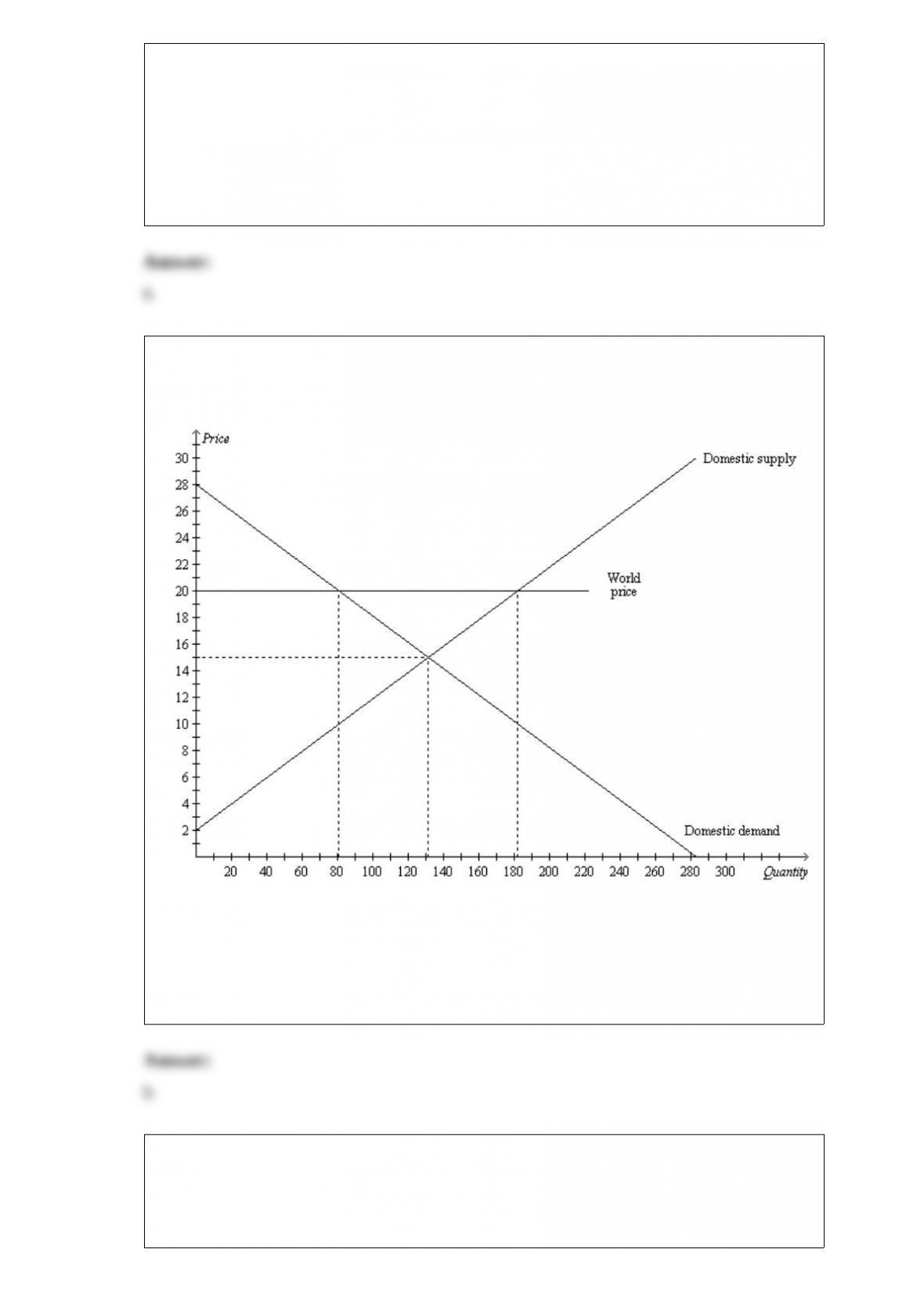
10) Figure 9-2
The figure illustrates the market for calculators in a country.
Without trade, consumer surplus is
a. $423.
b. $845.
c. $1,690.
d. $3,380.
11) Table 17-18
This table shows a game played between two firms, Firm A and Firm B. In this game
each firm must decide how much output (Q) to produce: 10 units or 12 units. The profit
for each firm is given in the table as (Profit for Firm A, Profit for Firm B).

Refer to Table 17-18. If these two firms play this game repeatedly, the likely outcome
will be
a.10 units of output for Firm A and 10 units of output for Firm B.
b.10 units of output for Firm A and 12 units of output for Firm B.
c.12 units of output for Firm A and 10 units of output for Firm B.
d.12 units of output for Firm A and 12 units of output for Firm B.
12) Al and Steve are both reporters at the same newspaper. Al is black and Steve is
white. Al earns less than Steve.
Which of the following can explain why Al earns less?
a.Although both have BA’s in Journalism, Al’s K12 and college education were of a
lower quality than Steve’s.
b.Al has greater experience.
c.Al works the night shift and Steve works the day shift.
d.Al writes editorials which are very popular with customers, while Steve covers the
police report which fewer subscribers read.