1)
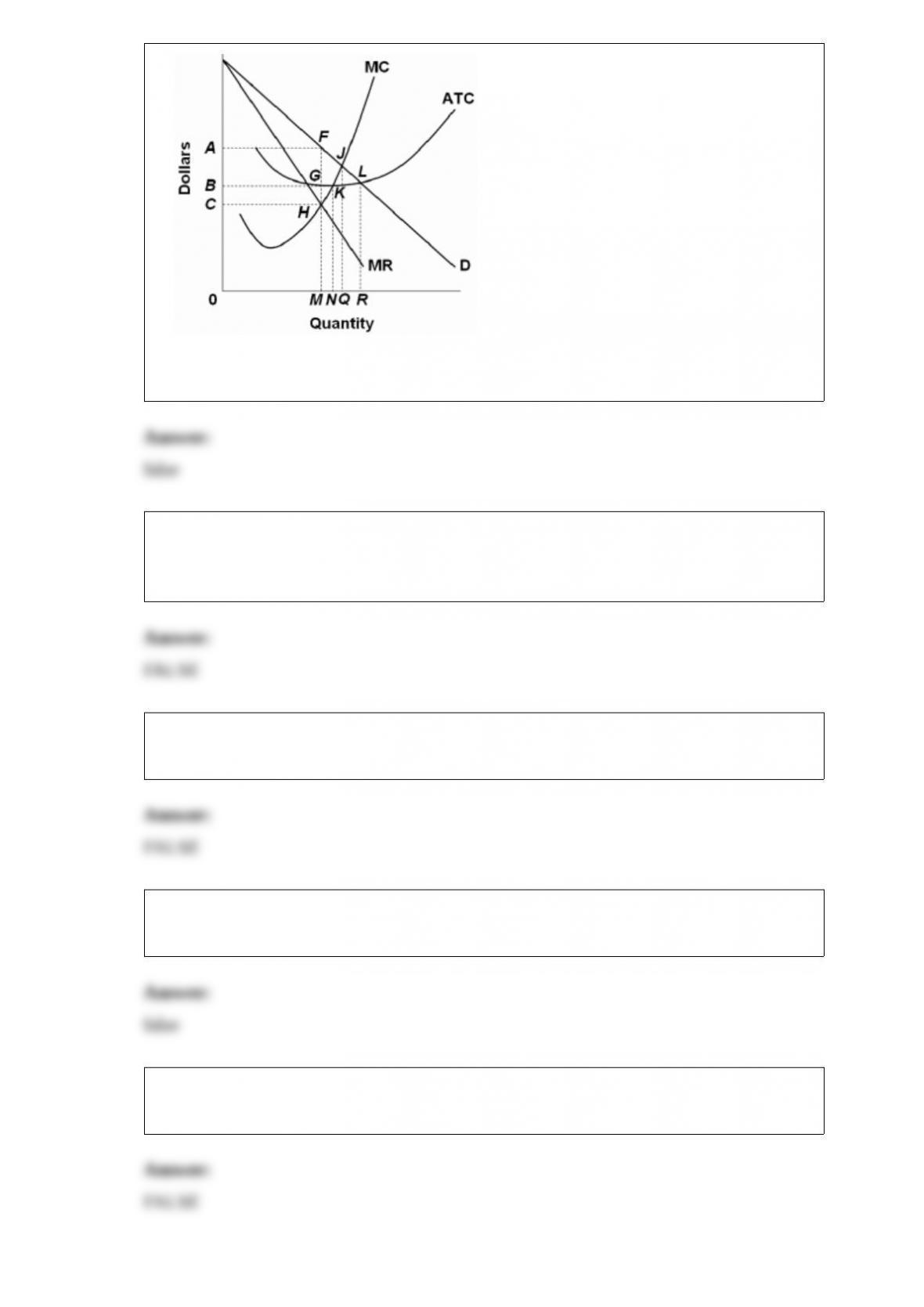
refer to the above diagram for a nondiscriminating monopolist. the profit-maximizing
price for this firm is j
2) Under the international gold standard, exchange rates fluctuate without restraint to
correct any international disequilibrium by affecting the relative attractiveness of
domestic and foreign goods.
3) Elephants are moving closer to extinction in places where they are treated as private
property.
4) water has greater marginal utility than diamonds, yet diamonds have greater total
utility than water.
5) Cost-push inflation is depicted as a rightward shift of the aggregate demand curve
along an upsloping aggregate supply curve.

6) about 14 percent of legal immigrants to the united states in 2007 came from mexico.
7) output-per worker in the united states declined between 1995 and 2007.
8) the guiding function of prices tends to keep resources flowing toward their most
highly valued uses.
9) Supporters of farm subsidies have:
A.argued that farmers are comparatively poor and therefore should receive public help.
B.contended that the family farm is an American “way of life” and should be protected.
C.argued that farmers are at a disadvantage because they buy inputs in monopolized
markets and sell their output in competitive markets.
D.made all of these arguments.
10) If the equilibrium exchange rate changes so that fewer dollars are needed to buy a
South Korean won, then:
A.Americans will buy fewer Korean goods and services.
B.the won has appreciated in value.
C.fewer U.S. goods and services will be demanded by the South Koreans.
D.the dollar has depreciated in value.
11) other things equal, the optimal number of immigrants will be greater, the:
a.greater the education and skill level of immigrants.
b.lower the education and skill level of immigrants.
c.higher the unemployment rate of the destination nation.
d.greater the fiscal burden of each immigrant.

12) If the multiplier in an economy is 5, a $20 billion increase in net exports will:
A.increase GDP by $100 billion.
B.reduce GDP by $4 billion.
C.decrease GDP by $100 billion.
D.increase GDP by $20 billion.
13) People’s incomes are relatively low when they are young, reach a peak in middle
age, and then decline. This fact helps explain:
A.the wide variations of Gini ratios among nations.
B.the equality-efficiency tradeoff.
C.why the lifetime distribution of income is more equal than the distribution in any
given year.
D.why the lifetime distribution of income is less equal than the distribution in any given
year.
14) If an employer is a monopsonist:
A.its MRC curve will lie below its labor demand curve.
B.its labor supply and MRC curves will coincide and be perfectly elastic.
C.it must also be a monopolist in the product market.
D.its labor supply curve will be upsloping and the MRC curve will lie above it.
15) An appropriate fiscal policy for severe demand-pull inflation is:
A.an increase in government spending.
B.depreciation of the dollar.
C.a reduction in interest rates.
D.a tax rate increase.
16) the price elasticity of demand for health care is such that an increase in the price of
health care will:
a.decrease total health care expenditures.

b.increase total health care expenditures.
c.shift the demand for health care rightward.
d.shift the demand for health care leftward.
17) an increase in the price of a product will reduce the amount of it purchased because:
a.supply curves are upsloping.
b.the higher price means that real incomes have risen.
c.consumers will substitute other products for the one whose price has risen.
d.consumers substitute relatively high-priced for relatively low-priced products.
18) Featherbedding refers to:
A.a situation in which a union forces an employer to hire union workers in preference
to nonunion workers.
B.the requirement that unneeded workers be retained on a job.
C.the refusal by one union to handle or transport goods produced by workers in another
union.
D.disputes among two or more unions as to which will perform certain jobs.
19) Relative to 1950, the inflation-adjusted prices of:
A.cattle and hogs have increased in the United States, but the prices of corn and wheat
have declined.
B.cattle and hogs have decreased in the United States, but the price of corn and wheat
have increased.
C.cattle, hogs, corn, and wheat have decreased in the United States.
D.cattle, hogs, corn, and wheat have increased in the United States.
20) At the optimal quantity of a public good:
A.marginal benefit exceeds marginal cost by the greatest amount.
B.total benefit equals total cost.
C.marginal benefit equals marginal cost.
D.marginal benefit is zero.

21) Suppose that Mick and Cher are the only two members of society and are willing to
pay $10 and $8, respectively, for the 3rd unit of a public good. Also, assume that the
marginal cost of the 3rd unit is $17. We can conclude that:
A.the 3rd unit should not be produced.
B.the 3rd unit should be produced.
C.zero units should be produced.
D. 4 units should be produced.
22) (last word) legislation proposed in 2007, if passed, would have:
a.eliminated immigration quotas.
b.increased the emphasis on allowing immigrants based on family connections rather
than based on education and skills.
c.provided a form of amnesty for illegal immigrants through the issuance of z visas.
d.done all of these.
23) supply curves tend to be:
a.perfectly elastic in the long run because consumer demand will have sufficient time to
adjust fully to changes in supply.
b.more elastic in the long run because there is time for firms to enter or leave the
industry.
c.perfectly inelastic in the long run because the law of scarcity imposes absolute limits
on production.
d.less elastic in the long run because there is time for firms to enter or leave an industry.
24) Evaluate the validity of the argument that a new industry in a nation needs
protection from foreign competition if it is to prosper.
25) Explain what is meant by cyclical asymmetry with regard to monetary policy
effects.
26) Define the relationship between the average expected rate of return, if, and the risk
premium.
27) Evaluate the statement: No nation can grow without a large natural resource base.
28) Is the downward price inflexibility applicable to todays economy? Why or why not?
29) Is the Federal Reserve an independent institution?