
1) Scenario 18-6
Rocchetta Industries manufactures and supplies bottled water in Mexico. As a result of
a contamination of water supplies at many of Mexico’s resort communities, the demand
for bottled water has increased.
Refer to Scenario 18-6. When the labor market adjusts to its new equilibrium, we
would expect the
a.marginal product of labor to be higher than it was before the increase in demand for
bottled water.
b.value of the marginal product of labor to be higher than it was before the increase in
demand for bottled water.
c.price of bottled water to be lower than it was before the increase in demand for bottled
water.
d.wages of Rocchetta workers to be lower than they were before the increase in demand
for bottled water.
2) The value and cost of goods are easiest to determine when the goods are
a.private goods.
b.public goods.
c.common resources.
d.club goods.
3) Stewart is a lobsterman. His traps are
a.private goods and the lobster he catches are common resources.
b.private goods and the lobster he catches are public goods.
c.rival in consumption and the lobster he catches are not rival in consumption.
d.not rival in consumption and the lobster he catches are not rival in consumption.
4) When Rick uses a common resource and diminishes other people’s enjoyment of it,
he creates
a.a free rider problem.
b.an externality.
c.a nonrenewable resource.
d.general knowledge.
5) Most economists prefer corrective taxes to regulation as a way to correct the problem
of pollution because
a.the market-based solution is less costly to society.
b.the market-based solution can result in a greater reduction in pollution.
c.the market-based solution raises revenue for the government.
d.All of the above are correct.
6) Relative to direct cash payments, in-kind transfers have the advantage of being
a.more politically popular.
b.more efficient.
c.more respectful of the poor.
d.of a higher dollar value than cash payments.
7) Marco earns more than Antonio. A legislator proposes taxing Marco to supplement
Antonio’s income. A libertarian would view this proposal as
a.a way to improve the welfare of all in society.
b.a way to enhance Antonio’s income in a socially responsible way.
c.validation of the role of diminishing marginal utility over the maximin criterion.
d.an inappropriate role for government, since government should not redistribute
income.
8) Economic theory assumes that voters, politicians, and other political participants are
largely motivated by
a.personal self-interest.
b.altruism.
c.a desire to promote the general welfare.
d.a desire to promote allocative economic efficiency.
9) If an oligopolist is part of a cartel that is collectively producing the monopoly level
of output, then that oligopolist has the incentive to increase production with the aim of
a.increasing prices.
b.increasing profits for the group of firms as a whole.
c.increasing profits for itself, regardless of the impact on profits for the group of firms
as a whole.
d.decreasing costs of production.
10) Scenario 12-3
Suppose Roger and Regina receive great satisfaction from their consumption of
cheesecake. Regina would be willing to purchase only one slice and would pay up to $8
for it. Roger would be willing to pay $11 for his first slice,$9 for his second slice, and
$5 for his third slice. The current market price is $5 per slice. Assume that the
government places a $4 tax on each slice of cheesecake and that the new equilibrium
price is $9. What is Regina’s consumer surplus from cheesecake?
a.zero
b.$2
c.$3
d.$6
11) Economists hold many positions advising the president and Congress including
a.being a member of the Council of Economic Advisers.
b.helping to enforce antitrust laws at the Department of Justice.
c.conducting research at the Congressional Budget Office.
d.All of these are possible positions that economists hold.
12) Total revenue will be at its largest value on a linear demand curve at the
a.top of the curve, where prices are highest.
b.midpoint of the curve.
c.low end of the curve, where quantity demanded is highest.
d.None of the above is correct.
13) Refer to Figure 9-24. With free trade, the country
a.exports 20 units of the good.
b.imports 20 units of the good.
c.exports 30 units of the good.
d.imports 30 units of the good.

14) Welfare economics is the study of
a.the well-being of less fortunate people.
b.welfare programs in the United States.
c.how the allocation of resources affects economic well-being.
d.the effect of income redistribution on work effort.
15) Scenario 14-4
Victor is the recipient of $1 million from a lawsuit. Victor decides to use the money to
purchase a small business in Florida. His business operates in a perfectly competitive
industry. If Victor would have invested the $1 million in a risk-free bond fund, he could
have earned $100,000 each year. After he bought the small business, Victor quit his job
as a market analyst with Research, Inc., where he used to earn $75,000 per year.
How large would Victor‘s accounting profits need to be to allow him to attain zero
economic profit?
a. $100,000
b. $125,000
c. $175,000
d. $225,000
16) Which of the following is not an example of a factor of production?
a.labor
b.interest
c.land
d.capital
17) Figure 19-7
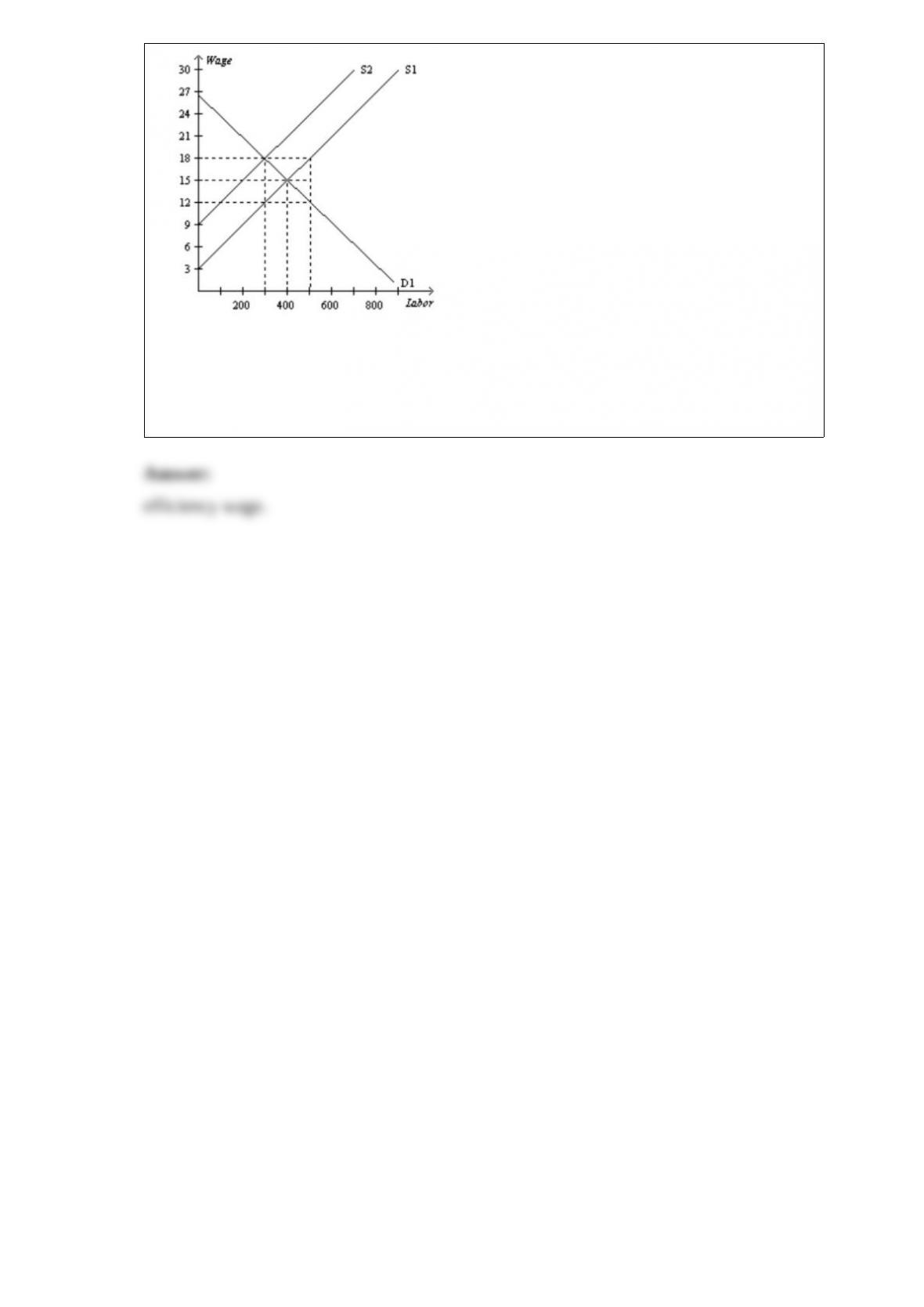
Refer to Figure 19-7. The figure shows labor demand and labor supply in a
non-unionized labor market. Suppose the current labor demand is D1 and the current
labor supply is S1. If a firm in this market decided to pay its workers $18 per hour to
increase the productivity of its workers, this firm would be paying a(n)