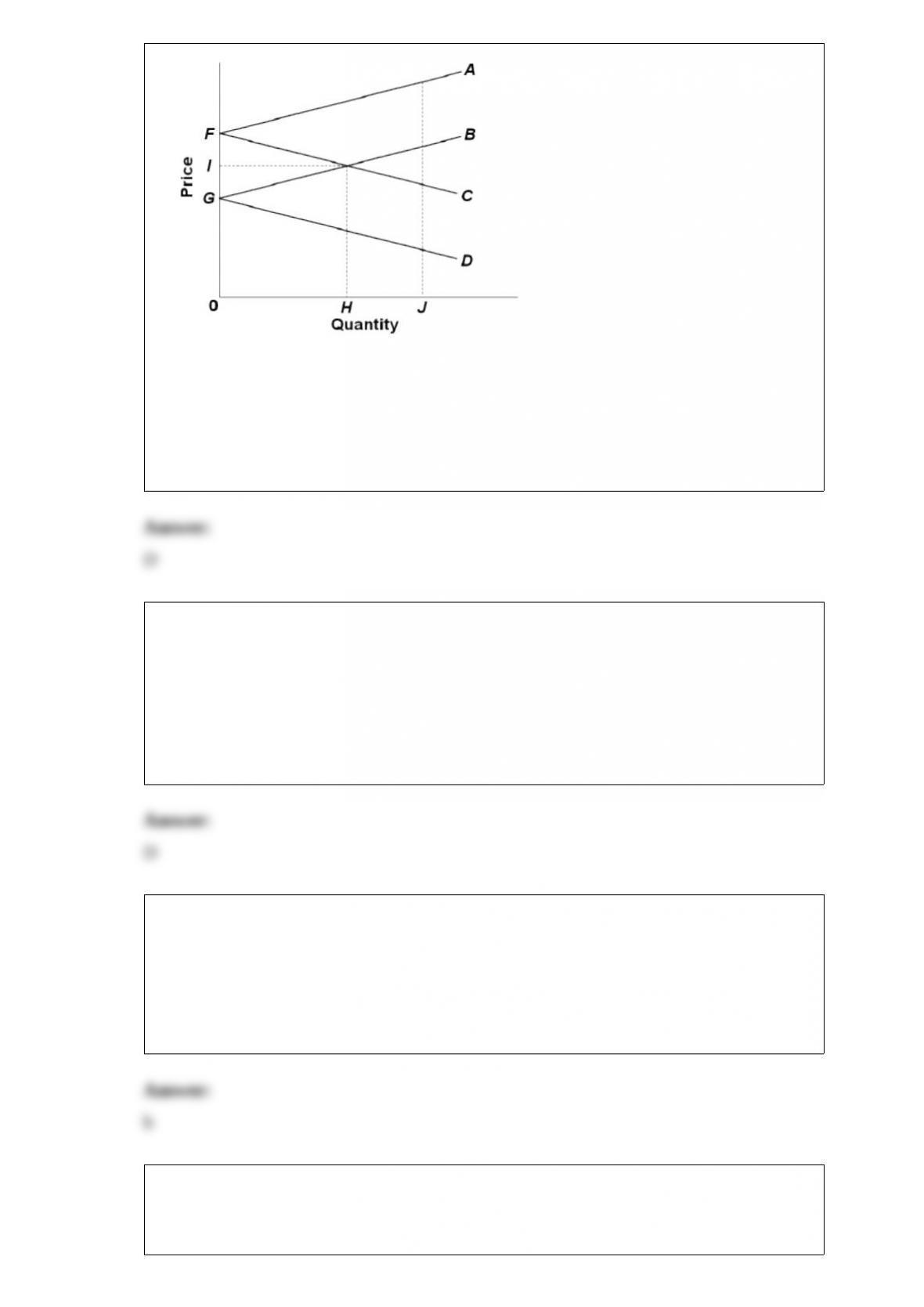
1)
Refer to the above diagram pertaining to two nations and a specific product. Lines FA
and GB are:
A.domestic supply curves for two countries.
B.domestic demand curves for two countries.
C.import demand curves for two countries.
D.export supply curves for two countries.
2) Suppose a firm is hiring resources l and m under purely competitive conditions to
produce product Y that sells for $2 in a purely competitive market. The prices of l and
m are $10 and $4 respectively. In equilibrium the MPs of l and m, respectively, are:
A.1 and 1
B.2 and 5
C.10 and 4
D.5 and 2
3) in industrially advanced countries the price elasticity of demand for health care is
about:
a.2.0.
b.0.2.
c.4.5.
d.1.0.
4) Nonrivalry and nonexcludability are the main characteristics of:
A.consumption goods.
B.capital goods.

C.private goods.
D.public goods.
5) When the Fed lends money to a commercial bank, the bank:
A.increases its reserves and enhances its ability to extend credit to bank customers.
B.decreases its reserves and reduces its ability to extend credit to bank customers.
C.pays the Federal funds interest rate on the loan.
D.pays the prime rate interest rate on the loan.
6) If the demand for an agricultural product is inelastic, a bumper crop will:
A.raise price and decrease total revenues.
B.raise price and increase total revenues.
C.lower price and decrease total revenues.
D.lower price and increase total revenues.
7) suppose that a firm has “pricing power” and can segregate its market into two distinct
groups based on differences in elasticities of demand. the firm might charge:
a.a lower price to the group that has the less elastic demand.
b.a higher price to the group that has the less elastic demand.
c.the same price to both groups but include a “free” related product for the group that
has an inelastic demand.
8) A firm operating in a purely competitive resource market faces a resource supply
curve that is:
A.perfectly inelastic.
B.perfectly elastic.
C.highly inelastic.
D.highly elastic.

9) Which of the following occupations is not among the ten projected fastest growing
U.S. occupations in terms of percentage increases?
A.medical assistants
B.veterinarians
C.desktop publishers
D.software engineers
10) Energy economics is concerned with:
A.attempting to find and exploit low cost energy sources.
B.per capita energy demand of an economy.
C.reducing energy costs for producers and consumers.
D.all of these.
11) Foreign aid to the DVCs has been criticized:
A.because it may generate economic dependence on the IACs.
B.because it encourages the centralization of government power over the economy.
C.because government corruption in the DVCs causes aid to be misused.
D.all of these reasons.
12) The tendency for society to overuse and therefore abuse common resources is called
the:
A.law of conservation of matter and energy.
B.moral hazard problem.
C.tragedy of the commons.
D.the Coase theorem.
13) The populations of the developing nations are growing:
A.at about 5 percent per year.
B.at about the same rate as those of the industrially advanced nations.
C.slower than those of the industrially advanced nations.
D.faster than those of the industrially advanced nations.
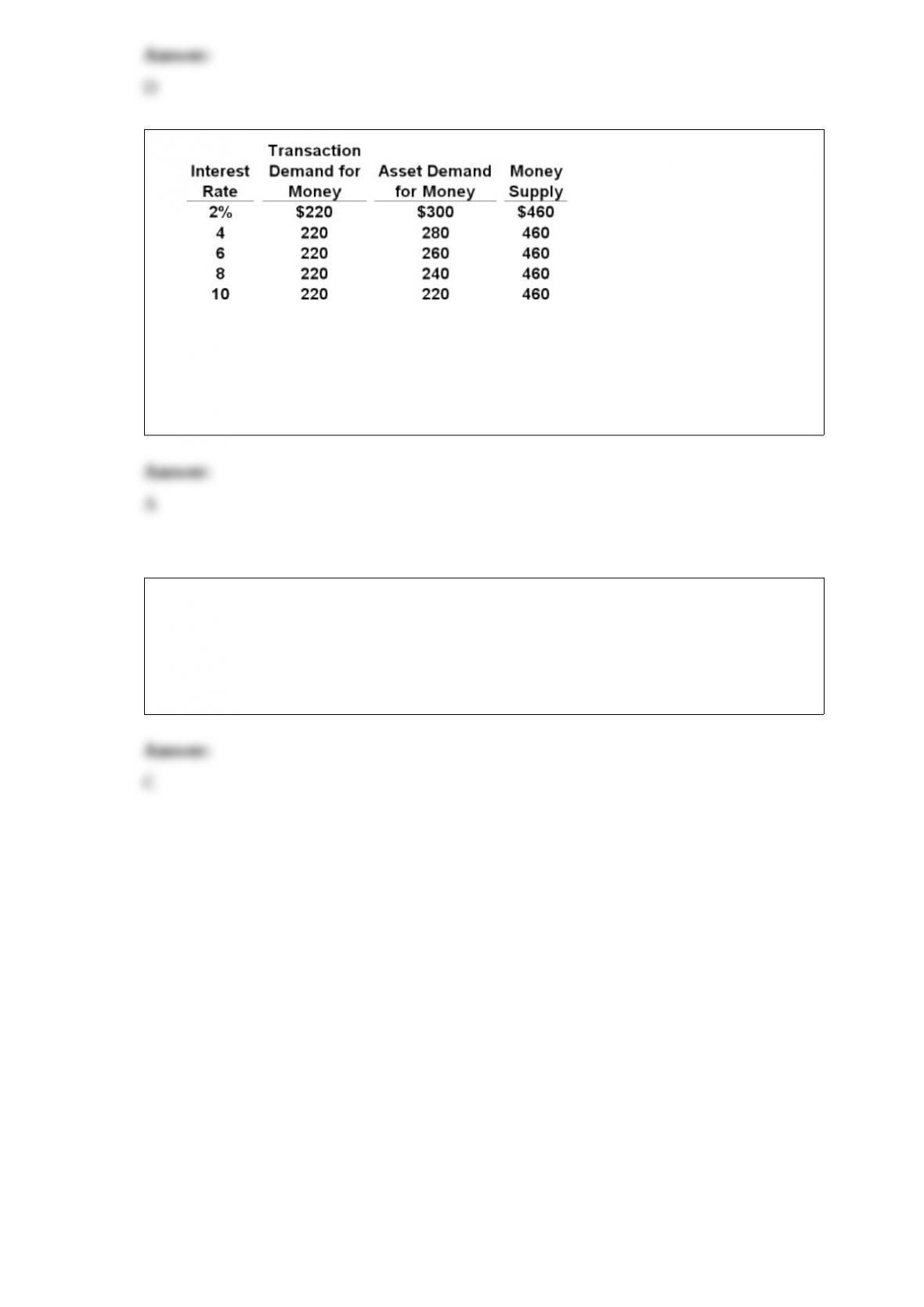
14)
All else equal, the transaction demand for money in the above table would increase if:
A.nominal GDP increased.
B.the interest rate fell.
C.the supply of money increased.
D. the economy’s MPC declined.
15) A vertical merger involves a combining of one or more firms:
A.as the result of one firm purchasing the assets of the other.
B.that are operating in entirely different industries.
C.operating at different stages of the production process in a particular industry.
D.operating at the same stage of the production process.