
Suppose a developing country experiences a reduction in machinery and capital
equipment as foreign entrepreneurs decrease the amount of investment in the economy.
As a result,
A) the long-run aggregate supply curve will shift to the right.
B) the long-run aggregate supply curve will shift to the left.
C) the economy will move up along the long-run aggregate supply curve.
D) the economy will move down along the long-run aggregate supply curve.
All of the following are part of the “taxes” provision of the Patient Protection and
Affordable Care Act (ACA) except
A) pharmaceutical firms and health insurance firms will pay new taxes.
B) investors earning more than $200,000 will pay a new tax on their investment
income.
C) beginning in 2018, all taxes on employer-provided health insurance plans will be
reduced or eliminated.
D) workers earning more than $200,000 will have their share of the Medicare payroll
tax increase.
A bond’s coupon payment divided by the bond’s current price is equal to the bond’s
A) dividend yield.
B) current yield.
C) price-earnings ratio.
D) maturity value.
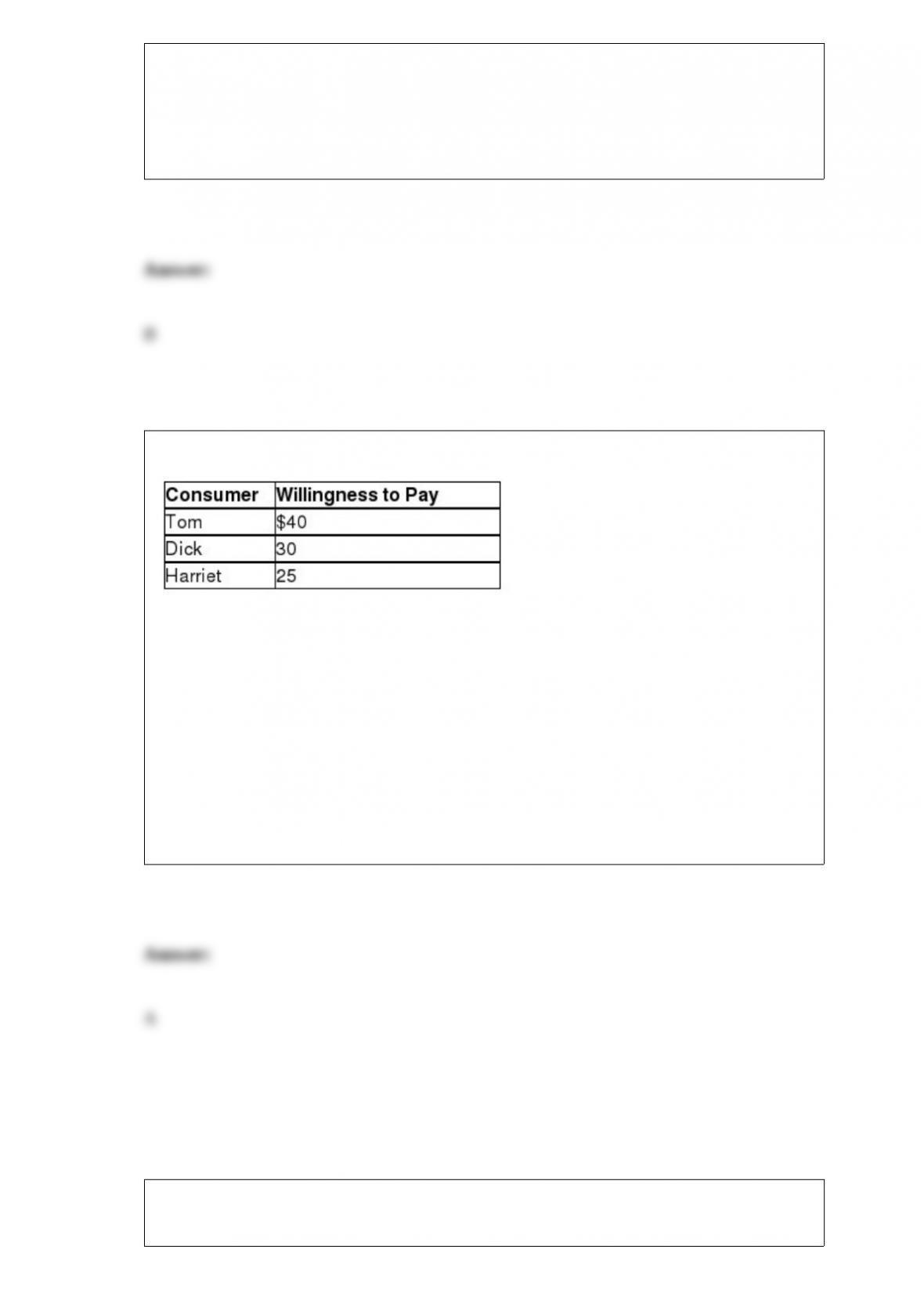
Table 4-1
The table above lists the highest prices three consumers, Tom, Dick and Harriet, are
willing to pay for a short-sleeved polo shirt. If the price of the shirts falls from $28 to
$20
A) consumer surplus increases from $14 to $35.
B) Tom will buy two shirts; Dick and Harriet will each buy one shirt.
C) consumer surplus will increase from $70 to $95.
D) Harriet will receive more consumer surplus than Tom or Dick.
Movie theaters often charge different people different prices for admission. Why don’t
theaters charge different prices for popcorn and other food items?

A) Although the elasticity of demand for admission differs among customers, most
people have the same the elasticity of demand for food items.
B) Concession stand personnel are too busy to ensure that different people pay different
prices for food items.
C) Once people are in the theater, concession stands have monopoly power and can
charge everyone the same high prices for food.
D) It is difficult to limit the resale of food items from those who pay low prices to those
who would have to pay high prices from the concession stand.
The quantity theory of money assumes that
A) the velocity of money is negative.
B) the velocity of money is constant.
C) the velocity of money is zero.
D) the velocity of money fluctuates unpredictably.
In the market for insurance,
A) buyers often have more information than sellers.
B) sellers often have better information than buyers.
C) sellers are protected from lawsuits brought by buyers.

D) demand is perfectly inelastic because, by law, home owners and automobile drivers
must have insurance.
Private producers have no incentive to provide public goods because
A) the government subsidy granted is usually insufficient to enable private producers to
make a profit.
B) production of huge quantities of public goods entails huge fixed costs.
C) they cannot avoid the tragedy of the commons.
D) once produced, it will not be possible to exclude those who do not pay for the good.
The sum of the value added of every firm involved in producing all final goods and
services ________ gross domestic product.
A) equals
B) is greater than
C) is less than
D) is sometimes greater than and other times less than

Consider a discount retailer such as Costco which uses a two-part tariff pricing strategy.
The Costco membership fee
A) buys the consumer the right to make future purchases at Costco.
B) is a resalable asset to the consumer.
C) is a resalable asset to the producer.
D) is used by Costco to cover its fixed costs of production.
Technological change will
A) shift the per-worker production function up.
B) shift the per-worker production function down.
C) move the economy to a point beneath the per-worker production function.
D) move the economy along a given per-worker production function.
When the price level rises from 110 to 115, the aggregate level of GDP supplied rises
from $80 billion to $120 billion. This ________ relationship represents the ________
relationship between the quantity of real GDP firms are willing to supply and the price

level.
A) negative; short-run
B) positive; short-run
C) negative; long-run
D) positive; long-run
Orange juice drinkers want to consume more orange juice at a lower price. Which of the
following events would have this effect?
A) a decrease in the price of orange juice processing
B) an increase in the cost of fertilizer used for orange groves
C) a decrease in income, assuming orange juice is a normal good
D) a decrease in the population