1)
refer to the above table. in relation to column (3), a change from column (5) to column
(4) would indicate a(n):
a.increase in demand.
b.decrease in demand.
c.increase in supply.
d.decrease in supply.
2)
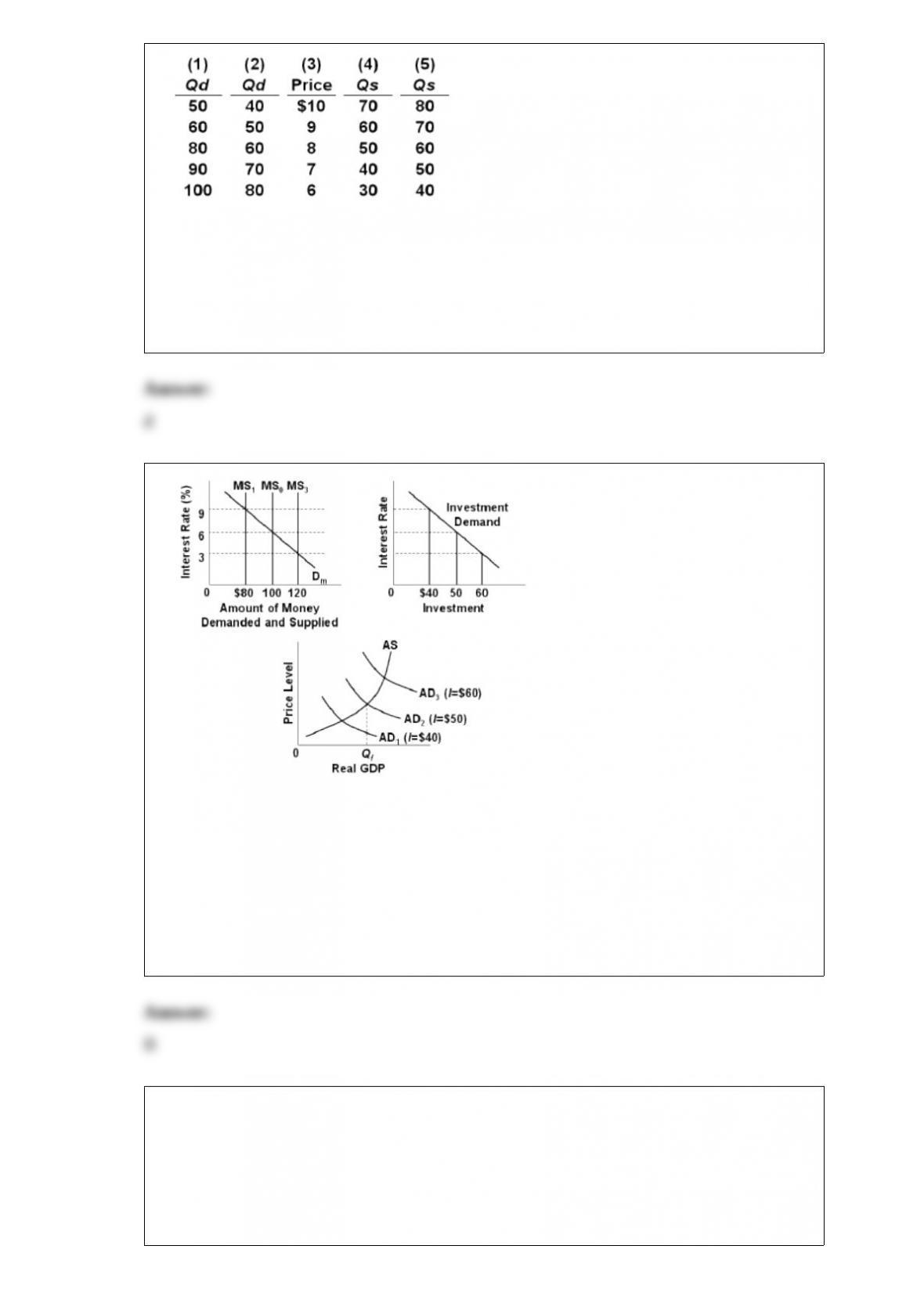
Refer to the above diagrams. The numbers in parentheses after the AD1, AD2, and AD3
labels indicate the levels of investment spending associated with each curve. All figures
are in billions. Which of the following would shift the money supply curve from MS1
to MS3?
A.an increase in the discount rate
B.purchases of U.S. securities by the Fed in the open market
C.sales of U.S. securities by the Fed in the open market
D.an increase in the reserve ratio
3) assume the xyz corporation is producing 20 units of output. it is selling this output in
a purely competitive market at $10 per unit. its total fixed costs are $100 and its average
variable cost is $3 at 20 units of output. this corporation:
a.should close down in the short run.
b.is maximizing its profits.
c.is realizing a loss of $60.
d.is realizing an economic profit of $40.
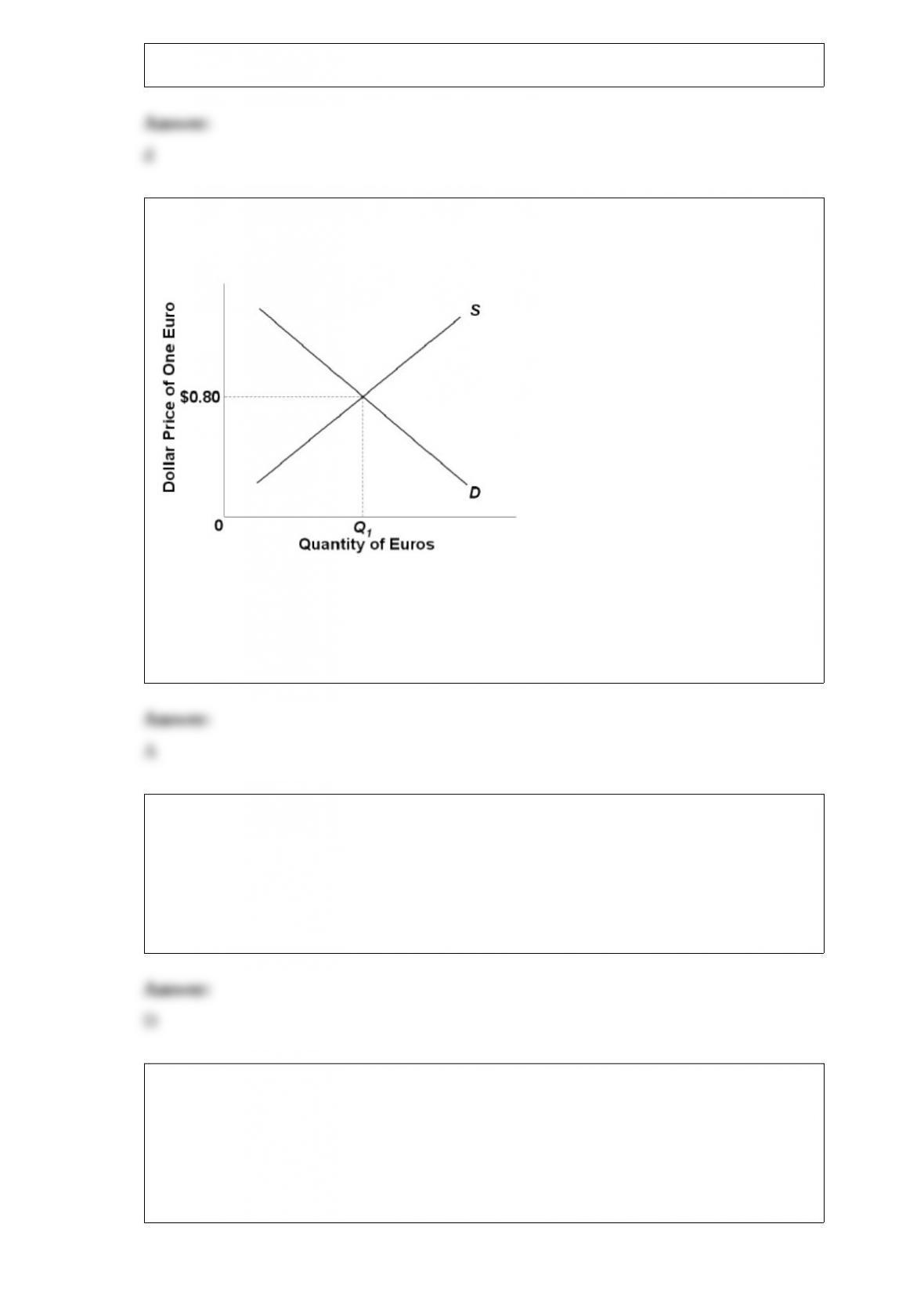
4) The following diagram is a flexible exchange market for foreign currency:
Refer to the above diagram. At the price $.80 for 1 euro:
A.the quantity of euros demanded equals the quantity supplied.
B.the dollar-euro exchange rate is unstable.
C.the dollar price of 1 euro equals the euro price of 1 dollar.
D.there will be a surplus of euros in the foreign exchange market.
5) If at some level of GDP the economy is experiencing an unintended decrease in
inventories:
A.the aggregate level of saving will decline.
B.the price level will fall.
C.the business sector will lay off workers.
D.domestic output will increase.
6) A high tariff on imported good X might reduce domestic employment in industry Y
if:
A.X is an input used domestically in producing Y.
B.X and Y are substitute goods.
C.X is an inferior good.
D.Y is an inferior good.

7) A situation in which society may not be able to rank its preferences consistently
through paired-choice majority voting refers to:
A.logrolling.
B.the paradox of voting.
C.the median-voter model.
D.the special-interest effect.
8) a change in the slope of a budget line is solely the result of a change in:
a.consumer preferences.
b.the price of one good relative to the other.
c.money income.
d.the slope of the indifference curve that is tangent to the budget line.
9) the rationing function of prices refers to the:
a.tendency of supply and demand to shift in opposite directions.
b.fact that ration coupons are needed to alleviate wartime shortages of goods.
c.capacity of a competitive market to equate the quantity demanded and the quantity
supplied.
d.ability of the market system to generate an equitable distribution of income.
10) Which of the following is incorrect?
A.The nominal interest rate is the rate of interest expressed in terms of current dollars.
B.The real interest rate is the rate of interest expressed in terms of dollars of constant or
inflation-adjusted value.
C.The nominal interest rate is the real interest rate less the rate of inflation.
D.During periods of inflation the nominal interest rate will exceed the real interest rate.
11) if depreciation exceeds gross investment:

a.the economy’s stock of capital may be either growing or shrinking.
b.the economy’s stock of capital is shrinking.
c.the economy’s stock of capital is growing.
d.net investment is zero.