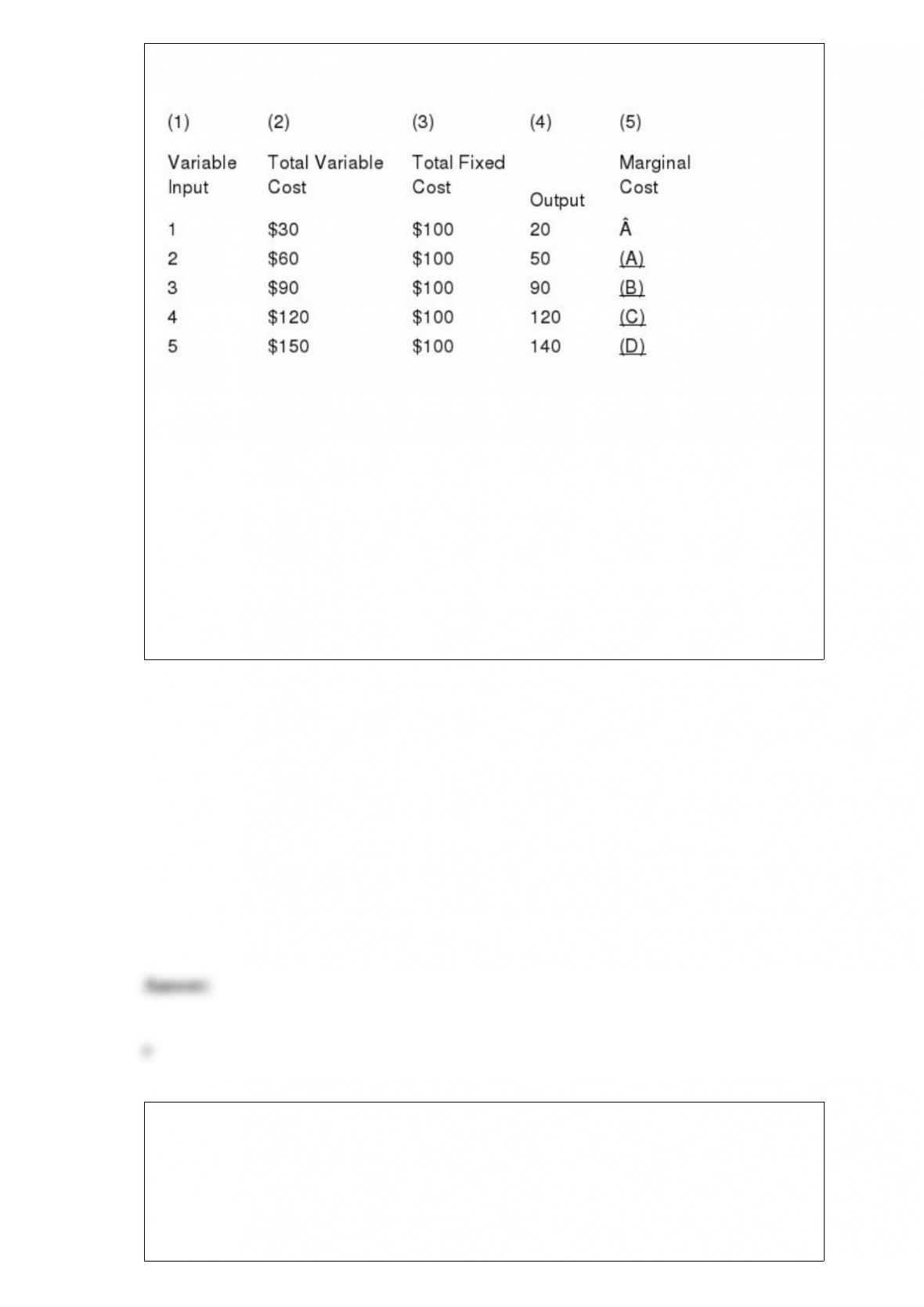
Exhibit 22-2
The dollar amounts that go in blanks (C) and (D), respectively, are
a. $10.00 and $1.00.
b. $30.00 and $34.00.
c. $3.00 and $4.00.
d. $6.67 and $10.00.
e. $1.00 and $1.50.
“Pure economic rent” is a payment
a. in excess of opportunity costs.
b. in excess of opportunity costs when opportunity costs are zero.

c. for the use of land.
d. in excess of opportunity costs when opportunity costs are positive.
e. to a pure monopolist for the monopolist’s product.
In economics, a synonym for utility is
a. usefulness.
b. satisfaction.
c. sacrifice.
d. a service.
If Max’s demand for hot dogs falls as his income rises, then for Max hot dogs are
a. a bad good.
b. an inferior good.
c. a preferential good.
d. a normal good.
e. a neutral good.
Which of the following statements is false?
a. Money must change hands before a cost can be incurred.
b. No monetary payment takes place when an implicit cost is incurred.
c. Costs may be either explicit costs or implicit costs.
d. Cost implies that a sacrifice has been made.
Which of the following is not an assumption of the theory of monopolistic competition?
a. There are high barriers to entry.
b. There are many sellers and few buyers.
c. Each firm in the industry produces and sells a homogeneous product.
d. a and b
e. all of the above
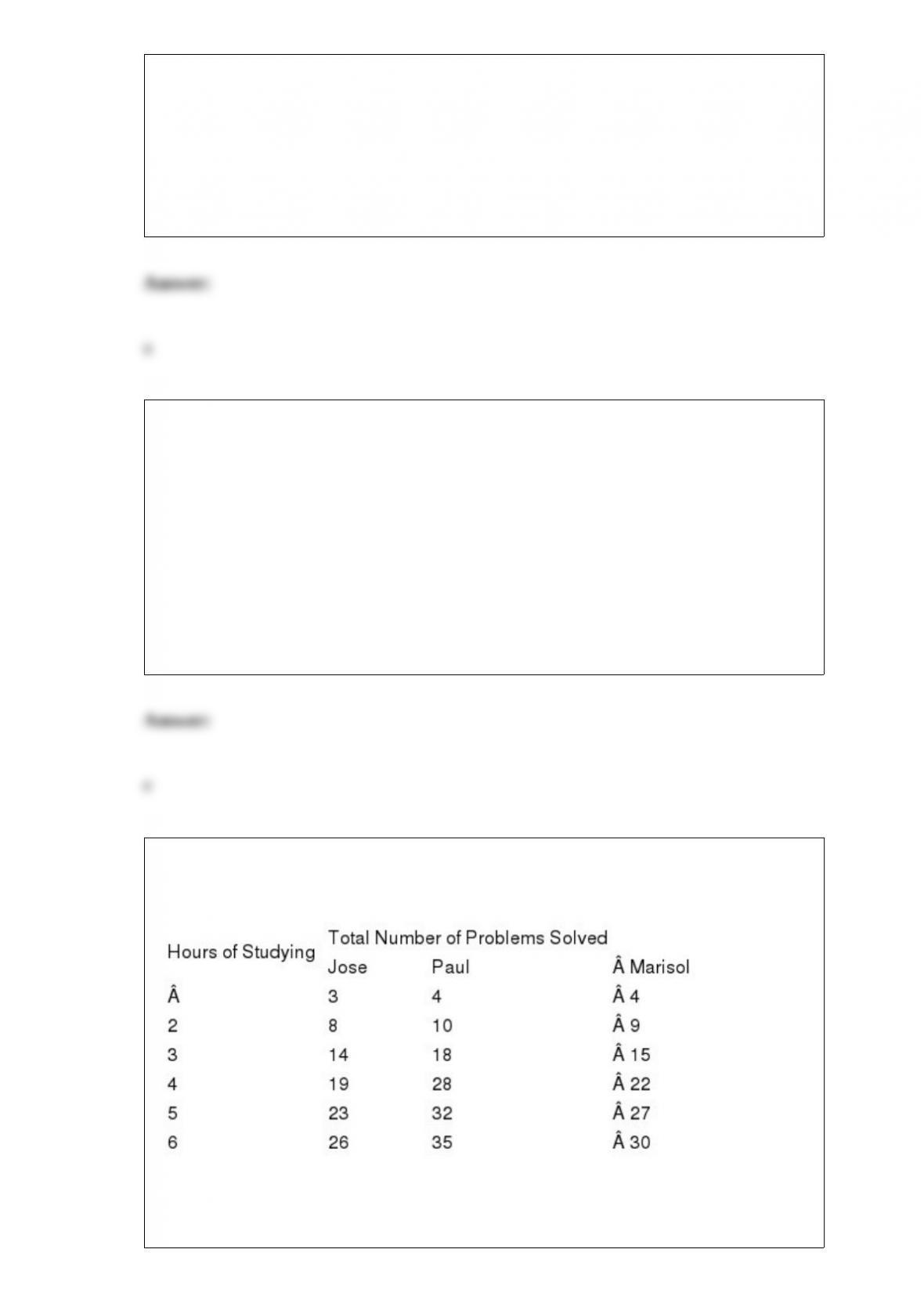
Exhibit 22-10
Jose is experiencing increasing marginal returns

a. only in the first hour of studying.
b. up to the third hour of studying.
c. up to the fourth hour of studying.
d. during all six hours of studying.
Jackson says that his fifth game of chess gave him greater utility than his first, and
therefore the law of diminishing marginal utility does not hold. An economist who
believes that marginal utility definitely and always declines with the consumption of
equal successive units of a good will likely say
a. the fifth game of chess is a different good than the first game of chess.
b. there are exceptions to the law of diminishing marginal utility.
c. the law of diminishing marginal utility does not apply to board games.
d. a or b
e. a or c
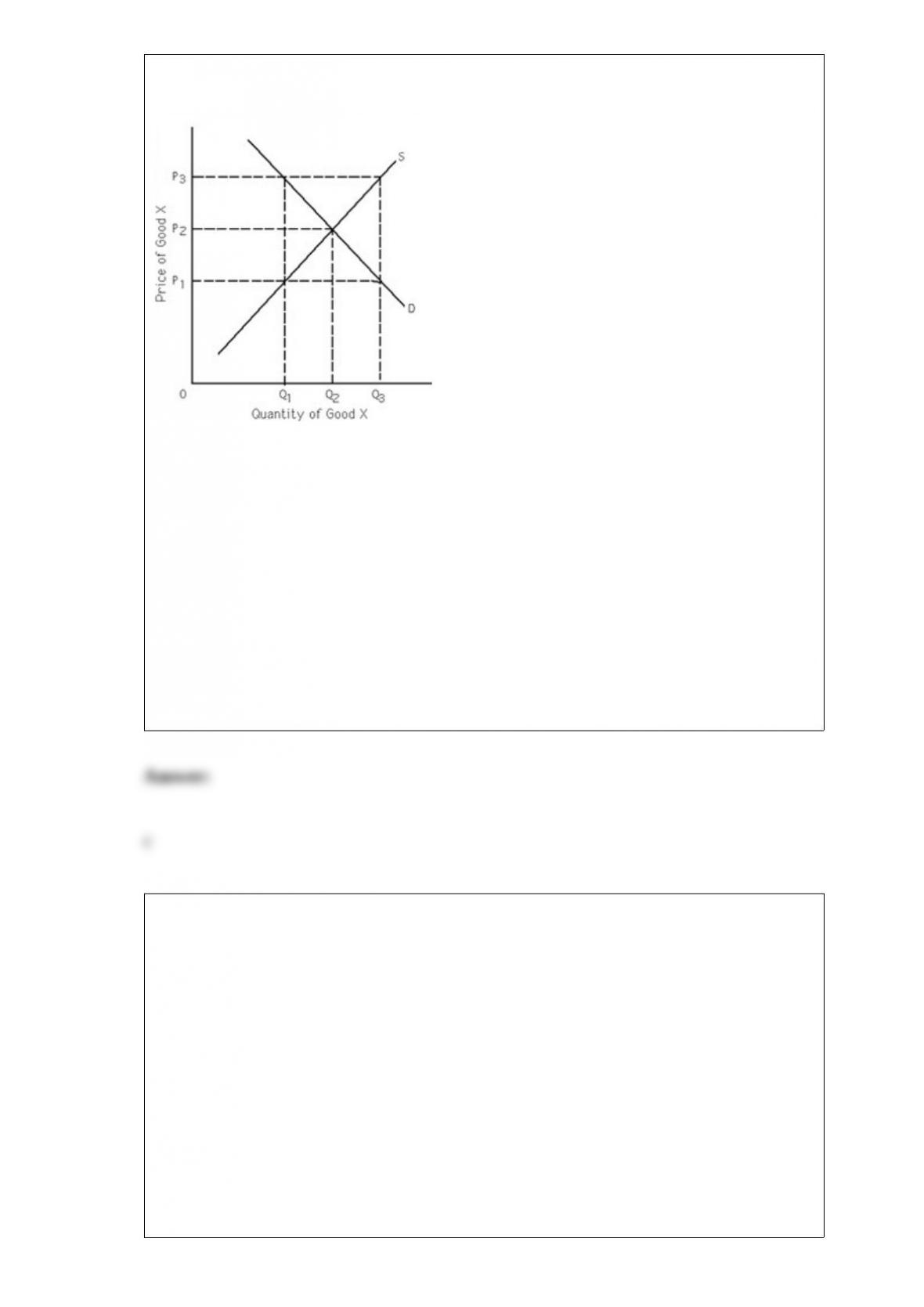
Exhibit 4-3
If price P2 is a price ceiling, then
a. there is a shortage in the market for good X.
b. the highest price that can legally be charged in this market is P3.
c. the price at which exchange legally takes place in the market for good X is P2.
d. the quantity exchanged is less than the quantity demanded.
e. all of the above
Which of the following statements is true?
a. In a price support program, consumers end up paying the price support.
b. In a target price system, consumers end up paying the target price.
c. In a target price system, the per-unit deficiency payment is equal to the difference
between the quantity demanded at the market price and the quantity supplied at the
market price.
d. Acreage allotment programs directly (as opposed to indirectly) raise agricultural
product prices.
e. b and d

Assume that the farmers know that their revenues would increase if each would take a
certain amount of acreage out of production. An agreement to do so
a. would not be made because the farmers have no incentive to enter into it.
b. would not be made because it would contradict the assumption that farmers are profit
maximizers.
c. probably would not be adhered to, if made, because it would be disadvantageous for
the farmers as a group.
d. probably would not last, if made, because each farmer would have an incentive to
break it.
Situation 33-1Suppose that the equation that represents the expected benefits of
burglary for a given prospective criminal is as follows:
EB = Ps x Loot
The criminal’s cost equation is as follows:
EC = [Pp x (I + F)] +AC
Where:
EB is the expected benefits of burglary
Ps is the probability of successfully burglarizing a house
Loot is the dollar take from the burglary
EC is the expected costs of burglary
Pp is the probability of imprisonment
I is the income the criminal gives up if caught and imprisoned
F is the dollar value the criminal puts on freedom

AC is the anguish cost of committing a burglary
If the prospective criminal sets the following values:
Ps = 65 percent
Loot = $20,000
Pp = 20 percent
I = $30,000
F = $15,000
AC = $5,000
The prospective criminal’s expected benefit from committing the burglary is
______________ and his expected cost of committing the burglary is
_______________.Economic theory tells us that under these circumstances, the
prospective criminal ______________ commit the burglary.
a. $13,000; $14,000; will
b. $13,000; $14,000; will not
c. $6,667; $50,000; will not
d. $57,500; $50,000; will
The bigger the shortage of a good or service, the ____________ the seller of the good
or service will be to an individual customer _________.(We are assuming here that the
shortage cannot, for legal reasons, be alleviated through a rise in price.)
a. more polite; without having sales adversely affected
b. ruder; without having sales adversely affect
c. more polite; even though sales will be adversely affected
d. ruder; even though sales will be adversely affected

If a firm is a factor price taker in the labor market,
a. it must pay higher wages in order to hire additional workers.
b. it can hire all the workers it wants to at the going wage rate.
c. it must hire all workers who apply for a job.
d. it will continue to hire workers as long as MFC > MRP.
In agriculture during much of the 20th century, supply grew more than demand. Which
two farm problems are these?
a. the high-productivity problem and the income elasticity problem
b. the low-productivity problem and the income inelasticity problem
c. the high-productivity problem and the income inelasticity problem
d. the low-productivity problem and the income elasticity problem
e. none of the above
If the nominal interest rate is 8 percent and the real interest rate is 6 percent, then the
expected rate of inflation is
a. 14 percent.
b. 7 percent.
c. 2 percent.
d. -2 percent.
e. impossible to determine from the data given.

The primary difference between private goods and public goods is that
a. private goods are consumed by private individuals whereas public goods are not
consumed by private individuals.
b. private goods often yield externalities but public goods do not.
c. property rights can be assigned to public goods but not to private goods.
d. public goods are nonrivalrous in consumption whereas private goods are rivalrous in
consumption.
If average total costs for a natural monopoly are declining where they intersect the
demand curve, and government regulators set the price equal to marginal cost, then the
firm will
a. likely earn a profit.
b. likely break even.
c. likely suffer a loss.
d. surely go out of business.
e. There is not enough information to answer this question.
Exhibit 22-10
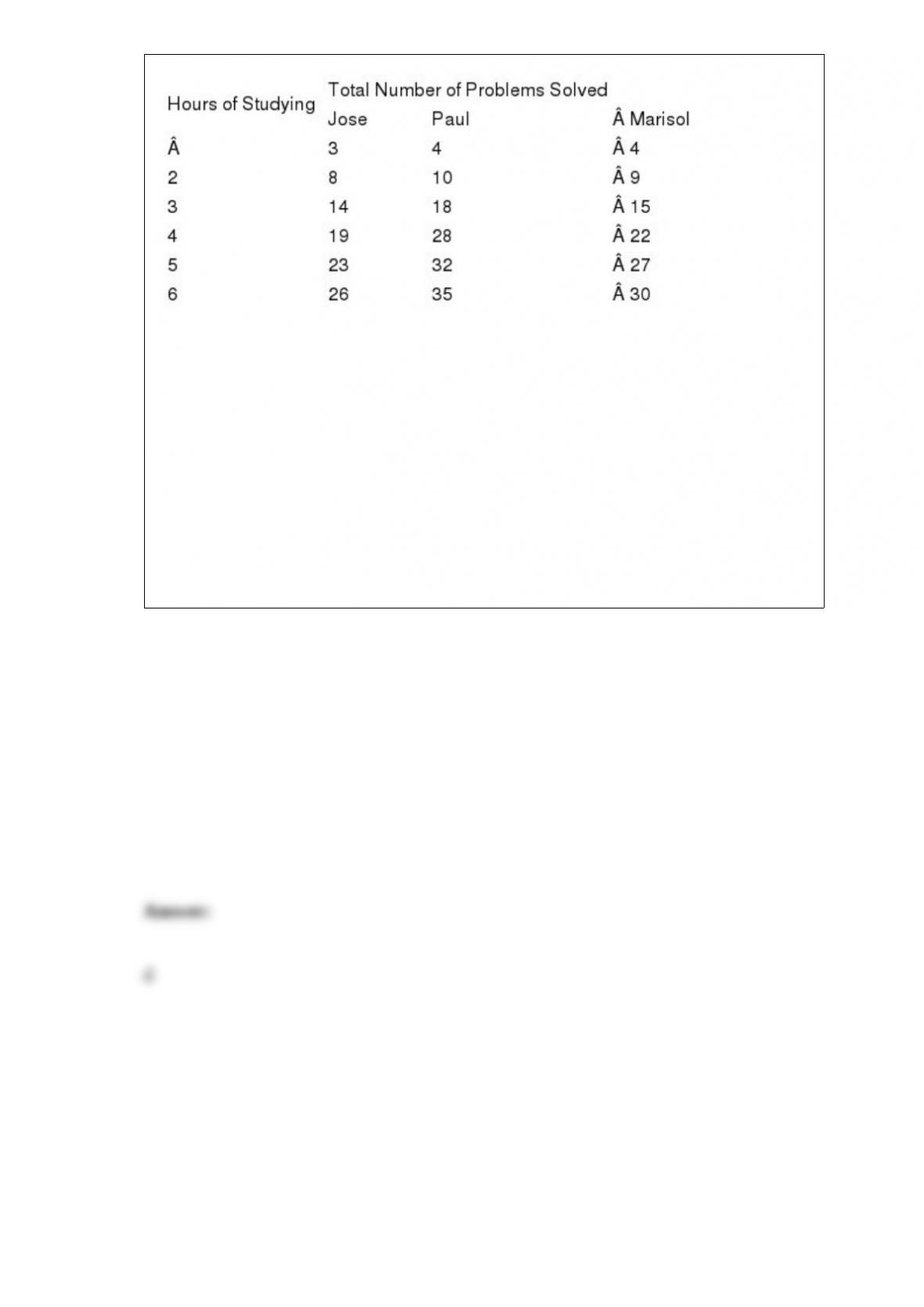
Marisol encounters diminishing marginal returns in hour
a. 2.
b. 3.
c. 4.
d. 5.
e. 6.