
Approximately how much is $25,000 to be received a year from now worth today at an
interest rate of 6 percent?
a. $26,500
b. $85,556
c. $23,585
d. $20,385
When a professor announces to the class that she will grade on a curve and that no one
in the class will receive a grade lower than a “C”
a. a moral hazard problem for her students will likely arise.
b. an adverse selection problem for her students will likely arise.
c. the marginal social benefit will exceed the marginal social cost.
d. the marginal social cost will exceed the marginal social benefit.
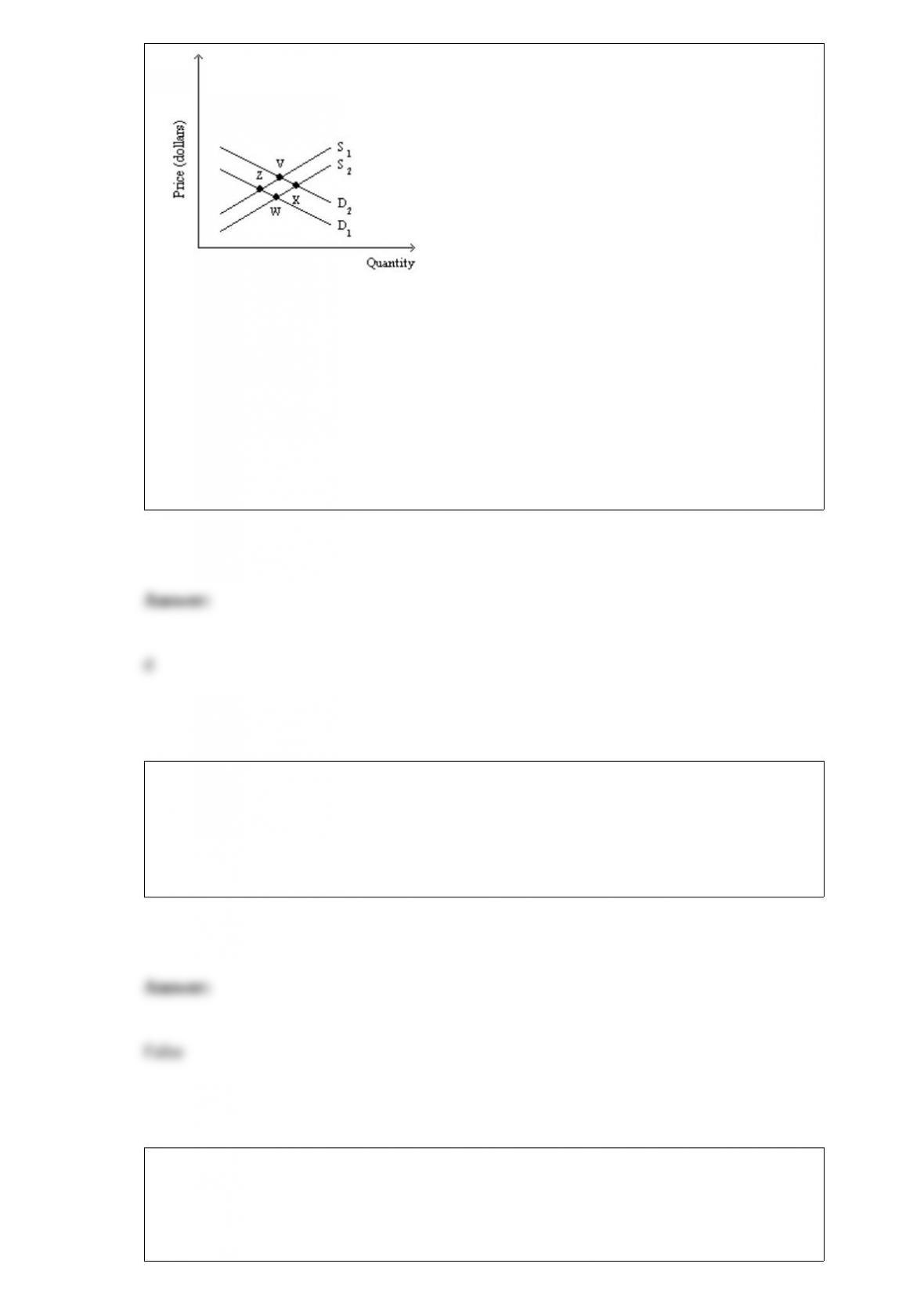
Refer to Exhibit 3-5. In the market shown, a rightward shift in supply from S1 to S2
could have been caused by
Exhibit 3-5
a. a decline in the number of buyers in the market.
b. a decline in the price of a substitute good.
c. a decrease in income (assuming the good is a normal good).
d. the granting of a subsidy to the producer.
e. none of the above
In economics, capital is defined as a financial asset such as stocks and bonds.
a. True
b. False
The law of diminishing marginal utility says that
a. the marginal utility gained by consuming equal successive units of a good will
decline as the amount consumed increases.

b. the more of a particular good one consumes, the greater is the utility received from
the consumption of that good.
c. the marginal utility gained by consuming equal successive units of a good will
increase as the amount consumed increases.
d. the more of a particular product one sells, the less utility one receives from selling.
e. none of the above
An American computer is priced at $1,200. If the exchange rate between the U.S. dollar
and the Japanese yen is $0.01 per yen, the equivalent price of the computer in yen is
approximately __________ yen.
a. 12,000
b. 12
c. 1,200,000
d. 120,000
Which of the following statements about a tariff and a quota is true?
a. With a tariff the government collects revenues, but not with a quota.
b. With a quota the quantity of imports falls, but not with a tariff.

c. With a tariff the domestic price of the good increases, but not with a quota.
d. With a quota the domestic production of the good increases, but not with a tariff.
e. all of the above
The theory of contestable markets places more emphasis than orthodox market structure
theories on
a. the number of sellers in an industry.
b. the type of product produced in an industry.
c. the issue of entry into and exit from an industry.
d. who has access to relevant information.
The demand for farm goods is income inelastic if the percentage change in quantity
demanded is __________ the percentage change in __________.
a. greater than; income
b. equal to; income
c. less than; income
d. greater than; revenue

e. less than; revenue
If a 7 percent increase in the price of a commodity results in a 12 percent increase in the
quantity supplied, supply is said to be
a. perfectly elastic.
b. elastic.
c. unit elastic.
d. inelastic.
e. perfectly inelastic.
A demand curve is the graphical representation of the law of demand.
a. True
b. False

Which of the following is a possible objective of labor unions?
a. employment for all union members
b. maximizing the total (union) wage bill
c. maximizing income for a limited number of union members
d. a and b
e. a, b, and c
If the MU/P ratio for two goods is the same, then
a. the slope of the budget constraint between the two goods is equal to the marginal rate
of substitution (MRS) between the two goods.
b. the indifference curve between the two goods is concave to the origin.
c. the prices of the two goods are the same.
d. it follows that consumers prefer fewer goods to more goods.
e. a and c

The law of increasing opportunity cost helps to explain why PPF’s are typically
bowed-outward.
a. True
b. False
Public choice theorists say that the greater the number of potential voters in an election,
the __________ the perceived benefits of voting held by each voter, and so the
__________ the likely percentage turnout of voters.
a. greater; lower
b. greater; higher
c. smaller; lower
d. smaller; higher
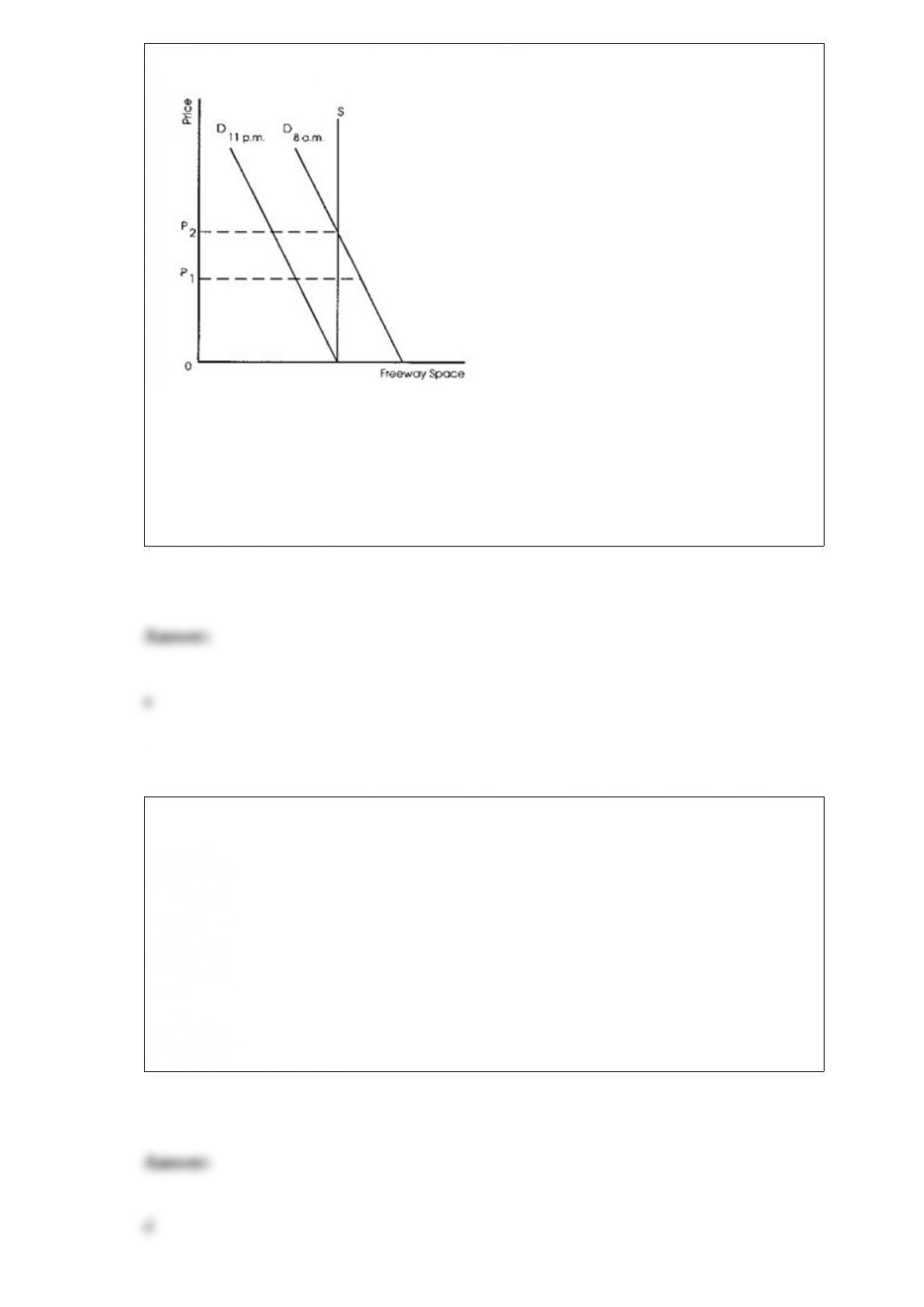
Refer to Exhibit 5-1, which shows supply and demand for freeway space at both 8 a.m.
and 11 p.m. A toll of P1 creates __________ at 8 a.m. and __________ at 11 p.m.
Exhibit 5-1
a. a shortage; a surplus
b. a surplus; a shortage
c. equilibrium; a surplus
d. a shortage; equilibrium
The theory of oligopoly assumes
a. a few sellers and many buyers.
b. a few buyers and many sellers.
c. significant barriers to entry.
d. a and c
e. b and c

Those who say that economics is becoming an increasingly imperialist social science
are suggesting that economics is
a. becoming increasingly concerned with corporations rather than small businesses.
b. becoming increasingly focused on government actions rather than on business
activity.
c. spreading out into other fields of study, such as history, anthropology, and sociology.
d. becoming increasingly focused on business activity rather than on government
actions.
There is a link between production and cost. We know this because
a. there are two periods of production, the short run and the long run.
b. what happens to MPP directs what happens to MC.
c. average fixed cost continually declines as output increases.
d. average productivity falls when marginal productivity is below it.
e. none of the above

To say that government sometimes functions as a “transfer mechanism,” means that
government sometimes
a. ends up transferring goods to individuals in return for taxes paid.
b. ends up transferring negative externalities into positive externalities.
c. ends up taking from group X to give to group Y.
d. transfers taxes into subsidies.
e. none of the above
Labor unions obtain higher wages for their members by reducing the profits of the
business owners in the short run and in the long run.
a. True
b. False
X-inefficiency results from
a. rent seeking behavior.
b. the lack of competitive pressure.
c. third-degree price discrimination.

d. first-degree price discrimination.
e. none of the above