
Suppose leisure is on the horizontal axis and dollars are on the vertical axis in the
consumer-choice diagram. What happens to the budget line when a head tax is
imposed?
a. The budget line shifts inward, but it may become steeper or flatter depending on the
size of the head tax.
b. The budget line pivots about the horizontal intercept, becoming steeper.
c. The budget line become flatter, with the vertical intercept falling and the horizontal
intercept remaining fixed.
d. There is an inward, parallel shift in the budget line.
Why has the cartel in diary farming not been broken up?
a. Organized crime is used to enforce a dairy compact.
b. The dairy industry is exempt from anti-trust laws.
c. Consumers do not mind paying higher prices for milk.
d. Economic studies indicate that to do so would decrease efficiency.
A result of selling concert tickets cheaply, that is below the equilibrium price, will be
that

a. only those with nothing else to do will wait in line to buy a ticket.
b. ticket buyers’ benefits increase, at the expense of the performers.
c. the costs associated with competition among buyers for the limited number of tickets
will create deadweight losses.
d. more tickets will be sold than if the price were at the market equilibrium.
The expected value of a basket with different outcomes is
a. the average of the values of the different outcomes.
b. the average of the values of different outcomes multiplied by the average of the
probabilities of the outcomes.
c. the sum of the values of the different outcomes.
d. the sum of the value of each outcome multiplied by its probability.
An economic explanation for why rock concert tickets sell at prices below the market
equilibrium is that musicians
a. are not greedy.
b. want to reward their loyal fans.

c. expect that younger people, who will spend more on merchandise at the concert, are
more willing to wait in long lines to buy tickets than adults.
d. expect that those who are more willing to wait in long lines to buy tickets will make a
more receptive audience than those who are willing to pay a higher price.
If a job requires two activities and there are two workers who can perform those
activities, then which of the following statements regarding absolute advantage must be
false?
a. One worker can have an absolute advantage in both activities.
b. One worker may not have an absolute advantage in neither activity.
c. Neither worker can have an absolute advantage in either activity.
d. Both workers can have an absolute advantage in both activities.
When interest rates come down, people on average
a. are better off since borrowing is now less expensive.
b. are worse off since the income of lenders will now decrease.
c. social welfare is left unchanged since what borrowers gain is exactly offset by what
lenders lose.
d. may or may not be better off, depending on how high the rate was to begin with.
If information about the total cost is not given for every possible 1 unit change in
quantity, marginal cost can still be computed as
a. the price of labor divided by the quantity of labor.
b. the price of labor divided by the marginal product of labor.
c. fixed cost divided by the marginal product of labor.
d. variable cost divided by the marginal product of labor.
The northwest boundary of the set of all portfolios is

If both demand and supply rise, which of the following must be true?
a. The equilibrium price will increase.
b. The equilibrium price will decrease.
c. The equilibrium price will not change.
d. The change in the equilibrium price is indeterminate.
The MRTS is currently -2. The wage rate is $15 per hour and the rental rate is $30 per
hour. It follows that
a. the marginal product of capital is twice that of labor.
b. the marginal product of labor is twice that of capital.
c. the marginal product of capital is equal to that of labor.
d. no statement about marginal productivity can be made without more information.
A profit maximizing firm in any type of market for its output would hire the quantity of

labor at which
a. the marginal cost of output is equal to the marginal revenue product of labor, where
MRP is sloping downward.
b. the wage rate is equal to marginal revenue product, where MRP is downward sloping.
c. the wage rate is equal to marginal revenue product, where MRP is still sloping
upward.
d. the difference between the wage rate and marginal revenue product is greatest.
One defense Microsoft can use to argue that it does not have monopoly power in the
market for operating systems, is to show that
a. demand for operating systems is highly elastic.
b. many other commodities have higher income elasticities of demand than operating
systems.
c. the cross elasticity of demand between Microsoft’s operating system and other
operating systems is large and positive.
d. many of its competitors’ products are complements for its service.
Price Ceiling
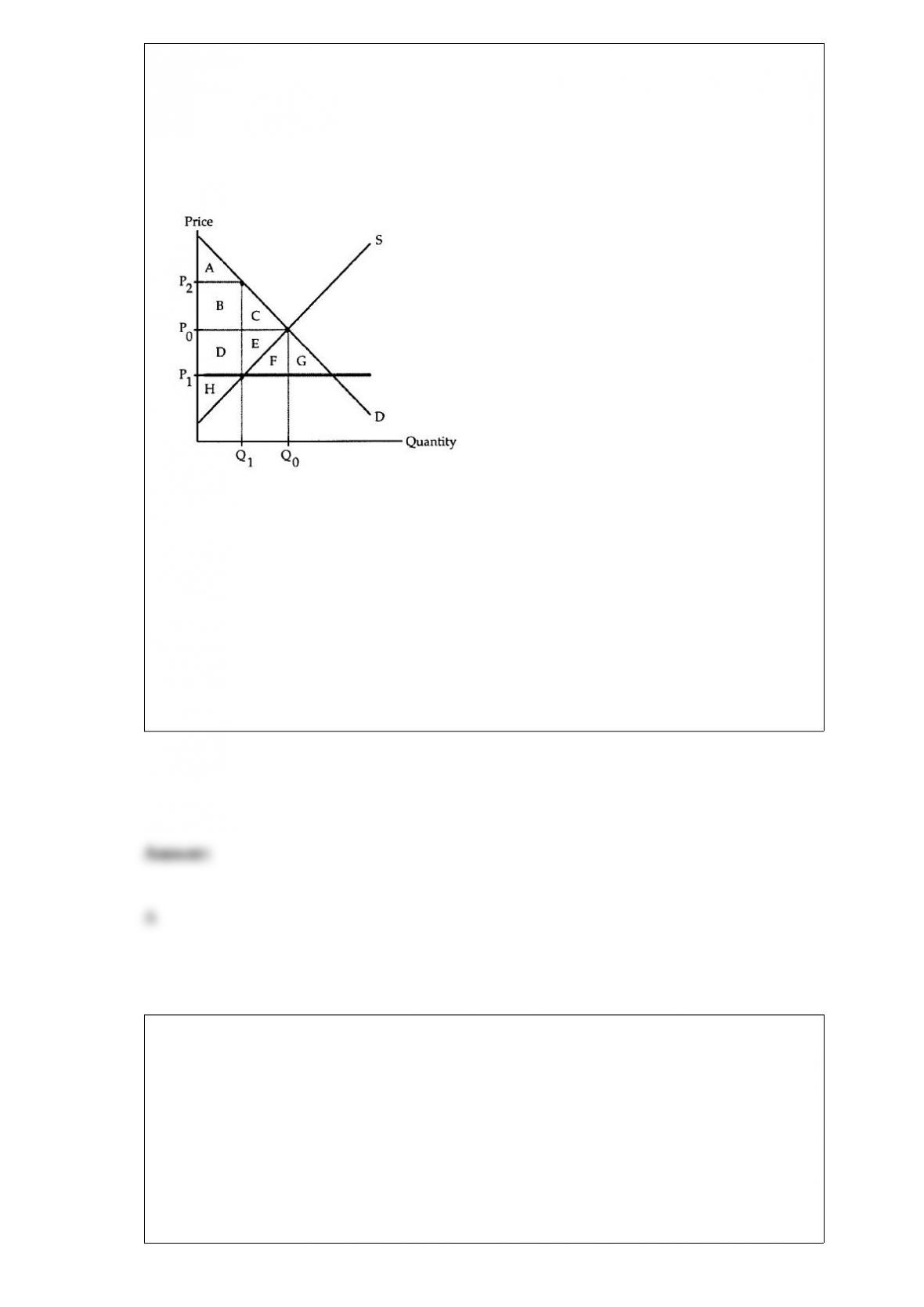
The following questions refer to the accompanying diagram which shows the effects of
a price ceiling. The initial price and quantity are P0 and Q0, respectively, and the price
ceiling is imposed at the price P1. Assume that none of the potential deadweight loss
can be avoided.
After the price ceiling is imposed, consumers’ surplus is equal to
a. area A.
b. area A + B.
c. area A + B + D.
d. area A + B + C + D + E + F + G.
Suppose the price of a DVD is $15 per unit. At that price, consumers wish to purchase
6,000 units weekly and producers wish to sell 4,000 units weekly. In this situation,
a. unsatisfied consumers will bid up the market price.
b. the market price will fall because producers are unsatisfied.
c. the price will rise and the demand will fall to bring the market to equilibrium.

d. supply will increase by 2,000 units in order to satisfy consumers.
If Odetta’s marginal value of freedom fries is $8 per pound, then
a. Odetta will be indifferent if she trades 1 pound of freedom fries for $8 worth of all
other goods.
b. Odetta thinks 1 pound of freedom fries is worth $8, 2 pounds of freedom fries are
worth $16, and so forth.
c. Odetta will not purchase any freedom fries if the price is more than $8 per pound.
d. Odetta must sacrifice $8 in currency for every pound of freedom fries she chooses to
purchase.
Excise Subsidy
The following questions refer to the accompanying diagram which shows the effects of
an excise subsidy given to firms. The initial price and quantity are P0 and Q0,
respectively. After the subsidy is granted, the equilibrium quantity is Q1, firms receive
the price Ps, and consumers pay the price Pd.
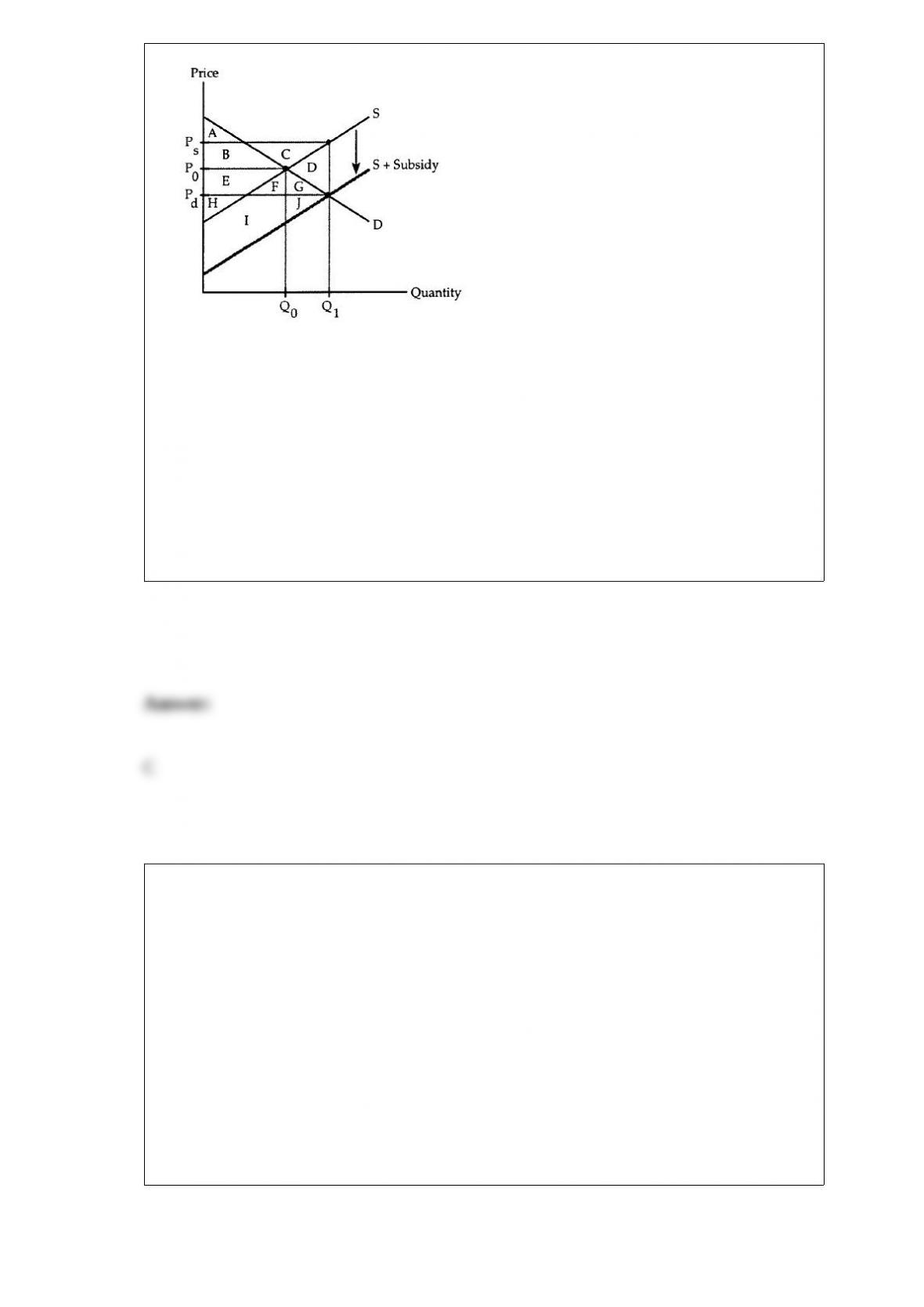
After the subsidy is granted, producers’ surplus equals
a. area A + B + E + H.
b. area E + H + F + I.
c. area B + C + E + H.
d. area H.
External costs are
a. negative externalities and are subtracted from marginal private costs to find marginal
social costs.
b. negative externalities and are added to marginal private costs to find marginal social
costs.
c. positive externalities and are added to marginal private costs to find marginal social
costs.
d. positive externalities and are subtracted from marginal private costs to find marginal
social costs.

In what way is monopolistic competition superior to perfect competition?
a. The cost of producing the industry’s output is lower in monopolistic competition.
b. Consumers benefit from having differentiated products instead of identical products.
c. Long-run profits are higher in monopolistic competition than in pure competition.
d. In monopolistic competition, firms can fully exploit any existing economies of scale.
Assume toys are produced using only labor and wood. Which of the following best
describes the cost of producing toys?
a. The number of dollars that the laborer spends to purchase the wood.
b. The amounts of labor and wood used in the production process.
c. The alternative uses that could be found for the labor and wood.
d. The monetary value of the labor and wood used.
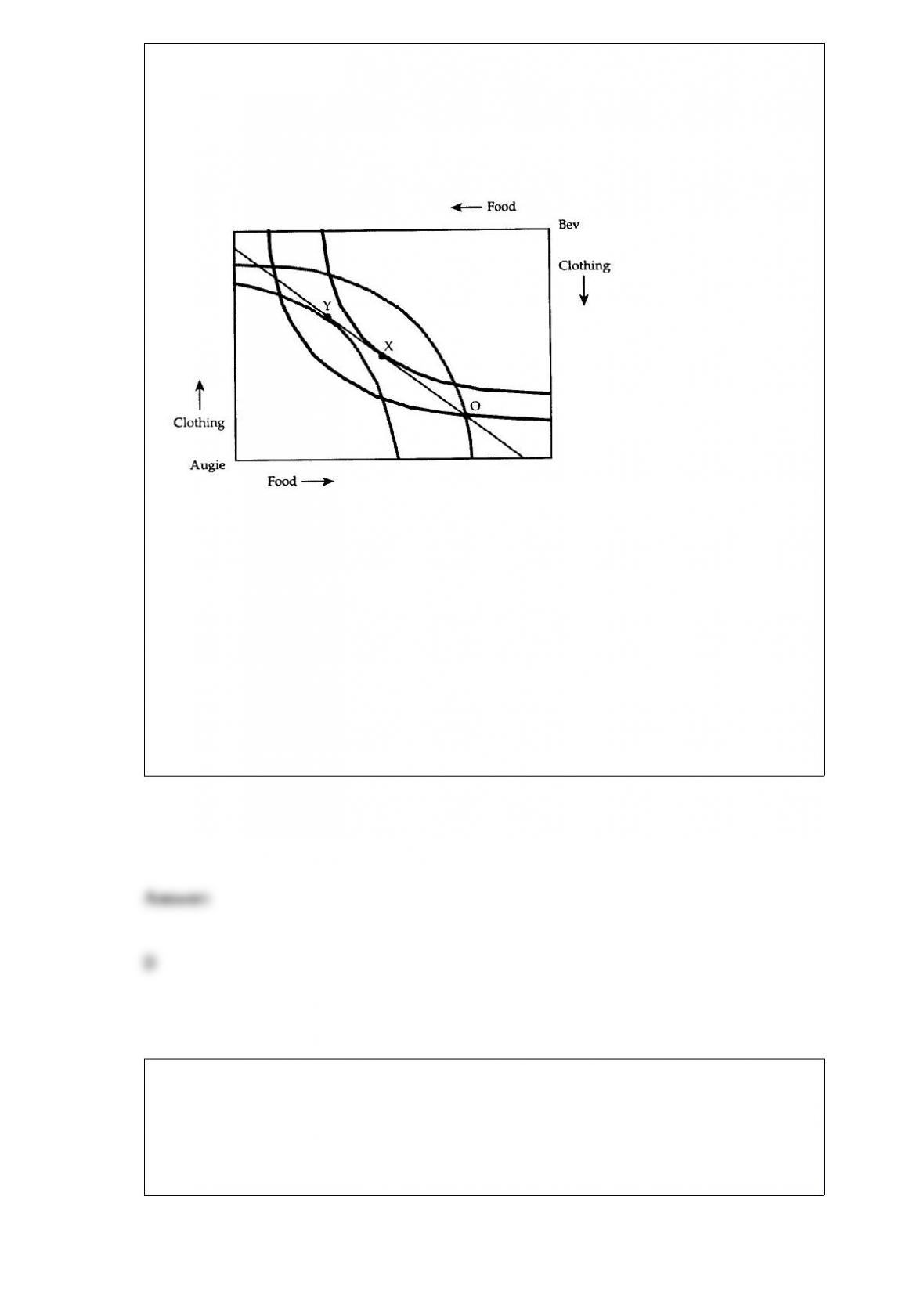
Edgeworth Box Economy
The accompanying diagram shows an Edgeworth box economy. The initial endowment
is point O. At current relative prices, Augie chooses point X and Bev chooses point Y.
In an Edgeworth box, points within the region of mutual advantage represent
allocations that
a. can be achieved by a competitive market.
b. both consumers prefer to the initial endowment.
c. exhaust the potential gains from trade.
d. are Pareto optimal.
Variable Cost of Production
The following questions refer to the following table which shows a firm’s variable costs
of production.

The marginal cost of the fifth unit of output is
a. $22 per unit.
b. $30 per unit.
c. $46 per unit.
d. $50 per unit.
In the absence of natural monopoly conditions, firms in a contestable market will
a. choose their price and output competitively.
b. be able to successfully form a cartel and share monopoly profit.
c. will not produce their output at the lowest possible cost.
d. produce more than a monopoly but less than a competitive industry.
A perpetuity is selling for $20,000 when the interest rate is 4%. What must the expected
annual payment be?
a. $400

b. $800
c. $4000
d. $5000
In a supply-demand diagram, the law of supply is illustrated by
a. shifting the supply curve to the right as suppliers expand production and to the left as
they contract production.
b. drawing the supply curve so that it slopes upward.
c. showing how the equilibrium point changes as the supply curve shifts.
d. drawing a vertical line at the quantity that producers choose to supply.
The market for airplane service on a particular route is a commonly cited example of
a. resale price maintenance.
b. monopolistic competition.
c. the benefits of vertical integration.
d. a contestable market.

A fall in supply is illustrated by
a. a downward shift in the supply curve.
b. moving the equilibrium point down and to the left along the supply curve.
c. drawing the supply curve flatter.
d. shifting the supply curve to the left.
A vertical merger, like the merger of Seagate and Dell, would be attractive
a. only to Dell because it then avoids paying monopoly prices to Seagate.
b. only to Seagate because it can then obtain two monopoly rents.
c. to both Seagate and Dell but not to consumers who would find no difference in their
welfare.
d. to Seagate, Dell and consumers, all of whom would stand to benefit in some way.

When neither player in a game would want to deviate from a particular outcome, taking
the opponent’s behavior as given, the outcome is
a. a Stackelberg equilibrium.
b. Pareto optimal.
c. a Nash equilibrium.
d. a dominant strategy.
A natural monopoly exists when a firm
a. owns all of the world’s known reserves of a natural resource.
b. has an average cost curve that is decreasing at the point where it crosses demand.
c. has obtained a patent on a new genetically modified organism.
d. is able to practice price discrimination in the sale of a natural resource.
Edgeworth Box Economy
The accompanying diagram shows an Edgeworth box economy. The initial endowment
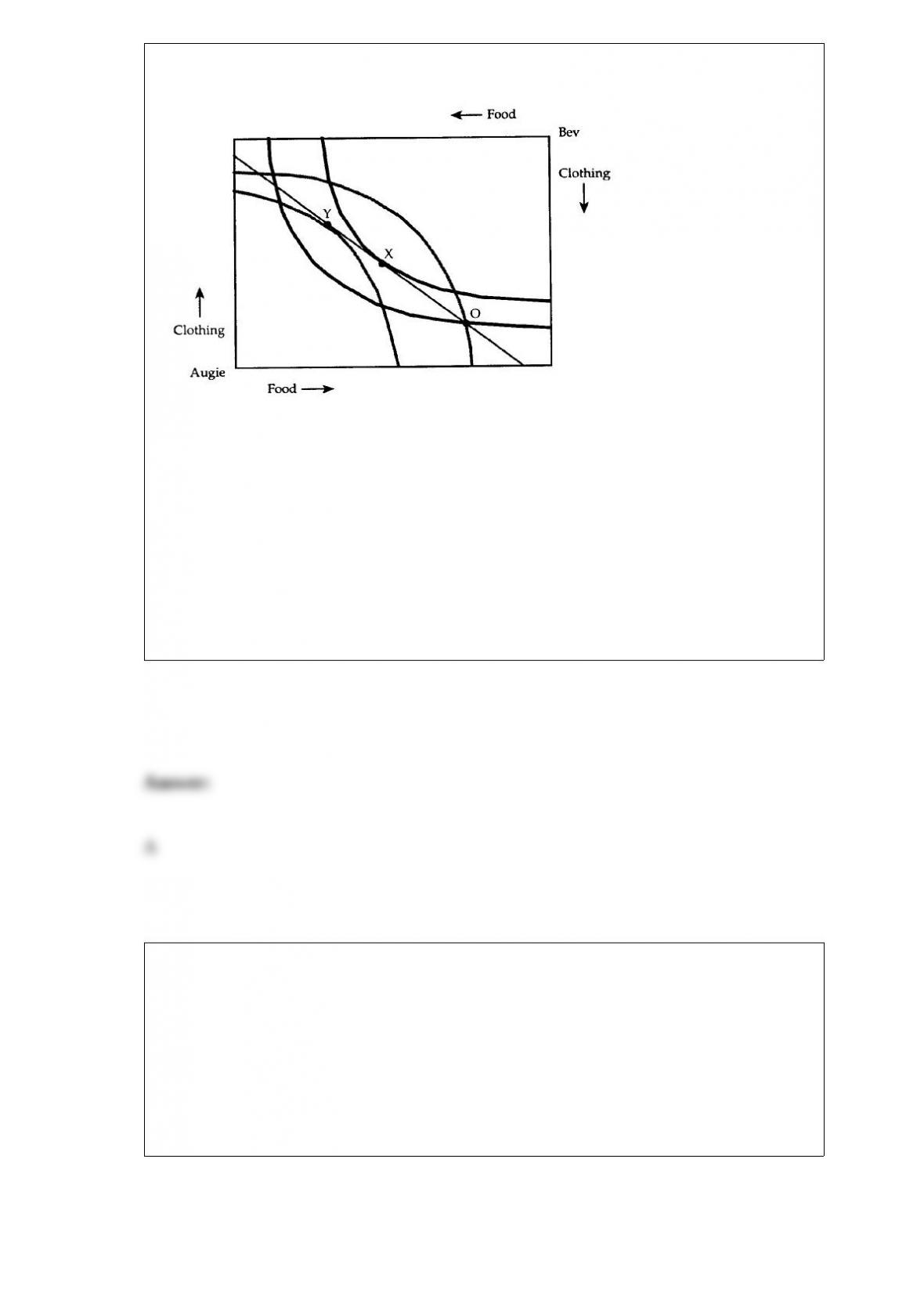
is point O. At current relative prices, Augie chooses point X and Bev chooses point Y.
Analysis of an Edgeworth box economy shows that a competitive equilibrium
a. must be Pareto optimal.
b. can be located anywhere along the contract curve.
c. may lie anywhere within the region of mutual advantage.
d. must lie to the southeast of the endowment point.
A firm is considering entering a market where demand for its product is Q = 100 – P.
This demand function implies that the firm’s marginal revenue function is MR = 100 –
2Q. The firm’s total cost of producing the product for that market is TC = 500 + 10Q +
Q2 which indicates that its marginal cost function is MC = 10 + Q. Indicate whether or
not the firm should enter the market by calculating the firm’s profit (Hint: to find the
price that the firm should charge, take the profit maximizing quantity and plug it into
the demand equation). Describe how your previous answer would change if the firm’s
total cost function became TC = 1000 + 10Q + Q2.

If safer cars reduce a driver’s chance of dying in an accident, then there will be fewer
driver fatalities.
A given level of output is efficient if no more social gain can be obtained from changing
the output level.
In a model that analyzes the effects of a tax change, the tax serves as an endogenous
variable.

A positive economics statement is one that aims to express how the world should be.
All Giffen goods must be inferior goods, but not all inferior goods are Giffen goods.
If the relative price of a gallon of water in terms of milk increases from 1 gallon to 1.5
gallons of milk, then the relative price of milk has fallen.

The value of a good is ultimately determined by the amount of labor needed to produce
the good.
It is possible to avoid the prisoners’ dilemma as long as the interaction is repeated and
has a definite ending date.
Suppose the price of coffee is $6 per pound. If this price is an absolute price, what is
meant by the phrase “$6 per pound”? If this price is a relative price, what is meant by
the phrase “$6 per pound”?
Suppose an econometrician discovers that during the past decade, lower unemployment
rates have always been accompanied by higher inflation rates. When asked how to
reduce unemployment, the econometrician recommends the policy of increasing the
money supply to trigger more inflation. Explain why this policy may fail to work in a
world where people have rational expectations.
Future productivity increases will be reflected in higher interest rates today.
Speculators will sell futures contracts when they believe future demand will be lower
than suppliers expect.
When an income tax is imposed, the amount of tax paid can be found as the vertical
distance between the pre-tax and post-tax budget constraints at either the pre-tax or the
post-tax optimum
If the market price is currently above the shut-down price, the firm will be making
positive profits.
Consider the following:
Why does a principal-agent problem create transactions costs? If the goal is economic
efficiency, what liability rule should be used when a principal-agent problem exists?
If a firm increases production from 100 units to 105 units, then its Marginal Revenue is
5.

Profits will be positive as long as marginal revenue is bigger than marginal cost.