
1) Suppose a tax of $3 is imposed on each new garden hose that is sold, resulting in a
deadweight loss of $22,500. The supply curve is a typical upward-sloping straight line,
and the demand curve is a typical downward-sloping straight line. Before the tax was
imposed, the equilibrium quantity of garden hoses was 100,000. We can conclude that
the equilibrium quantity of garden hoses after the tax is imposed is
a. 75,000.
b. 85,000.
c. 90,000.
d. 95,000.
2) Senator Hubris wants to pass a law that would require all monopolistically
competitive firms to operate at their efficient scale. If this law were to pass and be
enforced, we would expect that monopolistically competitive firms would
a.see their profits increase.
b.break even.
c.lose money.
d.not really be affected by the law.
3) Suppose that a steel factory emits a certain amount of air pollution, which constitutes
a negative externality. If the market does not internalize the externality,
a.the supply curve would adequately reflect the marginal social cost of production.
b.consumers will be required to pay a higher price for steel than they would have if the
externality were internalized.
c.the market equilibrium quantity will not be the socially optimal quantity.
d.producers will produce less steel than they otherwise would if the externality were
internalized.
4) Carol Anne makes candles. If she charges $20 for each candle, her total revenue will
be
a.$1,000 if she sells 100 candles.
b.$500 if she sells 25 candles.
c.$20 regardless of how many candles she sells.
d.$200 if she sells 5 candles.
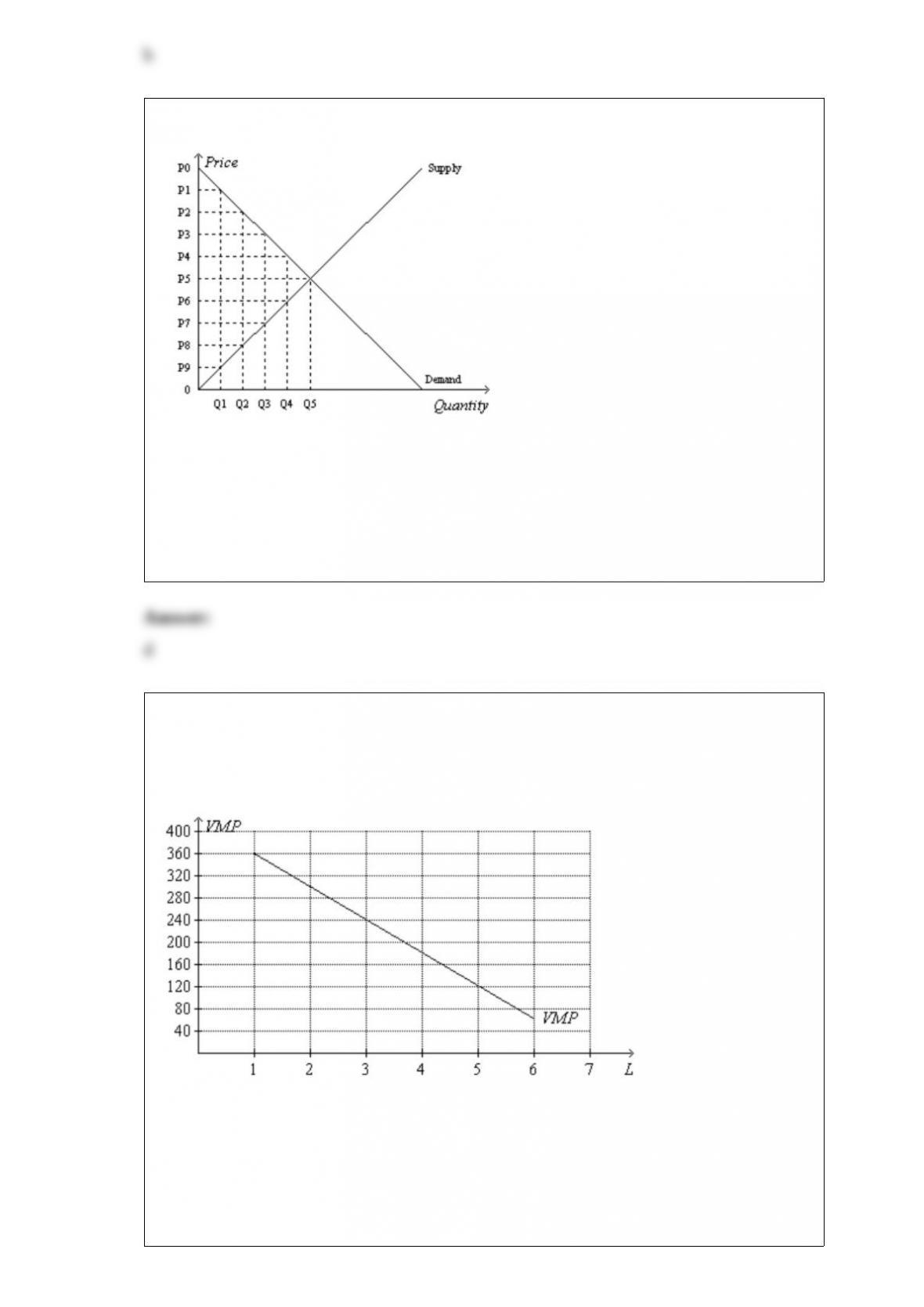
5) Figure 8-10
Suppose the government imposes a tax that reduces the quantity sold in the market after
the tax to Q2. The price that sellers receive is
a.P0.
b.P2.
c.P5.
d.P8.
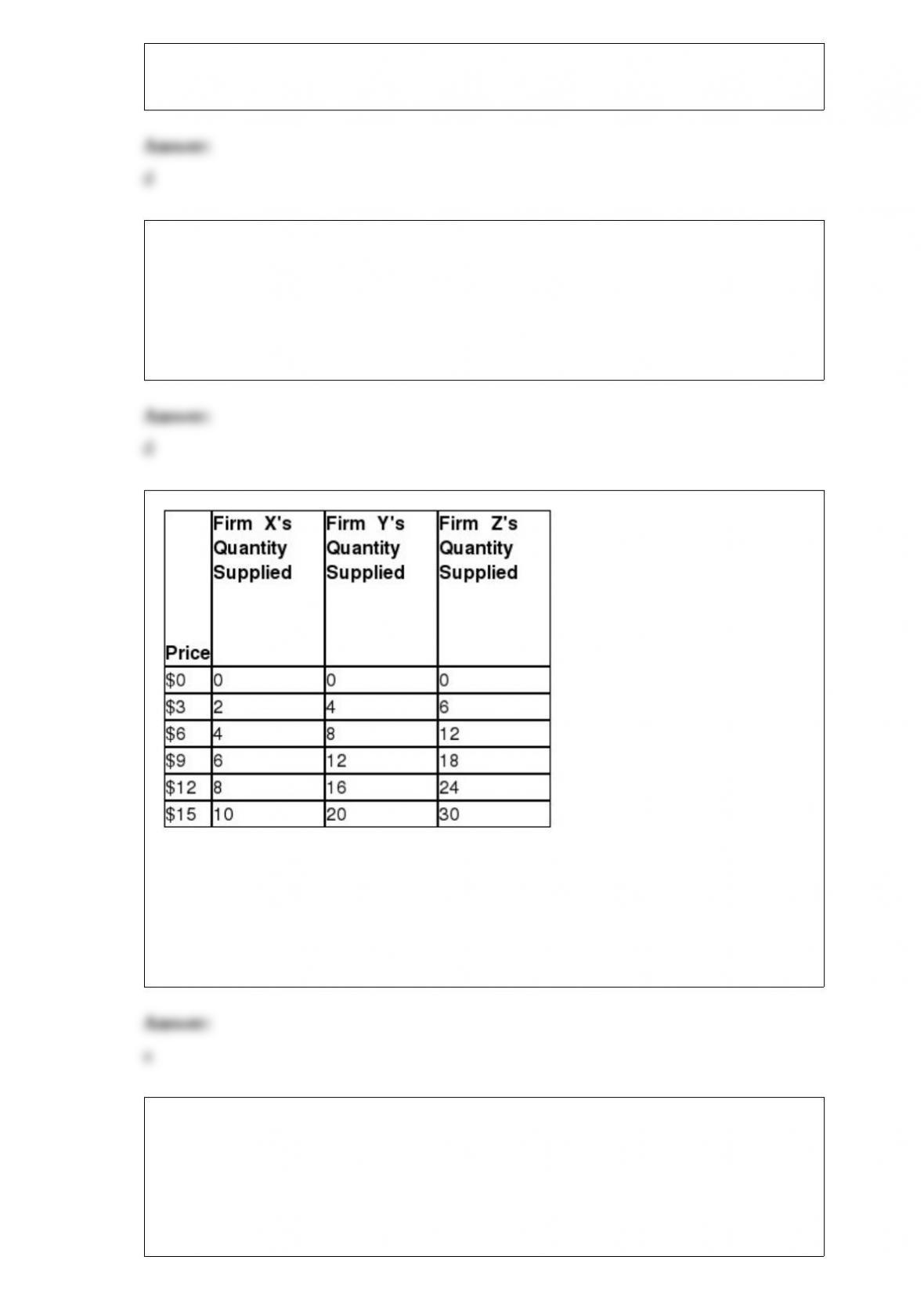
6) Figure 18-5
The figure shows a particular profitmaximizing, competitive firm’s valueofmarginal-
product (VMP) curve. On the horizontal axis, L represents the number of workers. The
time frame is daily.
Refer to Figure 18-5. Suppose one point on the firm’s production function is (L = 3, Q
= 180), where L = number of workers and Q = quantity of output. If the firm sells its
output for $5 per unit, then
a.a second point on the firm’s production function is (L = 4, Q = 216).
b.the firm’s production function exhibits the property of diminishing marginal product
of labor.
c.the firm will maximize profit by hiring four workers if it pays workers $160 per day.
d.All of the above are correct.
7) If Switzerland chooses to engage in trade, it
a.will only benefit if it trades with countries that produce goods Switzerland cannot
produce.
b.cannot benefit if it trades with less developed countries.
c.should first attempt to produce the good itself.
d.can benefit by trading with any other country.
8) Suppose Firm X and Firm Y are the only two sellers in the market. If the market
price decreases from $12 to $9, quantity supplied will
a.decrease by 6 units.
b.decrease by 12 units.
c.increase by 6 units.
d.increase by 12 units.
9) Which of the following is not a common response to the moral hazard problem that
employers face?
a.offering all employees some funding for additional education
b.paying efficiency wages
c.requiring employees to provide itemized receipts for reimbursable expenses
d.paying year-end bonuses rather than higher monthly earnings

10) In 2012, in The Wall Street Journal, economists Edward Prescott and Lee Ohanian
asserted that
a.in the United States, when the average worker earns $100 from additional work, he or
she will be able to consume an additional $85 worth of goods and services.
b.the typical American has always worked more hours per year than the typical
Frenchman and the typical German, despite vastly different tax rates in those countries.
c.raising tax rates from their 2012 levels would significantly reduce U.S. economic
activity.
d.raising tax rates from their 2012 levels would significantly increase the federal
government’s tax revenue.
11) If the government imposes a tax of $3,000 on everyone, the tax would be a(n)
a.income tax.
b.consumption tax.
c.lump-sum tax.
d.marginal tax.
12) Demand is said to have unit elasticity if the is
a.less than 1
b.greater than 1
c.equal to 1
d.equal to 0
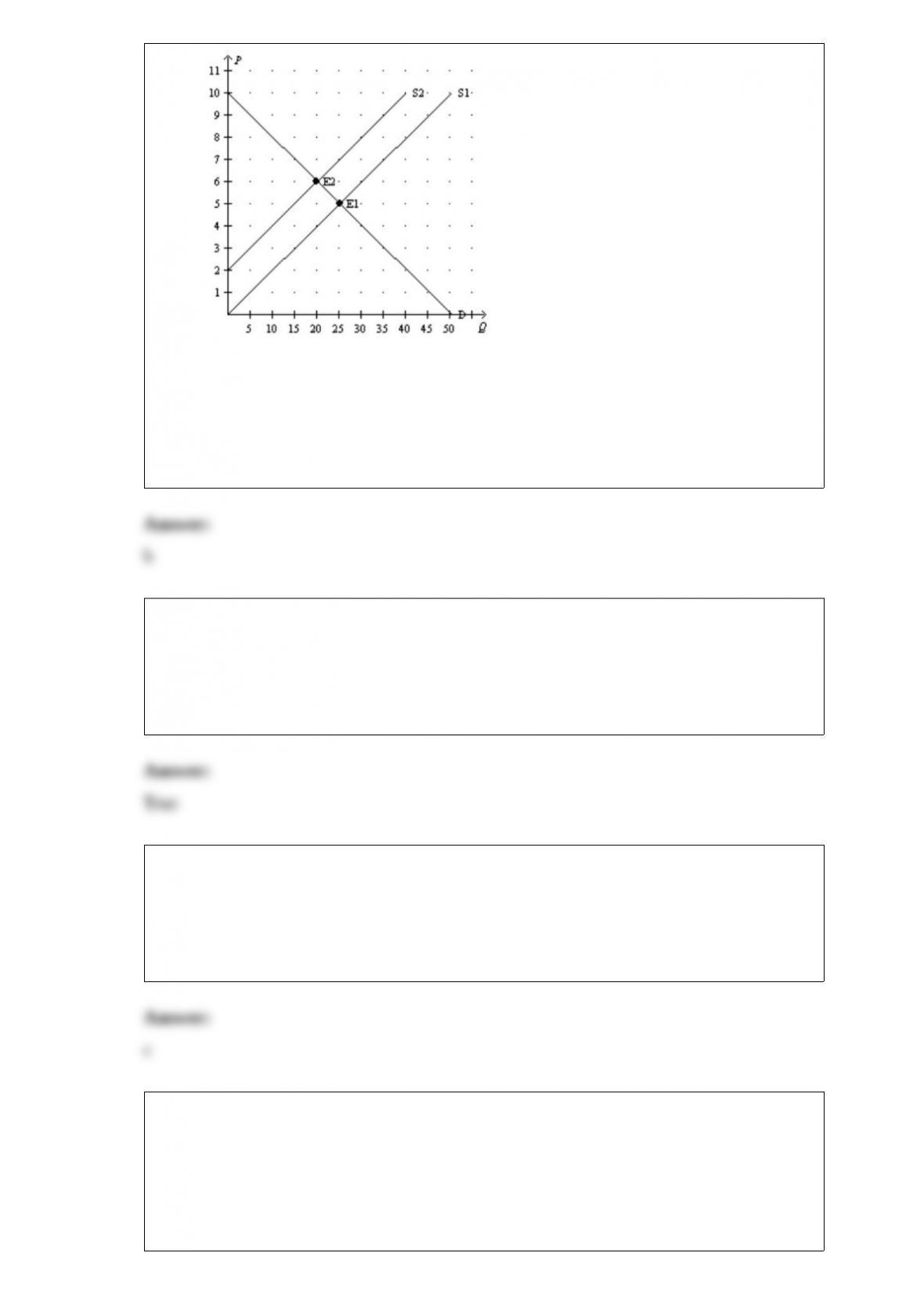
13)
Which of the following would explain a movement from E1 to E2?
a.There is an improvement in the technology used to produce this good.
b.The cost of an input to the production of this good increases.
c.This good becomes very popular.
d.The price of a substitute good decreases.
14) If the ABC company owns the exclusive rights to mine land in Afghanistan for
Lapis Lazuli, a rare stone used in jewelry which is found only in Afghanistan, the
company benefits from a barrier to entry.
a.True
b.False
15) The Federal Reserve
a.designs tax policy.
b.enforces the nation’s antitrust laws.
c.sets the nation’s monetary policy.
d.analyzes data on workers.
16) In which of the following cases is it most likely that an increase in the size of a tax
will decrease tax revenue?
a.The price elasticity of demand is small, and the price elasticity of supply is large.
b.The price elasticity of demand is large, and the price elasticity of supply is small.
c.The price elasticity of demand and the price elasticity of supply are both small.
d.The price elasticity of demand and the price elasticity of supply are both large.