
1) as it relates to public goods, nonexcludability means that nonpayers cannot be barred
from obtaining the benefits.
2) modern economic growth since the 1820s has widened wealth and income disparities
between richer and poorer nations.
3) The process by which new firms and new products destroy existing dominant firms
and their products is called creative destruction.
4) the process by which capital goods are accumulated is known as investment.
5) about 14 percent of legal immigrants to the united states in 2007 came from mexico.
6) Process innovation is represented as a downshift in a firm’s total product curve and
its average total cost curve.
7) Demand-pull inflation and cost-push inflation are identical concepts because both
involve lower unemployment rates and rising prices.

8) generally speaking, the smaller the percentage of one’s total budget devoted to a
particular product, the more price elastic will be the demand for that product.
9) diseconomies of scale stem primarily from the difficulties in managing and
coordinating a large-scale business enterprise.
10) Mainstream economists contend that use of stabilization policy has helped increase
macro stability in the U.S. economy over the past 40 years.
11) Pollution has its roots in the law of conservation of matter and energy.
12) A negative GDP gap can be caused by either a decrease in aggregate demand or a
decrease in aggregate supply.
13) positive statements are expressions of value judgments.
14) The right to buy and sell emission rights for sulfur-dioxide pollution was granted in
the:
A.Clean Air Act of 1990
B.Superfund Law of 1980
C.Market for Externalities Act of 1970
D.Acid-Rain Act of 1995

15) the following table which indicates the dollar price of luta, the currency used in the
hypothetical economy of luteland:
refer to the above table. suppose that the united states imports more products from
luteland than before. all else equal, the dollar price of luta will:
a.rise and the dollar will depreciate.
b.fall and the dollar will depreciate.
c.rise and the dollar will appreciate.
d.fall and the dollar will appreciate.
16) which of the following is a final good or service?
a.a haircut
b.fertilizer purchased by a farm supplier
c.diesel fuel bought for a delivery truck
d.chevrolet windows purchased by a general motors assembly plant
17) the largest functional share of the national income consists of:
a.wages and salaries.
b.interest and rental income.
c.proprietors’ income, that is, the income of unincorporated businesses.
d.corporate profits.
18) the demand curve in a purely competitive industry is ______, while the demand
curve to a single firm in that industry is ______.
a.perfectly inelastic, perfectly elastic
b.downsloping, perfectly elastic
c.downsloping, perfectly inelastic
d.perfectly elastic, downsloping
19) if a firm doubles its output in the long run and its unit costs of production decline,
we can conclude that:
a.technological progress has occurred.
b.economies of scale are being realized.
c.the firm is encountering diminishing returns.
d.diseconomies of scale are being encountered.
20) if the long-run supply curve of a purely competitive industry slopes upward, this
implies that the prices of relevant resources:
a.will fall as the industry expands.
b.are constant as the industry expands.
c.rise as the industry contracts.
d.rise as the industry expands.
21) The opportunity cost of holding money:
A.is zero because money is not an economic resource.
B.varies inversely with the interest rate.
C.varies directly with the interest rate.
D.varies inversely with the level of economic activity.
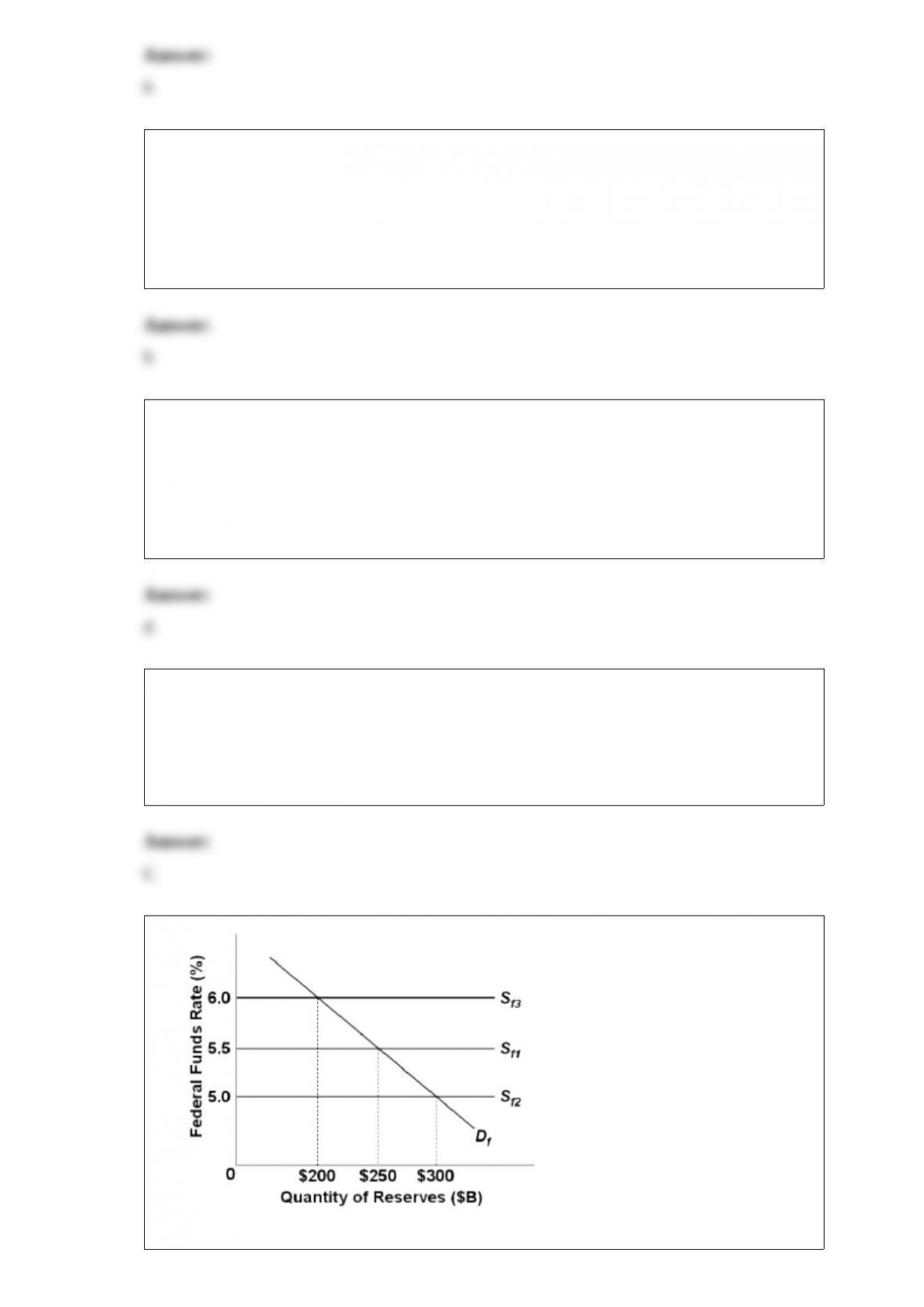
22)
Refer to the above diagram for the Federal funds market. If the Fed wants to raise the

Federal funds rate by one-half of a percentage point, it should:
A.act to increase reserves by $50 billion.
B.act to reduce reserves by $50 billion.
C.pursue an expansionary monetary policy.
D.buy bonds from banks and the public.
23) Clearly defined property rights and liability rules reduce negative externalities by:
A.threatening the perpetrators with lawsuits.
B.shifting the perpetrators’ market supply curve rightward.
C.shifting the perpetrators’ market demand curve leftward.
D.creating a market for externality rights.
24) How does investors preference for risk affect the slope of the security market line?
25) State two reasons why dire predictions of falling standards of living and a decline in
resource availability proved to be wrong.
26) Compare the determinants of consumption with investment. Most economists
regard investment as being less stable than consumption. Looking at the determinants of
each factor, support this contention.

27) Do the costs of social regulation outweigh the benefits?
28) What is the value added by all the firms AE from the production of a product as
described below? What did each firm add separately in value and what does it total?
29) Suppose a bridge for automobiles was constructed across a river and all the costs
associated with its construction have been paid. The amount of traffic is such that there
are no foreseeable problems of overcrowding in the use of the bridge. Assume, also,
that the extra cost associated with traffic crossing the bridge is for all practical purposes
equal to zero. What toll should be charged to achieve the most efficient use of the
bridge?

30) Explain: Ironically, by taking the rough edges off of capitalism, social regulation
may be a strong pro-capitalist force.
31) The following is a monopsonists employment schedule. What is the firms marginal
resource cost when it hires the eleventh worker?