If the demand for iPods is price elastic, then
A) the percentage change in quantity demanded is greater than the percentage change in
price (in absolute value).
B) the percentage change in quantity demanded is less than the percentage change in
price (in absolute value).
C) the percentage change in quantity demanded is equal to the percentage change in
price.
D) quantity demanded is not responsive to changes in price.
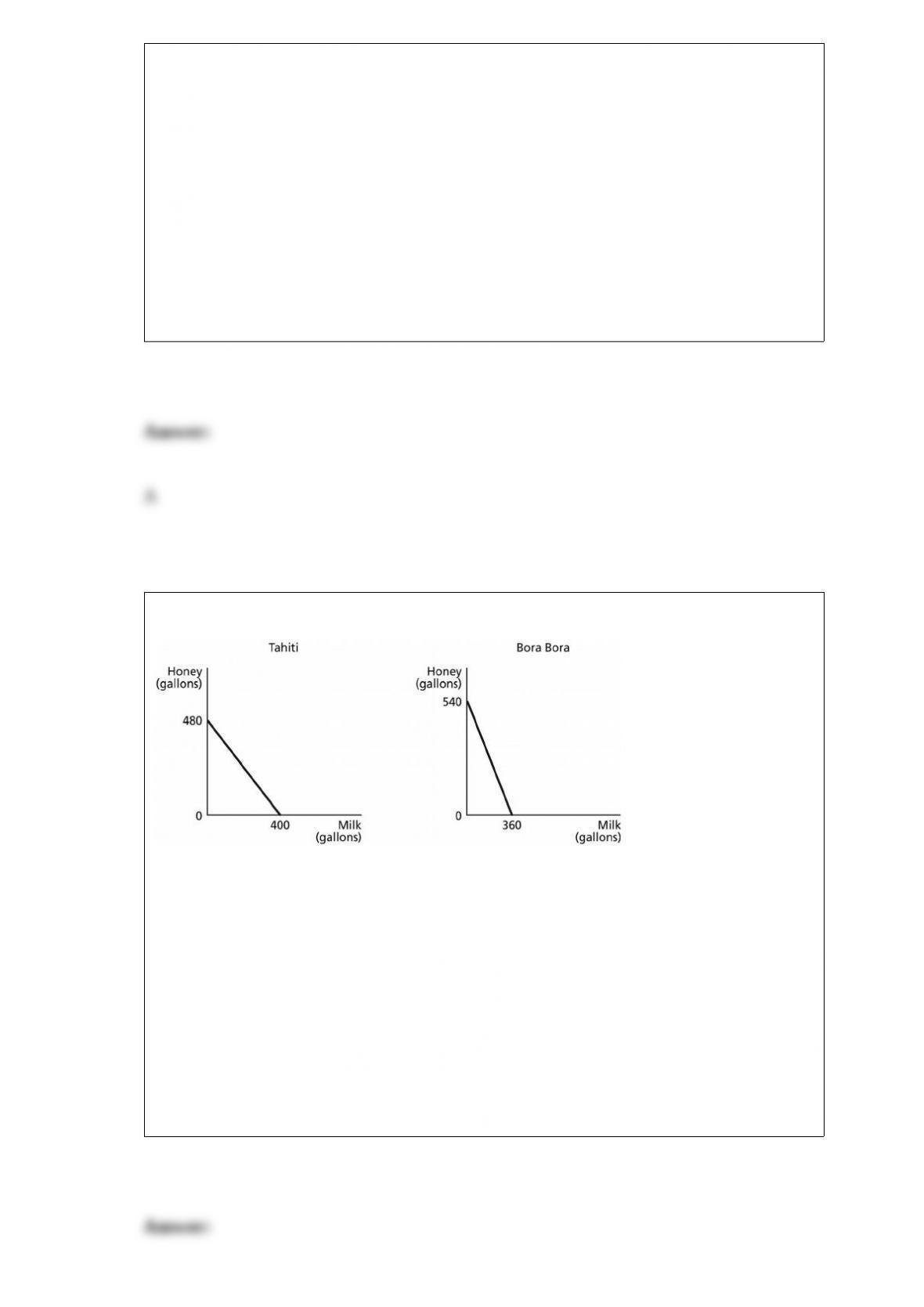
Figure 2-10
Figure 2-10 shows the
production possibilities frontiers for Tahiti and Bora Bora. Each country produces two
goods, milk and honey.
What is the opportunity cost of producing one gallon of honey in Bora Bora?
A) 2/3 gallon of milk
B) 0.9 gallon of milk
C) 1 1/3 gallons of milk
D) 1.5 gallons of milk

In a small economy in 2013, aggregate expenditure was $800 million while GDP that
year was $850 million. Which of the following can explain the difference between
aggregate expenditure and GDP that year?
A) Aggregate expenditure is always less than GDP in developed countries.
B) Firm investment in inventories was less than anticipated in 2013.
C) Firm investment in inventories was greater than anticipated in 2013.
D) Aggregate expenditure is always less than GDP in developing countries.
A firm’s demand curve for labor slopes downwards because
A) of the law of diminishing marginal returns.
B) firms supply less labor as the wage rate rises.
C) workers supply less labor services as the wage rate falls.
D) of rising marginal product.

Figure 3-8
The graph in this figure illustrates an initial competitive equilibrium in the market for
motorcycles at the intersection of D1 and S1 (point A). If there is an increase in the
wages of motorcycle workers and an increase in the price of motorcycle insurance, a
complement to motorcycles, the equilibrium could move to which point?
A) A
B) B
C) C
D) E
The income effect of a wage increase is observed when
A) the higher wage income causes workers to take more leisure and work less.
B) leisure’s higher opportunity cost causes workers to take less leisure and work more.
C) the higher wage income causes workers to take less leisure and work more.
D) leisure’s higher opportunity cost causes workers to take more leisure and work less.

When an economy faces diminishing returns,
A) the slope of the per-worker production function becomes steeper as capital per hour
worked increases.
B) the slope of the per-worker production function becomes flatter as capital per hour
worked increases.
C) the per-worker production function shifts to the left.
D) the per-worker production function shifts to the right.
The current price of canvas messenger bags is $36 each and sales of the bags equal 400
per week. If the price elasticity of demand is -2.5 and the price changes to $44, how
many messenger bags will be sold per week? Use the midpoint formula.
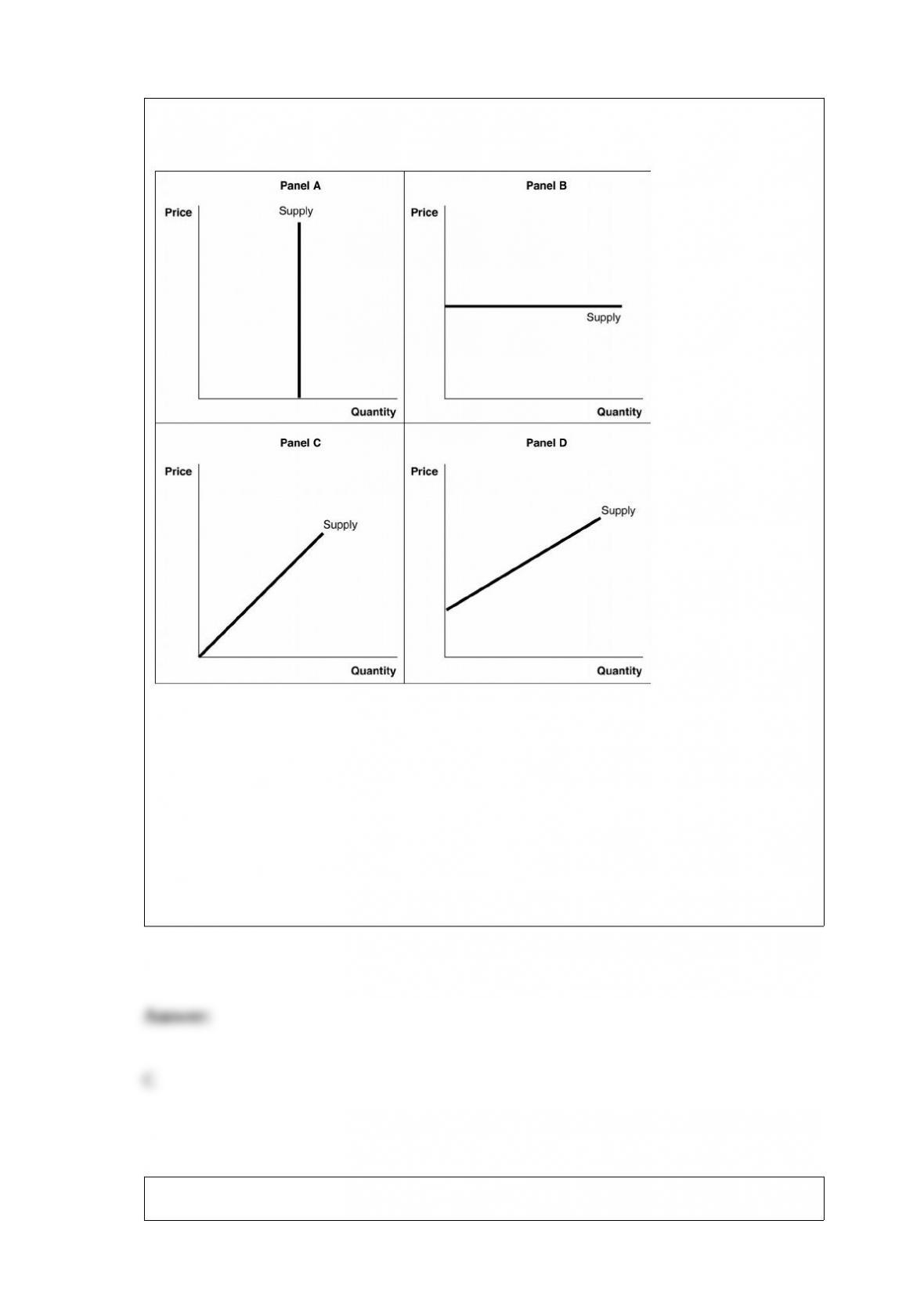
Figure 6-10
A unit-elastic supply curve is shown in
A) Panel A.
B) Panel B.
C) Panel C.
D) Panel D.
Table 2-7

Table 2-7 shows the output per month of two people, Fred and Barney. They can either
devote their time to making pogo sticks or making unicycles. Which of the following
statements istrue?
A) Fred has an absolute advantage in making both products.
B) Barney has an absolute advantage in making both products.
C) Barney has an absolute advantage in making pogo sticks and Fred in making
unicycles.
D) Barney has an absolute advantage in making unicycles and Fred in making pogo
sticks.
The health care system in Japan is referred to as ________, under which every resident
of Japan is required to enroll in either a private or the government-provided health
insurance program.
A) an out-of-pocket system
B) a single-payer health care system
C) a universal health insurance system
D) socialized medicine
If the average productivity of American firms is rising more quickly than the average
productivity of Indian firms, which of the following would you expect to see? (India’s
currency is the rupee.)
A) an increase in the value of the rupee relative to the dollar
B) a decrease in the prices of Indian products
C) a decrease in the quantity demanded of Indian products relative to American
products
D) an increase in the quantity demanded of Indian products relative to American
products
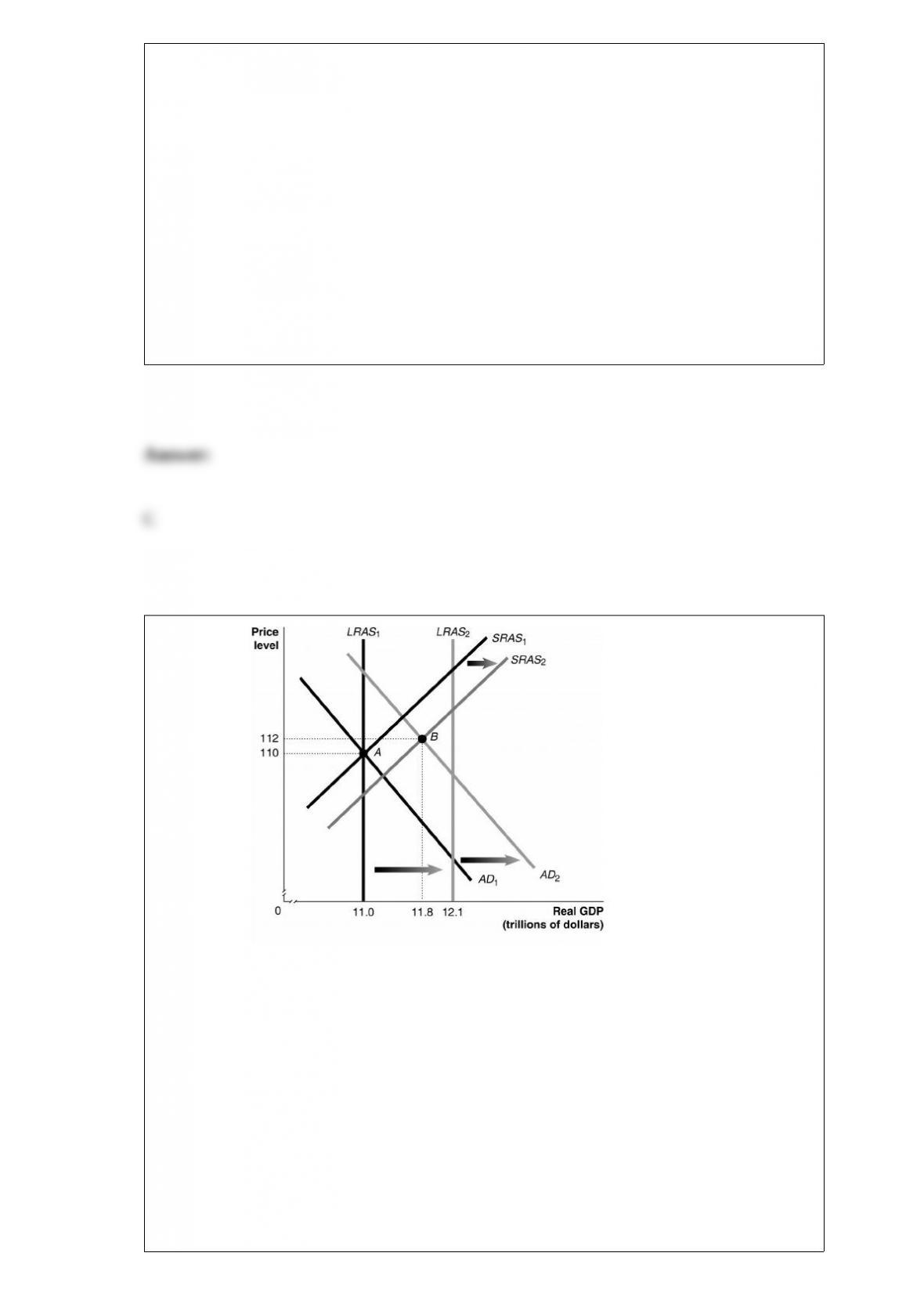
Figure 13-4
In the figure above, AD1, LRAS1 and SRAS1 denote AD, LRAS and SRAS in year 1,
while AD2, LRAS2 and SRAS2 denote AD, LRAS and SRAS in year 2. Given the
economy is at point A in year 1, what is the actual growth rate in GDP in year 2?
A) 2.5%
B) 7.3%
C) 8.0%
D) 10.0%

If the quantity of nail polish supplied is represented by the equation QS = -3 + 2P then
the corresponding price of nail polish is represented by the equation
A) P = 0.5QS + 1.5.
B) P = 2QS + 6.
C) P = 2QS – 6.
D) P = 1.5 – 0.5QS.