
Economic costs of production differ from accounting costs in that
A) economic costs include expenditures for hired resources while accounting costs do
not.
B) economic costs add the opportunity costs of a firm using its own resources while
accounting costs do not.
C) accounting costs include expenditures for hired resources while economic costs do
not.
D) accounting costs are always larger than economic cost.
Price discrimination
A) is the practice of charging different prices to different customers based on a seller’s
personal preferences and prejudices.
B) is the practice of charging different prices to different customers based on the
different costs of supplying the product to different customers.
C) is the practice of charging different prices to different customers when the price
differences cannot be attributed to variations in cost.
D) is the practice of giving preferential treatment to certain groups of customers based
on their long-standing relationship to the producer.
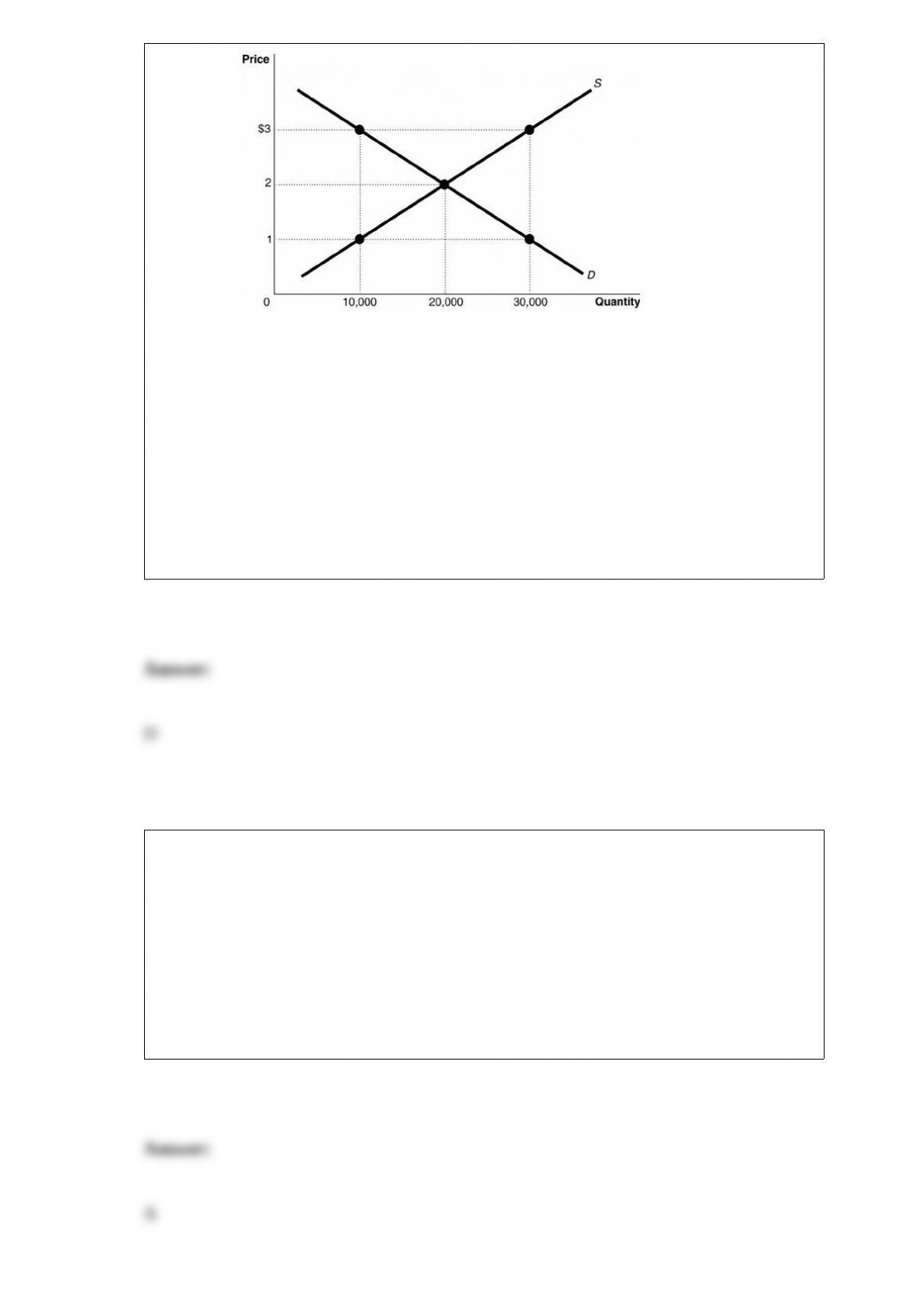
Figure 4-7
The figure above represents the market for iced tea. Assume that this is a competitive
market. If 20,000 units of iced tea are sold,
A) the deadweight loss is equal to economic surplus.
B) producer surplus equals consumer surplus.
C) the marginal benefit of each of the 20,000 units of iced tea equals $3.
D) marginal benefit is equal to marginal cost.
When deflation occurs,
A) the real interest rate is greater than the nominal interest rate.
B) the nominal interest rate is greater than the real interest rate.
C) the nominal interest rate is equal to the real interest rate and inflation is negative.
D) the nominal interest rate is equal to the real interest rate and inflation is positive.
A currency pegged at a value below the market equilibrium exchange rate is
A) overvalued.
B) undervalued.
C) achieving purchasing power parity.
D) None of the above are correct.
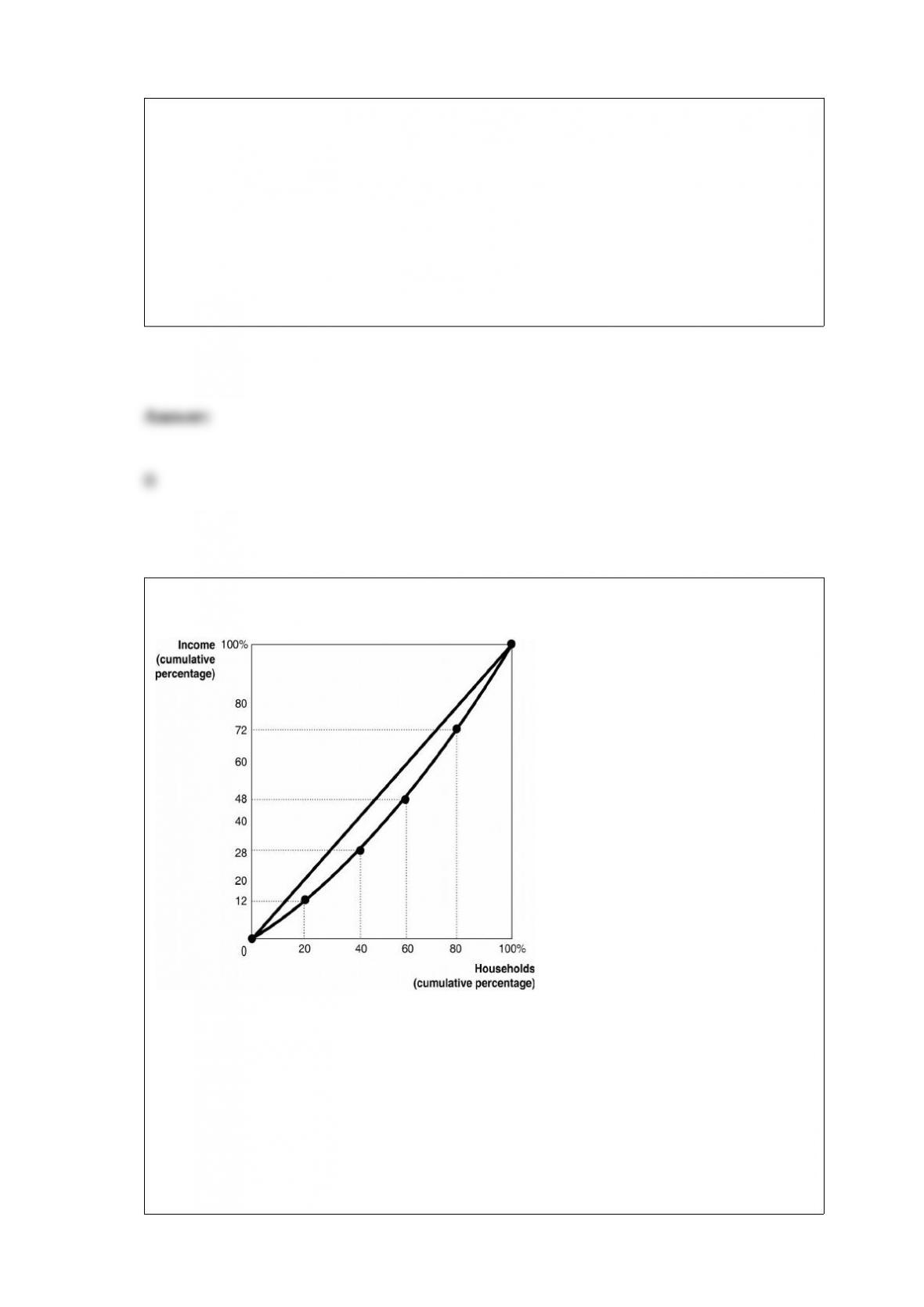
Figure 18-7
Figure 18-7 shows the Lorenz curve
for a hypothetical country. The second lowest 20 percent of households
A) earn 12 percent of the society’s total income.
B) earn 16 percent of the society’s total income.
C) earn 28 percent of the society’s total income.
D) earn 40 percent of the society’s total income.
Ted quits his $60,000-a-year job to be a stay-at-home dad. What is the opportunity cost
of his decision?
A) 0 since he will no longer be earning a salary
B) depends on the “going rate” for stay-at-home dads
C) at least $60,000
D) the value he attributes to the joy of parenting
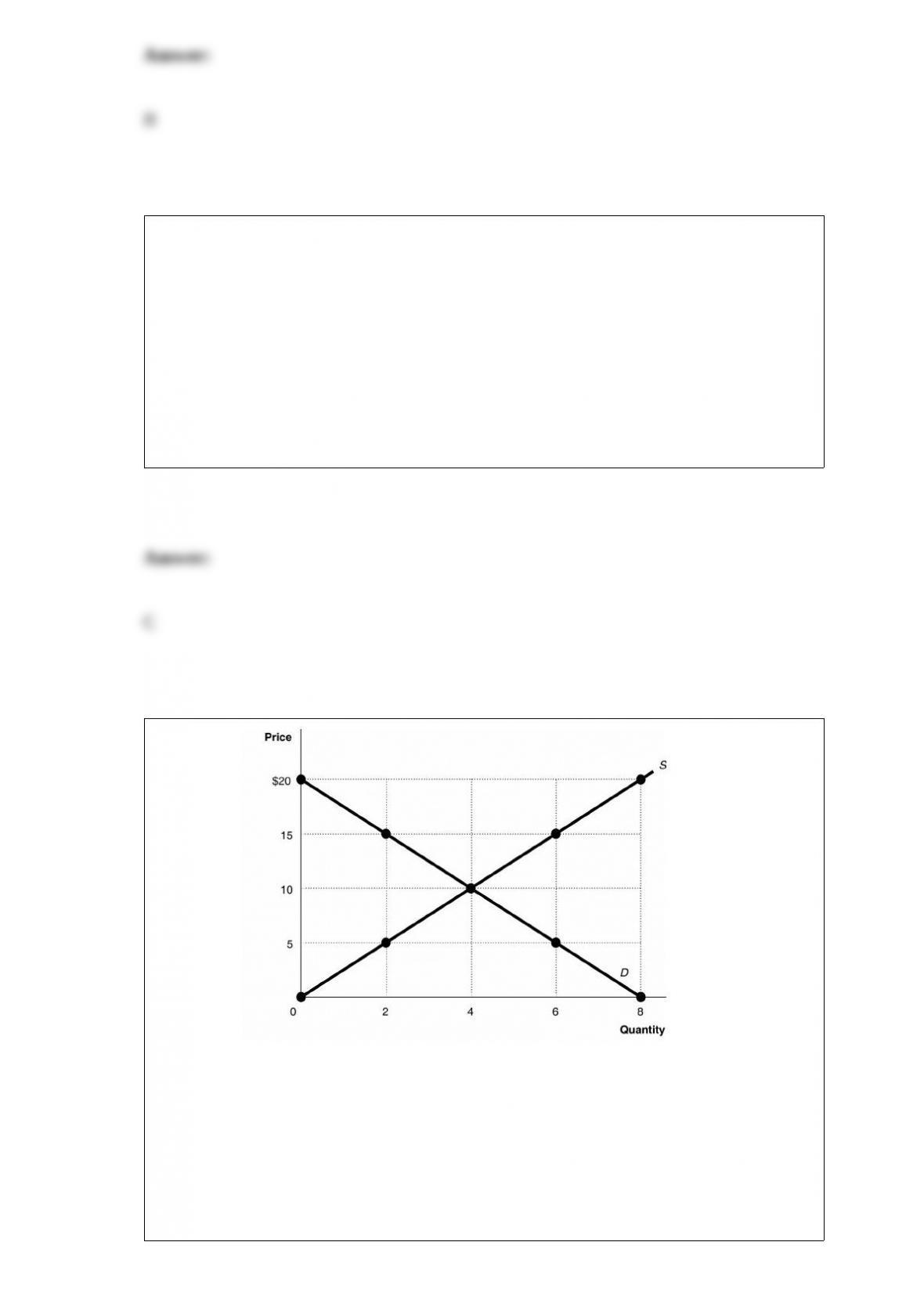
Figure 3-5
At a price of $20,
A) there would be a surplus of 8 units.
B) there would be a shortage of 8 units.
C) there would be a surplus of 0 units.
D) there would be a shortage of 4 units.
If equilibrium is achieved in a competitive market,
A) there is no deadweight loss.
B) the deadweight loss will be maximized.
C) the deadweight loss will equal the sum of consumer surplus and producer surplus.
D) the deadweight loss will be the same as the opportunity cost of the last unit of output
sold.
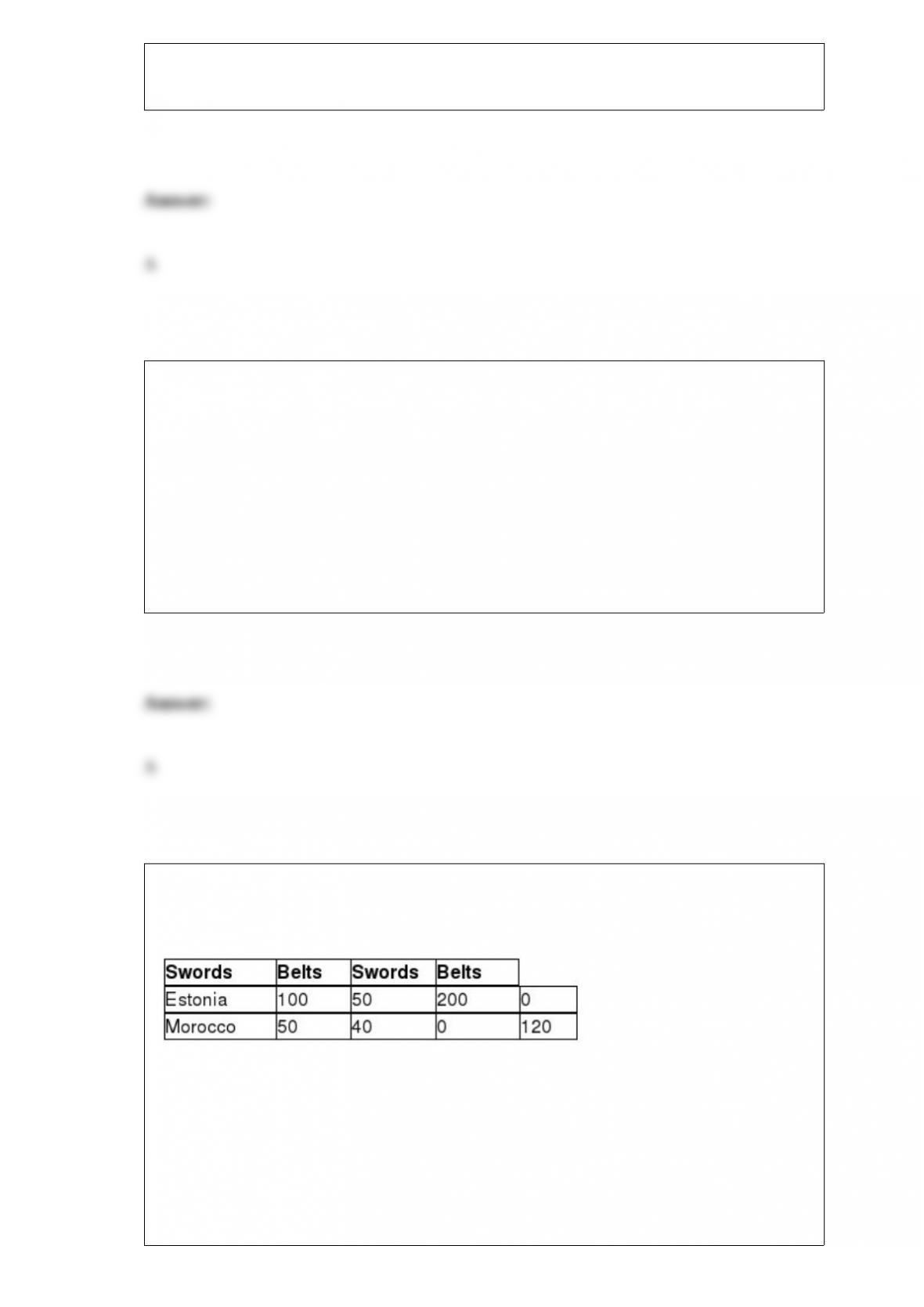
Table 9-12 Production and
Consumption Production
Without Trade With Trade
Estonia and Morocco can produce both swords and belts. Table 9-12 shows the
production and consumption quantities without trade, and the production numbers with
trade.
Which country has a comparative advantage in producing belts?
A) Estonia

B) Morocco
C) both countries
D) neither country
The currency adopted by most countries in ________ is referred to as the euro.
A) Western Europe
B) Eastern Europe
C) Europe and Asia
D) Southern Europe and Northern Africa
Consider three pricing strategies that the firm can pursue:
a. optimal two-part tariff pricing;
b. perfect price discrimination
c. single-price monopoly pricing Of these three strategies, which is most beneficial to
society as a whole?
A) Both perfect price discrimination and a two-part tariff pricing are equally beneficial
in that the marginal benefit of the last unit sold equals the marginal cost of producing
that unit.
B) only perfect price discrimination because this pricing method eliminates deadweight

loss
C) single-price monopoly pricing because consumers enjoy at least some consumer
surplus
D) only two-part tariff pricing because the per-unit portion of the price is set equal to
marginal cost
Of the following countries, which had the highest level of GDP per capita in 2012?
A) Japan
B) France
C) Italy
D) the United States