
There is a federal budget deficit when
A) the government spends less that it collects in taxes.
B) the government spends more that it collects in taxes.
C) the government spends the same amount it collects in taxes.
D) taxes are too high.
The Clayton Act prohibited
A) all vertical mergers.
B) all horizontal mergers.
C) any merger if its effect was to substantially lessen competition or create a monopoly.
D) all conglomerate mergers.
The most liquid measure of money supply is
A) M0.
B) M1.
C) M2.
D) M3.

Article Summary. In a September 2013 speech to the Independent Bankers
Association of Texas, Federal Reserve Bank of Dallas president Richard Fisher
stated that the Fed’s credibility was harmed when it announced the previous week
that it would continue its large bond purchasing program. In June, Fed Chairman
Ben Bernanke had stated that that the program could begin to be cut back later in
the year, and several other Fed officials expressed being open to the announced
timing of this policy. Bernanke’s change in his announced timeline of the Fed’s
intentions regarding the bond purchasing program brought criticism that the Fed
had misled investors. In his speech, Fisher stated “I disagreed with the decision of
the committee and argued against it. Doing nothing at this meeting would increase
uncertainty about the future conduct of policy and call the credibility of our
communications into question. I believe that is exactly what has occurred, though I
take no pleasure in saying so.” Fisher has been a long-time opponent of the Fed’s
bond purchasing program, claiming it is ineffective and may well lead to future
inflation, and had been calling for the Fed to begin phasing out this program in
September.
Source: “Fisher: Standing pat on policy hurt Fed’s credibility,” Reuters,
September 23, 2013.
If the Federal Reserve’s announcements about upcoming monetary policy decisions are
not seen as credible, as Richard Fisher alludes to regarding the announcements about
the bond purchasing program, which of the following would you expect to see?
A) Inflation expectations will accurately reflect actual inflation.
B) Expansionary monetary policy will result in lower rates of inflation.
C) Firms and workers will be unable to accurately forecast changes in the rate of
inflation.
D) The Federal Reserve will have more control over the inflation rate.
Poorly timed discretionary policy can do more harm than good. Getting the timing right
with fiscal policy is generally
A) less difficult than with monetary policy.
B) far less difficult than with monetary policy.
C) more difficult than with monetary policy.
D) about the same difficulty as with monetary policy.
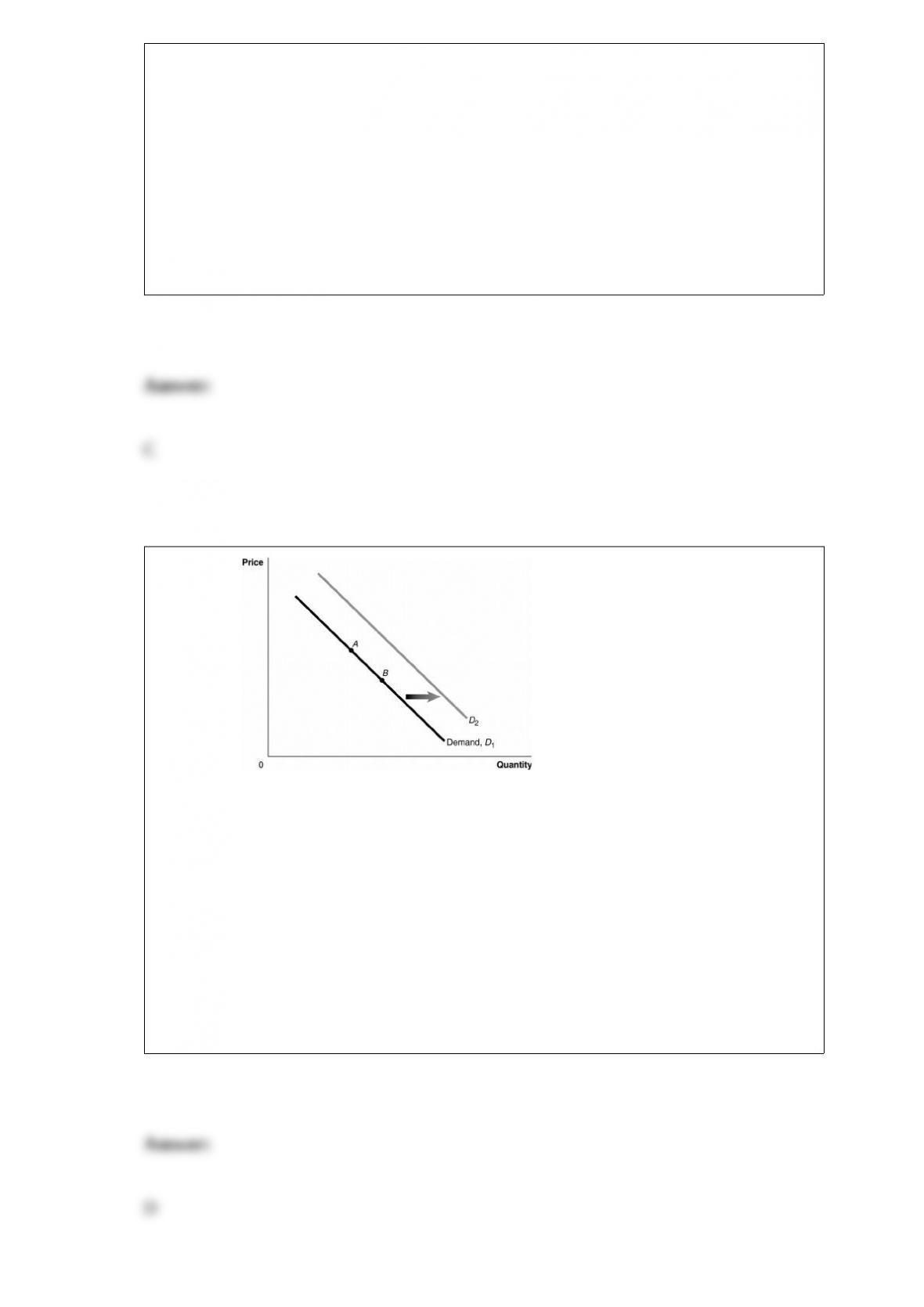
Figure 3-1
A decrease in the expected future price of the product would be represented by a
movement from
A) A to B.
B) B to A.
C) D1 to D2.
D) D2 to D1.

You earned $30,000 in 2000, and your salary rose to $80,000 in 2013. If the CPI rose
from 82 to 202 between 2000 and 2013, which of the following is true?
A) There was deflation between 2000 and 2013.
B) The purchasing power of your salary fell between 2000 and 2013.
C) The purchasing power of your salary remained constant between 2000 and 2013.
D) The purchasing power of your salary increased between 2000 and 2013.
Scenario 25-2 Imagine that Kristy deposits $10,000 of currency into her checking
account deposit at Bank A and that the required reserve ratio is 20%.
As a result of Kristy’s deposit, Bank A’s excess reserves increase by
A) $2,000.
B) $8,000.
C) $10,000.
D) $50,000.
The largest percentage of federal income tax revenue in the United States is paid by the
A) lowest income taxpayers.

B) middle income taxpayers.
C) highest income taxpayers.
D) All groups of taxpayers€low income, high income and middle income€pay the same
percent of federal income taxes.
A monopolistically competitive firm maximizes profit in the short run by producing
where
A) price is less than marginal cost.
B) price is less than marginal revenue.
C) price is less than average revenue.
D) price is greater than marginal cost.
Long-run cost curves are U-shaped because
A) of the law of demand.
B) of the law of diminishing returns.
C) of economies and diseconomies of scale.
D) of the law of supply.