
In the United States, health care spending as a percentage of GDP has declined since
1965.
A person’s wealth is the same as his income.
The marginal propensity to consume measures the average amount of wealth that a
consumer spends in a given period of time.
A rise in the dollar price of the Chinese yuan signals an appreciation of the yuan and a
depreciation of the dollar.

Globalization is the process of countries imposing trade restrictions on other countries.
As the number of firms in a market increases, the supply curve will shift to the left and
the equilibrium price will rise.
The consumer price index is the
A) cost of a market basket of goods and services typically consumed in the base year.
B) cost of a market basket of goods and services typically consumed in the current
period.
C) average of the prices of the goods and services purchased by a typical urban family
of four.
D) average of the prices of new final goods and services produced in the economy over
a period of time.
The demand and supply equations for the peach market are:

Demand: P = 24 – 0.5Q
Supply: P = -6 + 2.5Q
where P = price per bushel, and Q = quantity (in thousands).
a. Calculate the equilibrium price and quantity.
b. Suppose the government guaranteed producers a price of $24 per bushel. What would
be the effect on quantity supplied? Provide a numerical value.
c. By how much would the $24 price change the quantity of peaches demanded?
Provide
a numerical value.
d. Would there be a shortage or surplus of peaches?
e. What is the size of this shortage or surplus? Provide a numerical value.
Figure 13-2
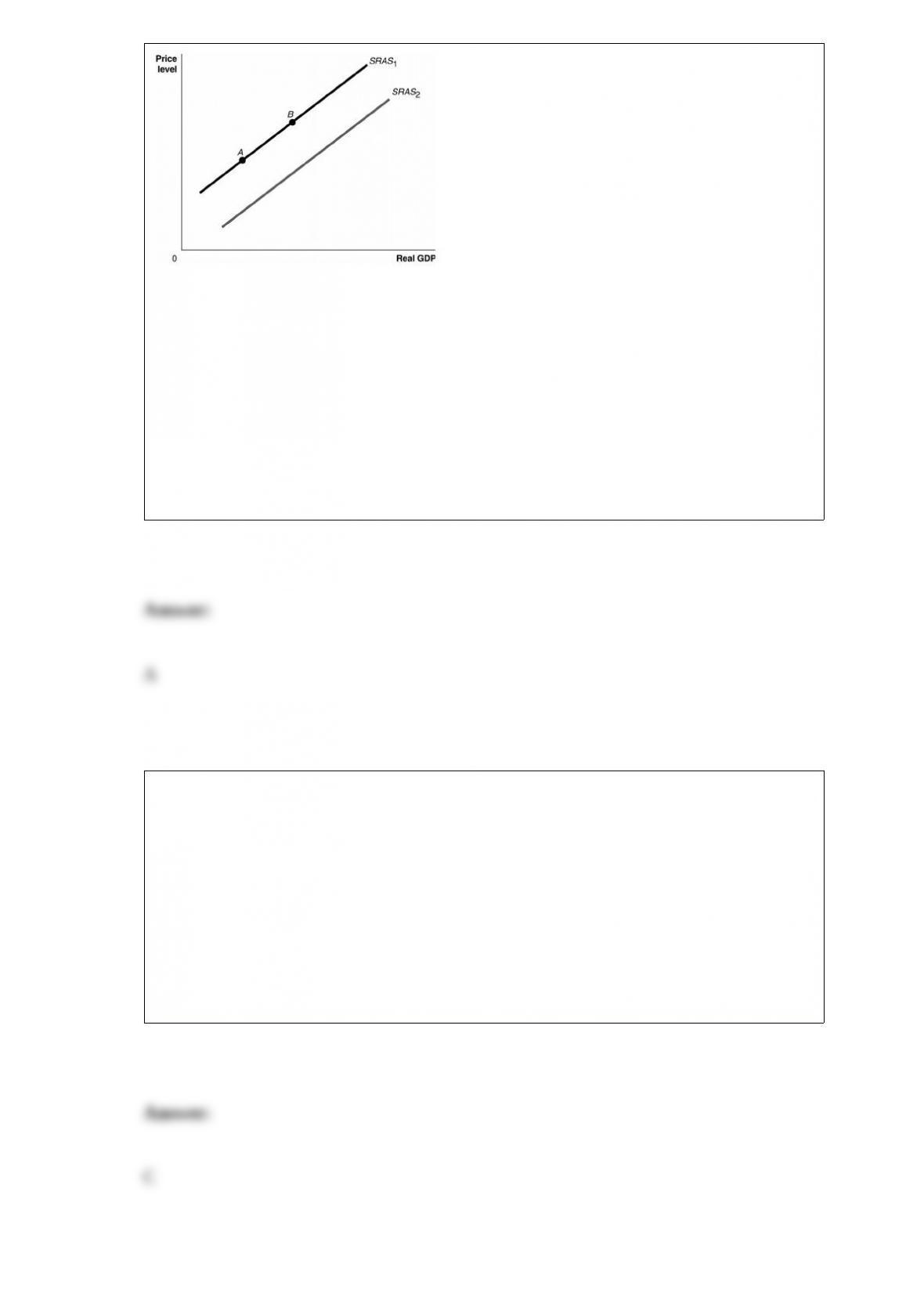
Refer to Figure 13-2. Ceteris paribus, an increase in productivity would be represented
by a movement from
A) SRAS1 to SRAS2.
B) SRAS2 to SRAS1.
C) point A to point B.
D) point B to point A.
Economist Robert Fogel has estimated that by the year 2040, individuals in the United
States will be spending
A) more time in the workforce and more time in leisure activities than they do today.
B) less time in the workforce and less time in leisure activities than they do today.
C) less time in the workforce and more time in leisure activities than they do today.
D) more time in the workforce and less time in leisure activities than they do today.
In an open economy, expansionary monetary policy will cause
A) consumption, investment, and net exports to rise.
B) consumption and investment to rise, but net exports will fall.
C) consumption to rise, but investment and net exports will fall.
D) consumption to fall, but investment and net exports will rise.
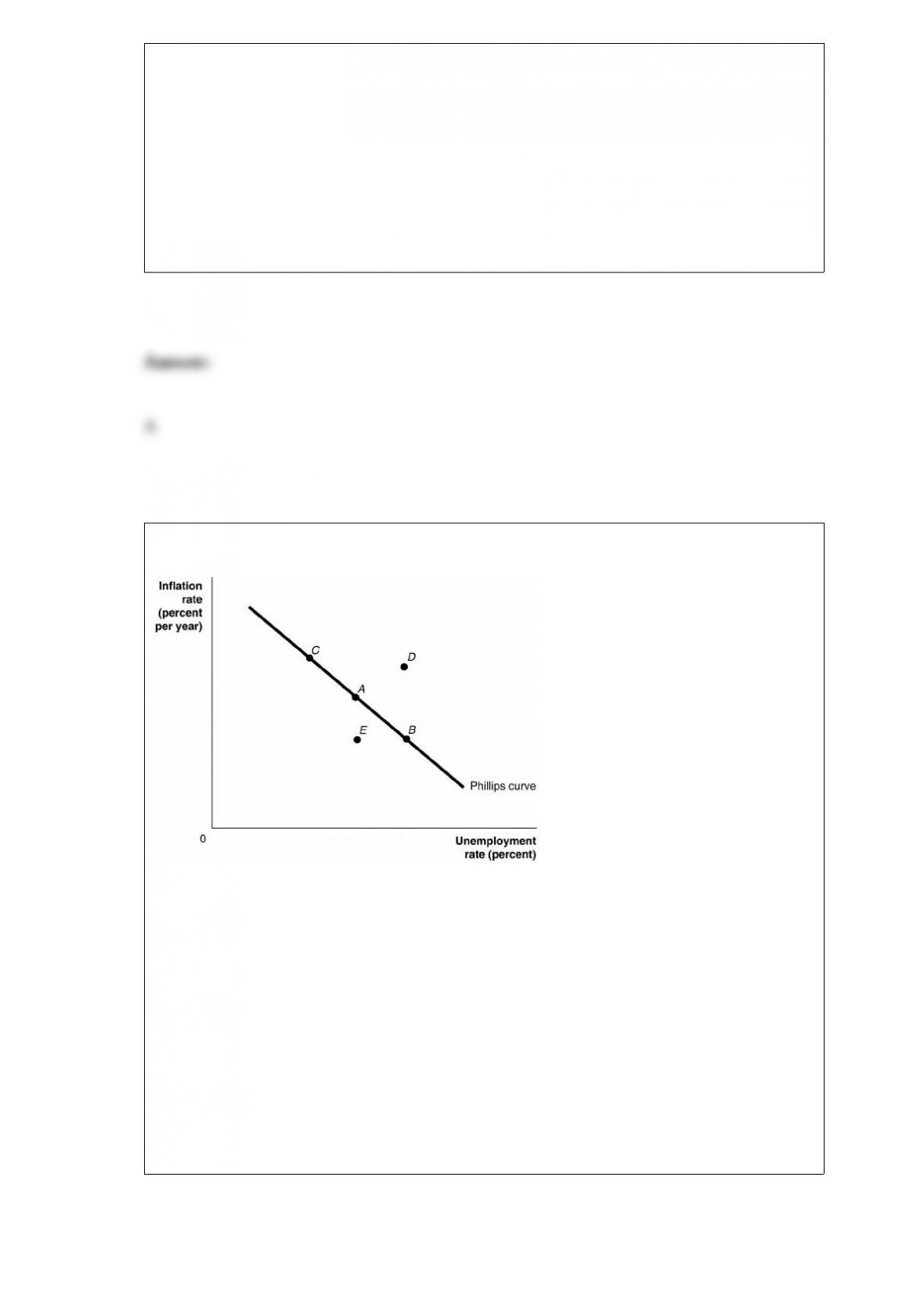
Figure 17-1
Refer to Figure 17-1. Suppose that the economy is currently at point A on the short-run
Phillips curve in the figure above, and the unemployment rate at A is the natural rate. If
the economy was to move to point C, which of the following must be true?
A) The economy is producing a level of GDP equal to potential GDP.
B) Aggregate demand must have decreased.
C) Equilibrium GDP at point C must be above potential GDP.
D) The Fed conducted contractionary policy to cause the move.
E) The Fed sold treasury bills to cause the move.

If real GDP in 2013 (using 2009 prices) is lower than nominal GDP of 2012, then
A) prices in 2013 are lower than prices in 2012.
B) nominal GDP in 2013 equals nominal GDP in 2012.
C) prices in 2013 are higher than prices in 2012.
D) real GDP in 2013 is larger than real GDP in 2012.
Federal government purchases, as a percentage of GDP,
A) have risen since the early 1950s.
B) have fallen since the early 1950s.
C) have remained roughly the same since the early 1950s.
D) rose from the early 1950s until the mid 1980s, and then fell.
To what do economists attribute the rapid growth of labor productivity in the United
States relative to other countries?

A) the flexibility of U.S. labor markets and the efficiency of the U.S. financial system
B) the strict government rules in the United States that regulate a firm’s ability to hire
and fire workers
C) the low rate of job mobility in the United States
D) the high level of unemployment benefits the United States pays relative to other
countries like Canada
Holding all other personal characteristics-such as age, gender, and income-constant,
economists would expect that
A) people without health insurance will be less likely to be overweight than people with
health insurance.
B) people without health insurance will be more likely to be overweight than people
with health insurance.
C) people without health insurance will be equally likely to be overweight as people
with health insurance.
D) there is no correlation between not having health insurance and being overweight.
The multiplier is calculated as the
A) change in real GDP/ change in autonomous expenditure.
B) change in autonomous expenditure/ change in real GDP.

C) change in nominal GDP/ change in autonomous expenditure.
D) change in real GDP/ change in induced spending.
In August 2013, the U.S. unemployment rate was highest for
A) whites.
B) Hispanics.
C) high school dropouts.
D) African-Americans.
E) Asians.
Which of the following statements about the Social Security, Medicare, and Medicaid
programs is true?
A) Spending on these three programs will rise from 9.7% of GDP currently to 10.2% of
GDP by 2050.
B) Costs are being driven up by the fact that Americans are living longer and medical
costs are rising substantially.
C) Some economists have argued for decreasing taxes to help with these programs’
funding problems.
D) Some economists have argued for increasing benefits to help with these programs’
funding problems.
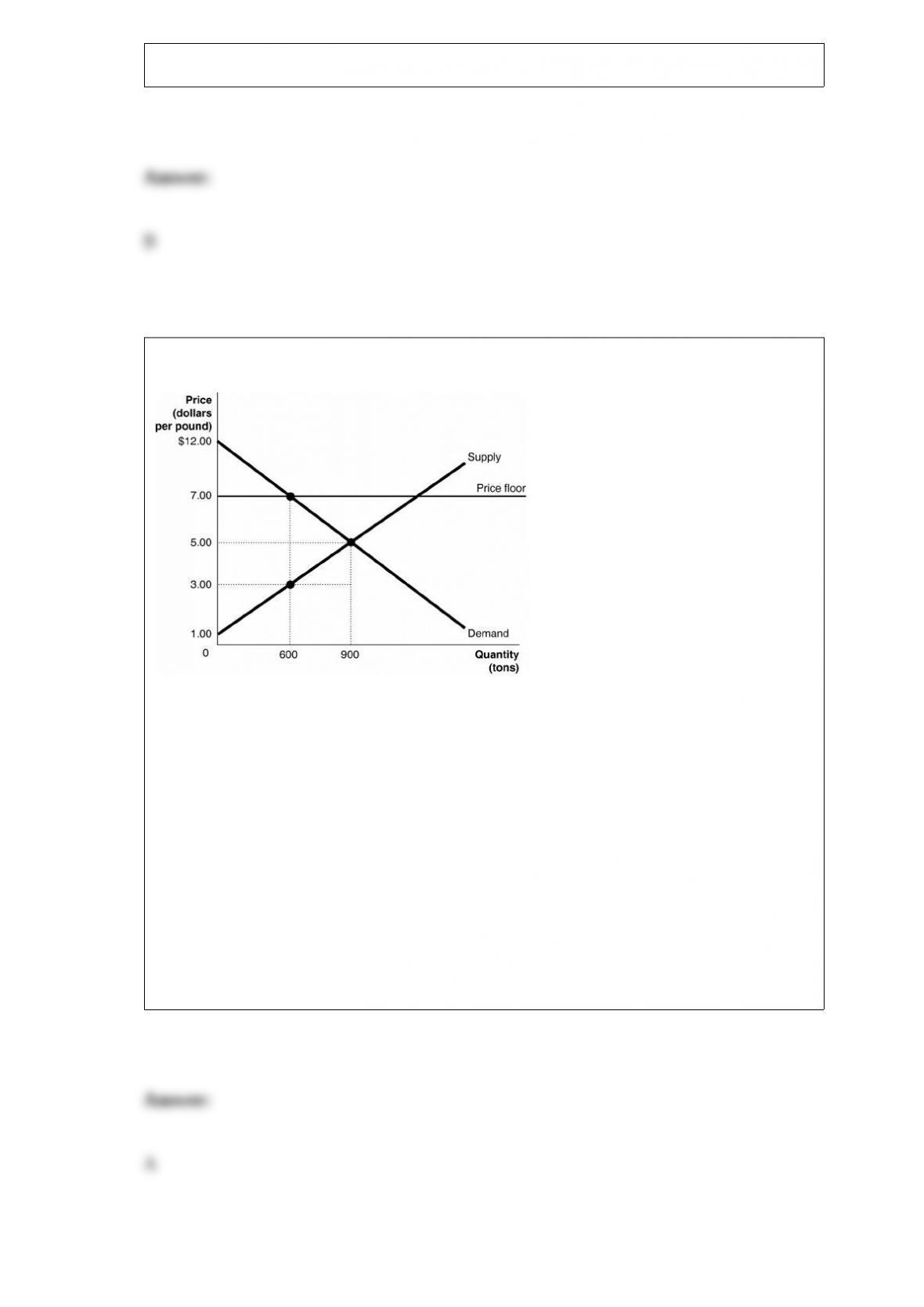
Figure 4-6
Figure 4-6 shows the demand and supply curves for the coffee market. The government
believes that the equilibrium price is too low and tries to help almond growers by
setting a price floor at $7.00.
Refer to Figure 4-6. What is the value of the portion of consumer surplus that has been
transferred to producer surplus as a result of the price floor?
A) $1,200
B) $1,500
C) $1,800
D) $3,000

If a firm expects that the price of its product will be lower in the future than it is today
A) the firm has an incentive to increase supply now and decrease supply in the future.
B) the firm has an incentive to decrease supply now and increase supply in the future.
C) the firm has an incentive to increase quantity supplied now and decrease quantity
supplied in the future.
D) the firm will not change supply until it knows for certain what will happen to its
price.
In economics, activities done for others, such as providing house cleaning or dental
work, are referred to as
A) technology.
B) physical capital.
C) services.
D) goods.
Table 2-7

Table 2-7 shows the output per week of two people, Minnie and Mickey. They can
either devote their time to making hats or making umbrellas.
Refer to Table 2-7. Which of the following statements istrue?
A) Minnie has a comparative advantage in making both products.
B) Mickey has a comparative advantage in making both products.
C) Minnie has a comparative advantage in making hats and Mickey in making
umbrellas.
D) Mickey has a comparative advantage in making hats and Minnie in making
umbrellas.
Who decides who controls a corporation?
What is the difference between explicit and implicit costs?
Explain how unemployment changes over the business cycle. Why do these changes
occur?
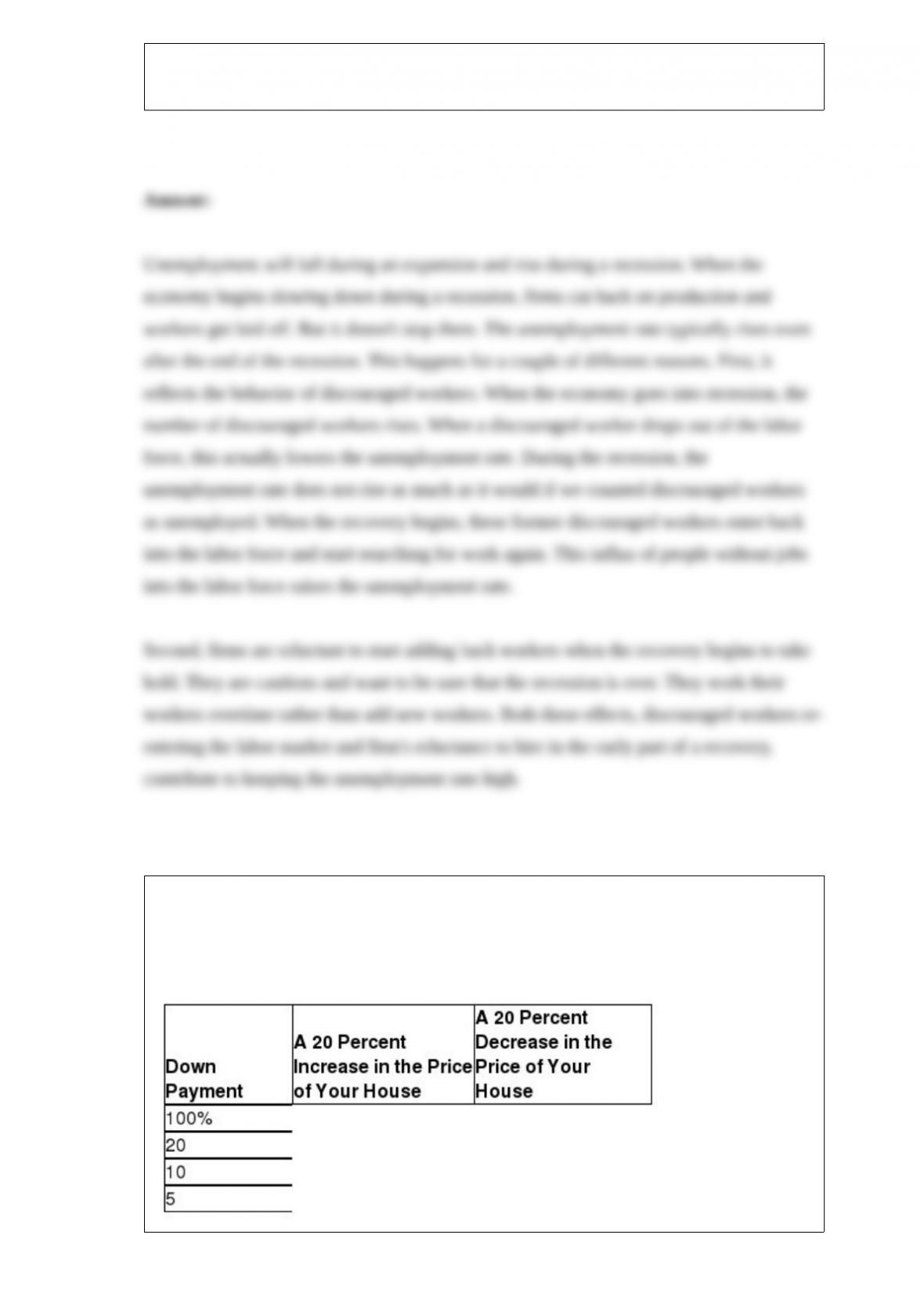
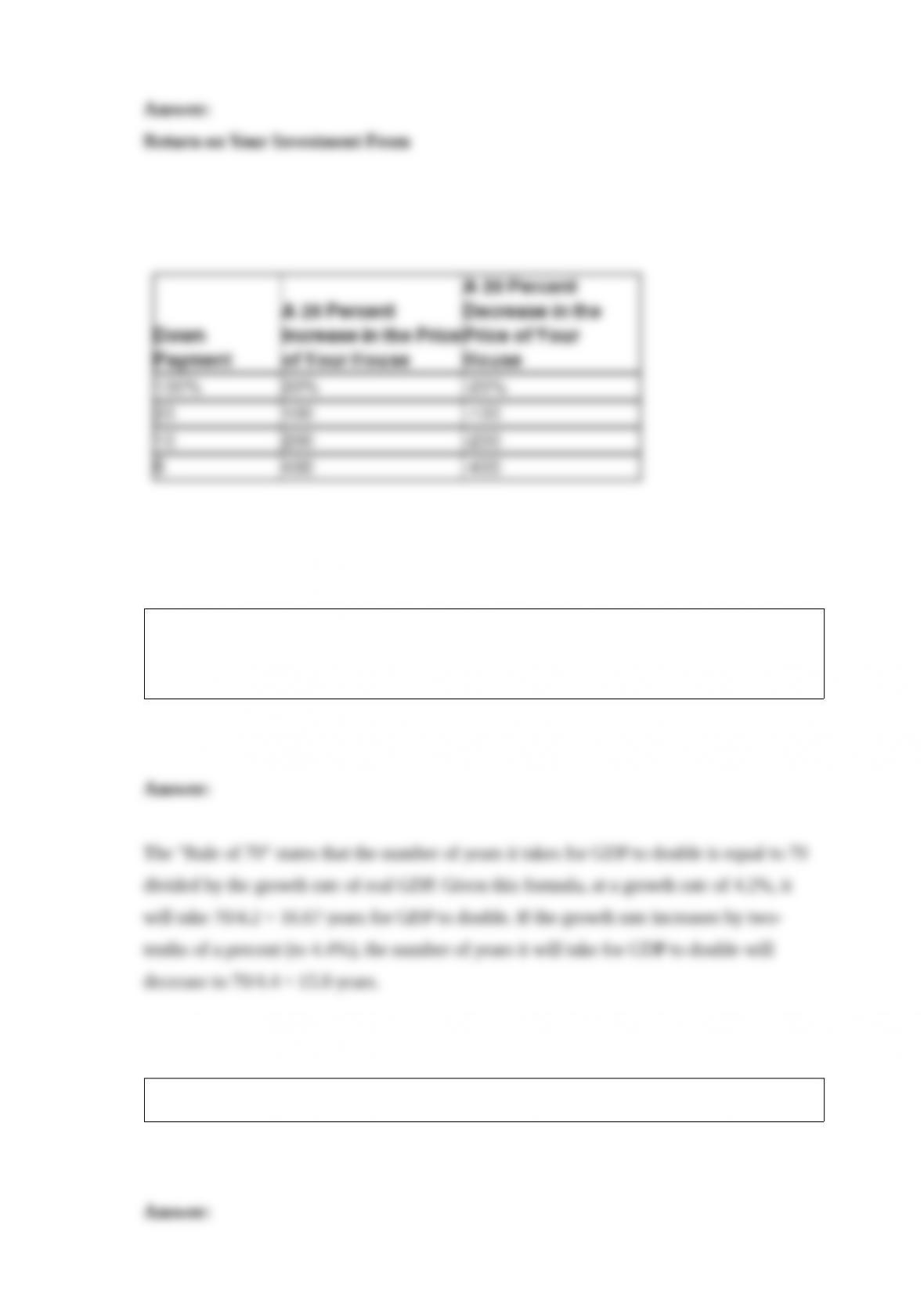
In the following table, fill in the columns for your return on investment if the price of
your house increased or decreased by 20 percent, based on the down payments
specified in the first column.
Return on Your Investment From
The growth rate of real GDP in the United States rises from 4.2% to 4.4%. Explain and
calculate how this increase in the growth rate of real GDP affects the number of years it
will take for real GDP to double.
What is corporate governance?

Why might a developing country choose to peg the value of its currency to the dollar?
Ceteris paribus, how does a recession in the United States affect U.S. net exports?