
Holding other factors constant, a higher relative price of a firm’s output will:
A. increase national saving.
B. decrease national saving.
C. increase investment.
D. decrease investment.
Indicators of economic activity that move at the same time as the overall economy are
called ______ indicators.
A. short-term
B. long-term
C. real
D. coincident
Government health and safety regulations or anti-discrimination laws can reduce real
wages by:
A. decreasing the demand for labor.
B. decreasing the supply of labor.
C. reducing employer costs.
D. increasing worker productivity.
The statement, “If a deal is too good to be true, then it probably is not true,” is most
closely related to which core economic principle?
A. The Low-Hanging Fruit Principle
B. The No-Cash-on-the-Table Principle
C. The Cost-Benefit Principle
D. The Scarcity Principle
Consider the labor market below.
If a minimum wage of $12 per hour is imposed in this labor market, then:
A. 200 workers will lose their jobs.
B. 400 workers will earn $12 an hour.
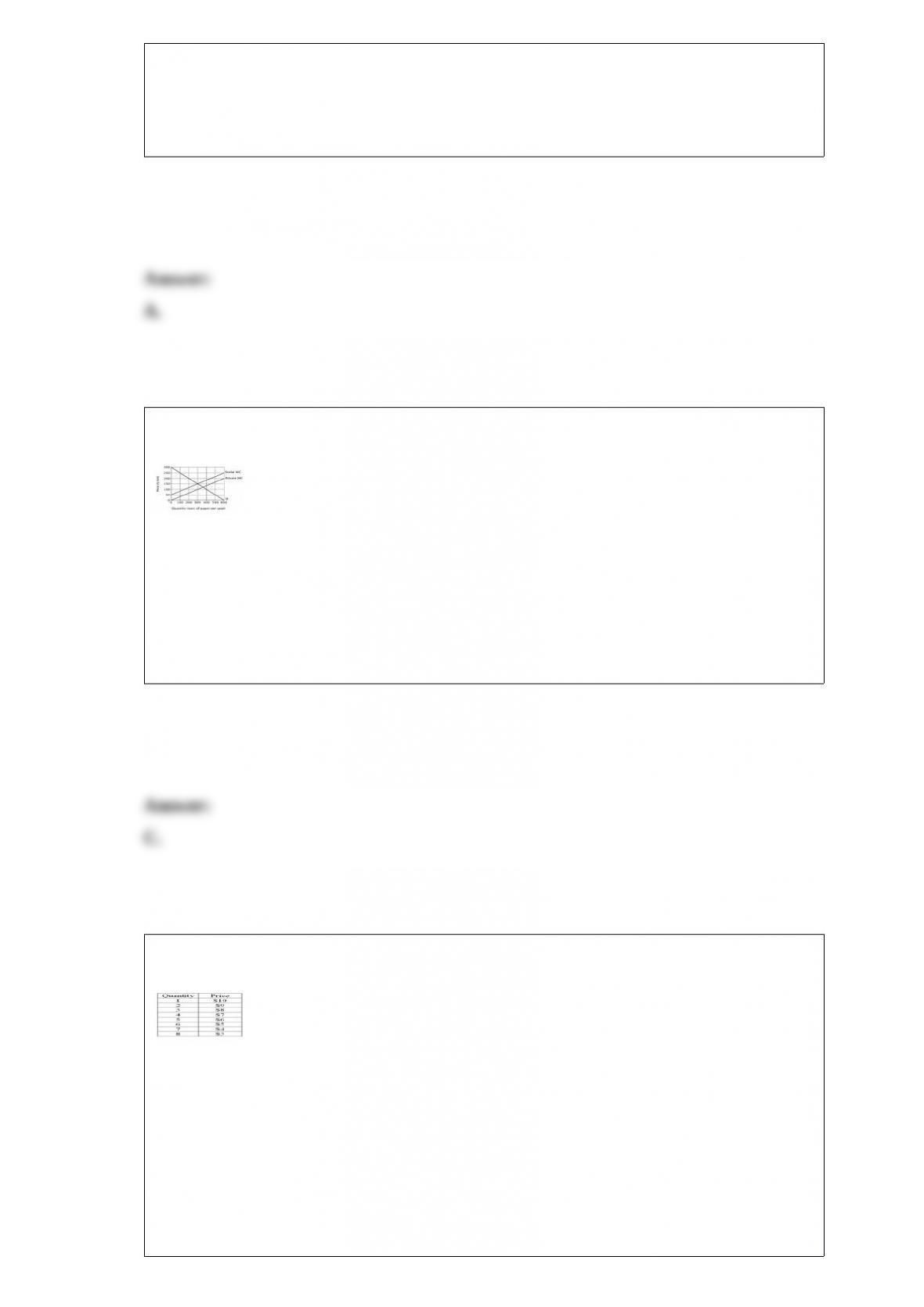
C. total earnings will rise
D. worker surplus will fall.
Refer to the figure below. If negotiation is impractical, the socially optimal level of
production can be achieved by:
A. banning production of paper.
B. compensating those injured by the externality.
C. imposing a tax on paper equal to the external cost.
D. subsidizing paper by the amount of the external benefit.
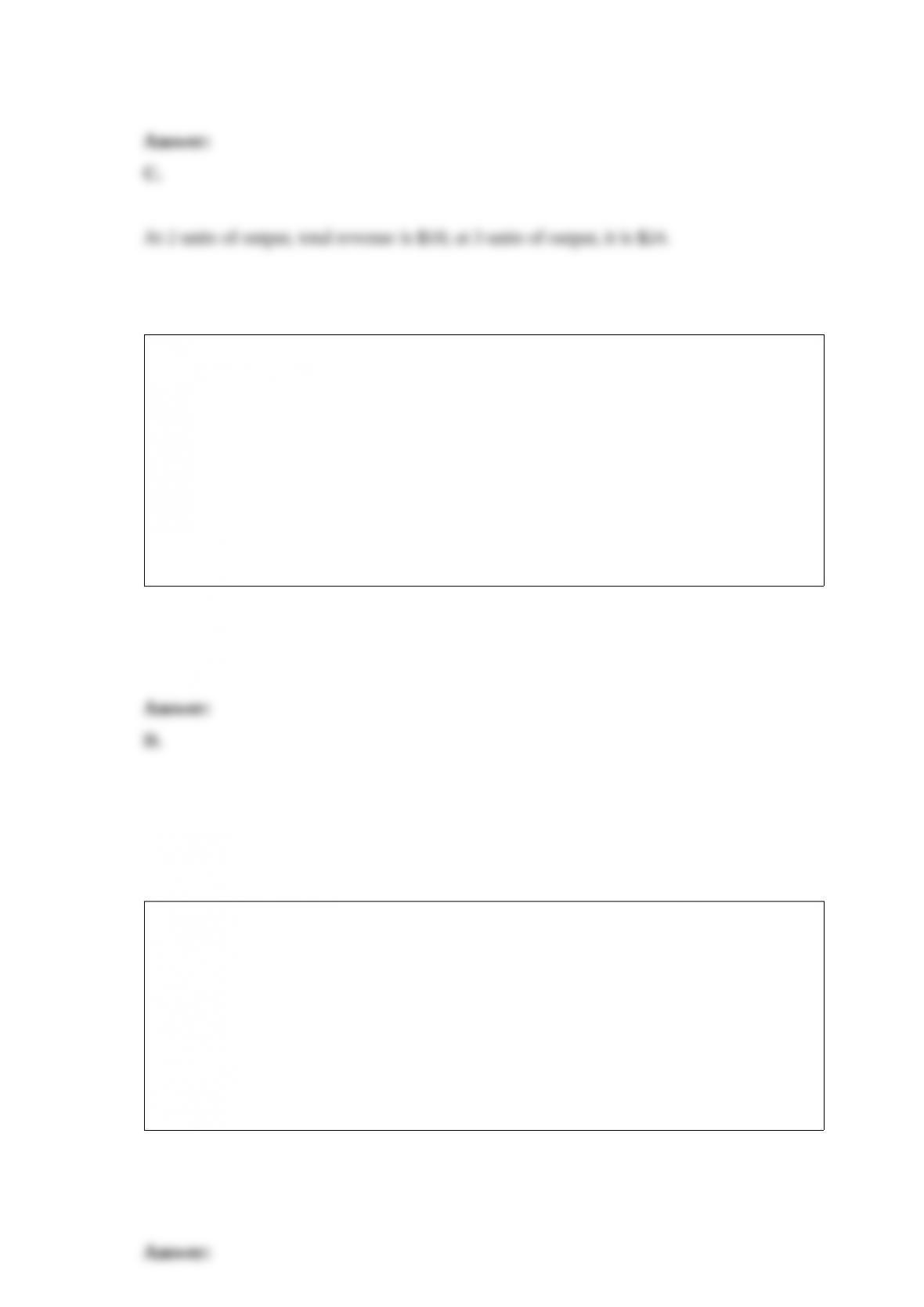
Suppose the table below describes the relationship between price and quantity
demanded for a monopolist.
The marginal revenue of the third unit of output is:
A. $24.
B. $8.
C. $6.
D. -$1.
The measure of the cost of a standard basket of goods and services in any period
relative to the cost of the same basket of goods and services in the base year is called
the:
A. consumption cost calculator.
B. consumption production index.
C. consumer production index.
D. consumer price index.
A gamble that offers a 1 percent chance of winning $699.93 and a 99 percent chance of
losing $7.07 would be classified as a(n):
A. better-than-fair gamble.
B. less-than-fair gamble.
C. fair gamble.
D. unfair gamble.
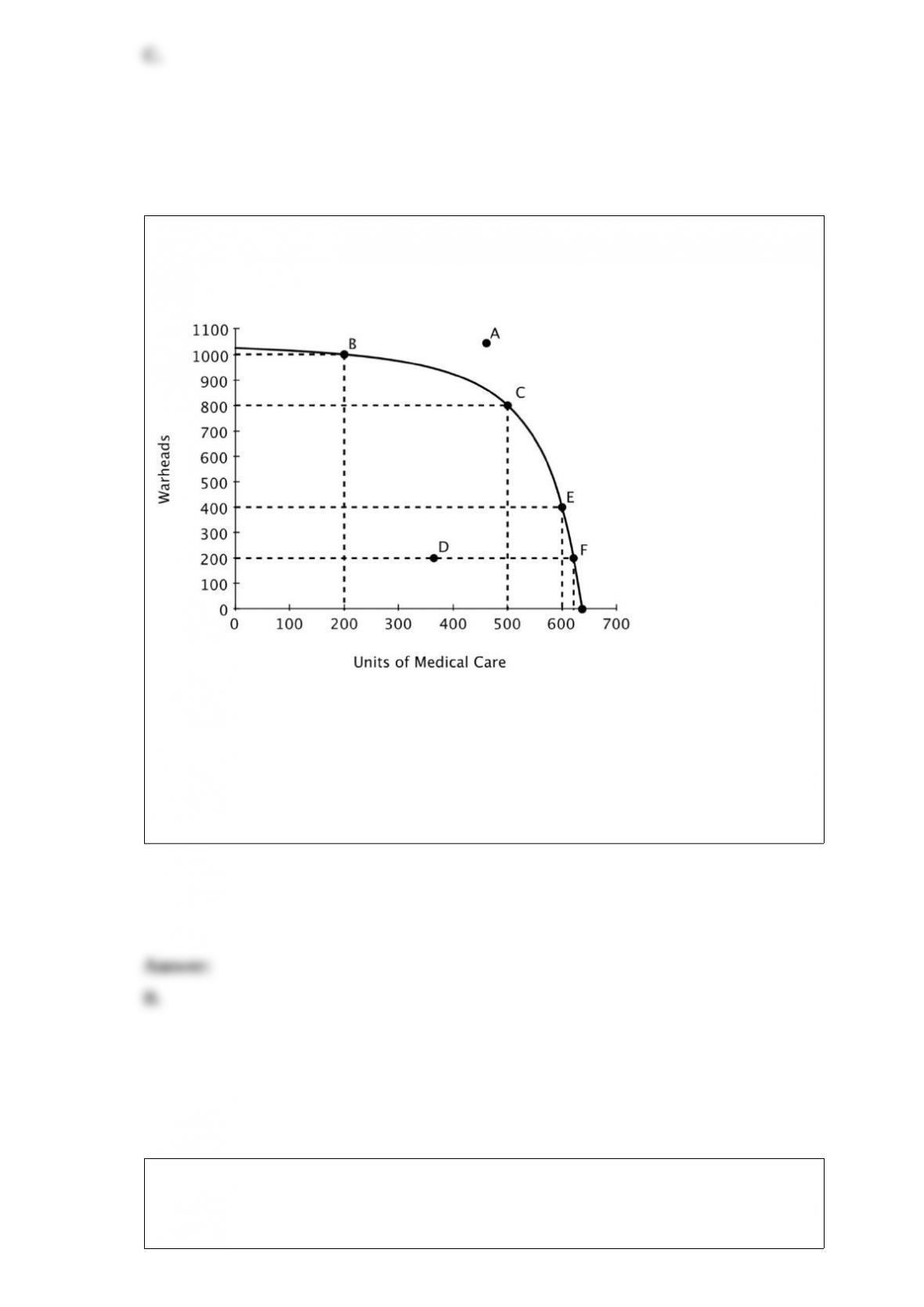
Refer to the figure below. The opportunity cost of increasing medical care from 200 to
400 units is ______ the opportunity cost of increasing medical care from 400 to 600
units.
A. greater than
B. less than
C. exactly the same as
D. twice as much as
Lunch in Jamie’s dorm is an all-you-can-eat buffet, served from 11 a.m. until 1 p.m. By
noon, the buffet is picked over, and by 12:30, there are very few popular items left. The
garbage bins, though, are full of food. Over time, you would expect that students
would:
A. stop eating so much at lunch because they would notice that it generates waste.
B. start distributing themselves more evenly over the lunch hours to avoid long lines.
C. come earlier and earlier for lunch in order to have a better selection from which to
choose.
D. be pickier in their selections from the buffet.
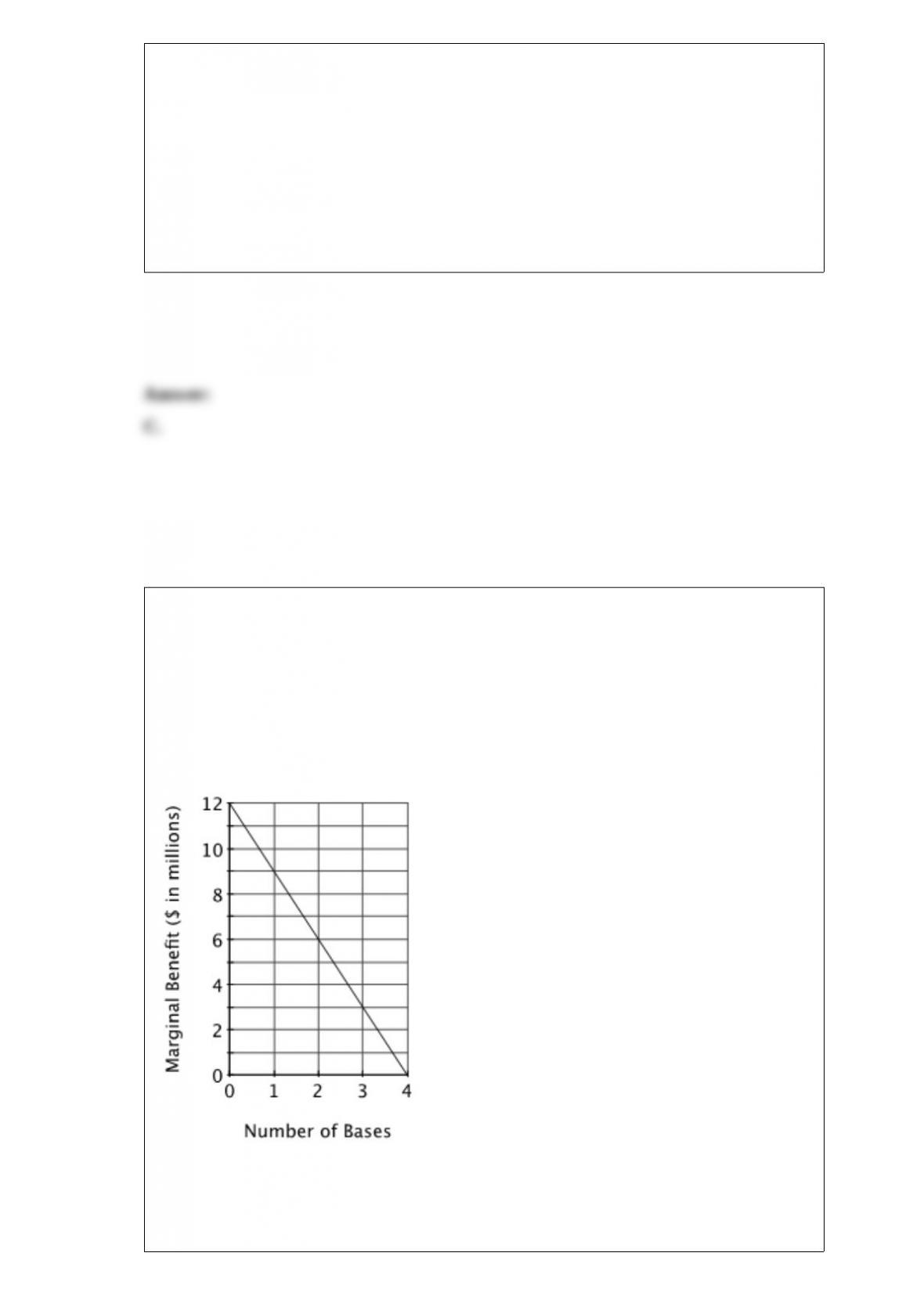
There are ten states in the democratic nation of Fatlandia, and each state has ten
thousand residents. Although incomes vary, each Fatlandian pays a tax equal to the total
cost of all government projects divided by the number of residents in the country.
Currently, two states each have one army base. An army base adds $2 million to a
state’s local economy each year. In addition, in terms of increased security, the annual
marginal benefit to Fatlandia of having an additional army base is shown below. The
total cost of an army base is $8 million per year.
Suppose the department of defense proposes to build a third base in the state of New
Porkswick. Apart from the value of the additional security to the nation, the state
economy will benefit by ______ per resident, and each resident’s taxes will increase by

______.
A. $200; $800
B. $20; $800
C. $200; $80
D. $20; $80
The price of the average domestic good or service relative to the price of the average
foreign good or service, when prices are expressed in terms of a common currency is
called the ______ exchange rate.
A. flexible
B. fixed
C. real
D. nominal
If potential output equals 3,000 and short-run equilibrium output equals 3,500, there is
a(n) ______ gap and the Federal Reserve must ______ real interest rates in order to
close the gap.
A. recessionary; raise
B. recessionary reduce
C. recessionary; not change
D. expansionary; raise
Suppose the local slaughterhouse gives off an unpleasant stench. The price of meat
would then be _______ because not all of the _________ are accounted for in the
marketplace.
A. too high; benefits
B. too low; benefits
C. too high; costs
D. too low; costs
Balanced, across the board U.S. income growth characterizes the period of the:

A. 1980’s to the present.
B. entire 20th century.
C. 1960’s to 1990’s.
D. mid 1940’s to the early 1970’s.
Refer to the figure below. If the price of Good A is $5 and the price of Good B is $4,
then the rational spending rule is satisfied when the consumer purchases ______ units
of Good A and ______ units of Good B.
A. 3; 3
B. 1; 3
C. 4; 2
D. 3; 2
The number of unemployed divided by the labor force equals the:
A. labor-force participation rate.
B. employment rate.
C. unemployment rate.

D. duration rate.
In Econland autonomous consumption equals 700, the marginal propensity to consume
equals 0.80, net taxes are fixed at 50, planned investment is fixed at 100, government
purchases are fixed at 100, and net exports are fixed at 40. Induced expenditure equals:
A. 0.20Y.
B. 990 + 0.20Y.
C. 0.80Y.
D. 900 + 0.80Y.
Two firms, Industrio and Capitalista, have access to five production processes, each of
which has a different cost and gives off a different amount of pollution. The daily costs
of the processes and the corresponding number of tons of smoke emitted are shown in
the table below. Both firms currently use process A, and each emits 4 tons of smoke per
day. The government is considering two plans to reduce pollution: requiring both firms
to reduce pollution by 25 percent or auctioning pollution permits. Each permit would
entitle the owner to emit one ton of smoke per day. Without a permit, no smoke can be
emitted.
process
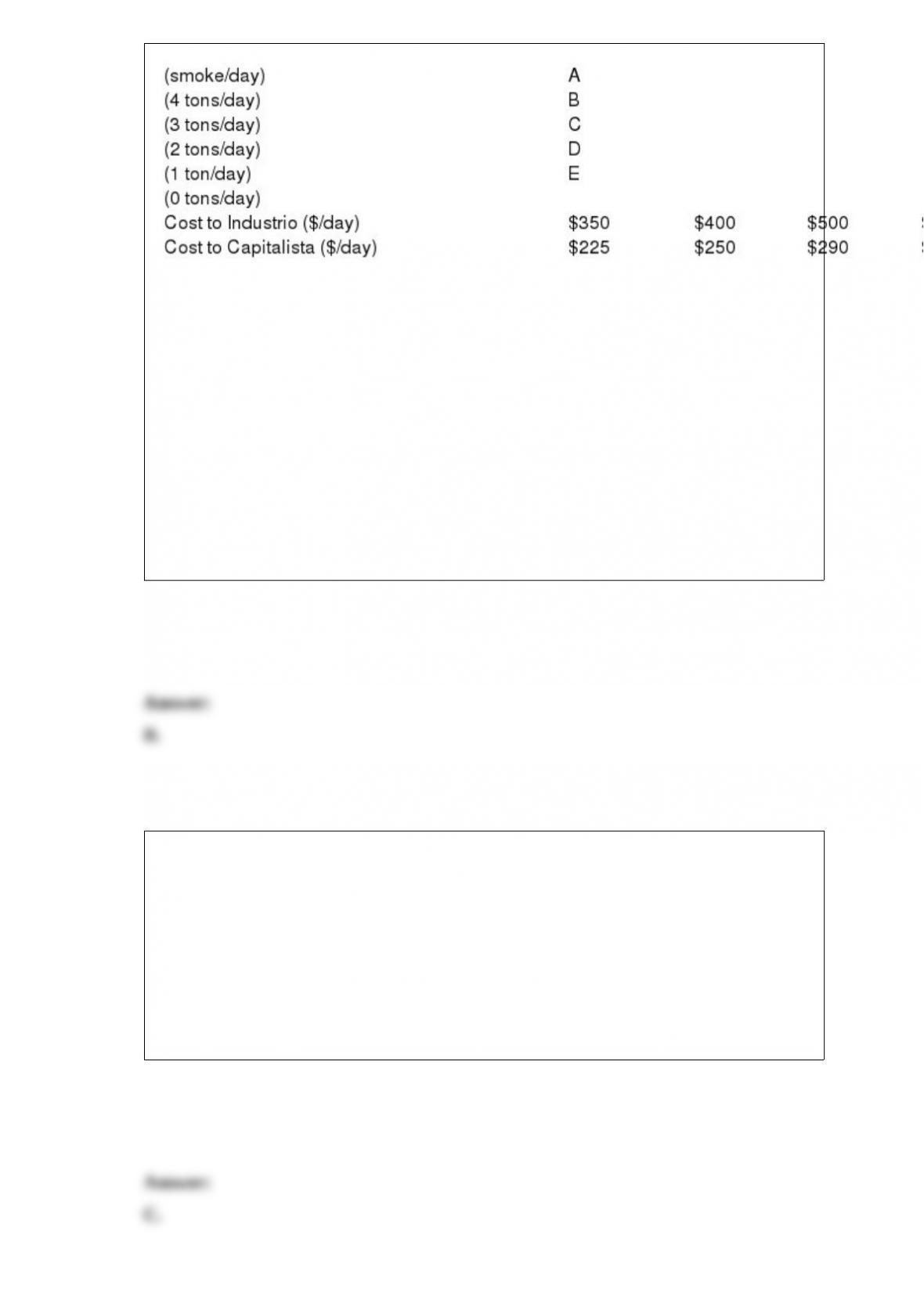
Suppose the government decides to auction 6 permits. The government conducts the
auction by starting at a price of $1 and asking how many permits each firm wants to
buy at that price. If the total is more than 6, it raises the price by $1 and asks again until
the total quantity demanded falls to 6. Under this system, each permit will sell for
______ with Industrio buying ______ and Capitalista buying ______.
A. $31; 2; 4
B. $41; 4; 2
C. $51; 4; 2
D. $101; 3; 3
The quantity and quality of human capital, physical capital, technology, natural
resources, entrepreneurship, and the legal and political environment determine the:
A. unemployment rate.
B. labor force participation rate.
C. average labor productivity.
D. real interest rate.
A profit-maximizing perfectly competitive firm must decide:
A. only on what price to charge, taking output as fixed.
B. both what price to charge and how much to produce.
C. only on how much to produce, taking price as fixed.
D. only on which industry to join, taking price and output as fixed.
Suppose that a disease that affects people who consume beef has been discovered in the
United States. One likely result is:
A. an increase in buyers’ reservation prices for beef.
B. a decrease in demand for chicken.
C. a decrease in demand for beef.
D. a decrease in the quantity demanded of beef.
If the market supply curve does not capture all of the costs to society of producing an
additional unit of good, then:
A. the market equilibrium will be socially optimal.
B. the market equilibrium will not be efficient.
C. the allocation of resources will be efficient.
D. the market will not be in equilibrium.
Suppose that the extra cost to Tim of a third glass of soda is zero because he’s at a
restaurant that gives free refills. According to the Cost-Benefit Principle Tim should:
A. drink a third glass of soda.
B. drink a third glass of soda if the extra benefit of doing so is positive.
C. drink a third glass of soda if his total benefit from drinking soda is positive.
D. not drink a third glass of soda.
Shifts in ______ can push the economy out of long-run equilibrium.
A. the AD curve only
B. the AS curve only
C. either the AD curve or the AS curve
D. the PAE line only
Total spending on final goods and services in an economy must equal total:
A. profits.
B. production value.
C. revenues from all transactions.
D. investment.
The last time gas prices increased drastically, sales of large Sport Utility Vehicles
(SUVs) fell. Why?
A. Higher gas prices lowered the benefit of driving an SUV.
B. Higher gas prices increased the benefit of driving an SUV.
C. Higher gas prices increased the cost of driving a SUV.
D. Higher gas prices lowered the cost of driving a SUV.
Refer to the figure below. The deadweight loss at the market equilibrium quantity is
equal to the area ______.
A. ½ × EF × AC
B. ½ × FG × BD
C. ½ × FG × AC
D. ½ × GH × BD
An increase in the nominal exchange rate, e, defined as the number of units of the

foreign currency that one unit of the domestic currency will buy, indicates that the
domestic currency has ______ relative to the foreign currency.
A. appreciated
B. depreciated
C. become overvalued
D. become undervalued
An in-kind transfer payment is:
A. made out of kindness.
B. a cash payment.
C. a benefit in the form of a good or service.
D. less costly to provide than a cash payment.