1) a country having stronger preferences for imports than its trading partners have for
its exports finds its demand for foreign exchange rising more rapidly than its supply of
foreign exchange.
a.true
b.false
2) which of the following is a fallacy of international trade?
a.trade is a zero-sum activity
b.exports increase employment in exporting industries
c.import restrictions increase employment in import-competing industries
d.tariffs and quotas reduce trade volume
3) among the codes of conduct addressed at the tokyo round of multilateral trade
negotiations were customs valuation, product standards, subsidies and countervailing
duties, government procurement policies, and import licensing procedures.
a.true
b.false
4) if the swiss demand for dollars is inelastic, a depreciation of the dollar against the
franc will lead to a greater quantity of francs being supplied to the foreign exchange
market to obtain dollars.
a.true
b.false
5) assume an economy operates at full employment and faces a trade deficit. according
to the absorption approach, currency devaluation will improve the trade balance if
domestic:
a.interest rates rise, thus encouraging investment spending

b.income rises, thus stimulating consumption
c.output falls to a lower level
d.spending is cut, thus freeing resources to produce exports
6) starting from a position where the nation’s money demand equals the money supply
and its balance of payments is in equilibrium, economic theory suggests that the
nation’s balance of payments would move into a deficit position if there occurred in the
nation:
a.an increase in the money supply
b.a decrease in the money supply
c.an increase in money demand
d.none of the above
7) international trade forces domestic firms to become more competitive in terms of:
a.the introduction of new products
b.product design and quality
c.product price
d.all of the above
8) most nations currently allow their currencies’ exchange values to be determined
solely by the forces of supply and demand in a free market.
a.true
b.false
9) given a floating exchange rate system an increase in ____ would cause the dollar to
appreciate against the euro.
a.u.s. labor costs
b.the u.s. money supply
c.u.s. prices of goods
d.u.s. real interest rates

10) concerning international lending risk, credit risk refers to the probability that part or
all of the interest rate or principal of a loan will not be repaid.
a.true
b.false
11) according to the law of one price, identical goods should cost the same in all
nations, assuming there are no shipping costs nor trade barriers.
a.true
b.false
12) if a currency’s exchange rate is undervalued, a government would likely initiate
actions to devalue the currency.
a.true
b.false
13) if japanese workers receive lower wages in the production of autos than do
american workers:
a.japan will have a comparative advantage in the production of autos
b.japan will have an absolute advantage in the production of autos
c.production costs will be lower in japan than in the u.s.
d.production costs could be lower in the u.s. if american labor productivity is higher
than the japanese
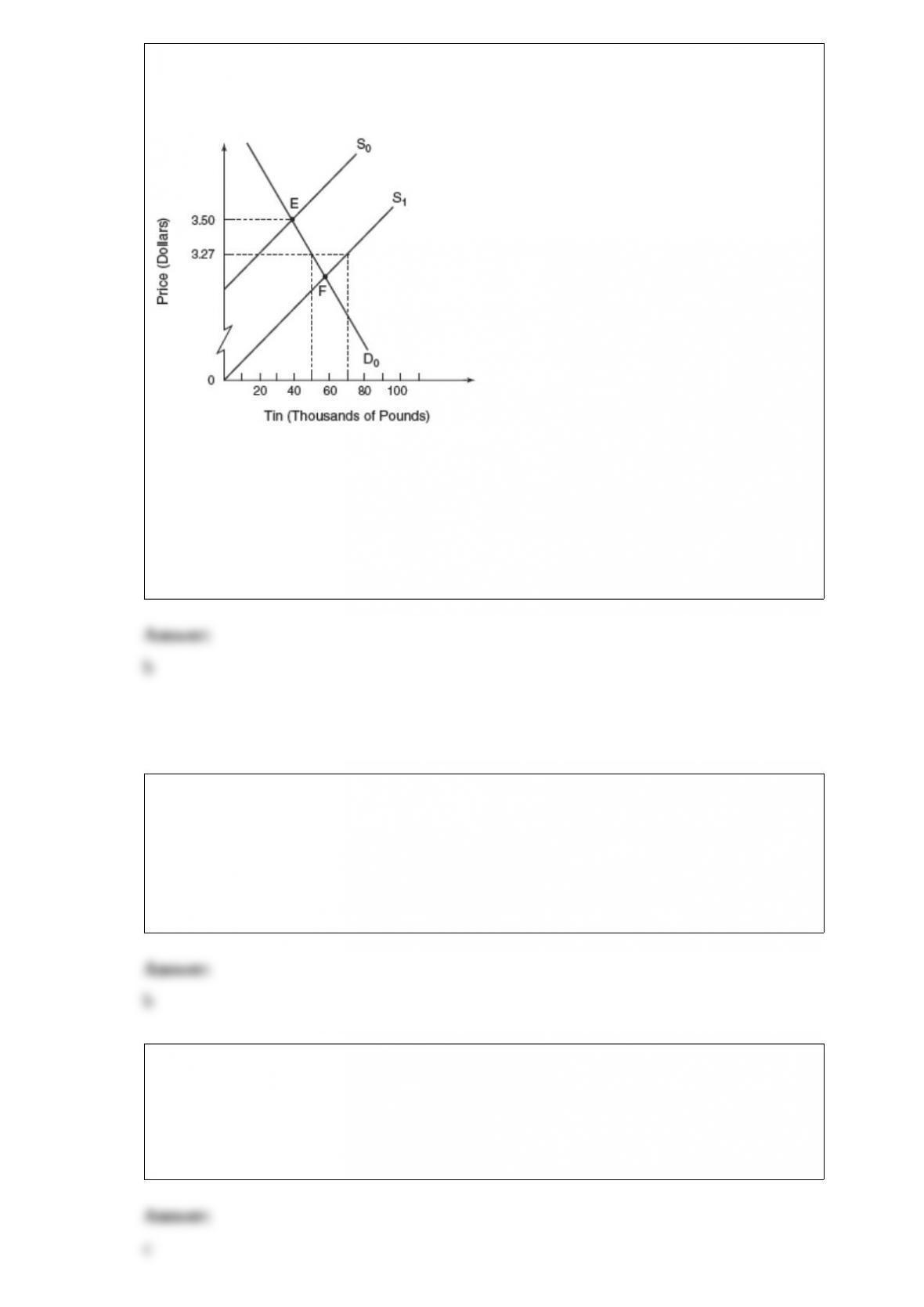
14) figure 7.5 global market for tin
figure 7.5 represents the global market for tin.the initial equilibrium price and quantity
is at point a.as a result of an international tin agreement a price range of $3.27 – $4.02 is
set.as the supply of tin increases from s0 to s1, the buffer-stock manager will need to
a.buy 10,000 pounds of tin
b.buy 20,000 pounds of tin
c.sell 10,000 pounds of tin
d.sell 20,000 pounds of tin
15) export subsidies levied by foreign governments on products in which the united
states has a comparative disadvantage:
a.lower the welfare of all americans
b.lead to increases in u.s. consumer surplus
c.encourage u.s. production of competing goods
d.encourage u.s. workers to demand higher wages
16) the first wave of globalization was brought to an end by
a.the great depression
b.the second world war
c.the first world war
d.the smoot-hawley act