
An increase in individual income taxes ________ disposable income, which ________
consumption spending.
A) increases; increases
B) increases; decreases
C) decreases; increases
D) decreases; decreases
Figure 5-5
Figure 5-5 shows a market with an externality. The current market equilibrium output of
Q1 is not the economically efficient output. The economically efficient output is Q2. If,
because of an externality, the economically efficient output is Q2 and not the current
equilibrium output of Q1, what does D2 represent?
A) the demand curve reflecting external benefits
B) the demand curve reflecting social benefits
C) the demand curve reflecting private benefits
D) the demand curve reflecting the sum of social and external benefits

The people firms hire to attempt to convince state legislators and members of Congress
to pass laws that are favorable to the economic interests of the firms are called
A) economic advisors.
B) legislative assistants.
C) government bureaucrats.
D) lobbyists.
Households
A) purchase final goods and services in the factor market.
B) purchase final goods and services in the product market.
C) purchase resources in the product market.
D) purchase resources in the factor market.
One reason for the success that firms have in getting the government to erect barriers to

foreign competition is that jobs lost to foreign competition are easy to identify but jobs
created by foreign trade are often hard to identify. Which of the following is a second
reason?
A) The costs that tariffs and quotas impose on consumers are large in total but relatively
small per person.
B) People who benefit from foreign trade tend not to vote in elections; people who are
harmed by foreign trade are much more likely to vote.
C) Firms that benefit from trade barriers have more money to lobby government
officials to support the barriers than do firms that are harmed by trade barriers.
D) The benefits from free trade are less than the costs.
If firms are more optimistic that future profits will rise and remain strong for the next
few years, then
A) investment spending will fall.
B) investment spending will rise.
C) investment spending will remain unaffected.
D) investment spending will rise and then fall.
The law of diminishing marginal returns
A) explains why the average total cost and marginal cost curves are U-shaped in the
short run.
B) explains why the average total cost, average fixed cost and the marginal cost curves
are U-shaped in the short run.
C) causes average total costs to rise at a decreasing rate as output increases.
D) causes the difference between average total cost and average variable cost to get
smaller as output increases.
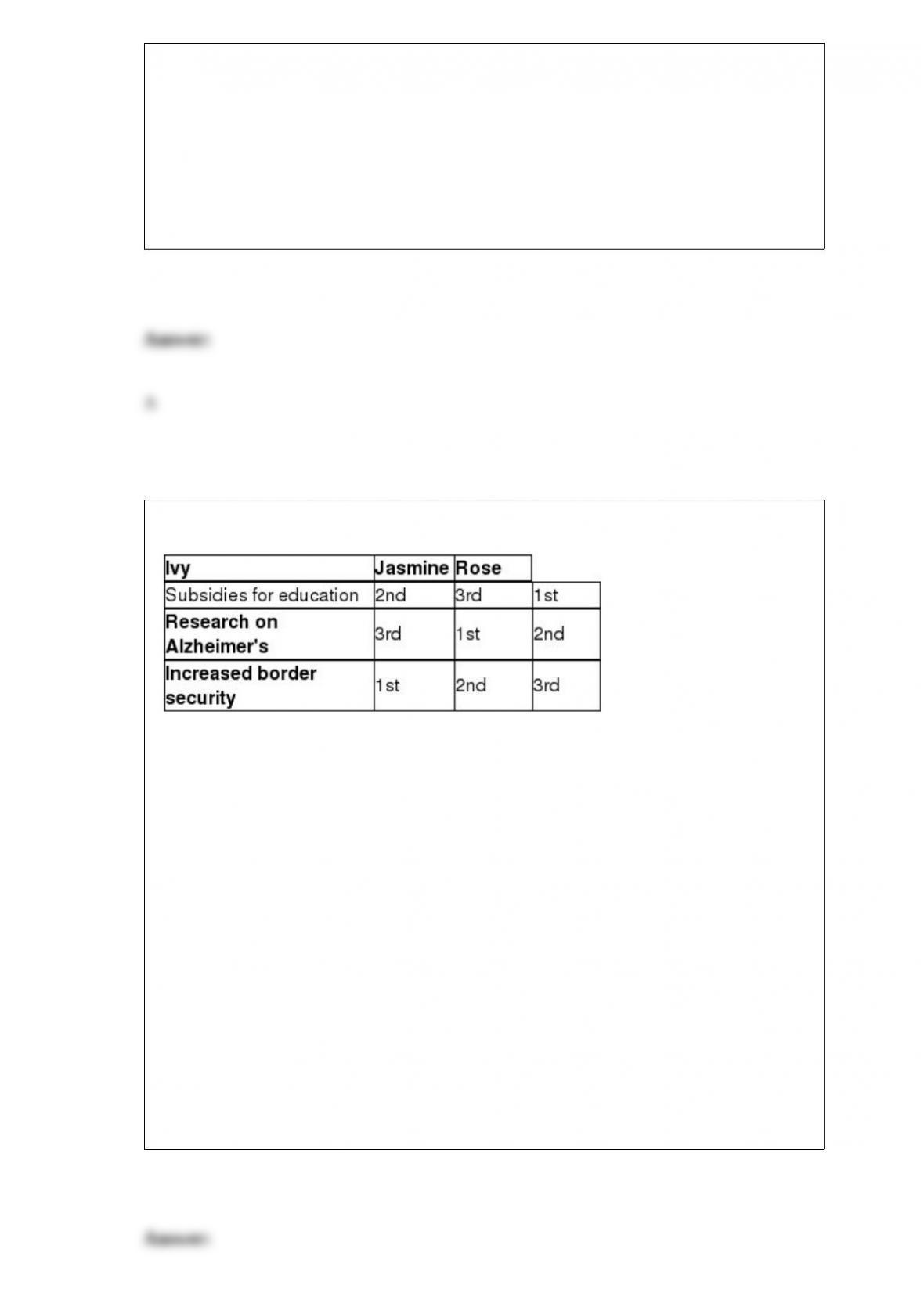
Table 18-1
Suppose $1 billion is available in the budget and Congress is considering allocating the
funds to one of the following three alternatives: 1) Subsidies for education, 2) Research
on Alzheimer’s or 3) Increased border security. Table 18-1 shows three voters’ rankings
of the alternatives. Suppose a series of votes are taken in which each pair of alternatives
is considered in turn. If the vote is between allocating funds to subsidies for education
and research on Alzheimer’s,
A) Ivy and Jasmine vote for education subsidies, Rose votes for Alzheimer’s research,
and education subsidies wins.
B) Ivy and Rose vote for education subsidies, Jasmine votes for Alzheimer’s research,
and education subsidies wins.
C) Jasmine and Rose vote for Alzheimer’s research, Ivy votes for education subsidies,
and Alzheimer’s research wins.
D) Jasmine and Ivy vote for Alzheimer’s research, Rose votes for education subsidies,
and Alzheimer’s research wins.

If the price of hairspray is represented by equation P = 10 – 0.2 QD, then the
corresponding quantity of hairspray demanded is represented by the equation
A) QD = 5P – 2.
B) QD = 0.5P + 2.
C) QD = 50 – 5P.
D) QD = -10 + 0.2P.
Assuming that the United States is the domestic economy, ________ are goods and
services produced by ________ and purchased by ________.
A) exports; foreign countries; the United States
B) exports; the United States; the United States
C) imports; foreign countries; foreign countries
D) imports; foreign countries; the United States

A monetary policy target is a variable that
A) the Fed can affect directly.
B) equals one of the Fed’s main policy goals.
C) the Fed has no ability to change.
D) the Fed cannot affect directly.
In 2013, global profits for McDonald’s ________ when measured in local currencies
than they did when measured in dollars. This occurred because the value of the U.S.
dollar increased relative to most other currencies.
A) increased by more
B) decreased by more
C) increased by less
D) decreased by less