Bill uses his entire budget to purchase Pepsi and hamburgers, and he currently
purchases no Pepsi and 6 hamburgers per week. The price of Pepsi is $1 per can, the
price of a hamburger is $2, Bill’s marginal utility from Pepsi is 2, and his marginal
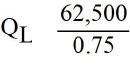
utility from hamburgers is Is Bill’s current consumption decision optimal?
A) No, he should increase Pepsi consumption and reduce hamburger consumption.
B) No, he should purchase more of both goods.
C) Yes, the corner solution is best because his MRS is less than the price ratio.
D) We do not have enough information to answer this question.
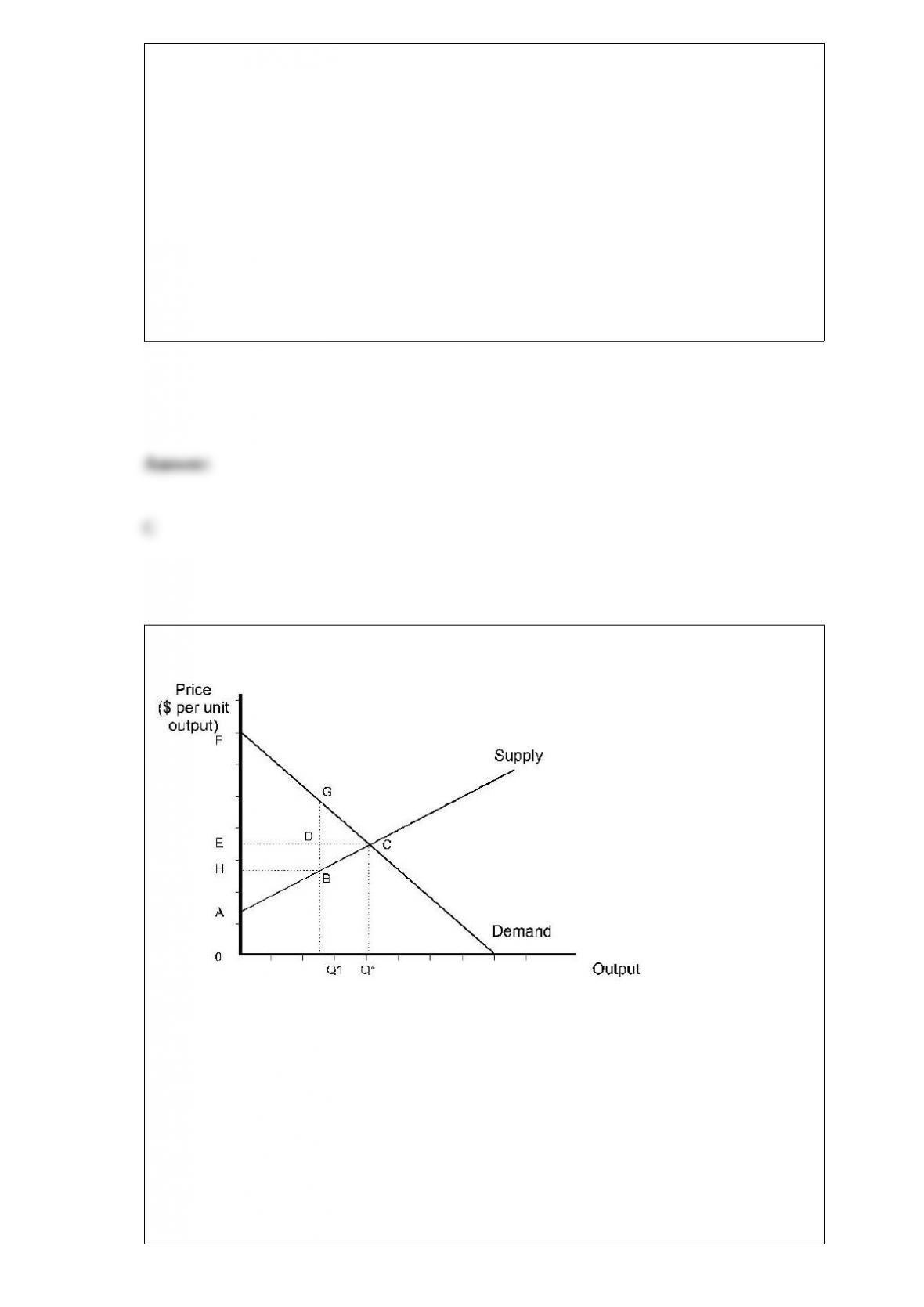
Figure 9.2
Refer to Figure 9.2. At price 0H and quantity Q1, consumer surplus is the area
A) EDGF.
B) 0FGQ1.
C) HFGB.
D) EFC.

E) none of the above
The slope of the budget line that expresses the tradeoff between risk and return for an
asset can be represented by
A) (Rf – Rm)/σm.
B) (Rm – Rf)/σm.
C) Rm – Rf.
D) b.
Lambert-Rogers Company is a manufacturer of petrochemical products. The firm’s
research efforts have resulted in the development of a new auto fuel injector cleaner that
is considerably more effective than other products on the market. Another firm, G.H.
Squires Company, independently developed a very similar product that is as effective as
the Lambert-Rogers formula. To avoid a lengthy court battle over conflicting patent
claims, the two firms have decided to cross-license each other’s patents and proceed
with production. It is unlikely that other petrochemical companies will be able to
duplicate the product, making the market a duopoly for the foreseeable future.
Lambert-Rogers estimates the demand curve given below for the new cleaner. Marginal
cost is estimated to be a constant $2 per bottle.
Q = 300,000 – 25,000P.
where P = dollars per bottle and Q = monthly sales in bottles.
a. Lambert-Rogers and G.H. Squires have very similar operating strategies.
Consequently, the management of Lambert-Rogers believes that the Cournot model is
appropriate for analyzing the market, provided that both firms enter at the same time.
Calculate Lambert-Rogers’s profit-maximizing output and price according to this
model.
b. Lambert-Rogers’s productive capacity and technical expertise could allow them to
enter the market several months before Squires’s. Choose an appropriate model and
analyze the impact of Lambert Rogers being first into the market. Should
Lambert-Rogers hurry to enter first?

During the presidential campaigns, the candidates from each party typically describe
their plans to maintain or change federal taxes on personal and business income. Are
these policy statements generally positive or normative?
A) Positive
B) Normative
C) Both positive and normative
D) Neither positive or normative

In the field of financial management it has been observed that there is a trade-off
between the rate of return that one earns on investments and the amount of risk that one
must bear to earn that return.
a. Draw a set of indifference curves between risk and return for a person that is risk
averse (a person that does not like risk).
b. Draw a set of indifference curves for a person that is risk neutral (a person that does
not care about risk one way or the other).
c. Draw a set of indifference curves for a person that likes risk.

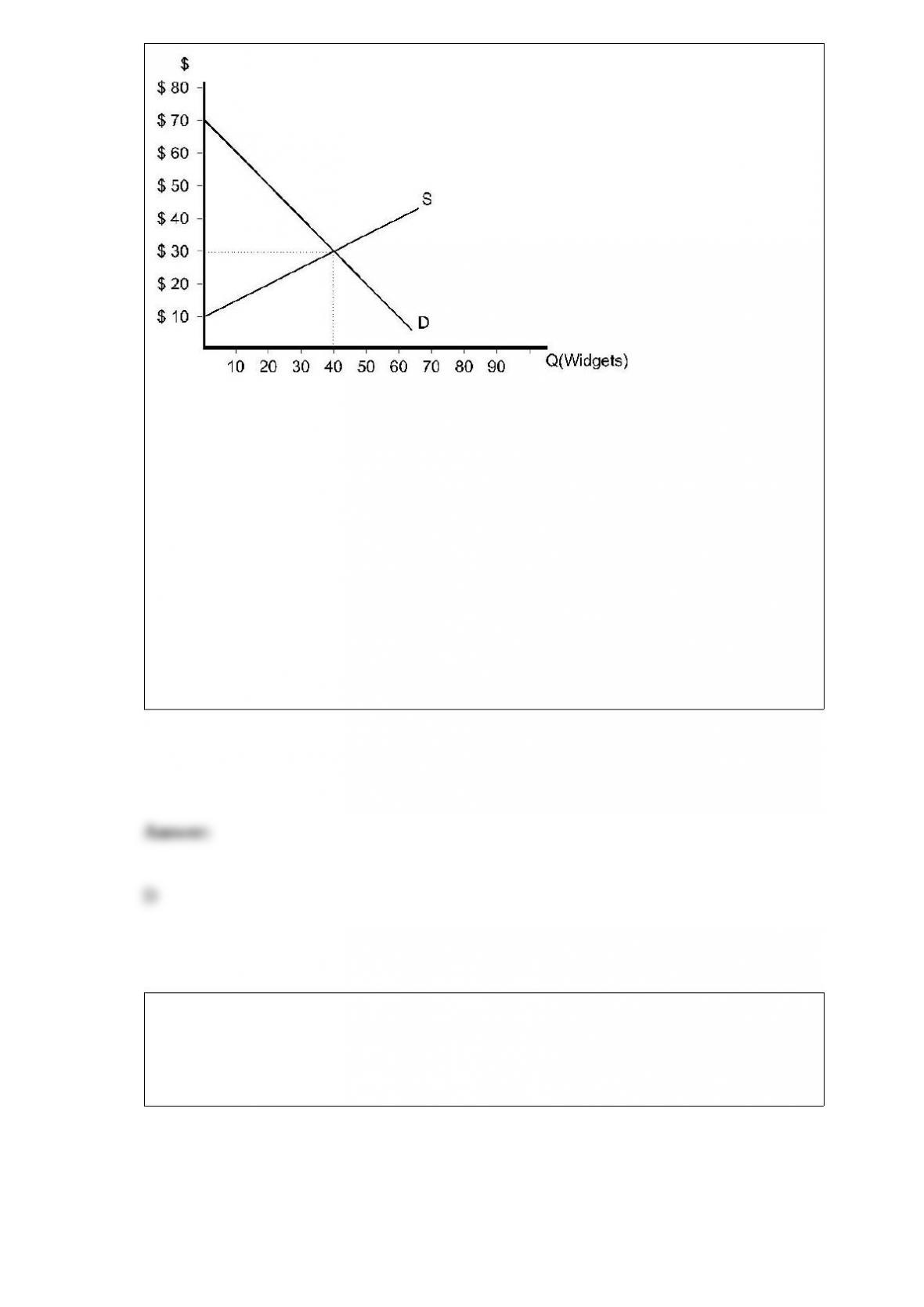
Figure 9.1
Refer to Figure 9.1. If the government establishes a price ceiling of $20, total consumer
and producer surplus will be
A) $30.
B) $400.
C) $600.
D) $900.
E) $1200.
The information in the table below describes choices for a new doctor. The outcomes
represent different macroeconomic environments, which the individual cannot predict.
Table 5.3

In Table 5.3, the standard deviation is
A) highest for the HMO choice, and it is $76,000.
B) lowest for the HMO choice.
C) higher for owning one’s own practice than for going into research.
D) higher for the HMO choice than for going into research.
Scenario 1:
It is the factory’s choice whether to install a filter. It is the choice of the nearby
fishermen whether to install a treatment plant. Dollar figures show profit. The factory
and the fishermen can negotiate costlessly, and no one else is affected by the result.
Factory Fishermen
A: No filter or treatment plant $10,000 $2,000
B: Filter; no treatment plant $6,000 $10,000
C: No filter; treatment plant $10,000 $4,000
D: Filter; treatment plant $6,000 $6,000
Which of the following is TRUE?
A) The factory will never agree to B, because that would leave them with much less
profit than the fishermen.

B) C will never occur because that would leave the fishermen with much less profit
than the factory.
C) If the factory refused to install a filter, the fishermen would refuse to install a
treatment plant.
D) The factory must install a filter, because they contaminate the water.
E) The profits above indicate profit before any agreement is made, and profit varies
enough to make a mutually acceptable agreement possible.
Deadweight loss refers to
A) losses in consumer surplus associated with excess government regulations.
B) situations where market prices fail to capture all of the costs and benefits of a policy.
C) net losses in total surplus.
D) losses due to the policies of labor unions.
Individuals who fully insure their house and belongings against fire
A) have wasted their money if a fire does not occur.
B) generally do so in order that their after-fire wealth can be equal to their before-fire
wealth.

C) generally do so in order that their after-fire wealth can be higher than their
before-fire wealth.
D) generally do so in order to guarantee that the worst outcome, a fire with no
insurance, does not occur.
E) can never come out as well financially after a fire as they were before it.
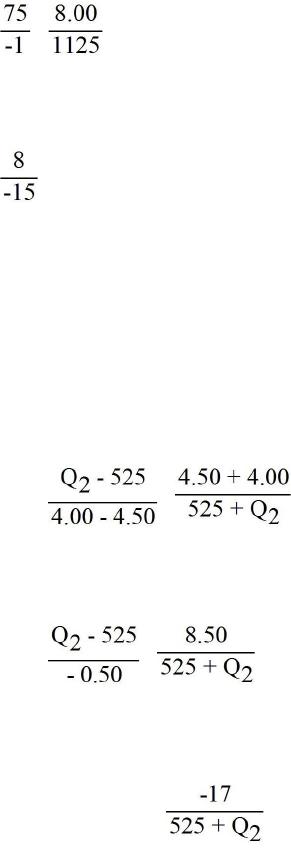
Joe’s Pig Palace sells barbecue plates for $4.50 each, and serves an average of 525
customers per week. During a recent promotion, Joe cut his price to $3.50 and observed
an increase in sales to 600 plates per week.
a. Calculate Joe’s arc price elasticity of demand.
b. Joe is considering permanently lowering his price to $4.00 to increase revenue. How
many plates should Joe expect to sell at the new price? Does the move make sense in
the light of Joe’s desire to increase revenue?

Suppose the market supply curve is upward sloping and market demand is perfectly
inelastic. If the market price is held above the equilibrium level, which of the following
statements about the resulting outcome is not true?
A) The decrease in consumer surplus is fully captured by the producers.
B) There will be an excess quantity supplied.
C) Quantity demanded will remain the same.
D) Quantity demanded will decline.
The demand for books is: Qd = 120 – P
The supply of books is: Qs = 5P
If P = $25, which of the following is true?
A) Quantity supplied is greater than quantity demanded.
B) Quantity supplied is less than quantity demanded.
C) Quantity supplied equals quantity demanded.
D) There is a shortage.

A valid and useful theory of gold prices:
A) helps to predict the movements of gold prices over time.
B) may be founded on simplifying assumptions.
C) need not exactly predict every change in gold prices.
D) all of the above
E) none of the above
Suppose that a tax of $2 per unit of output is imposed on red rubber ball producers.
What level of output maximizes profit?
A) -1
B) 3
C) 4.5
D) 5
E) B, C, and D are correct.

Suppose that the competitive market for rice in Japan was suddenly monopolized. The
effect of such a change would be:
A) to decrease the price of rice to the Japanese people.
B) to decrease the consumer surplus of Japanese rice consumers.
C) to decrease the producer surplus of Japanese rice producers.
D) a welfare gain for the Japanese people.
E) increase the consumption of rice by the Japanese people.
In an Edgeworth box, all points of efficiency occur at the
A) intersections of the indifference curves.
B) the points of tangency between the sets of indifference curves.
C) in the midpoint of the diagram.
D) at any point other than the intersections of the indifference curves.
When a good is price inelastic, consumer expenditures on the good
A) increase when price increases.

B) decrease when price increases.
C) do not change when price increases.
D) are not related to price elasticity of demand.
Which one of the following statements is a common criticism of the original Bertrand
duopoly model?
A) Firms never choose optimal prices as strategic variables.
B) Firms would more naturally choose quantities if goods are homogenous.
C) The assumption that market share is split evenly between the firms is unrealistic.
D) A and B are correct.
E) B and C are correct.
Which of the following will NOT cause a rightward shift in the demand curve for beer?
A) A change in the price of beer
B) A health study indicating positive health benefits of moderate beer consumption
C) An increase in the price of French wine (a substitute)

D) A decrease in the price of potato chips (a complement)
E) none of the above
Marginal revenue, graphically, is
A) the slope of a line from the origin to a point on the total revenue curve.
B) the slope of a line from the origin to the end of the total revenue curve.
C) the slope of the total revenue curve at a given point.
D) the vertical intercept of a line tangent to the total revenue curve at a given point.
E) the horizontal intercept of a line tangent to the total revenue curve at a given point.
According to a survey by the U.S. Bureau of Labor Statistics, which of the following
statements about annual U.S. household consumer expenditures is false?
A) The income elasticity of demand for entertainment is positive.
B) The income elasticity of demand for owner-occupied housing is positive.
C) The income elasticity of demand for rental housing is positive.
D) The income elasticity of demand for health care is positive.

E) Average family expenditures increase with income.
The Happy Mountain Brewing Company sells ground organic coffee in one pound
containers through several grocery chains in the US. The marginal cost of production is
constant at $4 per pound, and the advertising elasticity of demand is 0.2. The firm
current spends $4 million per year on advertising and sells 4 million pounds of coffee
per year.
a. What is the firm’s full marginal cost of advertising?
b. Suppose the firm switches to a more effective advertising agency, and the advertising
elasticity of demand increases to 0.3. What is the firm’s new full marginal cost of
advertising?
c. Suppose the firm was maximizing profits from advertising before the change, and the
marginal revenue from an additional dollar of advertising remains the same after the
change. Is the firm maximizing the profits generated from the advertising expenditures
after the change? If not, how can the firm adjust its advertising expenditures to
maximize profits?

We may be tempted to determine the optimal level of advertising expenditures at the
point where the last dollar spent on advertising generates an additional dollar of sales
revenue (i.e, the marginal revenue of advertising equals one). In general, this rule will
not allow the firm to maximize profits because it ignores the:
A) price elasticity of demand.
B) marginal cost of additional sales generated by the advertising.
C) advertising-to-sales ratio.
D) fixed costs of advertising.
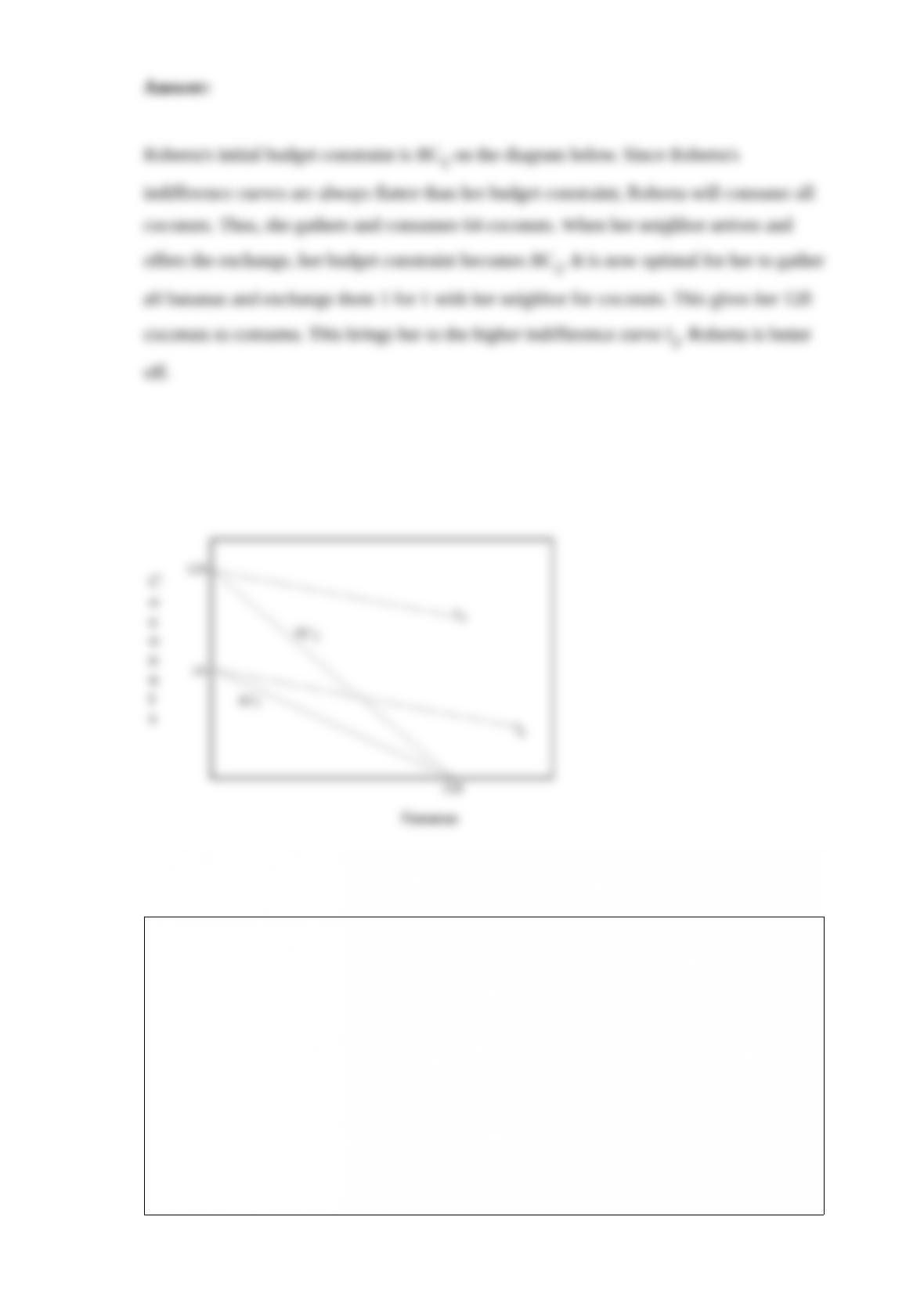
Roberta lives alone on a deserted island. She can spend her time gathering coconuts or
bananas. She has 16 hours available each day and can gather 4 coconuts in an hour or 8
bananas in an hour. Diagram Roberta’s budget constraint. Given that Roberta’s Marginal
Utility of bananas is always 25 and her Marginal utility of coconuts is always 100, what
is her optimal consumption? One day an individual from a neighboring island arrives by
boat and offers to exchange any number of fruits at a rate of 1 coconut for 1 banana.
Diagram Roberta’s budget constraint at this exchange rate assuming she will now spend
all her time gathering bananas. Is Roberta better off? What does she consume?
In an unregulated competitive market, supply and demand have been estimated as
follows:
Demand P = 25 0.10Q Supply P = 4 + 0.116Q,
where P represents unit price in dollars, and Q represents number of units sold per year.
a. Calculate annual aggregate consumer surplus.
b. Calculate annual aggregate producer surplus.
c. Define what producer surplus means.

Which of the following describes the Giffen good case? When the price of the good
A) rises, the income effect is opposite to and greater than the substitution effect, and
consumption falls.
B) falls, the income effect is in the same direction as the substitution effect, and
consumption rises.
C) falls, the income effect is in the opposite direction to the substitution effect, and
consumption falls.
D) falls, the income effect is in opposite direction to the substitution effect and
consumption rises.
E) Both A and D are correct.
Suppose the downward sloping labor demand curve shifts rightward in a labor market
with a single employer (monopsony). What happens to the marginal expenditure curve?
A) Shifts left
B) Shifts right
C) Remains the same
D) We do not have enough information to answer this question.

Which of the following is NOT a key component of every game?
A) Strategies
B) Players
C) Payoffs
D) Cooperation
Suppose there are 10 apples and 10 oranges in the economy. Joe is currently consuming
4 apples and 5 oranges, and Jane is consuming 6 apples and 5 oranges. At this
allocation, Joe’s marginal utility of apples is 3, and his marginal utility of oranges is 5.
Jane’s marginal utility of apples is 6, and her marginal utility of oranges is 10. If the
current price of apples is $4 and the current price of oranges is $5, then there is an:
A) excess demand for apples and an excess supply of oranges.
B) an excess demand for oranges and an excess supply of apples.
C) equilibrium in the market with no excess supply or demand for either good.
D) an excess supply of apples and oranges.