
Bigness, or large firms, may benefit consumers in which of the following ways?
a. Larger firms usually charge lower prices than smaller firms.
b. Larger firms with monopoly power definitely have greater incentive to be efficient
and innovative.
c. Larger firms may take advantage of economies of scale and scope.
d. Larger firms are more responsive to consumers’ desires.
In the aggregate demand-aggregate supply model, economic growth can be illustrated
by an
a. outward shift of the aggregate demand curve.
b. inward shift of the aggregate demand curve.
c. inward shift of the aggregate supply curve.
d. All of the above.
Which one of the following will cause velocity to increase?
a. a decrease in interest rates
b. increasing the efficiency of the payments system

c. switching from weekly to monthly payroll checks
d. an increase in the money supply
Assume that Michaela purchases $12,000 worth of a stock. To do so she uses $2,000 of
her own money and borrows the remaining $10,000 at an 8.0% interest rate. If the
stock’s value increases by 20% in one year and she sells the stock at that time, what is
her rate of return?
a. 13%
b. 16%
c. 20%
d. 80%
The concept of “government failure” implies
a. laissez faire is always best.
b. government intervention is always justified since government never fails.
c. no market failure can be corrected by government intervention.
d. government intervention to correct a “market failure” sometimes fails.

During the mid to late 1990s, the incentives for investment spending were provided by
rising
a. aggregate demand.
b. real interest rates.
c. levels of corporate taxes.
d. levels of capital gains taxes.
A savings account is an example of consumer income.
a. True
b. False

Which of the following is considered to be an investment in economists’ point of view?
a. Serena buys bonds issued by Citibank.
b. John purchases a new house.
c. Venus invests hundred thousand dollars in Bear Stearns stock.
d. Allen sells the old truck he used for transporting goods.
The monopolistically competitive firm differs from monopoly in that its
a. demand curve is flatter.
b. demand curve slopes downward.
c. MR curve lies below its demand curve.
d. profit is maximized where MR = MC.
One basic way to boost the nation’s growth rate is to
a. increase wages paid to labor.
b. slow the rate of technical progress.
c. reduce the population growth rate.

d. accumulate more capital
Critics of supply-side economics argue that a major flaw is
a. the small magnitude of supply-side effects.
b. the large size of demand-side effects.
c. increased income inequality.
d. All of the above.
What is the opportunity cost of economic growth?
a. investment in the current time period
b. improved technology in the current time period
c. capital goods in the current time period
d. consumption in the current time period

A $500 government bond is a money-fixed asset.
a. True
b. False
Which department in a modern university would most likely advertise itself as a
promoter of modern growth theory?
a. computer science
b. accounting
c. economics
d. history
The Industrial Revolution refers to the stream of new technology and the resulting
growth of output than began in England toward the end of the eighteenth century.
a. True
b. False
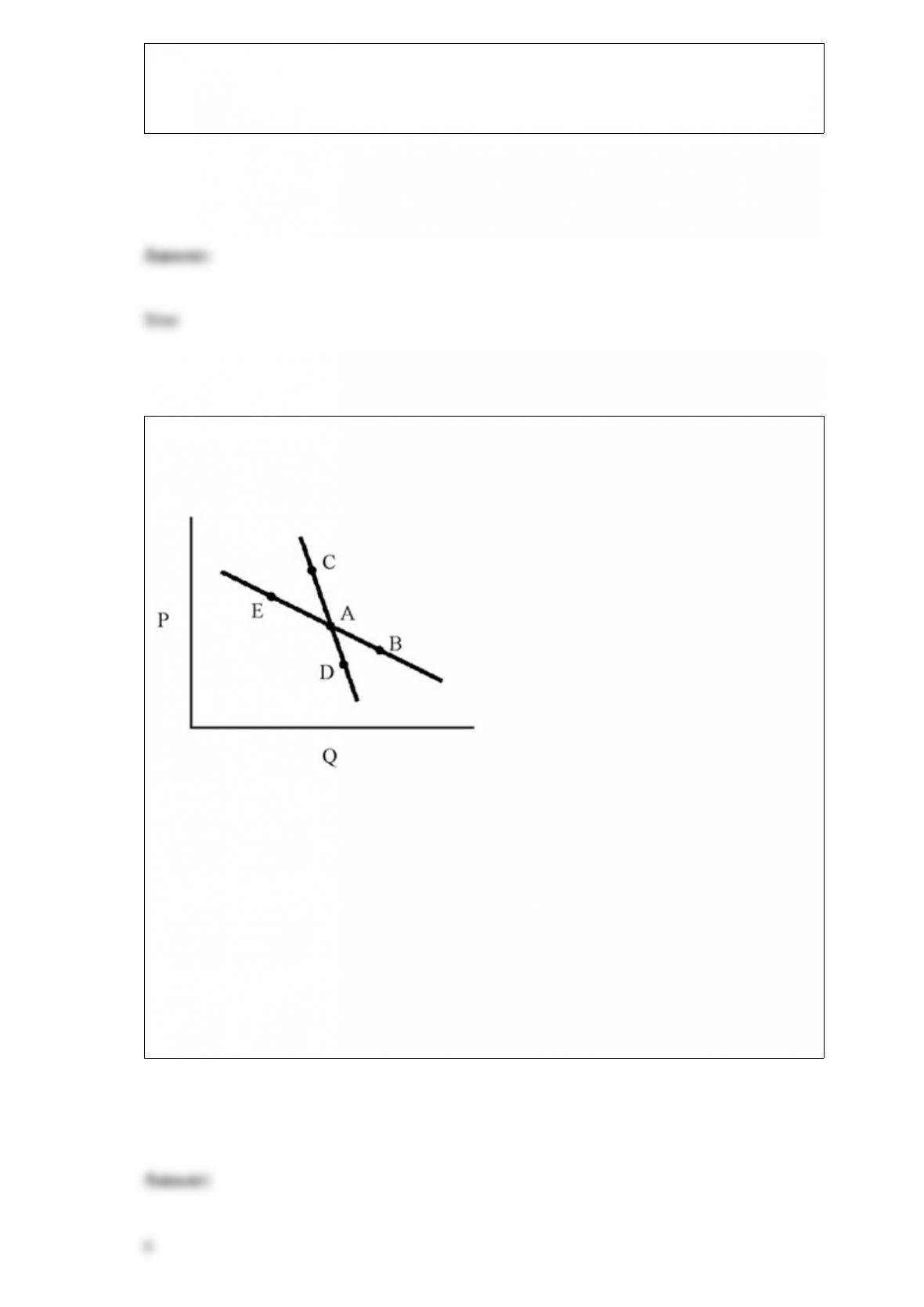
Figure 12-3
Oligopolist A cuts price in an attempt to enlarge his share of the market. His
competitors fail to retaliate with price cuts. In this case, in Figure 12-3, oligopolist A
will move from point A to which point?
a. B
b. C
c. D
d. E

Unions have the power to
a. set all working rules.
b. increase the firm’s total taxes.
c. push wages above competitive levels at times.
d. make a firm nationalized.
An exchange rate depreciation acts to reduce inflation.
a. True
b. False
After September 11, 2001, a small group of economists argued that the economy’s
self-correcting mechanism would work to counteract the recessionary effects of the
attack.
a. True
b. False

Following an anticapitalist coup, Freedonia forces all citizens to turn in and stop using
all credit cards. What is the most likely effect of this on velocity?
a. It will decrease.
b. It will increase.
c. It will remain constant.
d. Velocity is unrelated to credit cards.
On the vertical axis, the Phillips curve depicts the
a. the rate of unemployment.
b. rate of inflation.
c. rate of growth of nominal GDP.
d. rate of growth of real GDP.

One indication that an industry might be oligopolistic is that prices change
a. infrequently.
b. frequently.
c. in rhythmic patterns.
d. on a regular, periodic basis.
The term “depreciation” in the national income accounts refers to
a. the adjustment of GDP for inflation.
b. plant and equipment “used up” in producing current output.
c. citizenship differences among income recipients.
d. government transfer payments minus tax revenues.
Bank runs are “contagious” in that they often spread to other banks.
a. True
b. False

Bank failures in the U.S.
a. occurred frequently through the 1960s and declined since then.
b. occurred infrequently through the 1960s and have become more common since then.
c. occurred frequently through the 1930s, declined after that time, and became more
common in 2008.
d. occurred infrequently through the 1930s, increased after that time, and became less
common in 2008.
In Egypt, in 1970, the Aswan Dam was completed. By preventing the annual flood of
the Nile (thereby providing millions of acres of arable land) and by providing
electricity, the dam was expected to raise the living standard of the Egyptian people-and
it has. However, it has also led to a rise in the water table which causes Egypt’s
limestone structures, including the pyramids, to absorb more salt water and to suffer
serious erosion from crystallized salts. Combined with air pollution and traffic
vibration, this erosion is turning the pyramids to dust. Economists analyze this type of
problem with the concept of
a. an externality.
b. the antiquity problem.
c. a free-rider problem.
d. the public good problem.
e. the trade-off between equity and output.

Over the past few decades, nominal interest rates have been higher than real rates of
interest. This means that
a. lenders must have expected inflation.
b. borrowers must have expected deflation.
c. lenders must have expected prices to fall.
d. borrowers must have expected prices to fall.
From 1979 to 2011, which country had the lowest growth rate of GDP per hour of
work?
a. Singapore
b. United States
c. France
d. Japan

Capital goods are counted the same as consumer goods in the national product
accounts.
a. True
b. False
Contractionary fiscal policy may have some undesirable consequences. Among these is
a. higher unemployment.
b. higher inflation.
c. higher net exports.
d. larger federal deficits.
A perfectly competitive firm will always maximize profits by producing where
a. per-unit costs are lowest.
b. total costs and total revenue are equal.

c. P = MC.
d. P = AC.
A relatively large increase in the cost of electricity would likely
a. result in a large increase in the use of gas for home use immediately.
b. cause an immediate large decline in the use of electricity.
c. increase the use of gas and decrease the use of electricity after a time lapse.
d. cause an equal reduction in the use of electricity immediately.