
1) diseconomies of scale:
a.pertain to the long run.
b.pertain to the short run.
c.are synonymous with diminishing returns.
d.are synonymous with increasing returns.
2) which of the following would not shift the demand curve for beef?
a.a widely publicized study that indicates beef increases one’s cholesterol
b.a reduction in the price of cattle feed
c.an effective advertising campaign by pork producers
d.a change in the incomes of beef consumers
3) refer to the above diagram. the slope of curve zz at point c is approximately:
a.-4
b.-2
c.-22/5
d.+3
4) We know with certainty that a consumer will buy a newly introduced product rather
than an existing product when the:
A.MU/P of the new product exceeds the MU/P of the existing product.
B.price of the new product is less than the price of the existing product.
C.MU of the new product is more than the MU of the existing product.
D.law of diminishing marginal utility applies to the existing product.
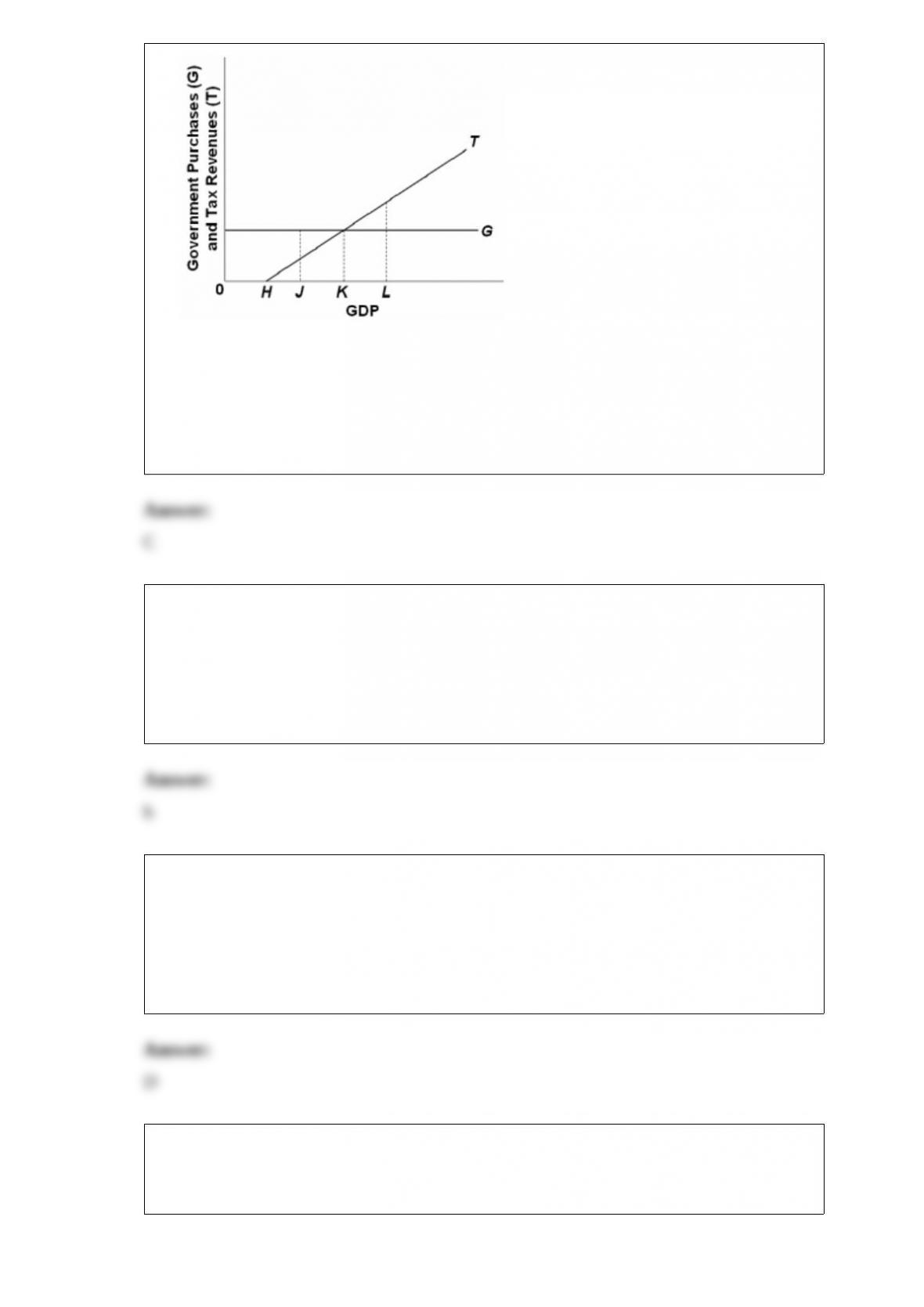
5)
With the expenditures programs and the tax system shown in the above diagram:
A.the public budget will be expansionary at all GDP levels above K, and contractionary
at all GDP levels below K.
B.the public budget will be a destabilizing force at all levels of GDP.
C.deficits will occur at income levels below K, and surpluses above K.
D.deficits will occur at income levels below H, and surpluses above H.
6) real per capita gdp:
a.grows at approximately the same rate for all countries.
b.was much more equal across nations in 1820 than it is today.
c.has been about 20 times higher in the richer nations than the poorer nations for about
2000 years.
d.grows much faster in “leader countries” than in “follower countries.”
7) Relatively rapid U.S. growth between 1999 and 2000, and from 2003 to 2007,
contributed to large U.S. trade deficits by:
A.increasing U.S. national income, which decreased U.S. exports.
B.reducing real interest rates in the United States.
C.increasing U.S. tax revenues and reducing the Federal budget deficit.
D.increasing U.S. national income, which increased U.S. imports.
8) The plus items below are “export-type” entries and the minus items are “import-type”
entries in the balance of payments for the hypothetical country of Zippo.
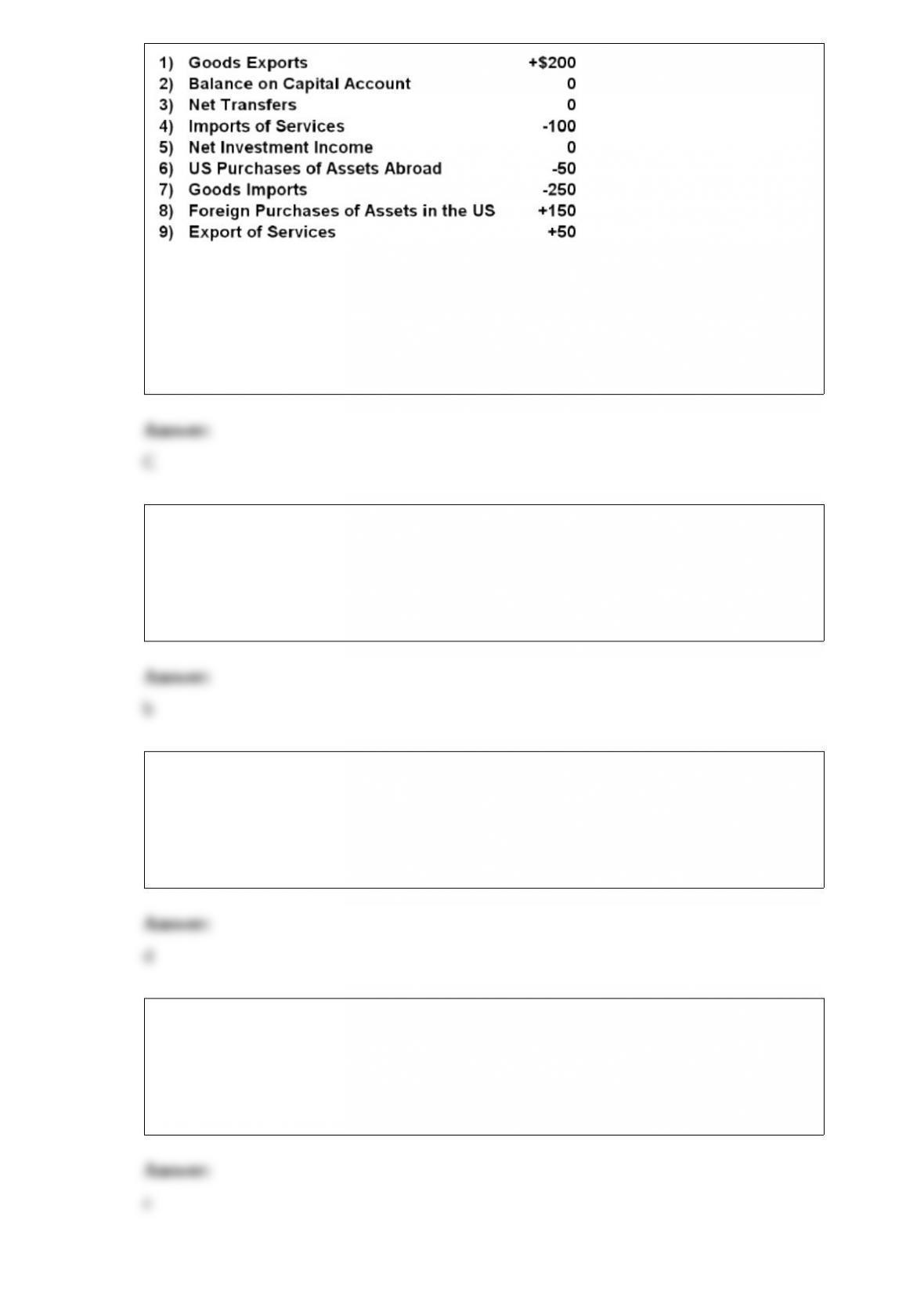
Refer to the above information. On the basis of its balance of payments position, and
other things equal, we can expect the international value of Zippo’s currency to:
A.increase.
B.decrease.
C.remain constant.
D.gyrate up and down.
9) microeconomics is concerned with:
a.the aggregate or total levels of income, employment, and output.
b.a detailed examination of specific economic units that make up the economic system.
c.positive economics, but not normative economics.
d.the establishing of an overall view of the operation of the economic system.
10) unemployment:
a.causes the production possibilities curve to shift outward.
b.can exist at any point on a production possibilities curve.
c.is illustrated by a point outside the production possibilities curve.
d.is illustrated by a point inside the production possibilities curve.
11) confronted with the same unit cost data, a monopolistic producer will charge:
a.the same price and produce the same output as a competitive firm.
b.a higher price and produce a larger output than a competitive firm.
c.a higher price and produce a smaller output than a competitive firm.
d.a lower price and produce a smaller output than a competitive firm.

12) an industry comprised of four firms, each with about 25 percent of the total market
for a product is an example of:
a.monopolistic competition.
b.oligopoly.
c.pure monopoly.
d.pure competition.
13) Other things equal, an excessive increase in the money supply will:
A.increase the purchasing power of each dollar.
B.decrease the purchasing power of each dollar.
C.have no impact on the purchasing power of the dollar.
D.reduce the price level.
14) Suppose that, for every 1-percentage point decline of the discount rate, commercial
banks collectively borrow an additional $2 billion from Federal Reserve banks. Also
assume that reserve ratio is 20 percent. If the Fed increases the discount rate from 4.0
percent to 4.25 percent, bank reserves will:
A.increase by $0.5 billion and the money supply will increase by $2.5 billion.
B.decline by $0.5 billion and the money supply will decline by $2.5 billion.
C.increase by $0.75 billion and the money supply will increase by $3.75 billion.
D.increase by $1 billion and the money supply will increase by $5 billion.
15) the following production possibilities data for landia and scandia:
refer to the above data. on the basis of the production possibilities data shown:
a.landia has a comparative advantage in chips while scandia has a comparative
advantage in fish.
b.landia has a comparative advantage in fish while scandia has a comparative advantage

in chips.
c.both landia and scandia have a comparative advantage in fish.
d.both landia and scandia have a comparative advantage in chips.
16) in contrast to american firms, japanese firms frequently make lifetime employment
commitments to their workers and agree not to lay them off when product demand is
weak. other things being equal, we would expect japanese firms to:
a.face more elastic product demand curves than american firms.
b.have relatively greater variable costs than american firms.
c.discontinue production at higher product prices than would american firms.
d.continue to produce in the short run at lower prices than would american firms.
17) Which of the following is not a component of the demand for loanable funds?
A.household purchases of housing and durable consumer goods
B.business purchases of capital goods
C.government financing of the public debt
D.household saving
18) What are the consequences of price discrimination for the producer, the consumer,
and for society?

19) Explain the relationship between the current account and the capital account in the
balance of payments.
20) Why cant food be used as a form of money?
21) Explain the problems with exchange rate controls.

22) What is demand-pull inflation?