
The study of economics arises due to
A) money.
B) scarcity.
C) greed.
D) resources.
Which of the following is a characteristic shared by a perfectly competitive firm and a
monopoly?
A) Each must lower its price to sell more output.
B) Each sets a price for its product that will maximize its revenue.
C) Each maximizes profits by producing a quantity for which marginal revenue equals
marginal cost.
D) Each maximizes profits by producing a quantity for which price equals marginal
cost.
Which of the following is not a reason for firms to choose a salary system rather than a
commission system to compensate their employees?
A) Research has shown that most companies will find that a salary system will be more
profitable than a commission system.
B) It is often difficult to attribute output to particular workers.
C) If workers are paid on the basis of the number of units of output they produce, they
may become less concerned about quality.
D) Commission compensation systems are riskier for employees than a salary system,
and many workers dislike risk.
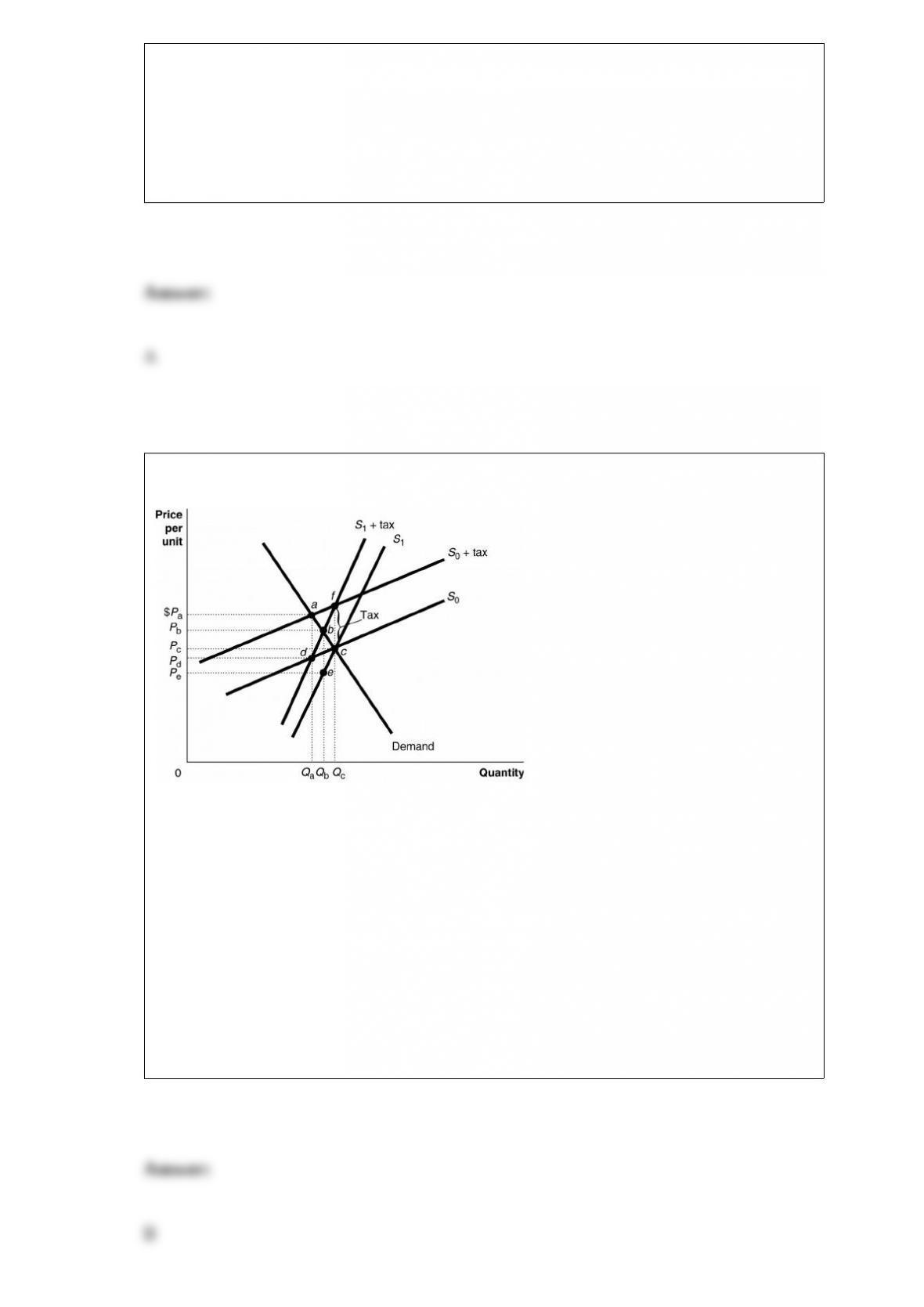
Figure 18-2
Figure 18-2 shows a demand curve
and two sets of supply curves, one set more elastic than the other.If the government
imposes an excise tax of $1.00 on every unit sold, the government’s revenue from the
tax is represented by the area
A) (PaPcQa) if the supply curve is S0 and (PPcQ) if the supply curve is S1.
B) (PaPdQa) if the supply curve is S0 and (PPeQ) if the supply curve is S1.
C) (PaPeQa) under either supply curve.
D) (PPeQ) under either supply curve.

Under pressure from Japan, the United States and Europe, China announced it switched
from pegging the yuan against the dollar to linking the value of the yuan to a ‘basket’ of
currencies. The result of this change was
A) the value of the yuan increased slightly relative to the dollar.
B) the value of the yuan has become very responsive to changes in demand and supply
in the foreign currency market.
C) the value of the yuan has increased dramatically and is beginning to remove the
trade imbalance between the United States and China.
D) the value of the yuan has decreased dramatically and has further spurred Chinese
exports.
Suppliers will be willing to supply a product in all of the following situations except
A) the price received is greater than the additional cost of producing the product.
B) the price received is at least equal to the additional cost of producing the product.
C) the price received is equal to the additional cost of producing the product.
D) the price received is less than the additional cost of producing the product.
Using the Taylor rule, if the current inflation rate equals the target inflation rate and real
GDP equals potential GDP, then the federal funds target rate equals the

A) current discount rate.
B) current inflation rate.
C) real equilibrium federal funds rate.
D) current inflation rate plus the real equilibrium federal funds rate.
A cartel is
A) a temporary storage facility for automobiles.
B) a group of firms that enter into an informal agreement to fix prices to maximize joint
profits.
C) a group of firms that enter into a formal agreement to fix prices to maximize joint
profits.
D) an example of a group of firms that collectively regulate a competitive industry.
Government deficits tend to increase during
A) recessions and booms.
B) periods of war and recession.
C) periods of below- or above-average growth.
D) periods of increased financial uncertainty.
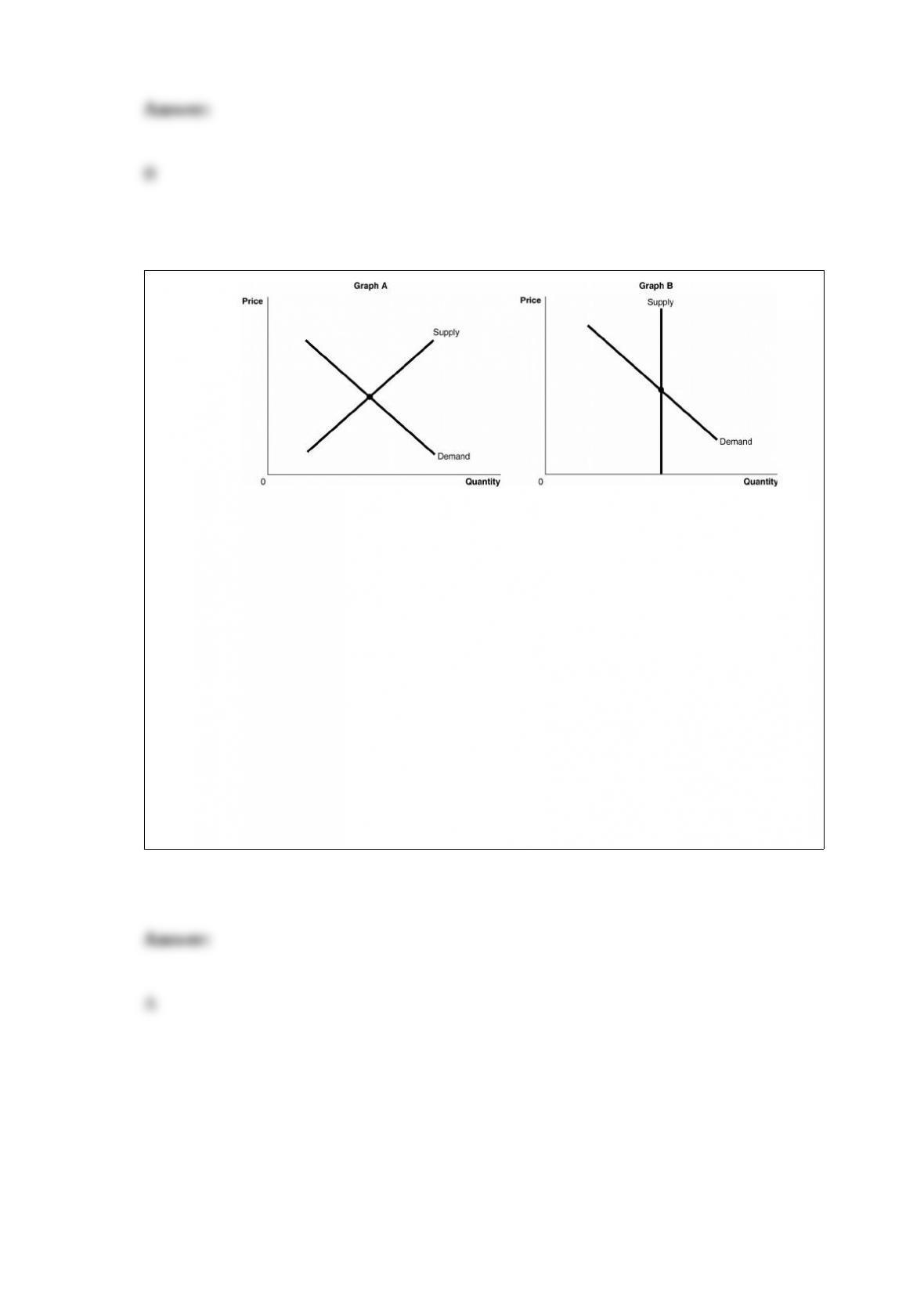
Figure 3-3
The figure above shows the supply and demand curves for two markets: the market for
original Picasso paintings and the market for designer jeans. Which graph most likely
represents which market?
A) Graph B represents the market for original Picasso paintings and Graph A represents
the market for designer jeans.
B) Graph A represents the market for original Picasso paintings and Graph B represents
the market for designer jeans.
C) Graph A represents both the market for original Picasso paintings and designer jeans.
D) Graph B represents both the market for original Picasso paintings and designer
jeans.