
1) A restrictive monetary policy may be frustrated if the investment-demand curve
shifts to the left.
2) An increase in imports (independent of a change in the U.S. price level) will increase
both U.S. aggregate supply and U.S. aggregate demand.
3) choices entail marginal costs because resources are scarce.
4) Financing wartime expenditures by increasing internally held public debt permits a
nation to defer a part of the economic cost of war.
5) If the economy is operating in the relative flat (lower) part of its aggregate supply
curve, a restrictive monetary policy will increase real output but not the price level.
6) Balance sheets always balance because reserves must always equal liabilities plus net
worth
7) Rightward and upward shifts of the Phillips Curve in the 1970s and early 1980s were
caused by:
A.adverse shocks to aggregate supply.
B.adverse shocks to aggregate demand.
C.an increase in the misery index.
D.the Vietnam War.

8) which of the following statements is true about migration behavior?
a.older workers are more likely to migrate than younger workers.
b.migrants are more likely to migrate to countries farther rather than nearer to their
home country.
c.single workers are more likely to migrate than workers with spouses and children.
d.workers are less likely to migrate where “beaten paths” exist.
9) if the unemployment rate is 9 percent and the natural rate of unemployment is 5
percent, then the:
a.frictional unemployment rate is 5 percent.
b.cyclical unemployment rate and the frictional unemployment rate together are 5
percent.
c.cyclical unemployment rate is 4 percent.
d.natural rate of unemployment will eventually increase.
10) “Player drafts” of professional athletes:
A.increase the competitiveness of the labor market for professional athletes.
B.reduce the profitability of professional sports franchises.
C.promote monopsony in the hire of professional athletes.
D.increase salaries of professional athletes.
11) the total-revenue test for elasticity:
a.is equally applicable to both demand and supply.
b.does not apply to demand because price and quantity are inversely related.
c.does not apply to supply because price and quantity are directly related.
d.applies to the short-run supply curve, but not to the long-run supply curve.
12) the primary motivation for economic immigration is:
a.the prospect of paying lower prices for goods and services.

b.to flee political oppression.
c.the opportunity to increase earnings.
d.to reunite with family members.
13) a budget line shows the:
a.alternative combinations of two goods that a consumer can purchase with a given
money income.
b.alternative combinations of two goods that will yield the same level of total utility to
a consumer.
c.quantities of a particular good that a consumer will buy at various prices.
d.ratio of money income to product price.
14) an improvement in production technology will:
a.increase equilibrium price.
b.shift the supply curve to the left.
c.shift the supply curve to the right.
d.shift the demand curve to the left.
15) Paper money (currency) in the United States is issued by the:
A.United States Mint.
B.Federal Reserve Banks.
C.United States Treasury.
D.national banks.
16) If the wage rate increases:
A.a purely competitive producer will hire less labor, but an imperfectly competitive
producer will not.
B.an imperfectly competitive producer will hire less labor, but a purely competitive
producer will not.
C.a purely competitive and an imperfectly competitive producer will both hire less
labor.
D.an imperfectly competitive producer may find it profitable to hire either more or less
labor.
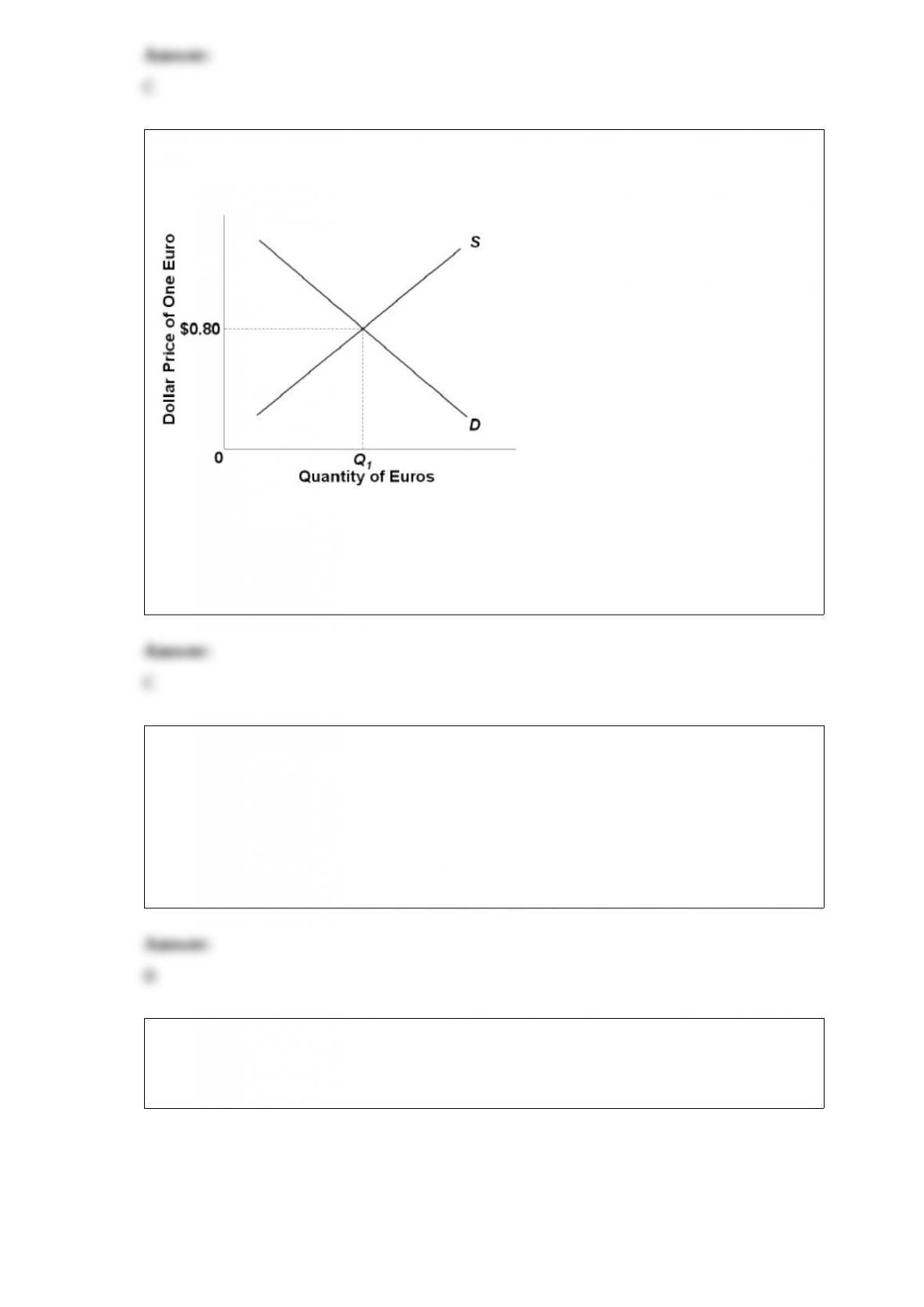
17) The following diagram is a flexible exchange market for foreign currency:
Refer to the above diagram. At the equilibrium exchange rate:
A.$8 will buy 1 euro.
B.0.8 euros will buy $1.
C.1.25 euros will buy $1.
D.$1 will buy 8 euros.
18) Which of the following argument is not generally made to justify farm subsidies?
A.The “family farm” is an American institution that should be protected and nurtured.
B.Agribusiness firms need subsidies to achieve economies of scale.
C.Farmers sell their output in purely competitive markets, but must buy inputs from
imperfectly competitive firms.
D.Farmers cannot fully insure themselves against the risks unusual to farming, such as
floods, droughts, and pests.
19) Suppose the potential level of real domestic output (Q) for a hypothetical economy
is $250 and the price level (P) initially is 100. Use the following short-run aggregate
supply schedules below to answer the questions.
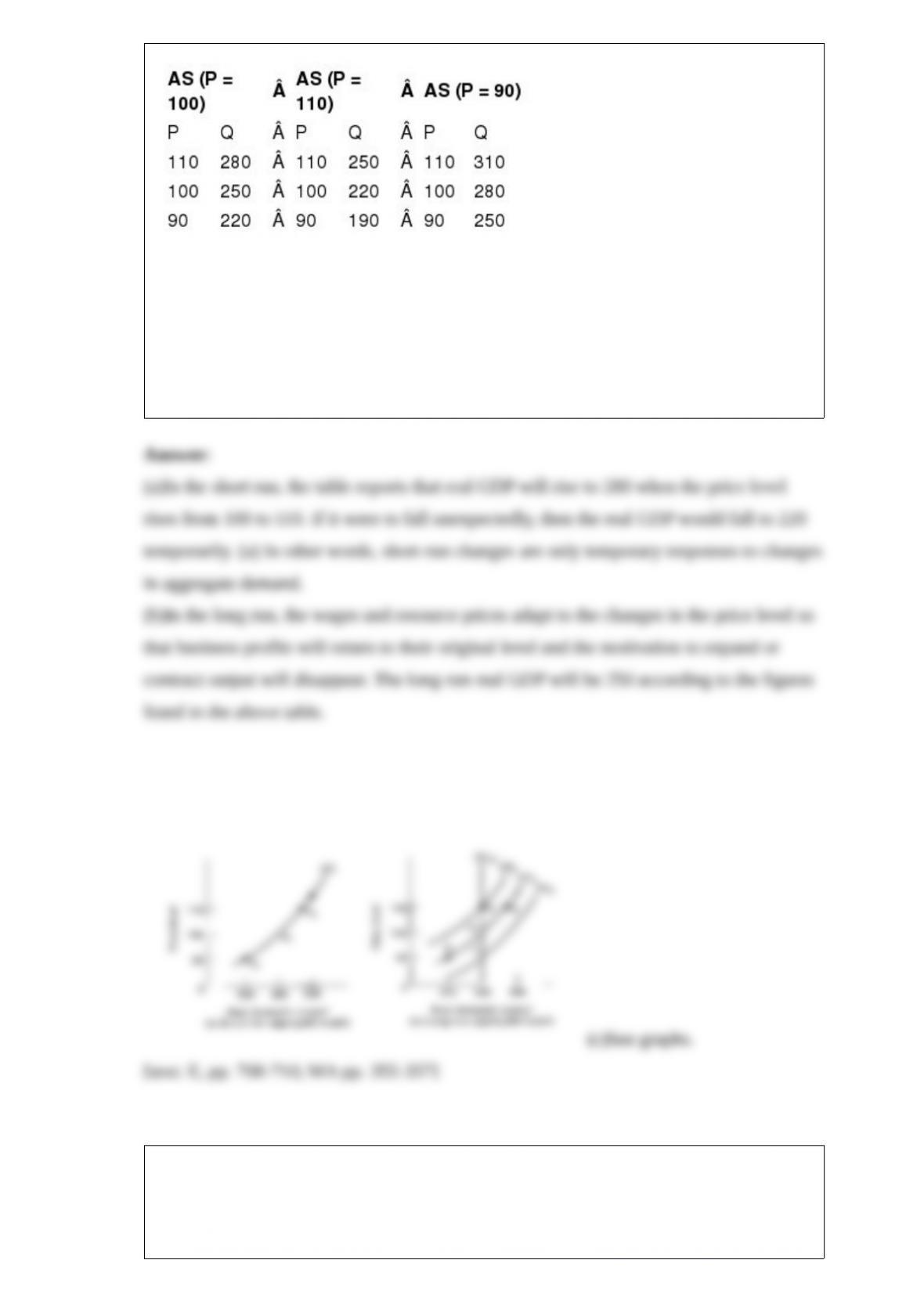
(a)What will be the short-run level of real GDP if the price level rises unexpectedly
from 100 to 110 because of an increase in aggregate demand? Falls unexpectedly from
100 to 90 because of a decrease in aggregate demand? Explain each situation.
(b)What will be the long-run level of real GDP when the price level rises from 100 to
110? Falls from 100 to 90? Explain each situation.
(c)Show the circumstances described in (a) and (b) on the graph below and derive the
long-run aggregate supply curve.
20) a market:
a.reflects upsloping demand and downsloping supply curves.
b.entails the exchange of goods, but not services.
c.is an institution that brings together buyers and sellers.
d.always requires face-to-face contact between buyer and seller.
21) which of the following statements is true about price ceilings?
a.price ceilings cause goods to be rationed.
b.price ceilings cause goods to be rationed by some other means than legally
determined market prices.
c.ration coupons are the only way to ration goods when price ceilings are in place.
d.all of the above statements are correct.
22) A profit-maximizing firm should not undertake a R&D project for which the:
A.expected rate of return exceeds its interest-rate cost of funds.
B.interest-rate cost of funds exceeds the expected rate of return.
C.expected returns are in the distant future.
D.the expected returns, though potentially very large, are uncertain.
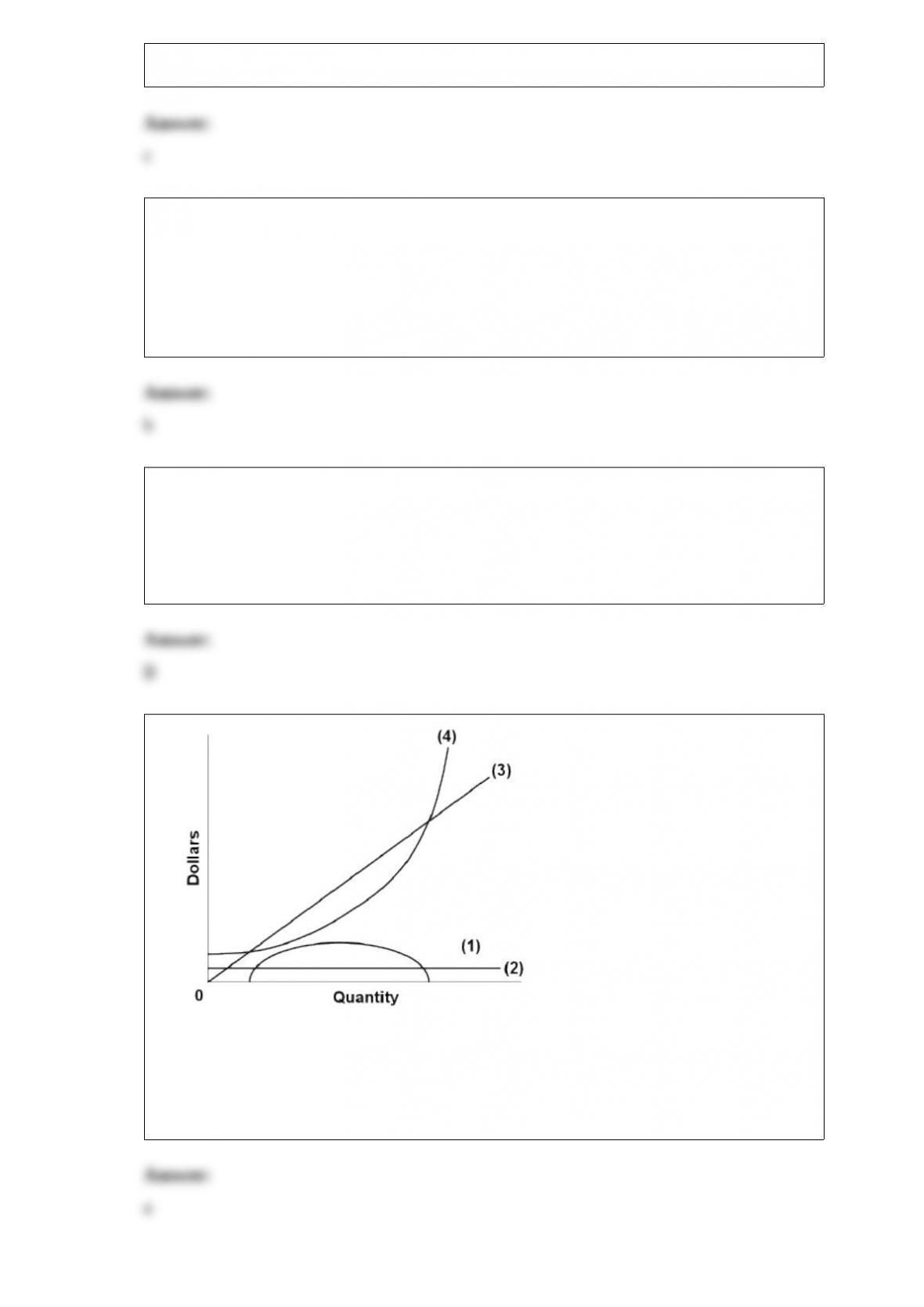
23)
curve (4) in the above diagram is a purely competitive firm’s:
a.total cost curve.
b.total revenue curve.
c.marginal revenue curve.
d.total profit curve.

24) (Advanced analysis) Answer the next question(s) on the basis of the following
information for a private closed economy where C is consumption, Y is the gross
domestic product, Ig is gross investment, and i is the interest rate:
Refer to the above information. The equilibrium level of GDP in this economy is:
A.$240.
B.$300.
C.$360.
D.$400.
25) The interest rate at which the Federal Reserve Banks lend to commercial banks is
called the:
A.prime rate.
B.short-term rate.
C.discount rate.
D.Federal funds rate.
26) What is the meaning of negative self-selection as it relates to unemployment in
low-income nations and immigration?
27) Why would farmland closer to the limits of a city be worth more than farmland
farther out?
28) Describe and give an example of a dominant strategy.
29) Explain the long-run relationship between real hourly earning and productivity.
30) How can discrimination be viewed as resulting from a preference or taste for which
the prejudiced employer is willing to pay? What will determine whether the prejudiced
employer hires nonpreferred workers in this model?