
1) Which of the following has bolstered the case for active monetary policy?
A.budget surpluses
B.increasing globalization of financial markets
C.the success of monetary policy in helping the economy emerge from the 1990-1991
recession and sustain economic growth through the 1990s
D.a decreasing role of banks and thrifts in the financial industry
2) suppose product x is an input in the production of product y. product y in turn is a
substitute for product z. an increase in the price of x can be expected to:
a.decrease the demand for z.
b.increase the demand for z.
c.have no effect on the demand for z.
d.decrease the supply of z.
3) Which of the following statements best illustrates the time-value of money concept?
A.Bob is willing to forgo receiving $100 today in order to receive $110 next month.
B.Tom is indifferent between receiving $50 now and receiving $50 six months from
now.
C.Terry works for an hourly wage instead of a fixed salary.
D.Jeff would prefer to receive $200 at the end of the year instead of $220 now.
4) (Last Word) In 2004, the wealthiest 1 percent of U.S. households held ____ percent
of U.S. household wealth.
A.33.4
B.69.5
C.82.4
D.26.8
5) Efficiency wages are:
A.above-market-wages that bring forth so much added work effort that per-unit
production costs are lower than at market wages.
B.wage payments necessary to compensate workers for unpleasant or risky work
conditions.
C.usually less than market wages.
D.relevant to macro economics because they explain rightward shifts in aggregate
demand.
6) In 2007, the U.S. Federal government legislation authorized:
A.4,800 earmarks totaling $5.8 billion.
B.22,300 earmarks totaling $14.8 billion.
C.16,500 earmarks totaling $22.9 billion.
D.11,700 earmarks totaling $16.9 billion.
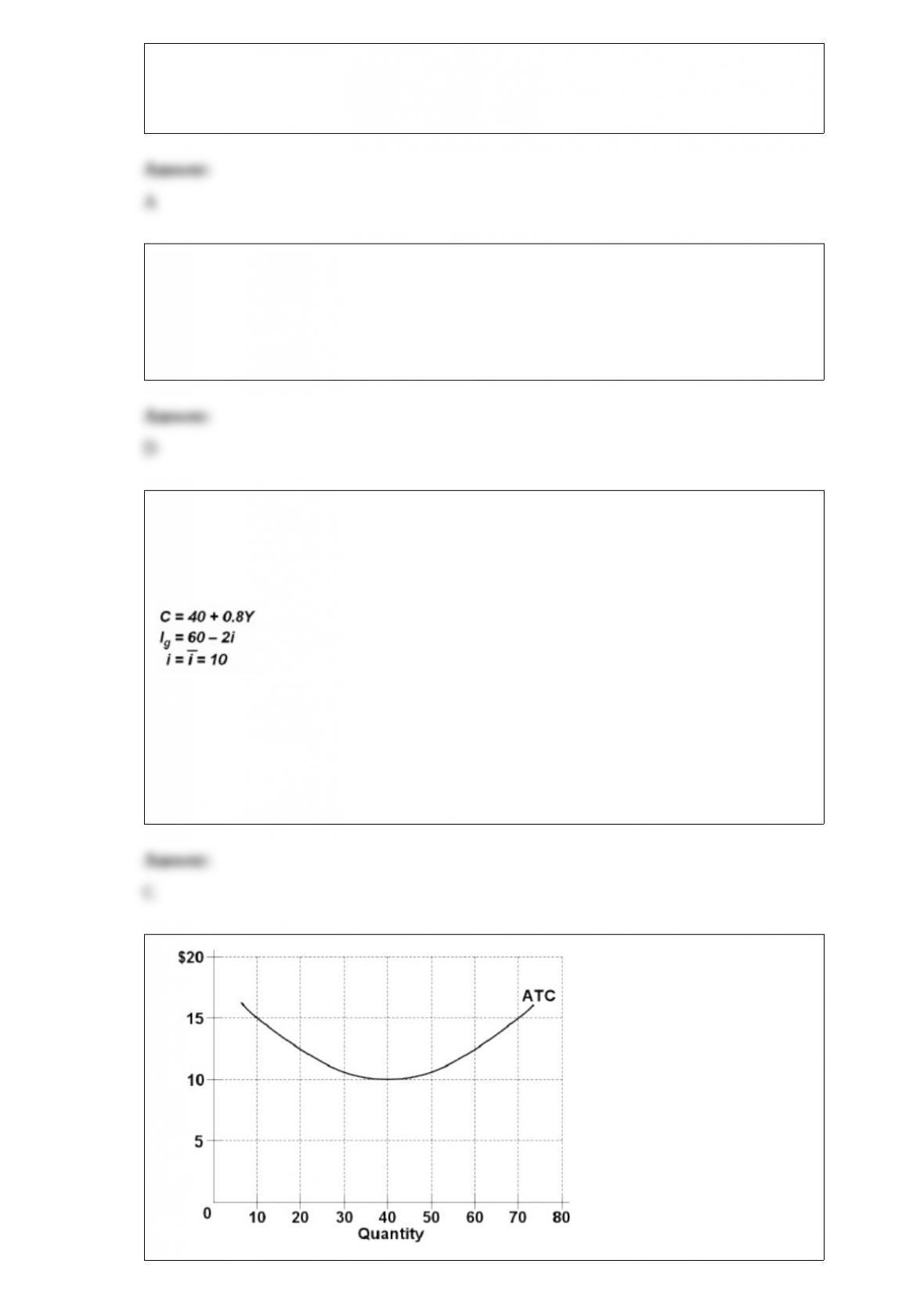
7) (Advanced analysis) Answer the next question(s) on the basis of the following
information for a private closed economy where C is consumption, Y is the gross
domestic product, Ig is gross investment, and i is the interest rate:
Refer to the above information. Given that the interest rate is 10 (percent), the amount
that businesses will want to invest will be:
A.$58.
B.$60.
C.$40.
D.$20.
8)
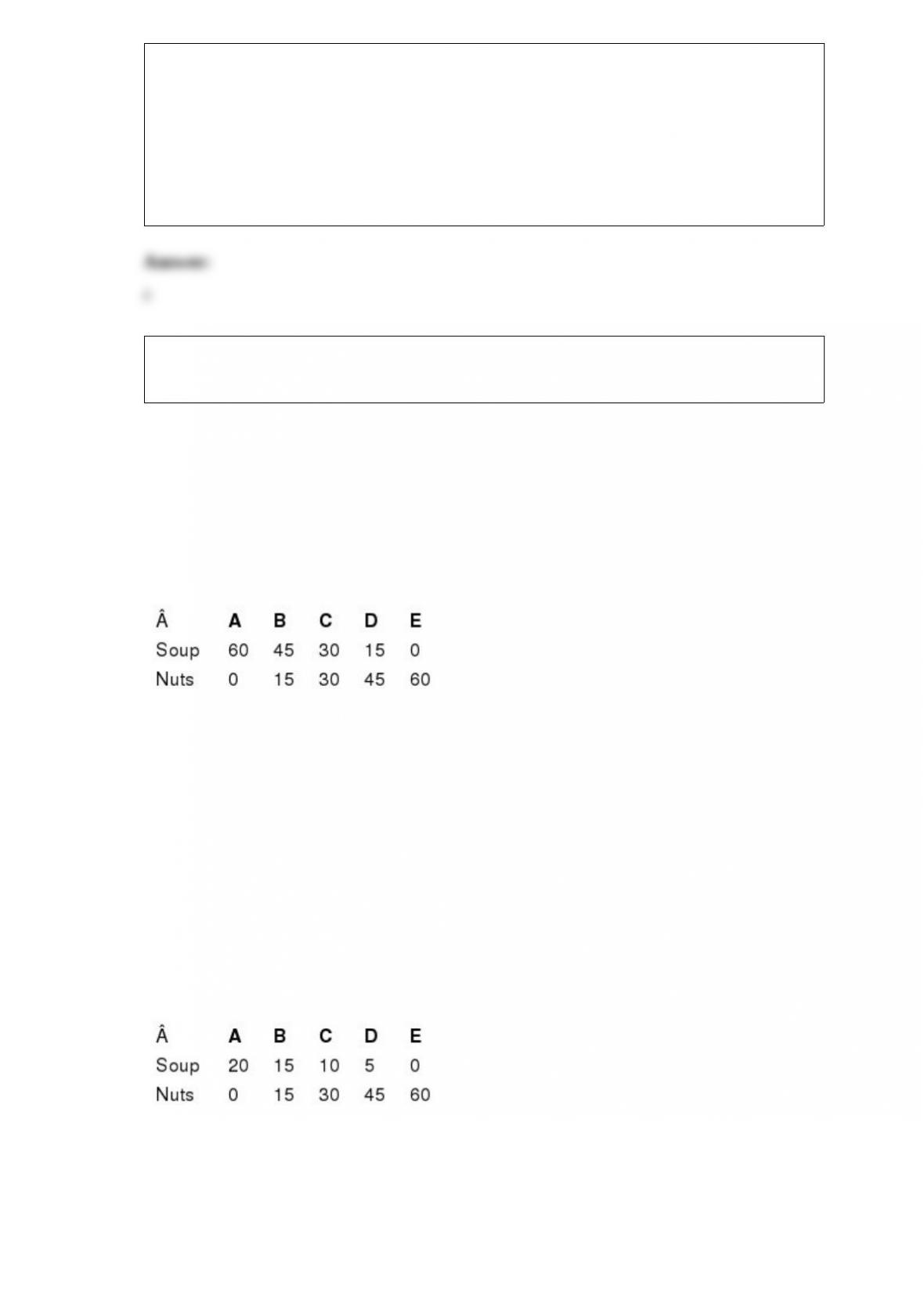
refer to the above diagram showing the average total cost curve for a purely competitive
firm. suppose that average variable cost is $8 at 40 units of output. at that level of
output, total fixed cost:
a.is $2.
b.is $40.
c.is $80.
d.cannot be determined from the information provided.
9) Answer the next three questions on the basis of the following production possibilities
data for Francia and Galacia. All data are in tons.
FRANCIA PRODUCTION
POSSIBILITIES:
GALACIA PRODUCTION
POSSIBILITIES:
(a) If trade occurs between Francia and Galacia, which nation should export what
product? Why?
(b) What are the limits of the terms of trade between Francia and Galacia?
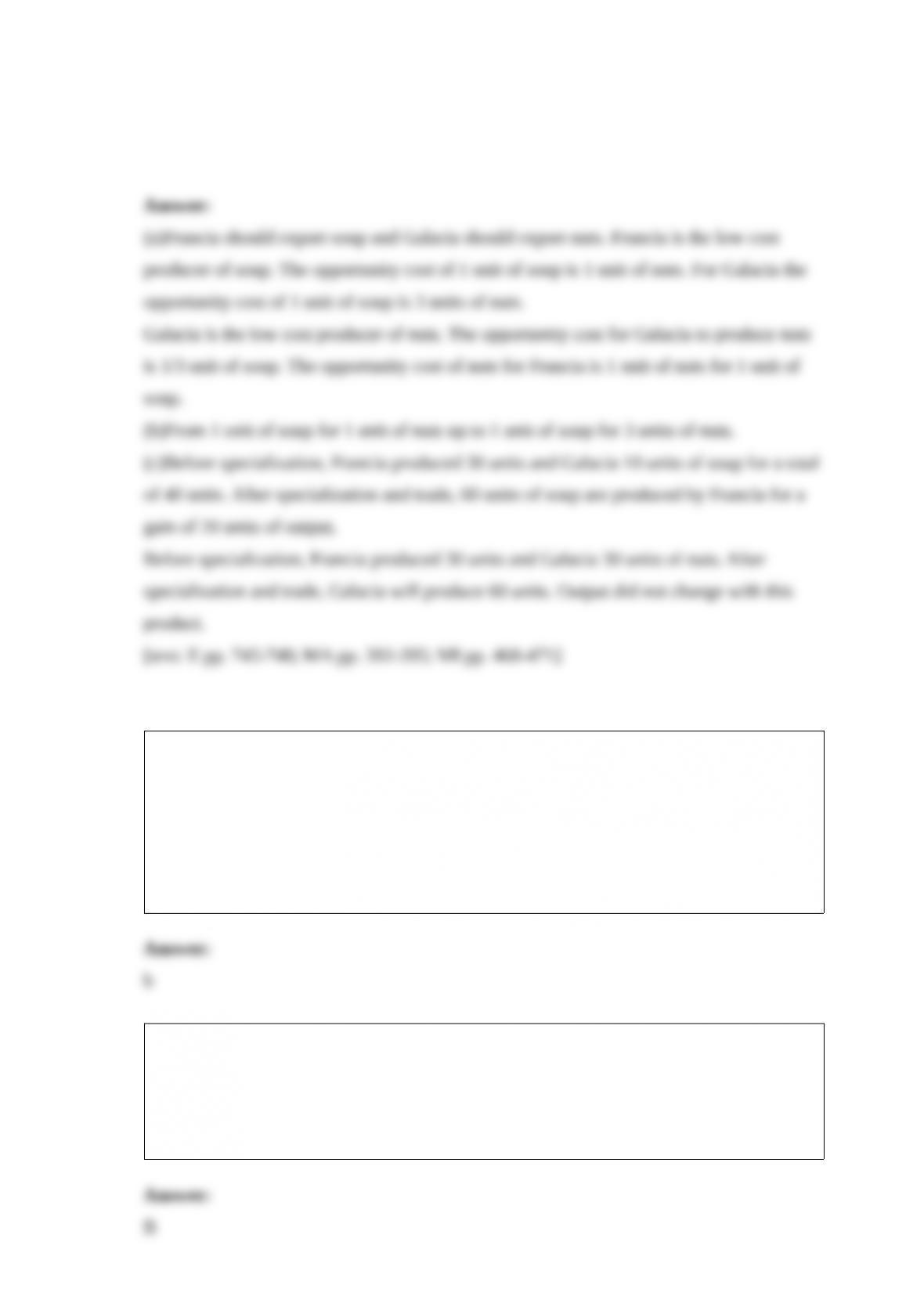
(c) Assume that prior to specialization and trade, Francia and Galacia chose production
possibility “C.” Now each specializes according to comparative advantage. What will be
the resulting gains from trade? Explain your answer.
10) “essential” water is cheaper than “nonessential” diamonds because:
a.new industrial uses for diamonds have been discovered.
b.the supply of water is great relative to demand and the supply of diamonds is small
relative to demand.
c.although the total utility of diamonds is greater, their marginal utility is small.
d.the supply of diamonds is great relative to demand and the supply of water is small
relative to demand.
11) The largest component of the money supply (M1) is:
A.currency in bank vaults.
B.currency in circulation.
C.checkable deposits.
D.stock certificates.