
Prisoner’s dilemma games imply that cooperative behavior between two people or two
firms always breaks down. But reality teaches us that people and firms often cooperate
successfully to achieve their goals. Why do the results from prisoner’s dilemma games
fail to predict real world results?
A) Prisoner’s dilemma games do not keep people or firms from reneging on agreements,
which often occurs in real word situations.
B) The prisoner’s dilemma does not apply to most business situations that are repeated
over and over.
C) Prisoner’s dilemma games predict the behavior of people and firms that engage in
illegal activity; most people and firms do not resort to illegal activity.
D) Most real world situations involve more than two people or firms; the prisoner’s
dilemma is only applicable to situations that involve two parties.
Consider the stock of ocean tuna which is massively overfished. It is rational for an
individual to exploit the resource rather than to conserve the stock because
A) the private benefit of harvesting tuna is higher than the social benefit of harvesting
it.
B) the private benefit of harvesting tuna is lower than the social benefit of harvesting it.
C) the social cost of harvesting the fish is lower than the private cost.
D) the private cost of harvesting the fish is lower than the social cost.

The idea that because of scarcity, producing more of one good or service means
producing less of another good or service refers to the economic concept of
A) optimization.
B) efficiency.
C) trade-off.
D) equity.
Because minimum wage is a price floor,
A) it will be set below the market equilibrium price.
B) it will create a deadweight loss.
C) it will increase the number of jobs available in the labor market.
D) it will maximize consumer surplus.
Assume that Bulgaria has a comparative advantage in producing sandals and Finland
imports sandals from Bulgaria. We can conclude that
A) Bulgaria also has an absolute advantage in producing sandals relative to Finland.
B) Bulgaria has a lower opportunity cost of producing sandals relative to Finland.
C) Finland has an absolute disadvantage in producing sandals relative to Bulgaria.
D) Labor costs are higher for sandal producers in Finland than in Bulgaria.
A four-firm concentration ratio measures
A) the fraction of an industry’s sales accounted for by the four largest firms.
B) the production of any four firms in an industry.
C) how the four largest firms became so concentrated.
D) the fraction of employment of the four largest firms in an industry.
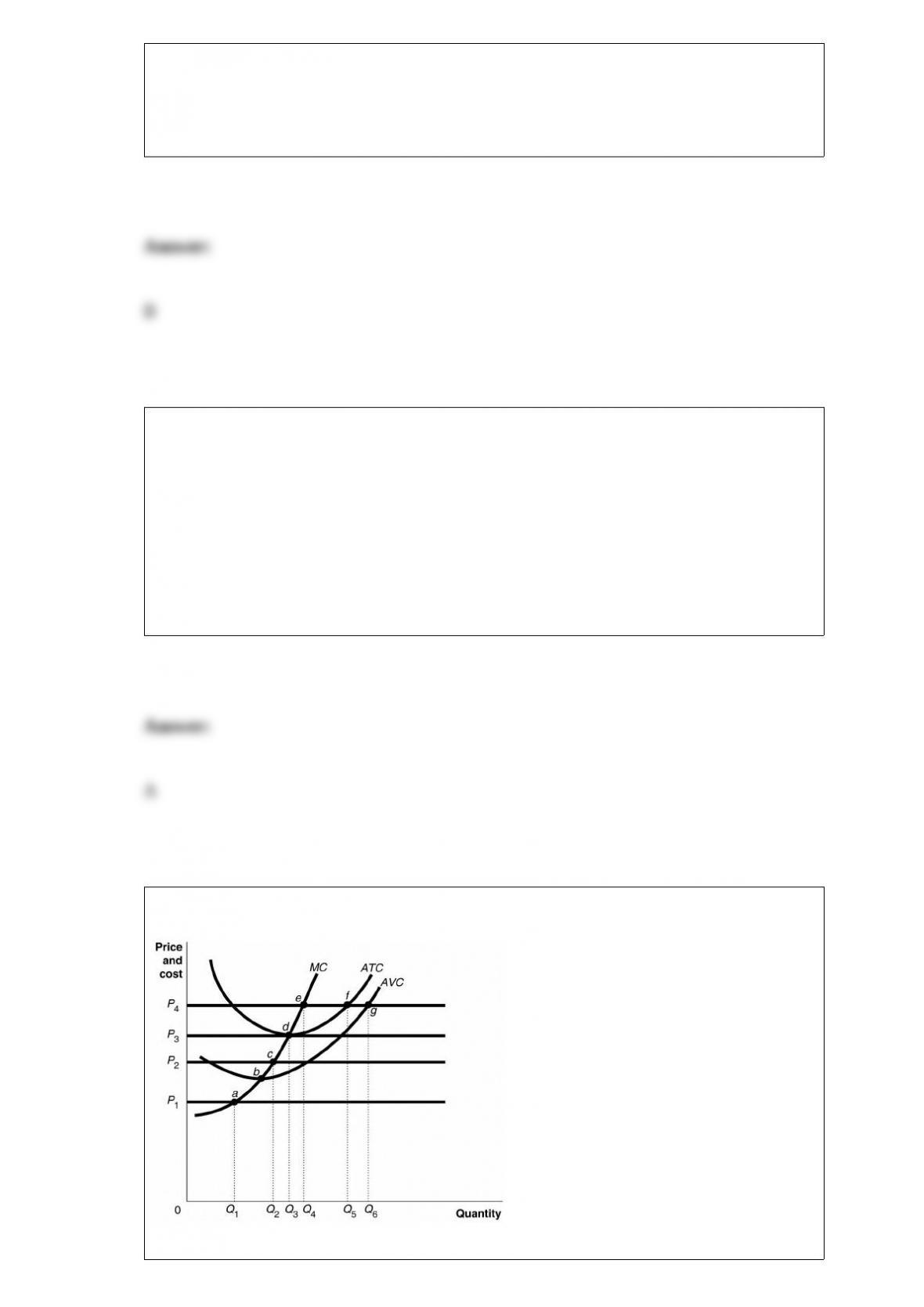
Figure 12-9
Figure 12-9 shows cost and demand
curves facing a profit-maximizing, perfectly competitive firm.

At price P1, the firm would produce
A) Q1 units
B) Q3 units.
C) Q5 units.
D) zero units.
Suppose President Obama is successful in passing a $10 billion tax increase. Assume
that taxes are fixed, the economy is closed, and the marginal propensity to consume is
0.8. What happens to equilibrium GDP?
A) There is a $50 billion increase in equilibrium GDP.
B) There is a $50 billion decrease in equilibrium GDP.
C) There is a $40 billion increase in equilibrium GDP.
D) There is a $40 billion decrease in equilibrium GDP.
Which is not one of the criteria necessary for a commodity to make a suitable medium
of exchange?
A) It should be durable.
B) It should be of standardized quality.

C) It should be valuable relative to its weight.
D) It should have intrinsic value.
Electric car enthusiasts want to buy more electric cars at a lower price. All of the
following events would have this effect except
A) technological advancement in the production of electric car batteries.
B) an increase in the number of manufacturers of electric cars.
C) a decrease in the price of lithium, which is used in the electric car batteries.
D) an increase in the price of gasoline.
Table 2-2 Production choices for Billie’s Bedroom Shop
Assume Billie’s Bedroom Shop only produces pillows and blankets. A combination of 9

pillows and 21 blankets would appear
A) along Billie’s production possibilities frontier.
B) inside Billie’s production possibilities frontier.
C) outside Billie’s production possibilities frontier.
D) at the vertical intercept of Billie’s production possibilities frontier.
If 50 units are sold at a price of $20 and 80 units are sold at a price of $15, what is the
absolute value of the price elasticity of demand? Use the midpoint formula.
A) 0.17
B) 0.62
C) 1.62
D) 5
Stagflation occurs when
A) inflation rises and GDP rises.
B) inflation falls and GDP rises.

C) inflation rises and GDP falls.
D) inflation falls and GDP falls.
A firm chooses its profit-maximizing quantity of capital by
A) comparing the marginal revenue product of capital with the rental price of capital.
B) comparing the price of capital with the price of labor.
C) examining the total cost of capital equipment.
D) determining the rate at which the firm can borrow funds to purchase plant and
equipment.
Because of the slope of the aggregate demand curve, we can say that
A) a decrease in the price level leads to a lower level of real GDP demanded.
B) an increase in the price level leads to no change in the level of real GDP demanded.
C) a decrease in the price level leads to a higher level of real GDP demanded.
D) an increase in the price level leads to a higher level of real GDP demanded.

Which of the following would not be considered a positive addition to household
wealth?
A) the equity in one’s home
B) 1,000 shares of Microsoft stock
C) a credit card balance
D) the balance in your checking account
Of the different types of businesses, a corporation has the ________ government rules
and the ________ government regulations affecting it.
A) least; least
B) least; most
C) most; least
D) most; most