
What is “brain drain”?
A) the tendency for highly educated workers in high-income countries to move to
low-income countries to volunteer their services
B) increased recruiting efforts that attempt to raise the average level of education in
developed nations
C) foreign direct investment that flows from a developed country to a developing
country
D) the loss of highly educated people from a low-income country as they move to
higher-income opportunities in foreign countries
Ronald Coase was awarded the 1991 Nobel Prize in Economics primarily for
addressing problems related to externalities. Which of the following describes Coase’s
work?
A) Coase argued that government intervention is necessary to achieve economic
efficiency in markets that are affected by externalities.
B) Coase proved that economic efficiency cannot be achieved in a market that is
affected by positive or negative externalities.
C) Coase argued that under some circumstances, private solutions to the problems of
externalities will occur.
D) Coase proved that a competitive market achieved a greater degree of economic
efficiency than a non-competitive market when externalities occur.

China runs a current account surplus with the United States. Which of the following
must be true about China’s balance of payments with the United States?
A) It must run a financial account deficit.
B) Its balance of trade must be in deficit.
C) Its net exports must be negative.
D) Its balance of payments must run a deficit.
When individuals use ________ about an economic variable to make a decision,
expectations are rational.
A) only historical information
B) only information announced by the Fed
C) all available information
D) only information garnered in the private sector
In the United States, the largest source of funds for public schools is
A) the federal income tax.
B) the property tax.
C) the consumption tax.

D) sales taxes.
One would speak of a change in the quantity of a good supplied, rather than a change in
supply, if
A) supplier expectations about future prices change.
B) the price of the good changes.
C) the cost of producing the good changes.
D) prices of substitutes in production change.
Monetarists think that the Fed should use ________ as a target when conducting
monetary policy.
A) the money supply
B) the federal funds rate
C) the Treasury bill rate
D) the inflation rate
E) the unemployment rate

The price elasticity of supply for umbrellas is 2. Suppose you’re told that following a
price increase, quantity supplied increased by 30 percent. What was the percentage
change in price that brought this about?
A) 60 percent
B) 15 percent
C) 6.7 percent
D) impossible to determine without additional information
If GDP grew 3% in 1970, 2.2% in 1971 and 2.5% in 1972 then, what is the average
annual growth rate over this period?
A) 5%
B) 4%
C) 2.6%
D) -2.2%
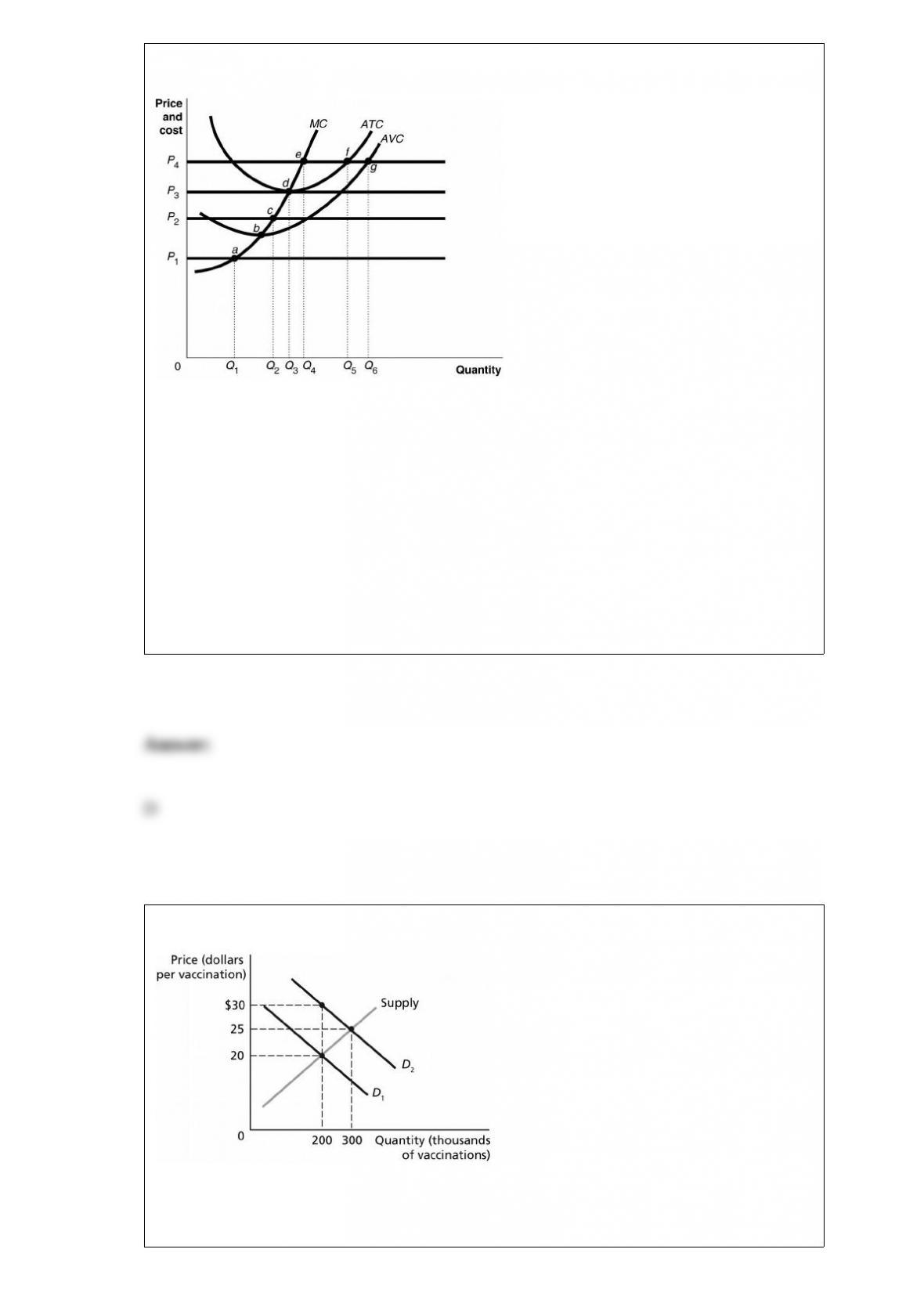
Figure 12-9
Figure 12-9 shows cost and demand
curves facing a profit-maximizing, perfectly competitive firm.
At price P3, the firm would
A) lose an amount equal to its fixed cost.
B) lose an amount more than fixed cost.
C) lose an amount less than fixed cost.
D) break even.
Figure 7-1
Figure 7-1 represents the market for
vaccinations. Vaccinations are considered a benefit to society, and the figure shows both
the marginal private benefit and the marginal social benefit from vaccinations. The
market equilibrium price is

A) $30.
B) $25.
C) $20.
D) <$20.
When a firm has been granted a trademark, which grants legal protection against other
firms using the name of the product that has been granted the trademark, the firm
A) still faces the possibility that the name will become widely used and no longer
associated with a specific company.
B) does not have to worry about legally enforcing the trademark; this is the
responsibility of the legal system.
C) still must apply for a copyright and a patent to ensure that no other firm will use the
product’s name.
D) must spend an annual amount on advertising the product each year; the amount it
must spend is negotiated by the firm and the government agency that grants the
trademark.