If real GDP grows by 3% in 2011, 3.2% in 2012, and 2.5% in 2013, what is the average
annual growth rate of real GDP?
A) 2.6%
B) 2.9%
C) 3.1%
D) 4.2%
Table 9-5
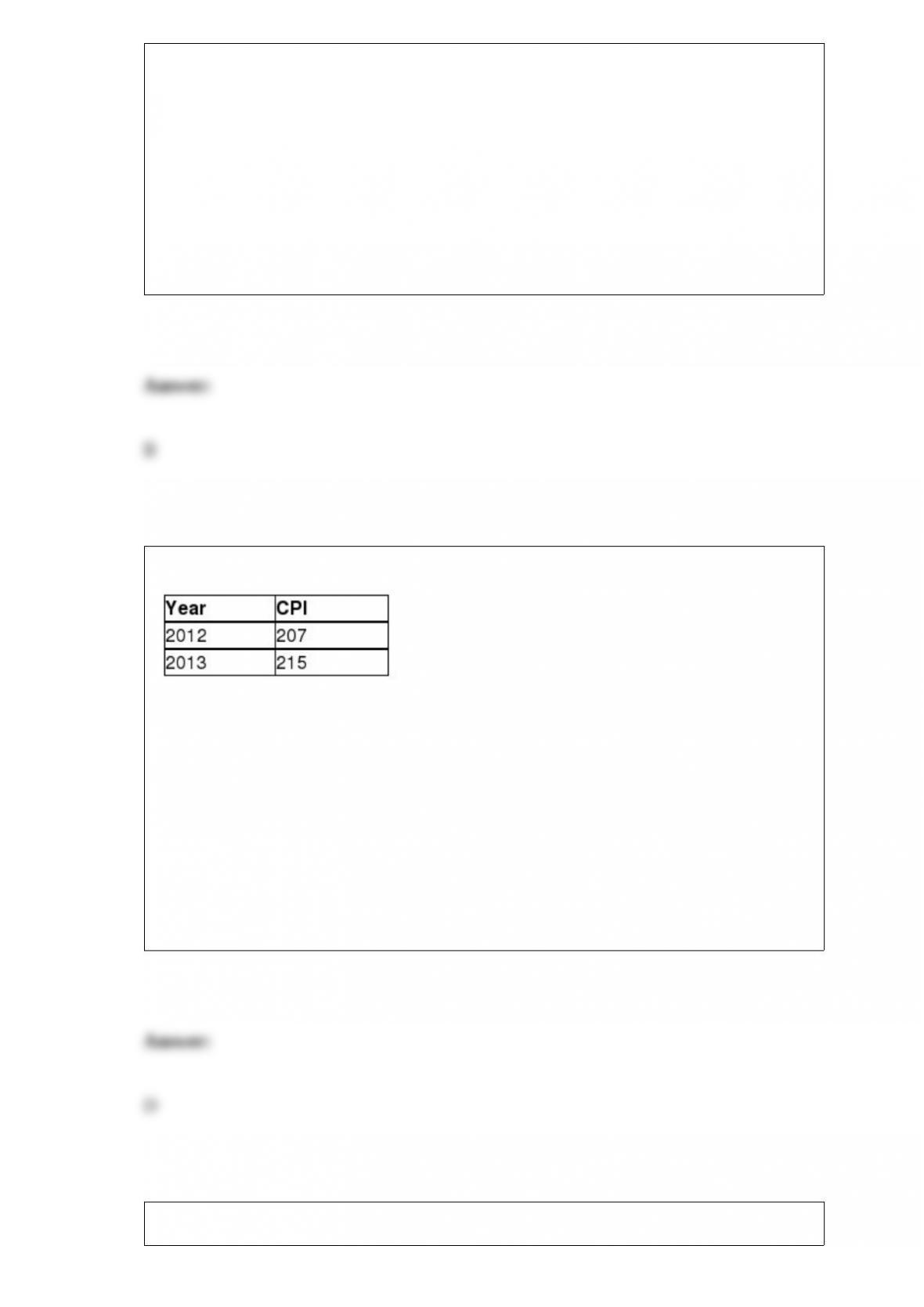
Consider the following values of the consumer price index for 2012 and 2013. The
inflation rate for 2013 was equal to
A) 215 percent.
B) 21.5 percent.
C) 8.0 percent.
D) 3.9 percent.
Studies have shown that drinking one glass of red wine per day may help prevent heart
disease. Assume this is true, and favorable weather has increased the grape harvest of
California vineyards. In the market for red wine, these two developments would
A) increase demand and decrease supply, resulting in an increase in the equilibrium
quantity and a decrease in the equilibrium price of red wine.
B) increase demand and increase supply, resulting in an increase in the equilibrium
quantity and an uncertain effect on the equilibrium price of red wine.
C) increase demand and increase supply, resulting in an increase in the equilibrium
price and an uncertain effect on the equilibrium quantity of red wine.
D) increase demand and increase supply, resulting in an increase in both the equilibrium
price and the equilibrium quantity of red wine.
If the Federal Reserve attempts to continue reducing unemployment by manipulating
monetary policy, which of the following would you expect to see?
A) The Fed will follow deflationary monetary policies.
B) The Fed will follow inflationary monetary policies.
C) The rate of inflation will fall as Fed tries to reduce the unemployment rate.
D) The Fed will reduce the natural rate of unemployment.
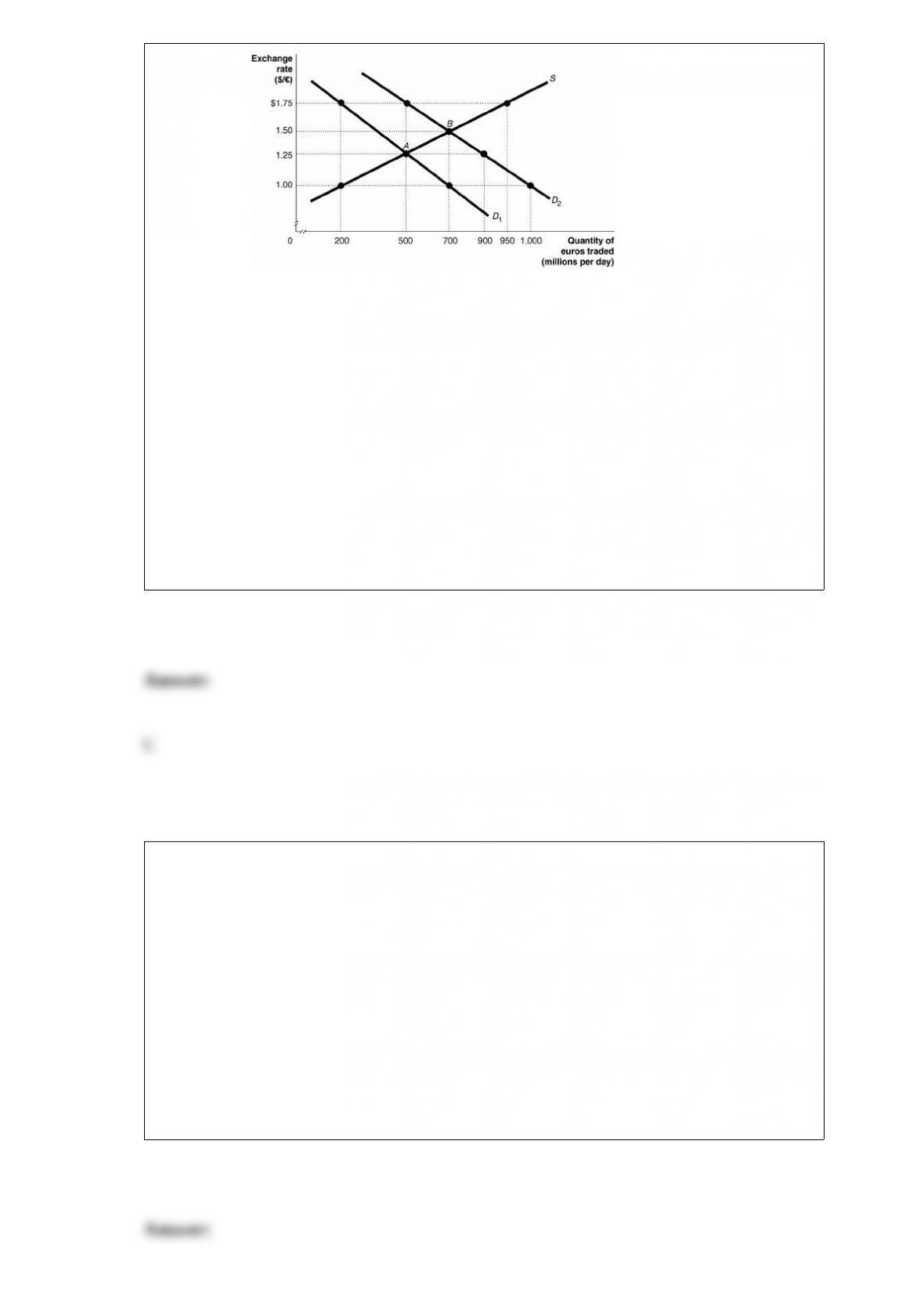
Figure 19-8
The equilibrium exchange rate is originally at A, $1.25/euro. Suppose the European
Central Bank pegs its currency at $1.00/euro. Speculators expect that the value of the
euro will rise and this shifts the demand curve for euro to D2. If the European Central
Bank abandons the peg, the equilibrium exchange rate would be
A) $1.00/euro.
B) $1.25/euro.
C) $1.50/euro.
D) $1.75/euro.
With a common currency such as the euro,
A) trade barriers between countries using the currency are increased.
B) individual countries using the currency are no longer able to run independent
monetary policies.
C) the prices of goods across countries using the currency must always be the same,
regardless of consumer preferences for goods across countries.
D) individual countries using the currency are no longer able to run independent fiscal
policies.

Which of the following arguments could be made as evidence that the market for
produce sold at a farmers’ market is perfectly competitive?
A) The U.S. Department of Agriculture has established standards for the labeling of
organic produce sold at farmers’ markets.
B) Sales of organically grown food have increased at a rate of 20 percent per year.
C) As more farmers began selling their products at farmers’ markets, the increase in
supply has driven down prices to the point where they just cover the cost of production.
D) The profits earned by farmers who sell their products at farmers’ markets have
continued to grow, despite the increasing number of farmers entering this market.
Because minimum wage is a price floor
A) it will be set below the market equilibrium price.
B) it will create a deadweight loss.
C) it will increase the number of jobs available in the labor market.
D) it will maximize consumer surplus.

Productive efficiency is achieved when
A) firms add a low profit margin to the goods and services they produce.
B) firms produce the goods and services that consumers value most.
C) firms produce goods and services at the lowest cost.
D) there are no shortages or surpluses in the market.
The aggregate demand curve illustrates the relationship between ________ and the
________, holding constant all other factors that affect aggregate expenditure.
A) the price level; quantity of planned aggregate expenditure
B) the inflation rate; quantity of planned aggregate expenditure
C) the price level; quantity of planned investment expenditure
D) the price level; quantity of consumption expenditure
Under the monetary growth rule proposed by the monetarists, the money supply would
grow each year at a constant rate equal to the long-run rate of growth of
A) inflation.
B) real GDP.
C) interest rates.

D) employment.
If a stock’s dividend is expected to grow at a constant rate of eight percent in the future
and it has just paid a dividend of $1.25 a share, and you have an alternative investment
of equal risk that will earn a 12 percent rate of return, what would you be willing to pay
per share for this stock?
A) $31.25
B) $1.40
C) $1.25
D) $1.12
A permanent tax cut would likely ________ consumption spending ________ than
would a tax rebate like the one issued in 2008.
A) increase; more
B) increase; less
C) decrease; more
D) decrease; less

If the price of prime rib falls, the income effect due to the price change will cause
A) an increase in the demand for prime rib.
B) an increase in the demand for flank steak, a substitute for prime rib.
C) an increase in the quantity demanded of prime rib.
D) an increase in the quantity supplied of prime rib.
Why is the multiplier for contractionary fiscal policy smaller in an open economy?
A) Contractionary fiscal policy reduces the deficit, which raises the interest rate, which
raises the foreign exchange value of the dollar, which increases net exports.
B) Contractionary fiscal policy increases the deficit, which raises the interest rate,
which reduces the foreign exchange value of the dollar, which increases net exports.
C) Contractionary fiscal policy reduces the deficit, which reduces the interest rate,
which reduces the foreign exchange value of the dollar, which increases net exports.
D) Contractionary fiscal policy reduces the deficit, which reduces the interest rate,
which reduces the foreign exchange value of the dollar, which decreases net exports.

An economy can improve its standard of living by
A) organizing production so that the quantity of goods produced per hour will decrease.
B) reducing the amount of human capital workers have.
C) increasing the amount of capital available per hour worked.
D) all of the above
The key idea of the aggregate expenditure model is that in any particular year, the level
of ________ is determined mainly by the level of aggregate expenditure.
A) frictional unemployment
B) export spending
C) government spending
D) GDP
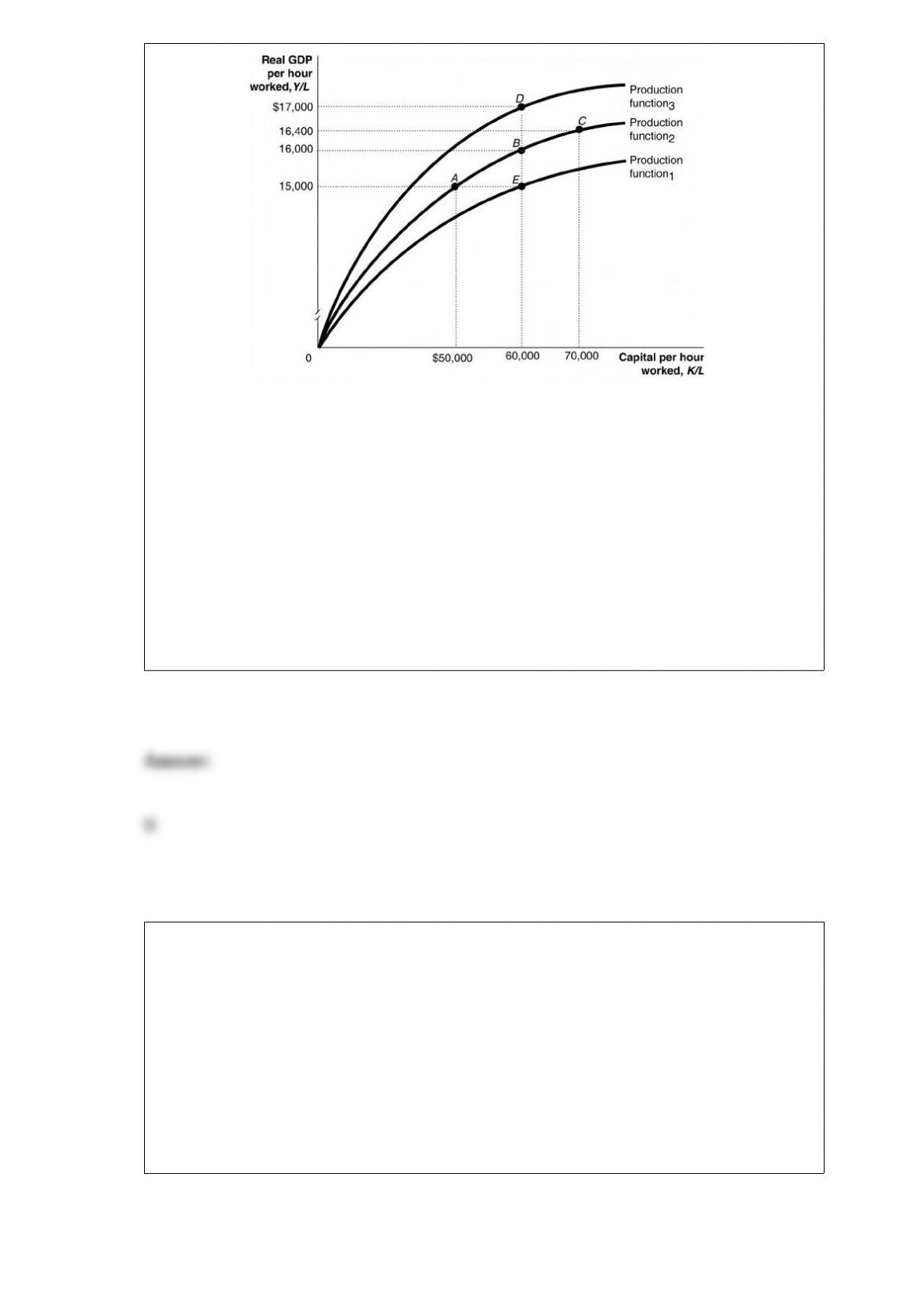
Figure 11-4
Many countries in Africa strongly discouraged and prohibited foreign direct investment
in the 1950s and 1960s. By doing so, these countries were essentially preventing a
moment from
A) B to A.
B) E to B.
C) A to E.
D) D to B.
Because of the productivity slowdown in the United States from the mid-1970s through
the mid-1990s,
A) real GDP per capita grew more rapidly.
B) real GDP per capita grew more slowly.
C) the standard of living did not change.
D) the standard of living increased in the United States.