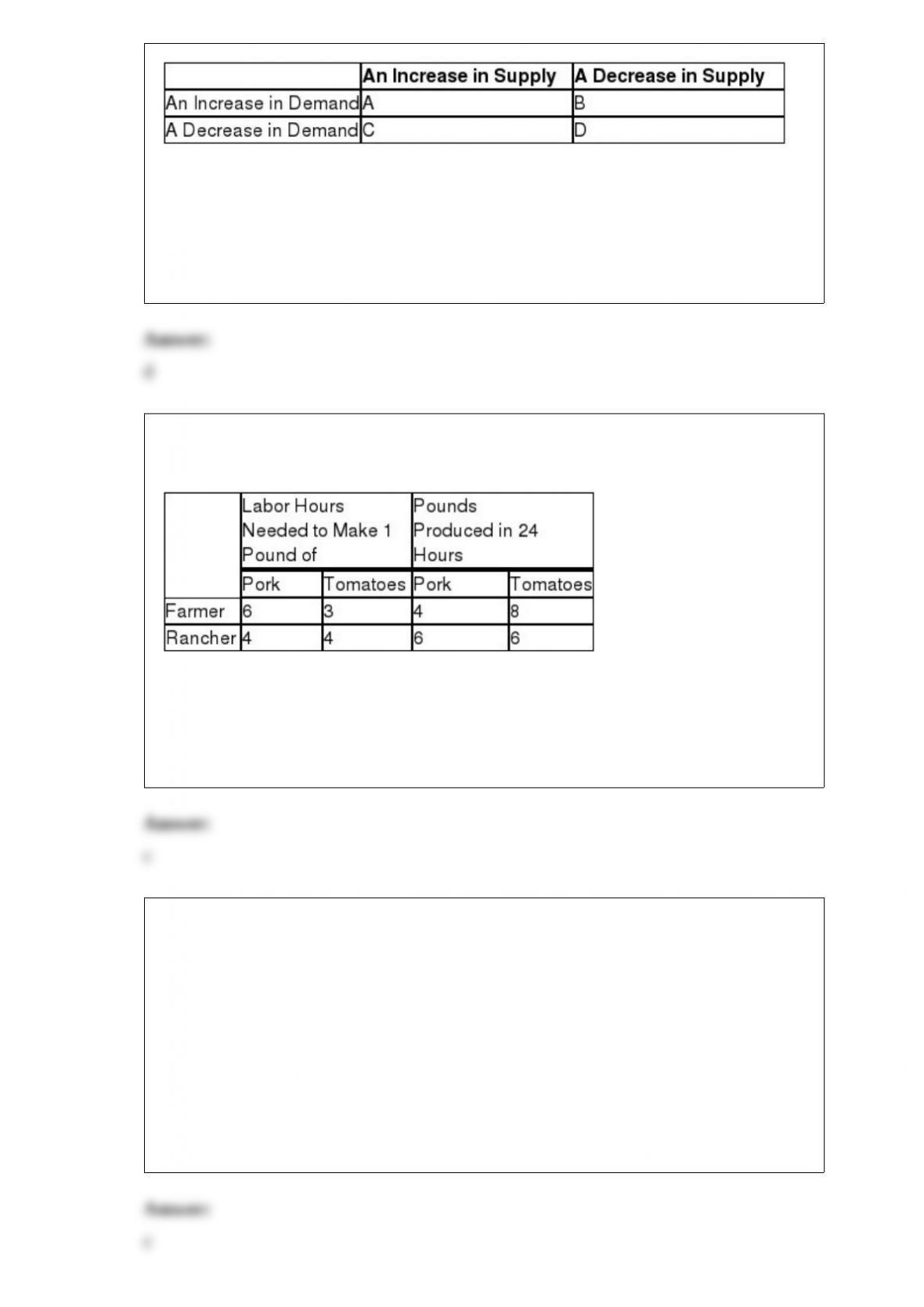
1) Which combination would produce a decrease in equilibrium quantity and an
indeterminate change in equilibrium price?
a.A
b.B
c.C
d.D
2) Assume that the farmer and the rancher can switch between producing pork and
producing tomatoes at a constant rate.
The opportunity cost of 1 pound of pork for the farmer is
a.1/2 pound of tomatoes.
b.1/2 hour of labor.
c.2 pounds of tomatoes.
d.2 hours of labor.
3) Scenario 18-3
Sam has two jobs, one for the winter and one for the summer. In the winter, he works as
a lift attendant at a ski resort where he earns $13 per hour. During the summer, he drives
a tour bus around the ski resort, earning $11 per hour.
Refer to Scenario 18-3. If Sam takes fewer hours of leisure in the winter than in the
summer, we can assume that his labor supply curve for the range of earnings in this
example
a.is horizontal.
b.is vertical.
c.is upward sloping.
d.has a backward-sloping portion.

4) Which of the following would increase the demand for labor?
(i)a decrease in the output price
(ii)an increase in the output price
(iii)a labor-saving technological advance
(iv)a labor-augmenting technological advance
a.(i) only
b.(i) and (iii) only
c.(ii) only
d.(ii) and (iv) only
5) When a firm’s only variable input is labor, then the slope of the production function
measures the
a.quantity of labor.
b.quantity of output.
c.total cost.
d.marginal product of labor.
6) Experimental evidence indicates women choose less competitive environments than
men.
a.True
b.False
7) Refer to Figure 9-18. Suppose Isoland changes from a no-trade policy to a policy
that allows international trade.
If the world price of peaches is $5, then the policy change results in
a.a decrease in consumer surplus.
b.an increase in producer surplus.
c.an increase in total surplus.
d.All of the above are correct.
8) For a particular good, an 8 percent increase in price causes a 4 percent decrease in
quantity demanded. Which of the following statements is most likely applicable to this
good?
a.There are many close substitutes for this good.
b.The good is a luxury.
c.The market for the good is broadly defined.
d.The relevant time horizon is long.
9) In the circular-flow diagram, in the markets for
a.goods and services, households and firms are both sellers.
b.goods and services, households are sellers and firms are buyers.
c.the factors of production, households are sellers and firms are buyers.
d.the factors of production, households and firms are both buyers.
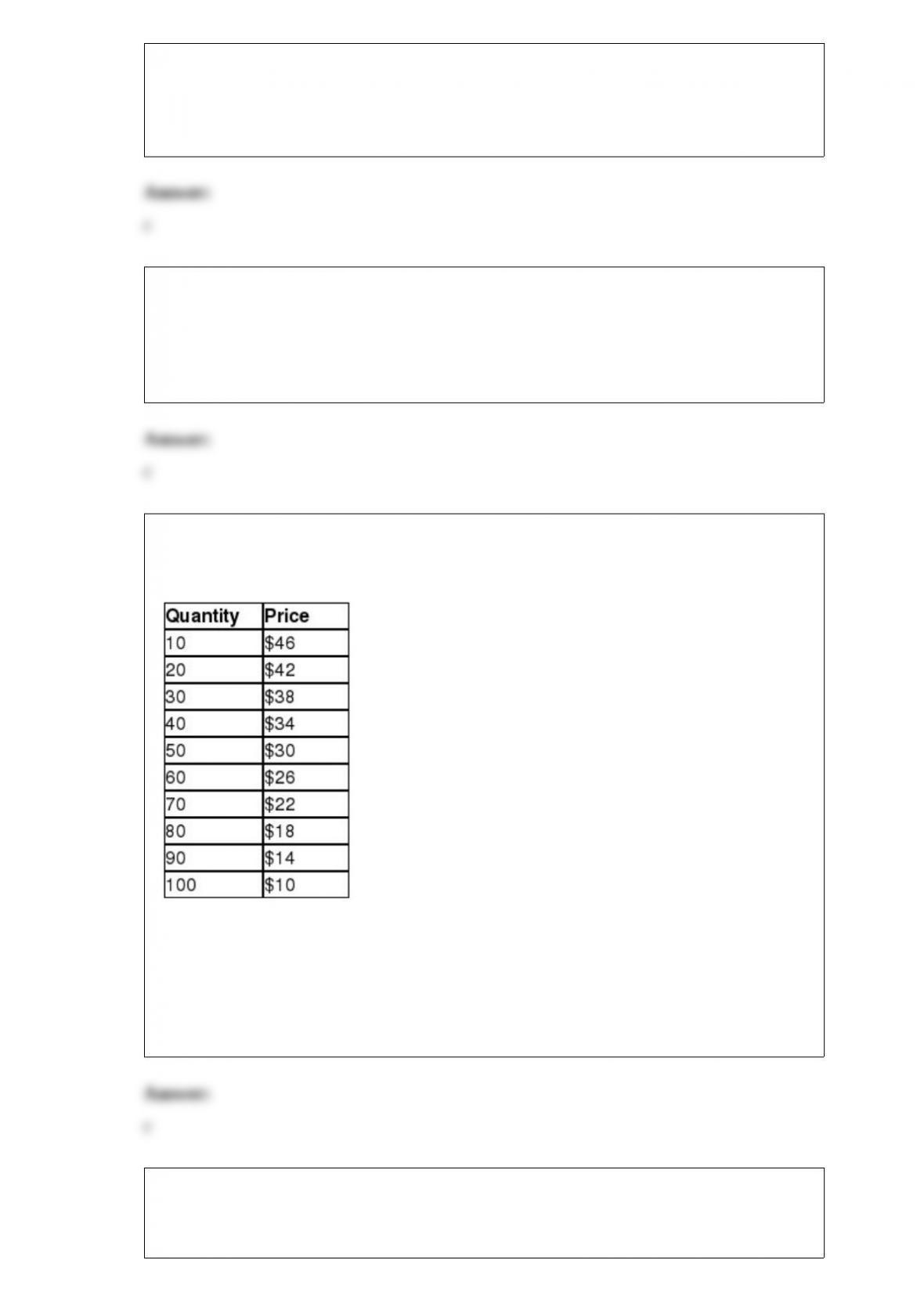
10) Table 15-17
A monopolist faces the following demand curve:
If the marginal cost of production is constant at $18 per unit, this profit-maximizing
monopolist will choose to produce
a.20 units.
b.30 units.
c.40 units.
d.50 units.
11) Figure 9-29
The following diagram shows the domestic demand and domestic supply curves in a
market. Assume that the world price in this market is $1 per unit.
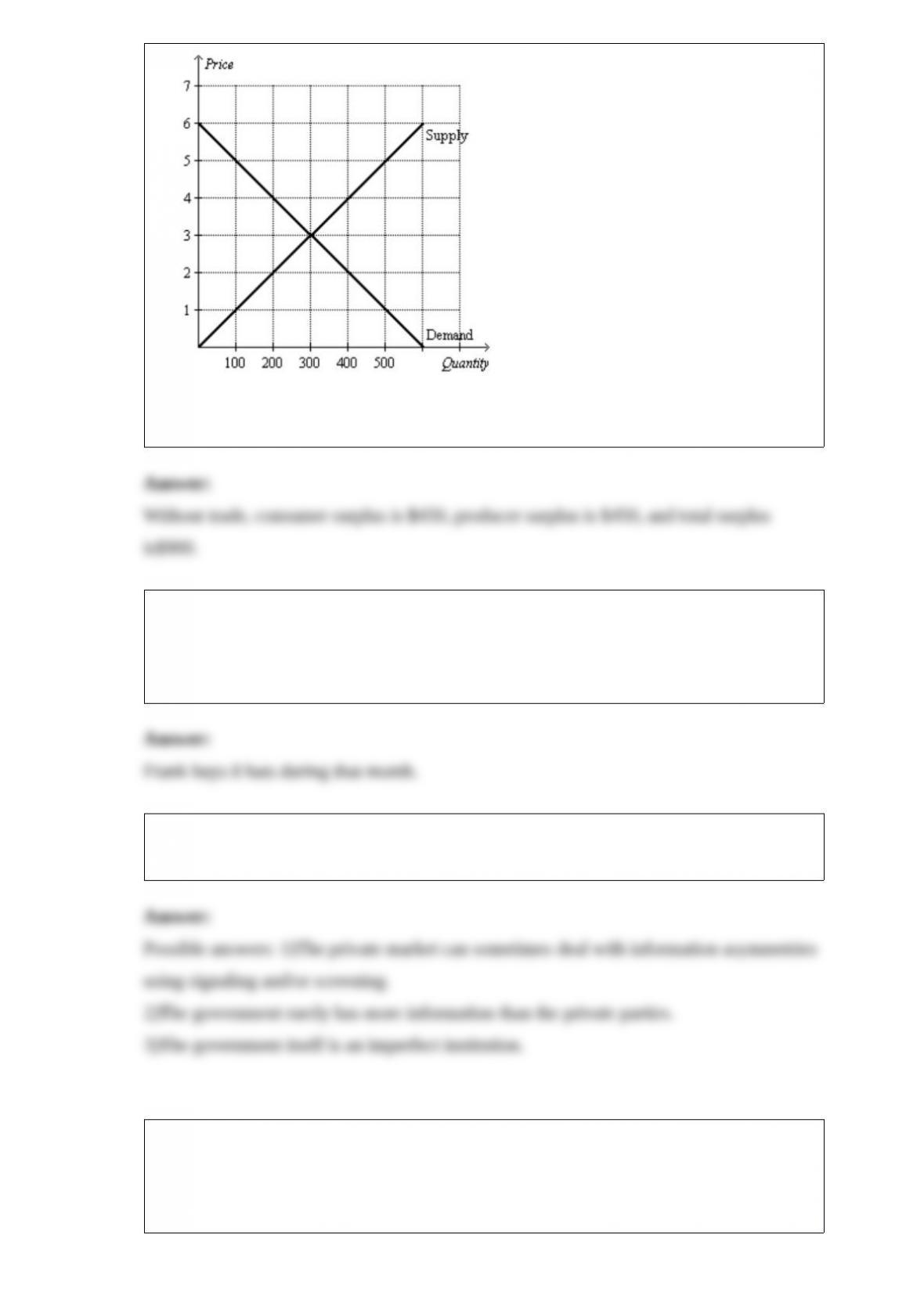
With no trade allowed, how much are consumer surplus, producer surplus, and total
surplus?
12) Scenario 21-4 Frank spends all of his income of $240 per month on shirts and hats.
The price of a shirt is $40 and the price of a hat is $30.
Refer to Scenario 21-4. If Frank uses all of his income to buy hats during a certain
month, then how many hats does he buy?
13) State one reason why government intervention may not be a good solution to an
asymmetric information problem.
14) A cutting-edge biotech firm is hiring recent college graduates. To attract the very
best applicants and to increase worker effort the firm is paying a wage 20% higher than
the market wage for entry level employees in this industry. What is the term for the
wage paid in this example?

15) A group of buyers and sellers of a particular good or service is called a
16) A recent study of the determinants of wages for clerical staff at a state university
found that years of schooling, years of experience, age and job characteristics only
explained about one-half of the difference in wages. Describe other factors that may be
important in explaining wages differences for clerical staff.