
Demand in factor markets differs from demand in product markets in that
A) the demand for a factor of production is difficult to determine.
B) the demand for a factor of production is influenced by workers’ productivity and by
the producers’ expected sales revenues, not by tastes and preferences of consumers.
C) demand for a factor of production is based on the tastes and preferences of firms.
D) demand for a factor of production is based on the tastes and preferences of resource
owners.
What characteristic of a competitive market has made the “long run pretty short” in the
market for iPhone applications?
A) few firms in the market
B) identical products
C) ease of entry
D) blocked entry
Suppose a negative externality exists in a market. If transactions costs are low and
parties are willing to bargain then, according to the Coase theorem
A) an efficient solution can be reached only if property rights are assigned to the

victims of the pollution.
B) an efficient solution can be reached only if property rights are assigned to the
polluters.
C) an efficient solution can be reached regardless of the initial assignment of property
rights.
D) government intervention is critical to reach an efficient solution.
Odd pricing became common in the late 19th century. Although the origins of odd
pricing are uncertain, several explanations for the practice have been given. Which of
the following is one of these explanations?
A) Odd pricing forced employees to give customers change. This made it more likely
that employees would record sales rather than pocketing their customers’ money.
B) Odd pricing began in an era when it was difficult for owners and managers of firms
to determine the marginal cost of the goods and services they sold. Odd prices were
rough estimates designed to cover costs plus earn firms a profit.
C) Odd pricing was begun in England in the 1700s when America was part of the
British Empire. Members of the British Royal Court were given the task of pricing
products. After independence, merchants in the United States carried on the practice of
odd pricing.
D) After the passage of the Sherman Act in 1890, merchants used odd pricing as a
means of avoiding prosecution for antitrust violations.

An average tax rate is calculated as
A) total taxable income taxes paid.
B) total taxable income taxes paid.
C) taxes paid total taxable income.
D) (total taxable income – taxes paid) taxable income.
Rayburn Reed is a highly talented photographer. He has chosen to specialize in
photography because of all of the following except
A) he obviously has a comparative advantage in photography.
B) his opportunity cost of pursuing another career is very low.
C) for him, this is the most lucrative way to purchase the products that he wants to
consume.
D) his photographs are highly esteemed by art lovers who are willing to pay very high
prices.
Figure 6-5
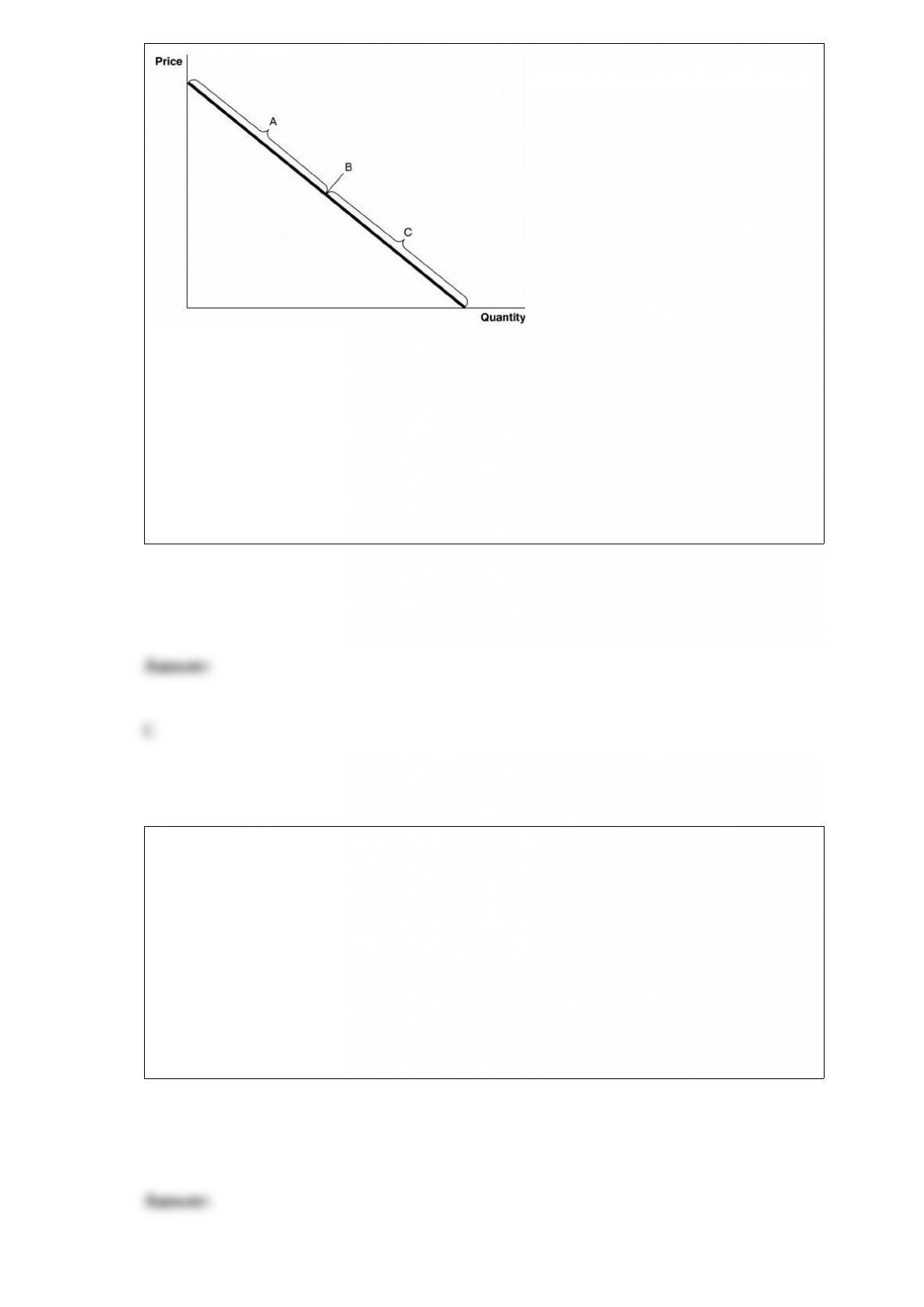
Refer to Figure 6-5. The section of the demand curve labeled “A” represents
A) the inelastic section of the demand curve.
B) the unit-elastic section of the demand curve.
C) the elastic section of the demand curve.
D) the perfectly elastic section of the demand curve.
Which of the following is true for a monopolistically competitive firm in long-run
equilibrium?
A) P = ATC and MR = MC.
B) P = ATC and P = MC.
C) P > ATC and P > MR.
D) P > MR and MC = ATC.

The cost of producing cigarettes in the U.S. has increased and at the same time, more
and more Americans are choosing to not smoke cigarettes. Which of the following best
explains the effect of these events in the cigarette market?
A) The supply curve has shifted to the right and the demand curve has shifted to the
left. As a result there has been an increase in the equilibrium quantity and an uncertain
effect on the equilibrium price.
B) Both the supply and demand curves have shifted to the right. As a result, there has
been an increase in the equilibrium quantity and an uncertain effect on the equilibrium
price.
C) Both the supply and demand curves have shifted to the left. As a result, there has
been a decrease in the equilibrium quantity and an uncertain effect on the equilibrium
price.
D) The supply curve has shifted to the right and the demand curve has shifted to the
left. As a result, there has been an increase in the equilibrium price and an uncertain
effect on the equilibrium quantity.
An economic principle that explains why countries produce different goods and
services is
A) absolute advantage.
B) trade as a percentage of GDP.
C) comparative advantage.
D) NAFTA.
One reason why airlines charge business travelers and leisure travelers different prices
is
A) business travelers fly according to schedules that are planned months in advance.
Many leisure travelers buy their tickets at the last minute.
B) business travelers usually travel alone. Leisure travelers often fly with friends and
family members; therefore, they have a more inelastic demand for airline tickets than
business travelers.
C) business travelers fly more often than most leisure travelers. As a result, their
employers are able to bargain with airlines for lower fares than leisure travelers pay.
D) business travelers often have inflexible schedules and have to travel on a particular
day. The opposite is true for leisure travelers.
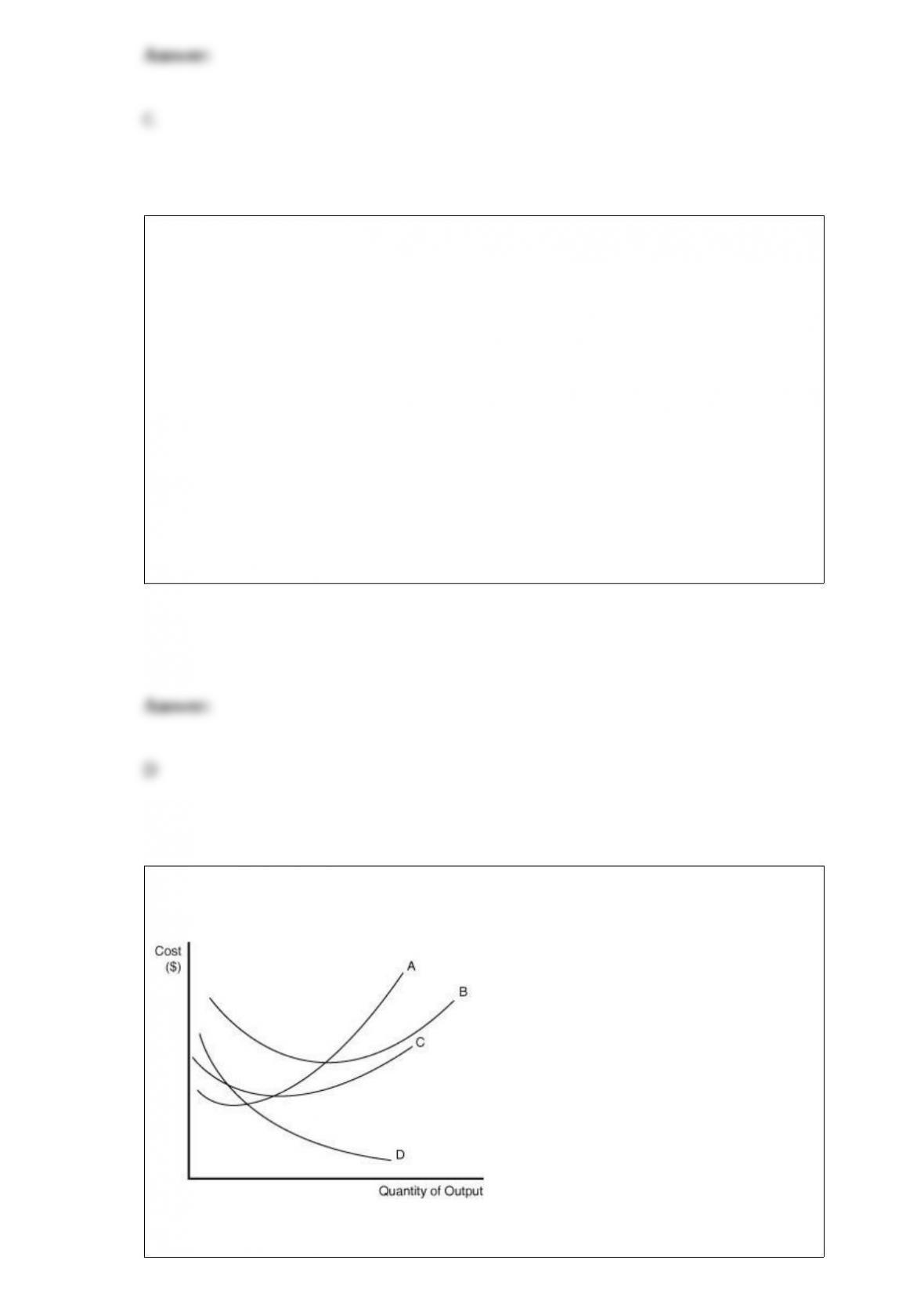
Figure 11-6
Figure 11-6 contains information about the short run cost structure of a firm.

Refer to Figure 11-6. In the figure above which letter represents the average fixed cost
curve?
A) A
B) B
C) C
D) D
In the United States, out-of-pocket spending on health care as a percentage of all
spending on health care has ________ since 1960.
A) slowly risen
B) steadily declined
C) more than doubled
D) remained stable
Microeconomics is the study of
A) how households and firms make choices.
B) the economy as a whole.

C) the global economy.
D) topics such as unemployment, inflation, and economic growth.
Article Summary
In an attempt to discourage smoking, New York City Mayor Michael Bloomberg
proposed a bill which would set a $10.50 minimum price for a pack of cigarettes. The
bill would also prohibit retailers from offering any discounts such as 2-for-1 offers or
accepting discount coupons. New York City already has the highest cigarette tax in the
country, at $5.85 per pack, and the state of New York is one of many which already
require cigarettes be marked up by a specified percentage. This bill is a companion to
one which would require stores to keep tobacco products hidden from sight. Although
the bills are expected to be challenged in court, a precedent has been set in Rhode
Island, where a court upheld a ruling allowing the city of Providence to forbid retailers
from accepting coupons and offering discounts on cigarettes.
Source: Vivian Yee, “Bloomberg Seeks End to Cheap Cigarettes,” New York Times,
March 26, 2013.
Refer to the Article Summary. The minimum price of $10.50 per pack of cigarettes
being proposed by Mayor Bloomberg is an example of
A) a price ceiling.
B) a price floor.
C) an economically efficient price.
D) a black market price.

Economists assume that the goal of consumers is to
A) do as little work as possible to survive.
B) make themselves as well off as possible.
C) expend all their income.
D) consume as much as possible.
The median voter theorem will be an accurate predicator of the outcomes of elections
A) only when voter turnout is very high.
B) when a majority of voters have preferences very similar to those of the median voter.
C) when a majority of voters have preferences different from those of the median voter.
D) regardless of whether preferences among voters are similar or different from those
of the median voter.
Suppose a negative technological change in the production of disease-resistant wheat
caused the price of wheat to rise. Holding everything else constant, how would this
affect the market for corn (a substitute for wheat)?
A) The supply of corn would decrease and the equilibrium price of corn would increase.
B) The demand for corn would increase and the equilibrium price of corn would
increase.
C) The demand for corn would decrease because consumers could afford to buy less
wheat and corn.
D) The demand for corn would increase and the equilibrium price of corn would
decrease.
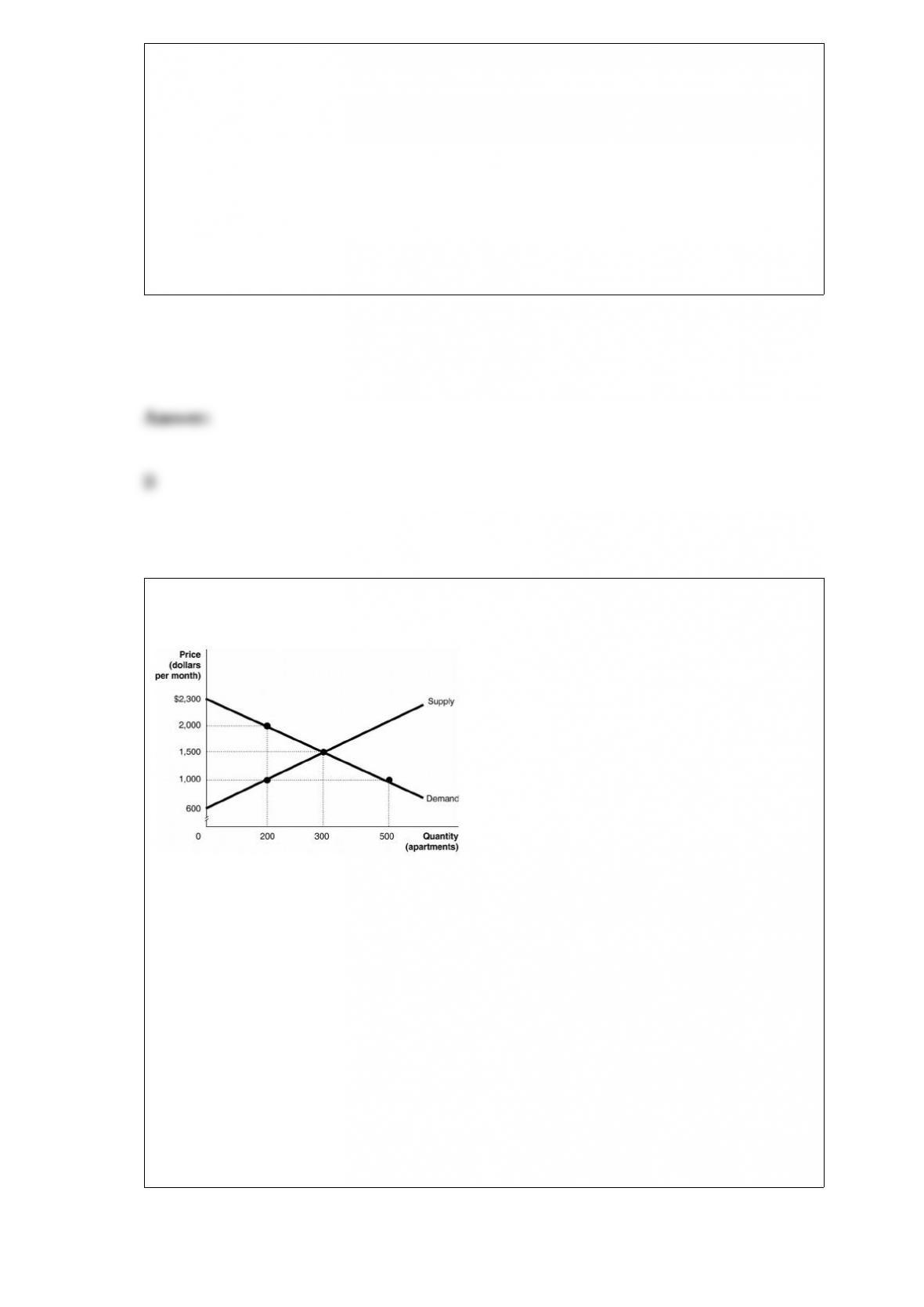
Figure 4-5
Figure 4-5 shows the market for apartments in Springfield. Recently, the government
imposed a rent ceiling of $1,000 per month.
Refer to Figure 4-5. Suppose that instead of a rent ceiling, the government imposed a
price floor of $2,000 per month for apartments. What is the value of the portion of
consumer surplus transferred to producers as a result of the price floor?
A) $40,000
B) $100,000
C) $125,000
D) $140,000

An example of a government-imposed barrier to entry gives a firm the exclusive right
to a new product for a period of 20 years from the date the product is invented. This
entry barrier is known as
A) a copyright.
B) a patent.
C) an exclusive marketing agreement.
D) a tariff.
Monopolistic competition is a market structure in which
A) firms produce and sell products for which there are no close substitutes.
B) the demand curve for a typical firm is horizontal.
C) firms cannot influence the market price.
D) barriers to entry are low.

The health care system in Japan is referred to as ________, under which every resident
of Japan is required to enroll in either a private or the government-provided health
insurance program.
A) an out-of-pocket system
B) a single-payer health care system
C) a universal health insurance system
D) socialized medicine
Anyone can purchase sulfur dioxide emissions allowances on the Chicago Mercantile
Exchange. Several environmental groups have raised money to buy allowances (which
they subsequently destroy). As part of their fund-raising, these groups have urged
contributors to buy the allowances as gifts. As one newspaper story put it, “For the
environmentalist in your life, here’s a gift that is sold by the ton, fits in an envelope and
will last forever.”
Source for quote: Randall Edwards, “Dear Santa: Please Bring Me Sulfur Dioxide for
Christmas,” Columbus Dispatch, December 19, 1999.
What would be the impact on the price of the emission allowances in the market?
A) The price rises.
B) The price falls to zero.
C) The price falls but not to zero.
D) The price remains unchanged because the allowances purchased by the
environmental groups are destroyed.

Which of the following is not a factor of production?
A) an acre of farmland
B) a drill press in a machine shop
C) the manager of the local tire shop
D) $1,000 in cash
When demand is elastic, a fall in price causes total revenue to rise because
A) when price falls, quantity sold increases so total revenue automatically rises.
B) the increase in quantity sold is large enough to offset the lower price.
C) the percentage increase in quantity demanded is less than the percentage fall in price.
D) the demand curve shifts.
Without an increase in the supplies of factors of production, how can a nation achieve

economic growth?
A) by producing more high-value goods and less of low-value goods
B) through technological advancement which enables more output with the same
quantity of resources
C) by lowering the prices of factors of production
D) by increasing the prices of factors of production
Suppose in the Germany, the opportunity cost of producing a gallon of beer is 5 gallons
of wine. In Italy, the opportunity cost of producing a gallon of beer is 3 gallons of wine.
a. What is the opportunity cost of producing a gallon of wine for Germany?
b. What is the opportunity cost of producing a gallon of wine for Italy?
c. Which country has a comparative advantage in the production of beer?
d. Which country has a comparative advantage in the production of wine?

Last year, Joan bought 50 pounds of hamburger when her household income was
$40,000. This year, her household income was only $30,000 and Joan bought 60 pounds
of hamburger. Holding everything else constant, Joan’s income elasticity of demand for
hamburger is
A) positive, so Joan considers hamburger to be an inferior good.
B) negative, so Joan considers hamburger to be an inferior good.
C) positive, so Joan considers hamburger to be a normal good and a necessity.
D) negative, so Joan considers hamburger to be a normal good.
Which of the following exemplifies the tragedy of the commons?
A) Residents on the northern coast of California receive only one public broadcasting
signal which may be eliminated altogether if government funding is cut.
B) The Pleasant Hill community is growing so fast that the city’s only post office is not
able to keep pace with the population growth in the community.
C) Canadian citizens receive free universal health care administered by provincial
governments.
D) The Malaysian tapir, distinguished for its unusual coloration, is a target for poachers
who hunt it for its tough and leathery hide.

Which of the following activities create a negative externality?
A) cleaning up the sidewalk on your block
B) graduating from college
C) repainting the house you live in to improve its appearance
D) keeping a junked car parked on your front lawn
If a stock’s dividend is expected to grow at a constant rate of 6 percent in the future and
it has just paid a dividend of $3.00 per share, and you have an alternative investment of
equal risk that will earn a 9 percent rate of return, what would you be willing to pay per
share for this stock?
A) $9
B) $20
C) $45
D) $106
Which of the following is an example of a Pigovian tax?
A) payments by utilities to obtain tradable emissions allowances

B) a payroll tax
C) payments for licenses to pollute
D) a tax imposed on a utility that internalizes the cost of externalities caused by the
utility
On a balance sheet
A) total assets must equal total liabilities plus equity.
B) total assets plus equity must equal total liabilities.
C) total assets plus total liabilities must equal zero.
D) total assets plus total liabilities plus equity must equal zero.