
Active changes in tax and spending by government intended to smooth out the business
cycle are called ________, and changes in taxes and spending that occur passively over
the business cycle are called ________.
A) automatic stabilizers; discretionary fiscal policy
B) discretionary fiscal policy; automatic stabilizers
C) automatic stabilizers; monetary policy
D) discretionary fiscal policy; conscious fiscal policy
In the dynamic aggregated demand and aggregate supply model, if AD shifts faster than
AS,
A) inflation occurs.
B) deflation occurs.
C) stagflation occurs.
D) disinflation occurs.
From an economic perspective, price discrimination is desirable because
A) the increase in profits is more than offset by the loss in consumer surplus, resulting
in a net increase in economic surplus.
B) it enables firms to increase profits with no loss in economic surplus, and in turn, this
could provide firms with incentives to engage in beneficial product innovation.

C) the increase in profits results in higher corporate tax revenues received by the
government which could be used to subsidize consumption for low-income individuals.
D) it redistributes wealth from wealthy consumers to highly innovative firms.
Each point on a demand curve shows
A) the willingness of consumers to purchase a product at Different prices.
B) the consumer surplus received from purchasing a given quantity of a product.
C) the economic surplus received from purchasing a given quantity of a product.
D) the legally determined maximum price that sellers may charge for a given quantity
of a product.
A decrease in aggregate demand results in a(n) ________ in the ________.
A) recession; long run
B) expansion; long run
C) expansion; short run
D) recession; short run
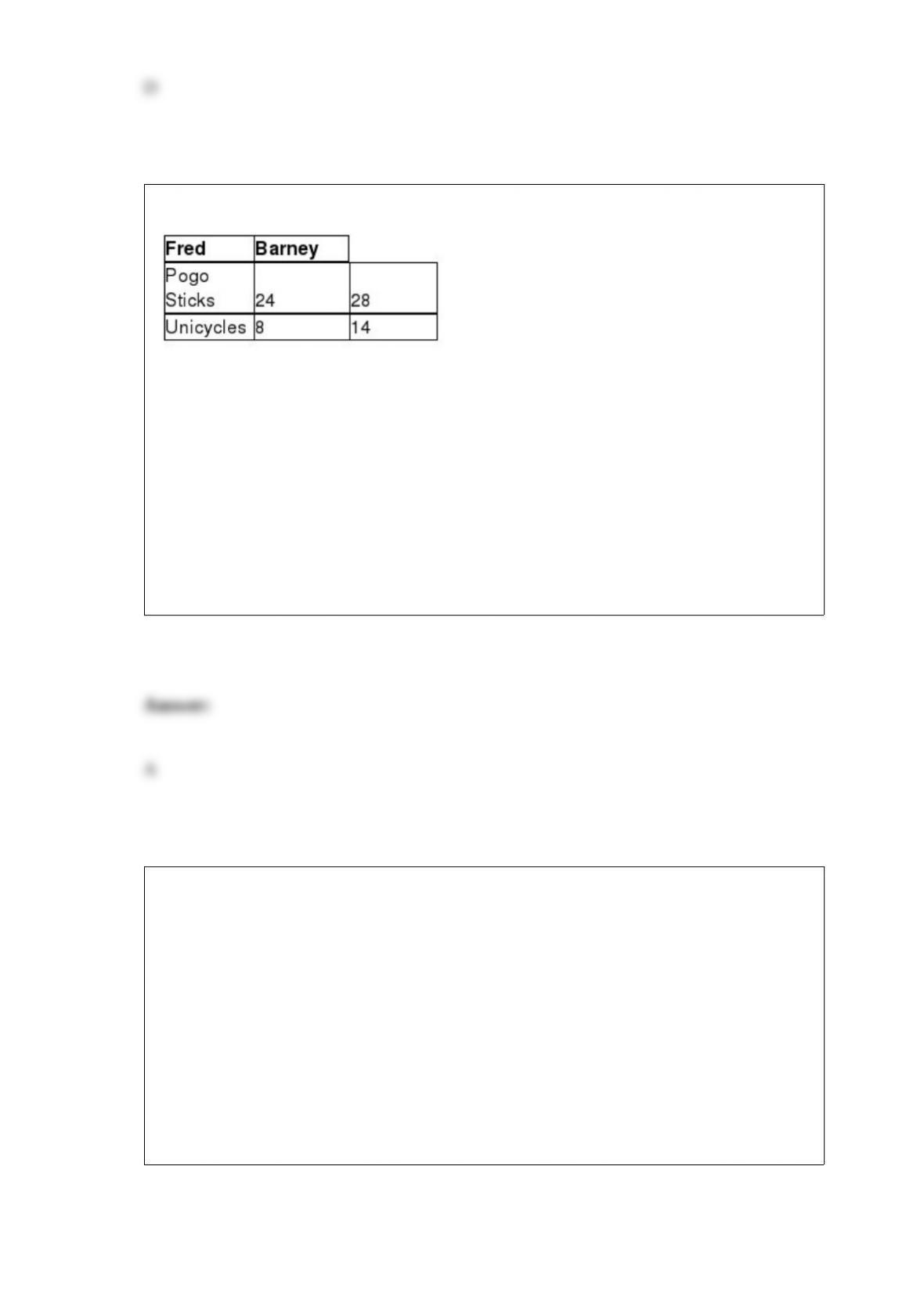
Table 2-10
Table 2-10 shows the output per month of two people, Fred and Barney. They can either
devote their time to making pogo sticks or making unicycles. What is Barney’s
opportunity cost of making a pogo stick?
A) 1/2 unicycle
B) 2 unicycles
C) 1/3 unicycle
D) 1.4 pogo sticks
Which of the following is the best example of a voluntary export restraint?
A) a limit set by the Japanese government on the number of sports utility vehicles that
the United States can import from Japan
B) a subsidy granted by the U.S. government to domestic garment manufacturers so
they can compete more effectively with foreign garment manufacturers
C) a tax placed on all sports utility vehicles sold in the domestic market
D) a $5,000 per-car fee imposed on all sports utility vehicles imported into the United
States
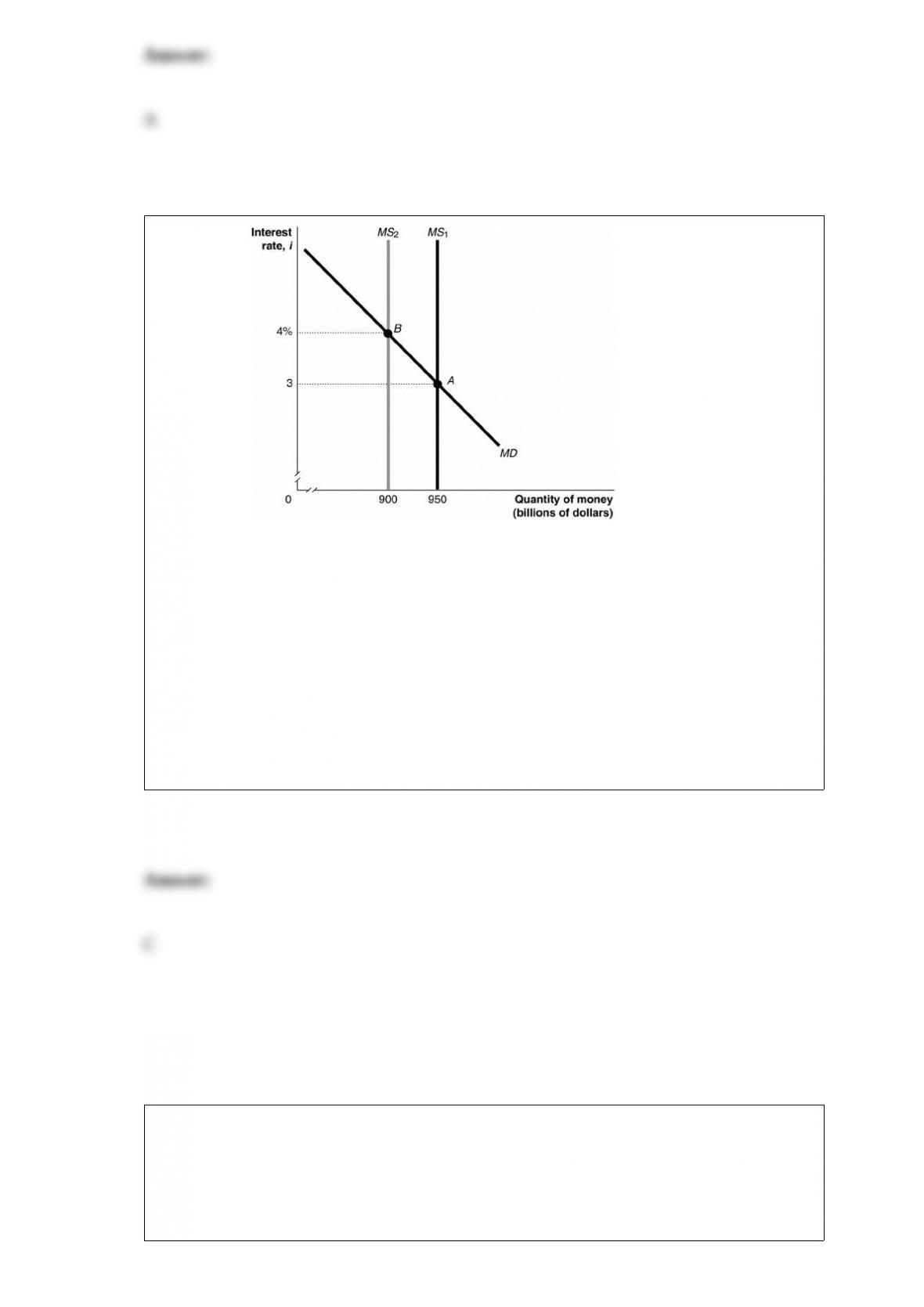
Figure 15-2
In the figure above, the movement from point A to point B in the money market would
be caused by
A) an increase in the price level.
B) a decrease in real GDP.
C) an open market sale of Treasury securities by the Federal Reserve.
D) a decrease in the required reserve ratio by the Federal Reserve.
The current exchange rate system has which of the following characteristics?
A) The United States allows the dollar to float against other major currencies.
B) All developing countries allow their currencies to float against the dollar and other

major currencies.
C) The countries of the European Union have adopted the gold standard.
D) Several developing countries in Asia have adopted the Bretton Woods system.
E) The current global foreign exchange system is a fixed system.
When production reflects consumer preferences, ________ occurs.
A) allocative efficiency
B) productive efficiency
C) equity
D) efficient central planning
Last week, six Swedish kronor could purchase one U.S. dollar. This week, it takes eight
Swedish kronor to purchase one U.S. dollar. This change in the value of the dollar will
________ exports from the United States to Sweden and ________ U.S. aggregate
demand.
A) increase; increase
B) decrease; decrease
C) increase; decrease
D) decrease; increase

In the first half of 2011, automobile sales in the United States were lower than they
were in the first half of 2010. The decrease in auto sales impacts GDP because new
automobiles are counted as ________ when purchased by households and ________
when purchased by businesses.
A) nondurable goods; durable goods
B) consumption; investment
C) investment; consumption
D) durable goods; nondurable goods
If the price of gasoline decreases, what will be the impact in the market for public
transportation?
A) The demand curve for public transportation shifts to the right.
B) The quantity of public transportation demanded increases.
C) The demand curve for public transportation shifts to the left.
D) The quantity of public transportation demanded decreases.

The “Big Mac Theory of Exchange Rates” tests the accuracy of the purchasing power
parity theory. In July 2013, the Economist reported that the average price of a Big Mac
in the U.S. was $4.56. In Sweden, the average price of a Big Mac at that time was 41.6
kronor. What is the “implied exchange rate” between Swedish kronor and U.S. dollars?
A) 0.11 kronor per dollar
B) 1.90 kronor per dollar
C) 9.12 kronor per dollar
D) 46.2 kronor per dollar
The law of diminishing marginal returns states
A) that at some point, adding more of a fixed input to a given amount of variable inputs
will cause the marginal product of the variable input to decline.
B) that at some point, adding more of a variable input to a given amount of a fixed input
will cause the marginal product of the variable input to decline.
C) that in the presence of a fixed factor, at some point average product of labor starts to
fall as more and more variable inputs are added.
D) average total costs of production initially fall and after some point starts to rise at a
decreasing rate as output increases.