1) money functions as a medium of exchange by eliminating the need for a coincidence
of wants.
2) A recessionary expenditure gap in a mixed open economy can be measured as the
extent to which aggregate expenditures (Ca + Ig + Xn + G) fall short of real GDP at the
full-employment level of real GDP.
3) Rent performs an incentive function, but no rationing function.
4) Human beings consume more both in absolute terms and on a per capita basis than
they did 200 years ago.
5) The Wheeler-Lea Act prohibits corporations from purchasing the stock of competing
firms.
6) in moving northeasterly from the origin we encounter indifference curves that reflect
higher and higher levels of total utility.
7) If the MPC in the economy is .75, government could shift the aggregate demand
curve rightward by $30 billion by cutting taxes by $10 billion.
8) Capital flight refers to the fact that many DVCs must use their export earnings to pay
interest on their outstanding external debts.
9) business income will decrease in the nation from which workers emigrate.
10) The immediate-short-run aggregate supply curve is vertical at the full employment
level of output.
11) in maximizing profit a firm will always produce that output where total revenues
are at a maximum.
12) which of the following is an intermediate good?
a.the purchase of gasoline for a ski trip to colorado.
b.the purchase of baseball uniforms by a professional baseball team.
c.the purchase of a pizza by a college student.
d.the purchase of jogging shoes by a professor
13) An efficiency wage is:
A.a wage payment necessary to compensate workers for risk of injury on the job.
B.a “wage” that contains a profit-sharing component as well as traditional hourly pay.
C.an above-market wage that minimizes a firm’s labor cost per unit of output.
D.a wage that automatically rises with the national index of labor productivity.
14) Use this aggregate demandaggregate supply schedule for a hypothetical economy to
answer the following questions.
(a)What will be the equilibrium price level and quantity of real domestic output?
(b)If the quantity of real domestic output demanded increased by $2000 at each price
level, what will be the new equilibrium price level and quantity of real domestic output?
(c)Using the original data from the table, if the quantity of real domestic output
demanded increased by $5000 and the quantity of real domestic output supplied
increased by $1000 at each price level, what would the new equilibrium price level and
quantity of real domestic output be?
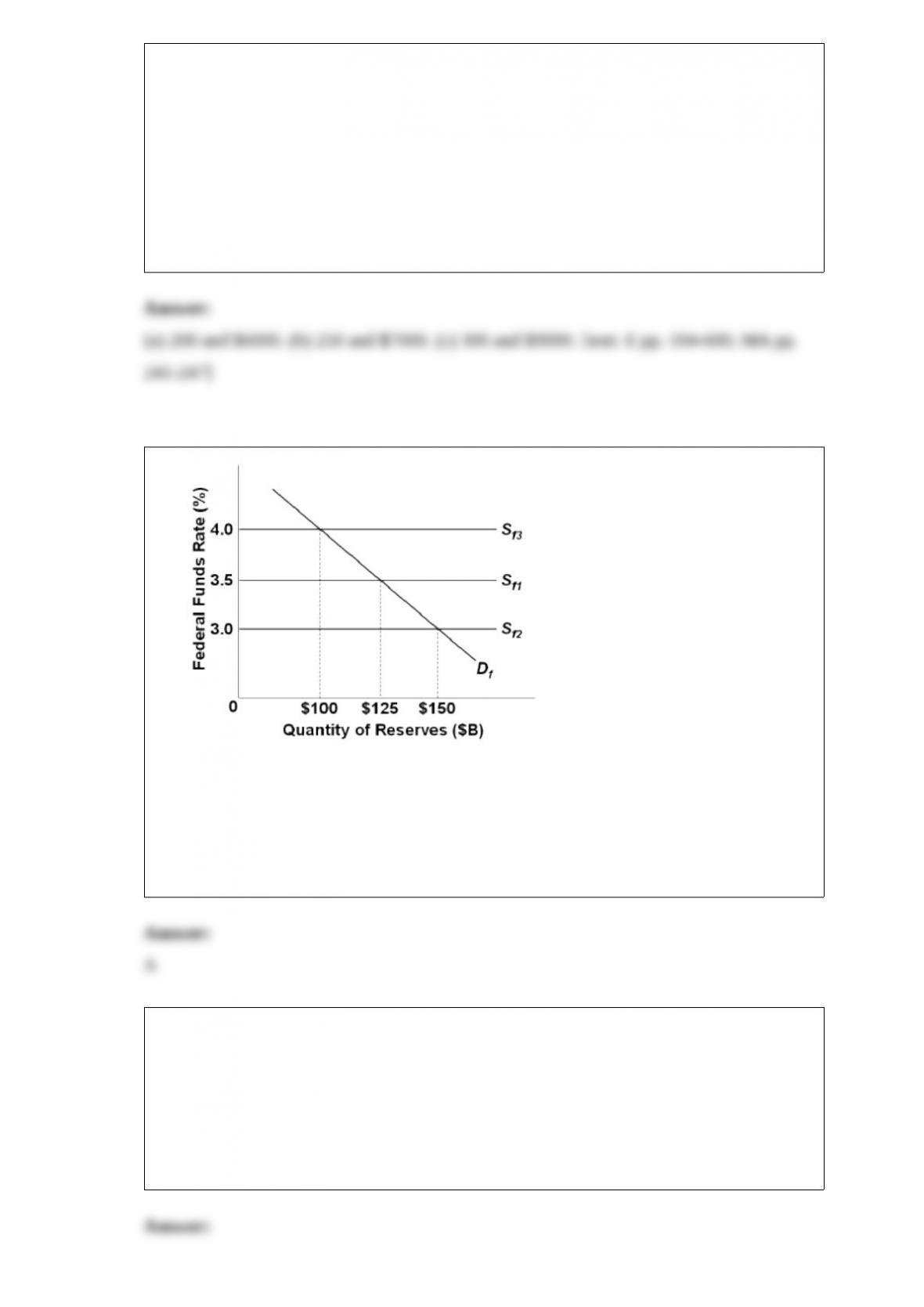
15)
Refer to the above diagram for the Federal funds market. The equilibrium Federal funds
rate:
A.depends on the supply of Federal funds.
B.is 3.0 percent.
C.is 3.5 percent.
D.is 4.0 percent.
16) strong property rights are important for modern economic growth because:
a.they allow governments to extract the gains from private citizens’ investments.
b.people are less likely to invest if they are fearful that others can take their returns on
investment without compensation.
c.they ensure an equitable distribution of income.
d.business cycle fluctuations will be smaller and less likely to disrupt investment
patterns.
17) fixed cost is:
a.the cost of producing one more unit of capital, say, machinery.
b.any cost which does not change when the firm changes its output.
c.average cost multiplied by the firm’s output.
d.usually zero in the short run.
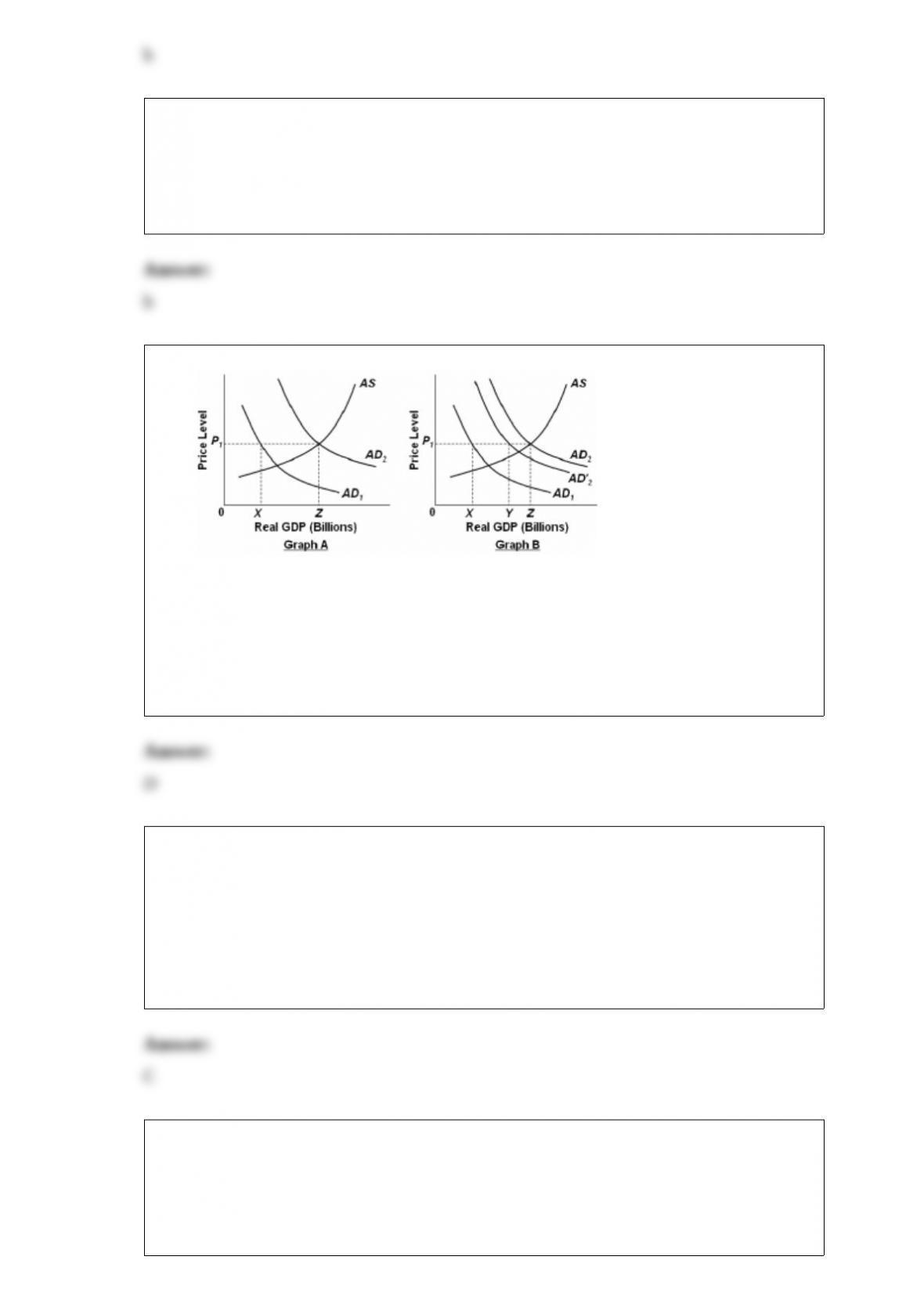
18)
Suppose real GDP is X, as shown in graph A. Appropriate government fiscal policy
would be to:
A.increase taxes.
B.reduce government spending.
C.reduce government spending and taxes by equal-sized amounts.
D.reduce taxes or increase government spending.
19) A major difference between social insurance and welfare is that social insurance:
A.exclusively involves older Americans whereas welfare is confined mainly to mothers
with young children.
B.forces recipients to demonstrate need while welfare does not.
C.is normally financed by earmarked payroll taxes while welfare is financed out of
general tax revenues.
D.provides cash transfers while welfare does not.
20) Suppose the G8 nations decide that the dollar is too strong (high in value) relative
to the yen. These nations might:
A.use official reserves of yen to buy dollars.
B.use official reserves of dollars to buy yen.
C.encourage Japan to print more yen.
D.encourage the United States to increase interest rates.
21) In the Microsoft antitrust case, the Federal government said in essence that:
A.the mere presence of monopoly violated the Sherman Act, irrespective of Microsoft’s
behavior.
B.Microsoft was a “bad monopoly.”
C.Microsoft was generally a “good monopoly,” but that its tying contracts involving
Internet Explorer violated the Clayton Act.
D.the case was similar to the U.S. Steel case of 1920.
22) What is the effect of the multiplier when aggregate demand increases and there is a
large increase in the price level? What happens when there only is a small increase in
the price level?
23) Why do economists refer to prices as sticky rather than stuck?
24) What is the opportunity cost of unemployment for an economy? What social
problems have been linked to higher rates of unemployment?
25) Explain the Phillips Curve concept and construct an example of the curve on the
below graph.
26) Using the extended ADAS model, explain how inflation depends on aggregate
demand and not the level of real GDP.
27) Pollution should be completely eliminated. Evaluate. Support your answer using
MB and MC analysis.