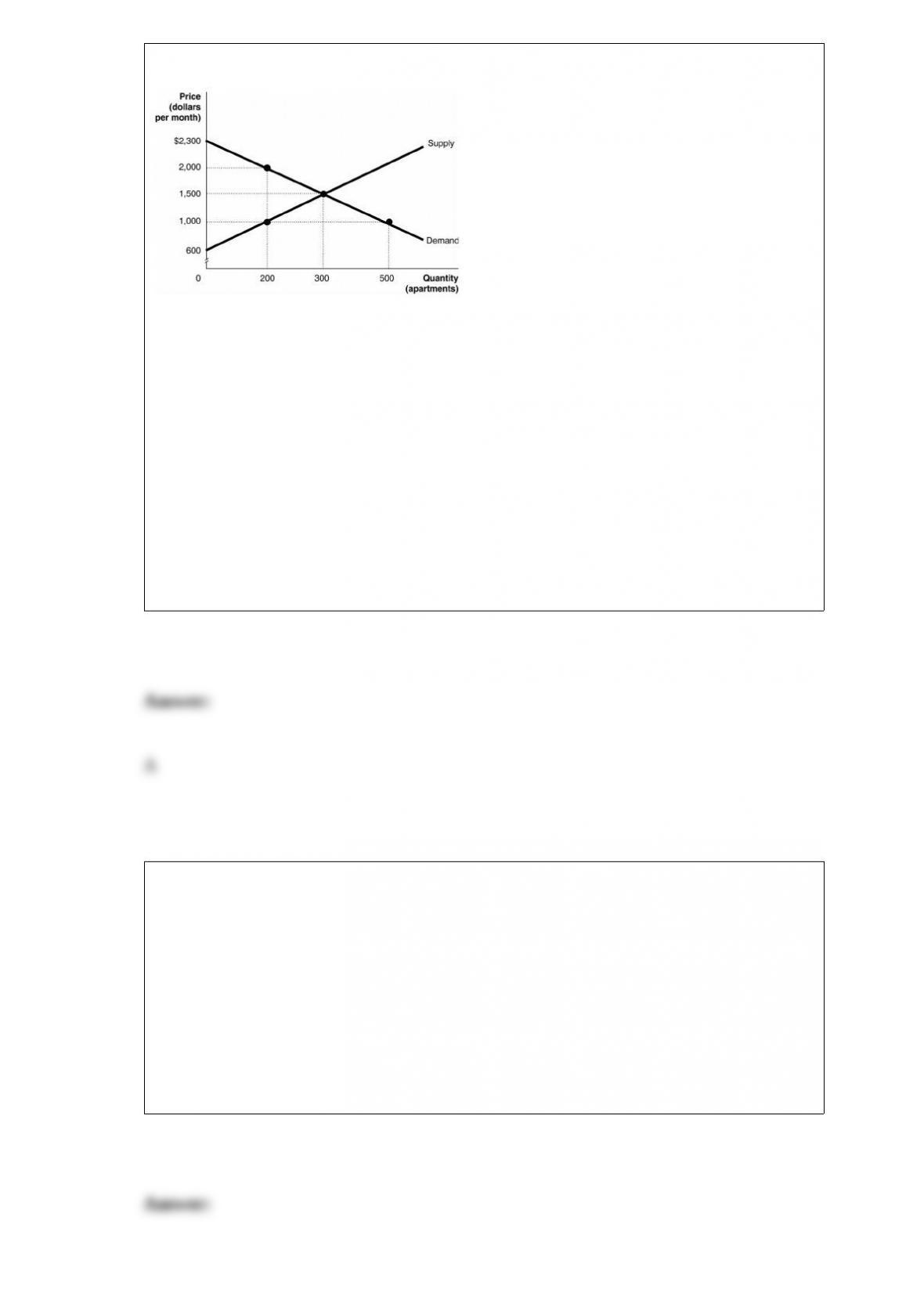
Figure 4-5
Figure 4-5 shows the market for apartments in
Springfield. Recently, the government imposed a rent ceiling of $1,000 per month.
Suppose that instead of a rent ceiling, the government imposed a price floor of $2,000
per month for apartments. What is the value of the deadweight loss after the imposition
of the price floor?
A) $50,000
B) $125,000
C) $175,000
D) $260,000
Suppose the demand curve for a product is vertical and the supply curve is upward
sloping. If a unit tax is imposed in the market for this product
A) sellers bear the entire burden of the tax.
B) buyers bear the entire burden of the tax.
C) the tax burden will be shared equally between buyers and sellers.
D) buyers share the burden of the tax with government.

Oligopoly differs from perfect competition and monopolistic competition in that
A) barriers to entry are lower in oligopoly industries than they are in perfectly
competitive and monopolistically competitive industries.
B) demand and marginal revenue curves are more useful for analyzing oligopoly than
they are for analyzing perfect competition and monopolistic competition.
C) because oligopoly firms often react when other firms in their industry change their
prices, it is difficult to know what the oligopolist’s demand curve looks like.
D) the concentration ratios of oligopoly industries are lower than they are for perfectly
competitive and monopolistically competitive firms.
Suppose in Finland a worker can produce either 32 cell phones or 4 kayaks while in
Canada a worker can produce either 40 cell phones or 10 kayaks.
a. Which country has an absolute advantage in cell phone production? In kayak
production?
b. What is the opportunity cost of 1 cell phone in Finland? In Canada?
c. What is the opportunity cost of 1 kayak in Finland? In Canada?
d. Which country has a comparative advantage in cell phone production? In kayak
production?
e. Suppose each country has 1,000 workers. Currently, each country devotes 40 percent
of its labor force to cell phone production and 60 percent to kayak production. What is
the output of cell phones and kayaks for each country and what is the total output of cell
phones and kayaks between the two countries?
f. Suppose each country specializes in the production of the good in which it has a
comparative advantage. What is the total output of cell phones and kayaks in the two
countries?
g. Provide a numerical example to show how Finland and Canada can both gain from
trade. Assume that the terms of trade are established at 6 cell phones for 1 kayak.

You borrow $10,000 from a bank for one year at a nominal interest rate of 5%. If
inflation over the year is 2%, what is the real interest rate you are paying?
A) 2%
B) 2.5%
C) 3%
D) 5%
In a study conducted by Marianne Bertrand and Sendhil Mullianthan, identical resumes
were sent in response to help wanted ads in newspapers, with half of the resumes
assigned an African-American-sounding name and half assigned a white-sounding
name. The study found that
A) employers were equally likely to interview workers with white-sounding names and
with African-American-sounding names.
B) employers were 50 percent more likely to interview workers with
African-American-sounding names.
C) employers were 50 percent more likely to interview workers with white-sounding
names.
D) no employers chose to interview workers with African-American-sounding names.
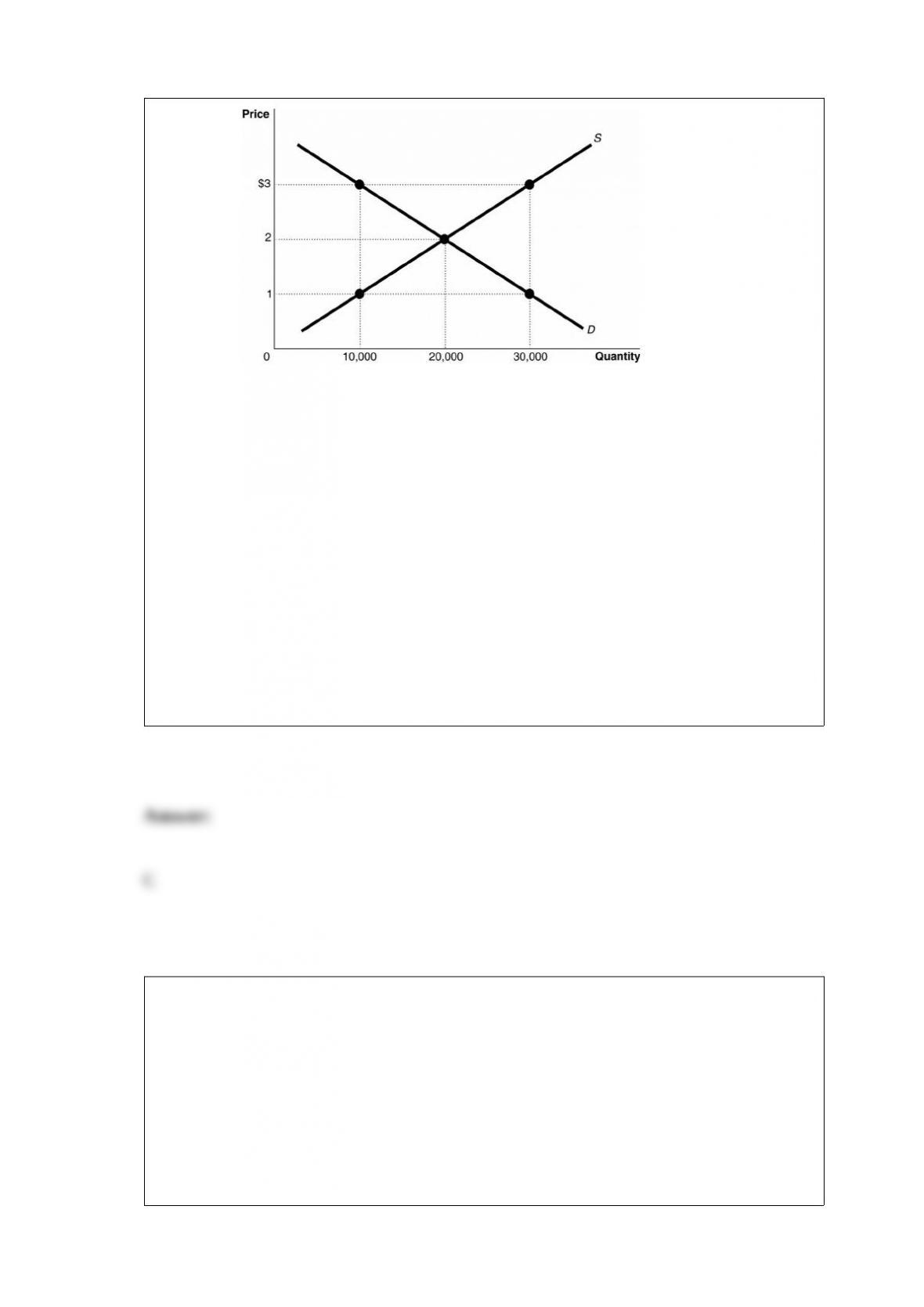
Figure 4-7
The figure above represents the market for iced tea. Assume that this is a competitive
market. At a price of $3,
A) the marginal cost of iced tea is greater than the marginal benefit; therefore, output is
inefficiently low.
B) producers should lower the price to $1 in order to sell the quantity demanded of
10,000.
C) the marginal benefit of iced tea is greater than the marginal cost; therefore, output is
inefficiently low.
D) the marginal benefit of iced tea is greater than the marginal cost; therefore, output is
inefficiently high.
A black market is a market where buying and selling take place
A) at prices that violate government price regulations.
B) in non-licensed shops and warehouses.
C) after regular office hours.
D) on foreign soil.
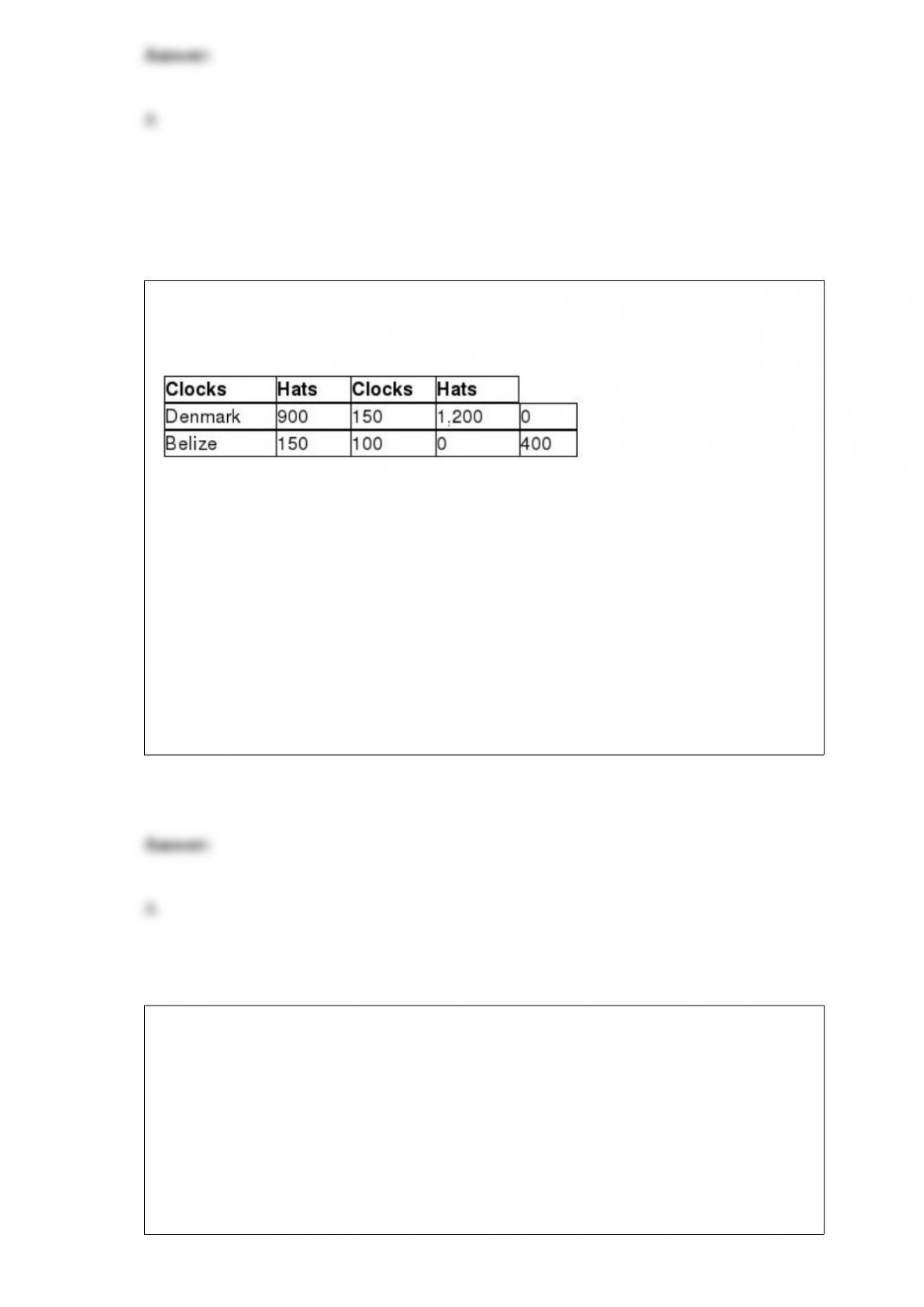
Table 9-11 Production and
Consumption Production
Without Trade With Trade
Denmark and Belize can produce both clocks and hats. Table 9-11 shows the production
and consumption quantities without trade, and the production numbers with trade.
With trade, what is the total gain in hat production?
A) 150
B) 300
C) 400
D) 650
When Ford increases the production of cars in Australia, which of the following occurs?
A) GDP in the United States rises.
B) GNP in the United States rises.
C) GNP in Australia rises.
D) Both A and C occur.

The producer price index measures the prices that firms
A) pay for imported natural resources that go into the production process.
B) receive for the goods and services they export.
C) receive for the goods and services they use at all stages of production.
D) pay for labor, whether or not the labor is foreign or domestic.
Article Summary. According to the International Energy Agency (IEA), increased
oil production resulting from U.S. shale oil has invigorated the North American oil
industry and has created a global supply shock. The shale oil and gas industry has
generated tens of billions of dollars in revenues and hundreds of thousands of new
jobs, and could result in the United States changing from being the world’s largest
oil importer to a net exporter within a few years. An IEA forecast predicts that
because of shale oil, the United States will become the world’s largest oil producer
by 2017, with supply growing by 3.9 million barrels per day from 2012-2018.
Source: Denise Roland, and AFP, “US shale energy creates global oil ‘supply
shock’,” Telegraph, May 14, 2013.
The supply shock mentioned in the article summary may well result in a decrease in the
price of oil. When the price of oil falls unexpectedly, the equilibrium price level
________ and the unemployment rate ________ in the short run.
A) rises; falls
B) rises; rises
C) falls; falls

D) falls; rises
Which of the following is an asset for a bank?
A) deposits of its customers
B) short-term borrowing
C) shareholders’ equity
D) loans
________ spending follows a smooth trend whereas, ________ spending is more
volatile and subject to fluctuations.
A) Consumer; government
B) Consumer; investment
C) Investment; consumer
D) Government; consumer

Which of the following correctly describes the automatic mechanism through which the
economy adjusts to long-run equilibrium?
A) the leftward shift of the short-run aggregate supply curve that occurs after a
recession
B) the rightward shift of the short-run aggregate supply curve that occurs after a
recession
C) the leftward shift of the aggregate demand curve that occurs after a recession
D) the rightward shift of the aggregate demand curve that occurs after a recession
The economic analysis of minimum wage involves both normative and positive
analysis. Consider the following consequences of a minimum wage:
a. The minimum wage law causes unemployment.
b. Unemployment would be lower without a minimum wage law.
c. Minimum wage laws benefit some workers and harm others.
d. The minimum wage should be more than $7.25 per hour. Which of the consequences
above are positive statements and which are normative statements?
A) a, b, and c are positive statements; d is a normative statement.
B) a and b are positive statements; c and d are normative statements.
C) Only a is a positive statement; b, c and d are normative statements.
D) a and c are positive statements; b and d are normative statements.
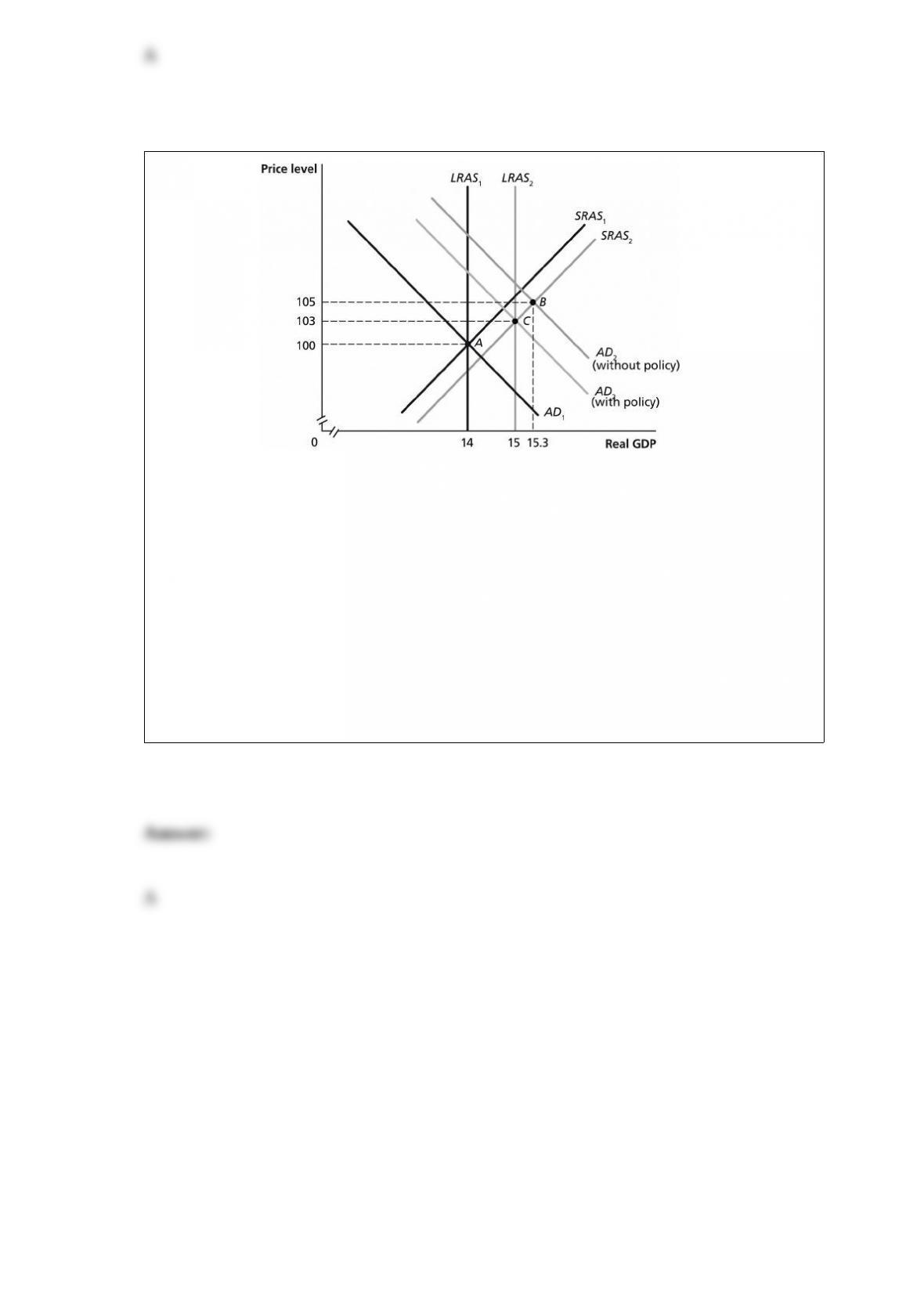
Figure 27-10
In the graph above, suppose the economy in Year 1 is at point A and expected in Year 2
to be at point B. Which of the following policies could the Congress and the president
use to move the economy to point C?
A) increase income taxes
B) increase government spending
C) buy Treasury bills
D) decrease the discount rate