
1) Assume there is an increase in government spending and a reduction in net taxes.
With a specific money supply, the consequent:
A.contractionary impact might be lessened by the resulting increase in the interest rate.
B.expansionary impact might be lessened by the resulting increase in the interest rate.
C.contractionary impact might be enhanced by the resulting decline in the interest rate.
D.expansionary impact might be enhanced by the resulting decline in the interest rate.
2) other things equal, immigration has what effects on the destination nation?
a.reduced average wage rate, increased domestic output, increased business income,
and lower total wage income of native-born workers.
b.reduced average wage rate, increased domestic output, increased business income,
and greater total wage income of native-born workers.
c.increased average wage rate, increased domestic output, increased business income,
and greater total wage income of native-born workers.
d.increased average wage rate, reduced domestic output, reduced business income, and
lower total wage income of native-born workers.
3) Answer the next question(s) on the basis of the following list of assets:
1> Large ($100,000 and over) time deposits
2> Noncheckable savings deposits
3> Currency (coins and paper money)
4> Small (under $100,000) time deposits
5> Stock certificates
6> Checkable deposits
7>Money market deposit accounts
8>Money market mutual fund balances held by individuals
9>Money market mutual fund balances held by businesses
Refer to the above list. The M1 definition of money comprises item(s):
A.6 only.
B.3, 4, and 6.
C.3 and 6.
D.2, 3, and 6.
4) the total amount of income earned by u.s. resource suppliers in a year, plus taxes on
production and imports, is measured by:
a.gross domestic product.
b.national income.
c.personal income.
d.disposable income.
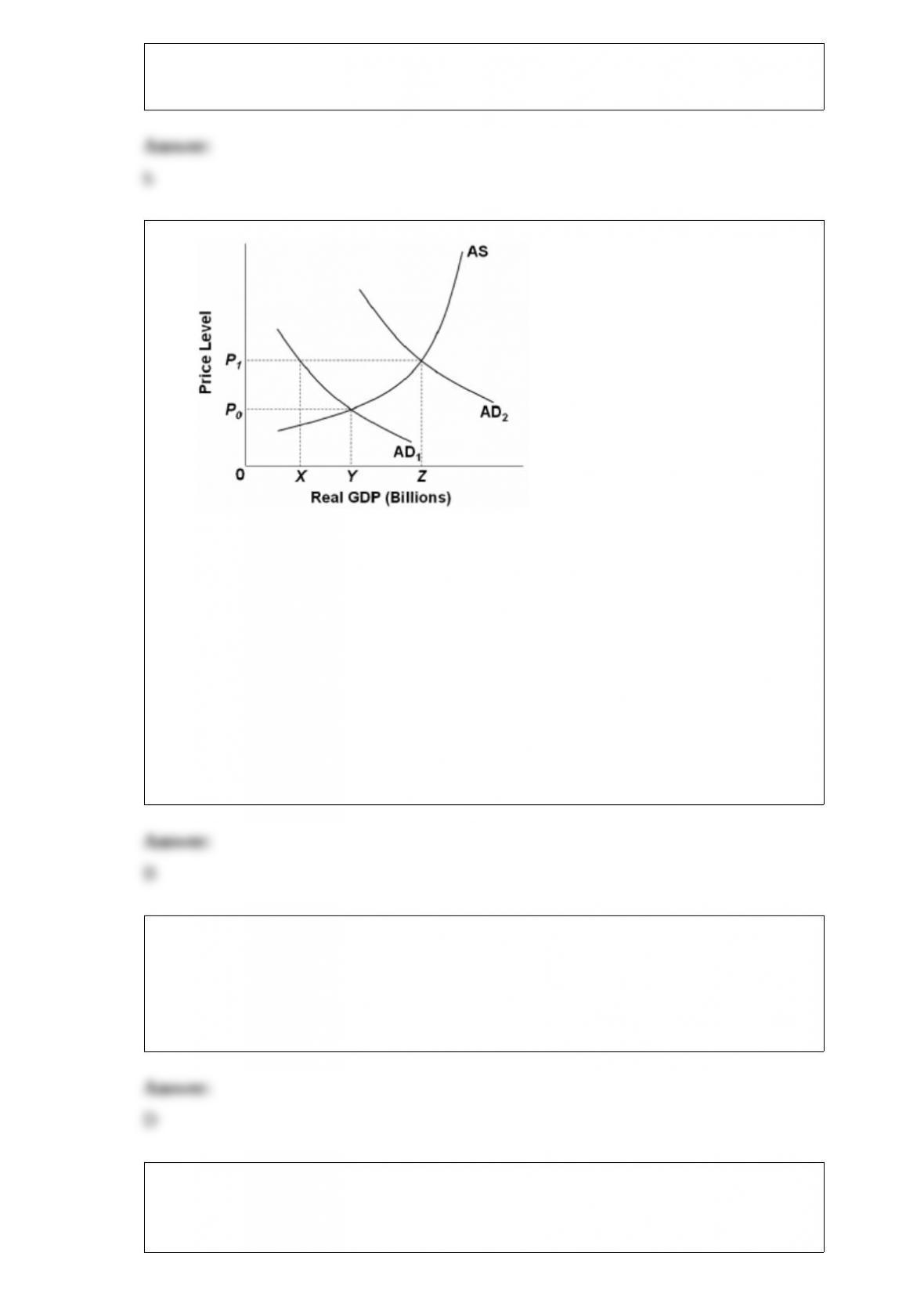
5)
Refer to the above figure. Suppose that the economy is currently operating at the
intersection of AS and AD2, and that the full employment level of output is Y. If
contractionary fiscal policy and accompanying multiplier effects move aggregate
demand from AD2 to AD1, what will be the effect on real GDP and the price level?
A.Real GDP will fall to Y and the price level will fall to P1, assuming a ratchet effect
occurs.
B.Real GDP will fall to X and the price level will remain unchanged, assuming a ratchet
effect occurs.
C.Real GDP will fall to X and the price level will fall to P1, assuming a ratchet effect
occurs
D.Real GDP will fall to Y and the price level will remain unchanged, assuming a ratchet
effect occurs
6) Money functions as:
A.a store of value.
B.a unit of account.
C.a medium of exchange.
D.all of these.
7) according to the office of immigration statistics, approximately what percentage of
legal immigrants to the united states in 2007 were refugees?
a.2.2 percent
b.4.0 percent
c.12.9 percent
d.15.4 percent
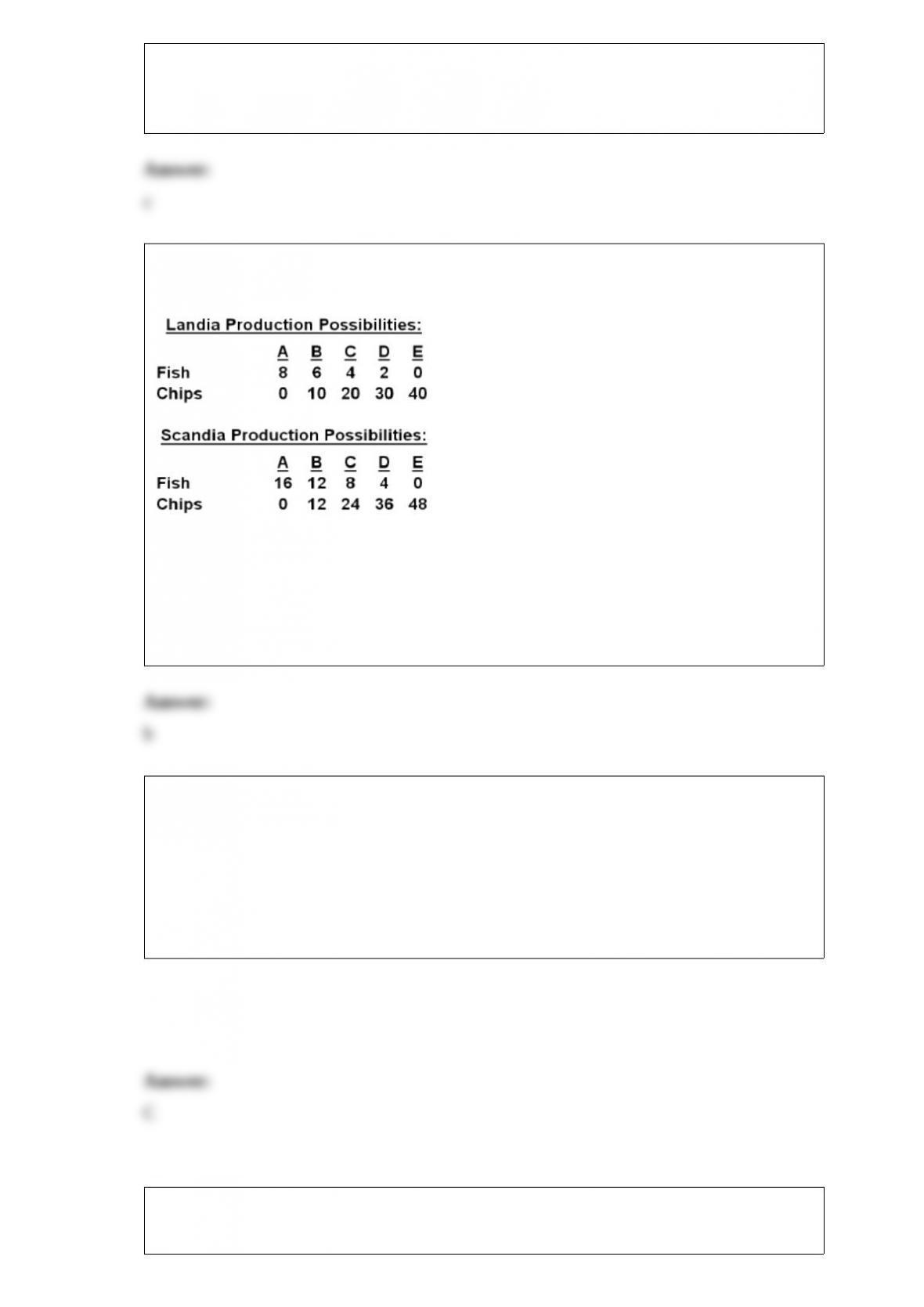
8) the following production possibilities data for landia and scandia:
refer to the above data. if landia and scandia fully specialize based on comparative
advantage, their aggregate output will be:
a.48 chips and 8 fish.
b.40 chips and 16 fish.
c.36 chips and 10 fish.
d.42 chips and 12 fish.
9)
ACME Corporation used to produce $50 worth of goods (in year 2000 dollars) per
million BTUs used. Now it produces $60 worth of goods (in year 2000 dollars) per
million BTUs. Based on this, we can conclude:
A.nothing about ACME’s energy efficiency.
B.that ACME’s energy efficiency has declined.
C.that ACME’s energy efficiency has improved.
D.that ACME is using a single energy source and achieving economies of scale in
production.
10) The table below lists the domestic supply, demand and price levels for sugar in
Haiti and the Dominican Republic. Use this information to answer the following
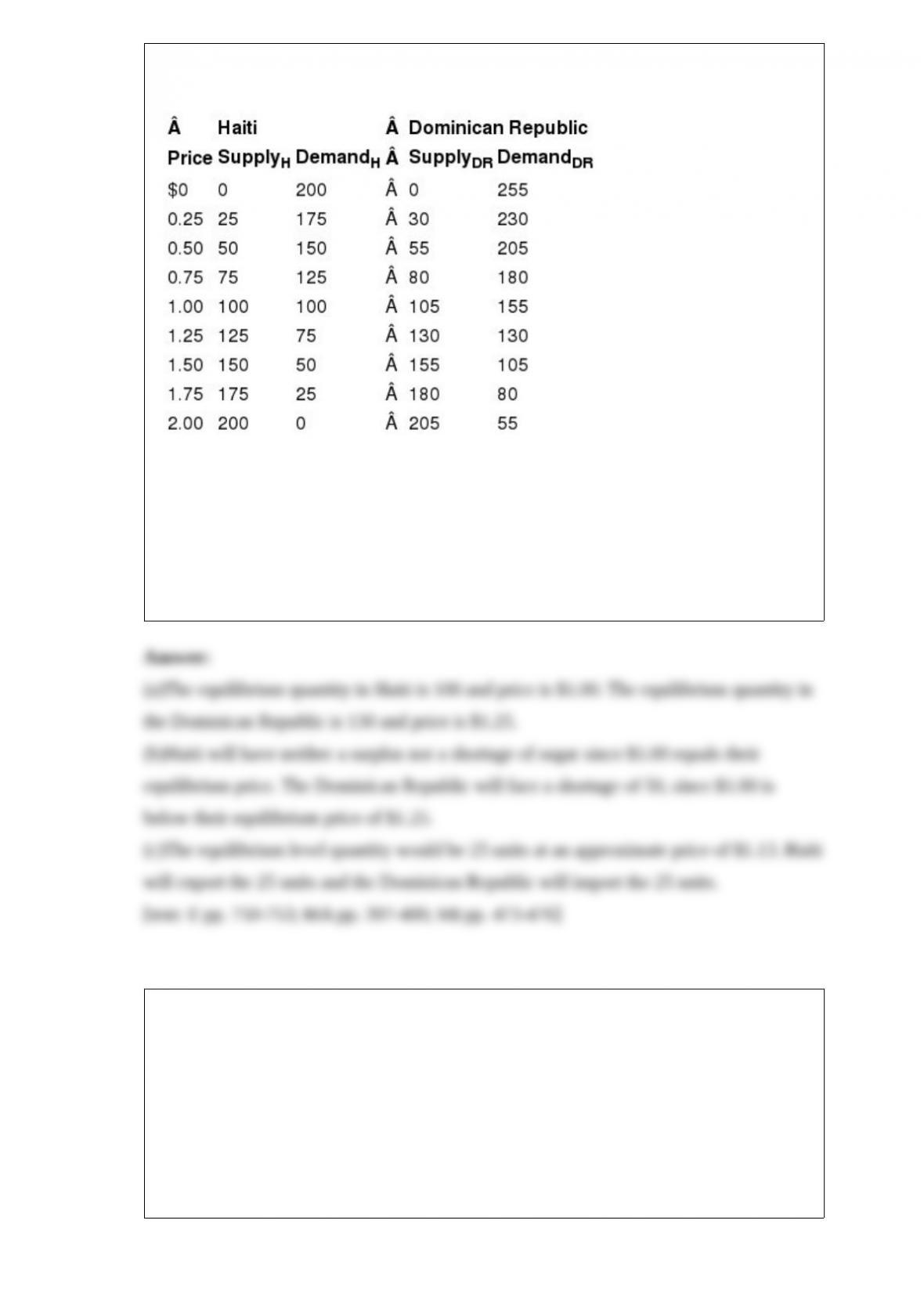
questions.
(a)What is the domestic equilibrium level of quantity and price of sugar in each
country?
(b)Suppose the world price of sugar is currently $1.00. Will each country face a
shortage, surplus or neither for sugar?
(c)If the domestic markets for sugar of each country were combined, what would be the
equilibrium quantity and price of imports/exports? Which country will import sugar and
which will export? Support your answer graphically.
11) Which of the following generalizations is correct?
A.the more elastic the supply of a product, the larger the portion of an excise tax that is
borne by buyers
B.the more elastic the demand for a product, the larger the portion of an excise tax that
is borne by buyers
C.the more inelastic the supply of a product, the larger the portion of an excise tax that
is borne by buyers
D.the more inelastic the demand for a product, the larger the portion of an excise tax
that is borne by sellers

12) mild demand-pull inflation:
a.raises the natural rate of unemployment.
b.usually leads to hyperinflation.
c.has an uncertain effect on real output.
d.decreases the natural rate of unemployment.