
The “Taylor rule” for monetary policy provides the Fed with a
a. mechanical prescription for monetary policy.
b. benchmark to guide policy decisions.
c. time frame for discount rate changes.
d. rule for changing the M1 money supply.
A budget deficit will be most inflationary if the aggregate
a. demand curve is very steep.
b. demand curve is very flat.
c. supply curve is very flat.
d. supply curve is very steep.
If the Fed is increasing its holdings of government bonds at the same time the federal
deficit is increasing,
a. the Fed and the Treasury are, as usual, coordinating activities.
b. crowding out is more likely to occur.

c. the debt is being monetized.
d. the Fed is attempting to increase interest rates.
Opportunity cost can always be measured in money terms.
a. True
b. False
A car sells at different prices at different dealerships in an oligopolistic market. If a
consumer has imperfect information about the price of a car at each dealership, he
should
a. always gather all available information about prices.
b. gather information about prices until the expected marginal utility of more
information equals the marginal cost of gathering it.
c. gather information about prices only if it can be gathered without cost.
d. ignore information about prices because it is irrelevant to making an “optimally
imperfect” decision.

A monopolist is a price maker.
a. True
b. False
When the goods of competing companies are identical, consumers have no reason to
prefer one product over the other so the demand curve for each manufacturer will be
perfectly elastic.
a. True
b. False
An increase in demand will have what effect on equilibrium price and quantity?
a. Price will increase; quantity will decrease.
b. Price will decrease; quantity will increase.

c. Both price and quantity will increase.
d. Both price and quantity will decrease.
Vertical equity refers to the notion that equally situated individuals should be taxed
equally.
a. True
b. False
The supply curve of books (which are produced using paper made from trees) will shift
to the left in response to
a. a decline in college tuition.
b. an increase in home building.
c. an increase in the supply of lumberjacks.
d. an end to government regulations that limit timber harvesting in national forests.

Oligopolists seldom change prices, because they don’t like change.
a. True
b. False
At the beginning of the 20th century, average U.S. income was less than $6,000; as of
2013, the average income was nearly $53,000.
a. True
b. False
If (X − IM) < 0, then capital inflows
a. will be zero.
b. will be greater than zero.
c. will be less than zero.

d. can be zero, positive, or negative.
Increases in the availability of natural resources will affect the aggregate supply curve
such that it
a. shifts inward and becomes flatter.
b. shifts inward.
c. shifts outward.
d. becomes flatter.
e. becomes steeper.
Environmentalists, politicians, and economists have different perspectives on what
constitutes appropriate environmental policy. Which of the following statements was
probably made by an economist?
a. “We take the position that there are rights involved here, rights to be protected from
threats to your health, regardless of the costs involved.”
b. “Protecting the environment is so important that standards cannot be too high, and
continuing improvements must be made regardless of cost.”
c. “Pollution is a moral issue that cannot be reduced to dollars and cents.”

d. “Clean air and water are things we can buy-if the price is right.”
Issuing stocks with little or nothing to back them up is described as “plowing back.”
a. True
b. False
Firms may reasonably make a decision to cut prices if
a. profits are not likely to decline.
b. marginal profit is not negative.
c. MR > MC.
d. All of the above are correct.

Which of the following statements is true of entrepreneurs?
a. They have a talent for spotting new profit-making opportunities.
b. They are an indispensable ingredient to the U.S.’s unprecedented growth performance
c. They are an indispensable ingredient to the U.S.’s success over the centuries.
d. All of the above are true.
If the demand curve for a product is vertical, then
a. consumers will refuse to bear any share of tax burden.
b. producers will bear the larger share of the tax burden.
c. consumers will bear the entire tax burden.
d. producers and consumers will equally share the tax burden.
If business fluctuations are from demand-side forces,
a. monetary and fiscal policy will move inversely.
b. interest rates and budget deficits will move inversely.

c. unemployment and inflation will move inversely.
d. unemployment and budget deficits will move inversely.
A profit-maximizing, monopolistically competitive restaurant serves 60 burgers a day at
a total cost of $180 and earns a total profit of $180. In the long run, everything else
equal, the
a. restaurant will charge more than $6 per burger.
b. restaurant’s average total cost will rise and its total revenue will fall.
c. restaurant will sell more burgers at a lower average profit per burger.
d. All of the above are correct.
Raising taxes or increasing transfer payments would reduce total spending.
a. True
b. False
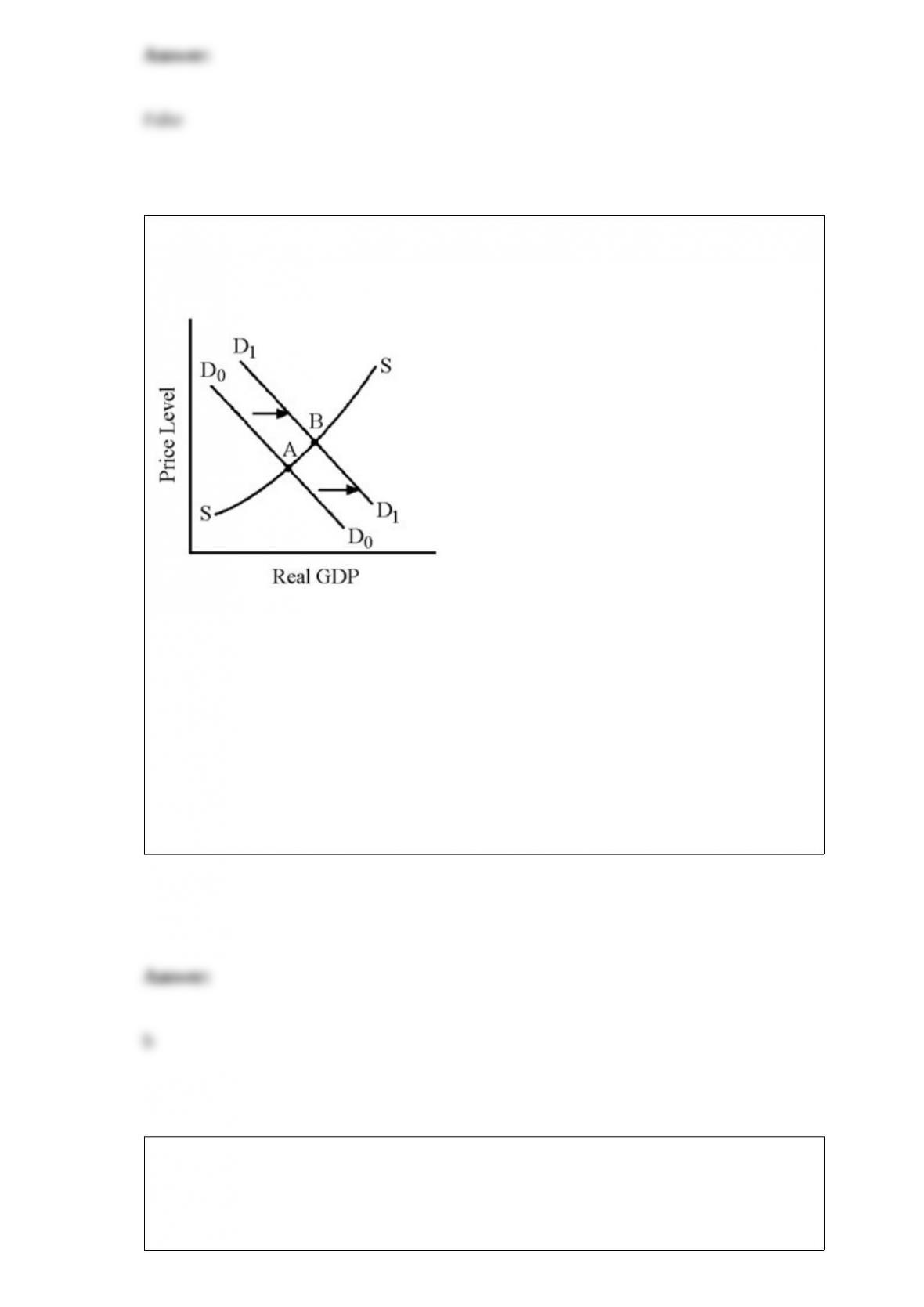
Figure 17-1
Which of the following is true about the economy depicted in Figure 17-1?
a. Tax incentives are being used to stimulate aggregate supply.
b. Policy makers believe the costs of unemployment are higher than the costs of
inflation.
c. Contractionary monetary policy is being enacted to fight inflation.
d. Prices are rising but real GDP is falling.
Opponents of indexing fear that it will lead to a(n)
a. acceleration of inflation.

b. abrupt reduction of the money supply.
c. shortfall of tax revenues, and increased budget deficits.
d. unfair wealth transfer to debtors.
The growth rate of potential GDP depends on
a. the rate of technical progress.
b. the growth rate of the capital stock.
c. the growth rate of the labor force.
d. all of the above.
The economic theory of discrimination suggests that the practice of apartheid in South
Africa should have
a. worsened the economic condition of only the blacks.
b. worsened the economic condition of only the whites.
c. worsened the economic condition of whites as well as others.
d. improved the economic condition of the whites.

Marginal analysis involves looking at the extra costs involved in a decision.
a. True
b. False
The appreciation of the dollar in the late 1990s shifted the U.S. aggregate supply curve
outward.
a. True
b. False
A productivity decrease would be illustrated by a shift in the production function
a. downward.

b. leftward.
c. upward.
d. rightward.
Someone unemployed for a long period of time due to technological change would be
described as structurally unemployed.
a. True
b. False
Real wages in the United States tend to rise at the same rate as
a. prices.
b. tax rates.
c. average productivity levels.
d. inflation.

The cost disease of the service sector is evidenced by
a. a failure of the market mechanism.
b. increased quality of public and private services.
c. dramatic increases in municipal budget burdens for education, health care, and police
and fire protection.
d. the increased productivity in the services area.
Union membership in the United States has fallen compared to what it was in the
1950s.
a. True
b. False
A monopolist’s cost curves may shift down because

a. large-scale input purchases may permit the monopolist to take quantity discounts.
b. of advertising expenditure.
c. competitors are pushed out of the market.
d. of bureaucratic inefficiencies.
As the multiplier process is working on the demand side:
a. firms will meet the additional demand without raising prices
b. firms will meet the additional demand only by raising prices
c. firms will not meet the additional demand
d. the multiplier process will cease creating demand