
Foreign portfolio investment in the United States has continually declined since 1995.
Answer:
Expansionary monetary policy enacted during a recession will cause the inflation rate to
increase.
Answer:
If the rate of growth in real GDP exceeds the rate of growth in the money supply, the
quantity theory of money predicts a price deflation.
Answer:
For a monopolistically competitive firm, price equals average revenue.
Answer:

Inflation redistributes income to a greater extent when the inflation is unanticipated
compared to when the inflation is anticipated.
Answer:
An appropriate fiscal policy response when aggregate demand is growing at a slower
rate than aggregate supply is to cut taxes.
Answer:
________ is called an implicit cost, while ________ is called an explicit cost.
A) An accounting cost; an economic cost
B) A nonmonetary opportunity cost; a cost that involves spending money
C) A production cost; a sales cost
D) An actual cost; a hypothetical cost
Answer:
A budget constraint
A) represents the bundles of consumption that make a consumer equally happy.

B) refers to the limited amount of income available to consumers to spend on good and
services.
C) reflects the desire by consumers to increase their income.
D) shows the prices that a consumer chooses to pay for products he consumes.
Answer:
Which of the following statements regarding a firm’s long-run average total cost
(LRATC) curve and its short-run average total cost (SRATC) curve is true?
A) The shape of the LRATC is affected by the law of diminishing returns.
B) The SRATC, but not the LRATC, can be used by a firm’s managers for planning.
C) The LRATC shows the lowest cost at which a firm is able to produce a given level of
output when no inputs are fixed.
D) The contribution of average fixed cost to LRATC is greater than its contribution to
SRATC.
Answer:
The aggregate expenditure model focuses on the short-run relationship between
________ and ________.
A) real spending; real GDP
B) unemployment; inflation
C) nominal spending; nominal GDP

D) planned inventories; unplanned inventories
Answer:
Which of the following would decrease the value of the dollar in the long run?
A) a decrease in inflation in the United States relative to other countries
B) a decrease in the demand for American goods relative to goods from other countries
C) an increase in U.S. tariffs on foreign goods
D) a decrease in the supply of dollars on the foreign exchange market
Answer:
Which of the following takes place in the direct finance market?
A) Firms borrow funds from banks.
B) Deposits from savers are accumulated and loans made to borrowers.
C) Ownership in corporations is sold in the form of preferred stock.
D) Banks offer savings accounts to customers.
Answer:

When the price of a financial asset ________ its interest rate will ________.
A) rises; rise
B) falls; fall
C) falls; rise
D) rises; remain the same
Answer:
When President Obama took office in January 2009, he pledged to pursue an
expansionary fiscal policy to try to pull the economy out of the recession. The next
month, Congress passed the American Recovery and Reinvestment Act of 2009, an
$840 billion package of spending increases and tax cuts that was
A) the largest fiscal policy action in U.S. history.
B) second in size only to the fiscal policy action taken during the Great Depression.
C) small in comparison to the actions taken during the recession of 1974-1975
D) roughly equal to the spending increases and tax cuts implemented during the
recession of 1980-1982.
Answer:
The economic growth model predicts that

A) GDP per capita of rich countries will grow more rapidly than in poor countries.
B) GDP per capita of poor countries will grow more rapidly than in rich countries.
C) Governments must centrally direct the economy for growth to occur.
D) GDP per capita of poor countries will never change.
Answer:
A firm that can effectively price discriminate will charge a higher price to
A) customers who have the more elastic demand for the product.
B) customers who have the more inelastic demand for the product.
C) buyers who belong to the largest market segment.
D) buyers who are members of the smallest market segment.
Answer:
The president of Toyota’s Georgetown plant was quoted as saying, “Demand for high
volumes saps your energy. Over a period of time, it eroded our focus [and] thinned out
the expertise and knowledge we painstakingly built up over the years.” Based on this
quote, what must be true of the plant’s average cost of production curve?
A) It is upward-sloping.
B) It is downward-sloping.
C) It is a ray from the origin.
D) It is U-shaped.
Answer:
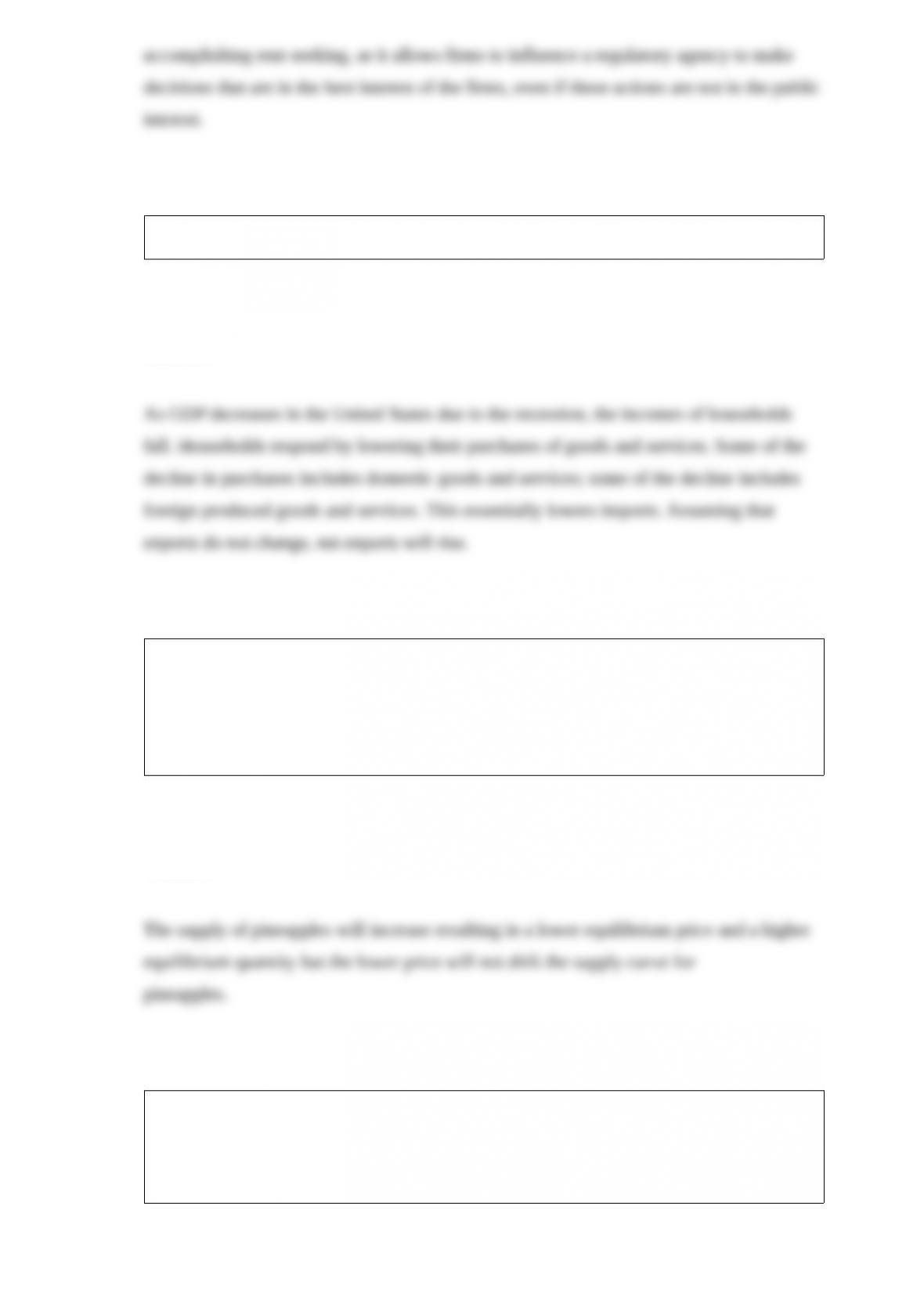
Table 2-7
Table 2-7 shows the output per week of two people, Minnie and Mickey. They can
either devote their time to making hats or making umbrellas. Which of the following
statements istrue?
A) Mickey has an absolute advantage in making both products.
B) Minnie has an absolute advantage in making both products.
C) Minnie has an absolute advantage in making hats and Mickey in making umbrellas.
D) Minnie has an absolute advantage in making umbrellas and Mickey in making hats.
Answer:
What is rent seeking and how is it related to regulatory capture?
Answer:
Ceteris paribus, how does a recession in the United States affect U.S. net exports?
Answer:
Discuss the correct and incorrect economic analysis in the following statement.
“If good weather in Hawaii creates a bumper crop of pineapples, the supply of
pineapples will increase. This will result in a price decrease, which will then cause the
supply of pineapples to decrease.”
Answer:
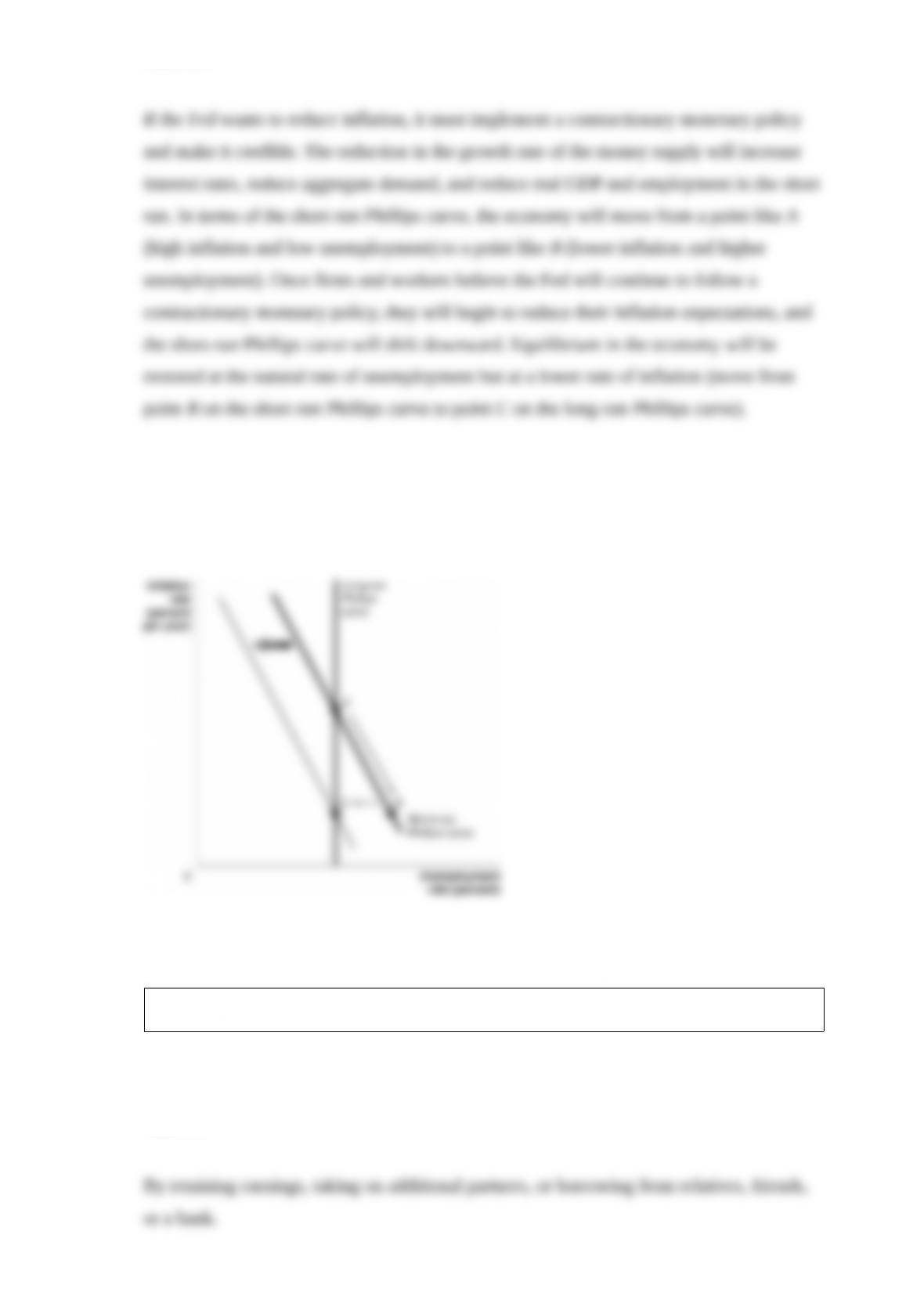
If the Federal Reserve wants to reduce inflation from 4 percent to 3 percent
permanently, how can that goal be achieved, and what impact will that have on
employment in the short run and the long run? Support your answer with a graph of the
Phillips curve in the short run and the long run.
Answer:
How can a partnership raise funds needed for firm expansion?
Answer: