
You paid $25 for your ticket to the football game, only to see your favorite team losing
28-0 at the end of the first quarter. That $25 should now be regarded as a(n)
__________ cost that economists say should be __________ in your decision on
whether or not to stay at the game or leave.
a. explicit; included
b. explicit; disregarded
c. sunk; included
d. sunk; disregarded
If the government does not provide it, the quantity of a nonexcludable good that private
firms will choose to produce is
a. zero.
b. more than the optimal amount.
c. the optimal amount.
d. optimal only if property rights are assigned.
e. optimal only if the industry is competitive.
A firm that is perfectly competitive will continue to hire factor units as long as
a. MRP < MFC.

b. MRP > MFC.
c. VMP < MFC.
d. MC > MR.
Which of the following is a positive economic statement?
a. The temperature is too high today.
b. The temperature is 105 degrees today.
c. It is too hot to jog today.
d. I enjoy summer evenings when it cools off.
Suppose that the exchange rate between the U.S. dollar and the Mexican peso starts out
at $0.11 per peso.If the exchange rate then changes to $0.08 per peso, there will be a(n)
__________ in the quantity demanded of dollars by Mexicans, and therefore there will
be a(n) __________in the quantity supplied of pesos to the foreign exchange market.
a. decrease; decrease
b. decrease; increase
c. increase; decrease
d. increase; increase

The study of an economy’s price level is explicitly a part of
a. macroeconomics.
b. microeconomics.
c. positive economics.
d. normative economics.
The supply of labor in a particular labor market can change as a result of changes in
wage rates in other labor markets.
a. True
b. False
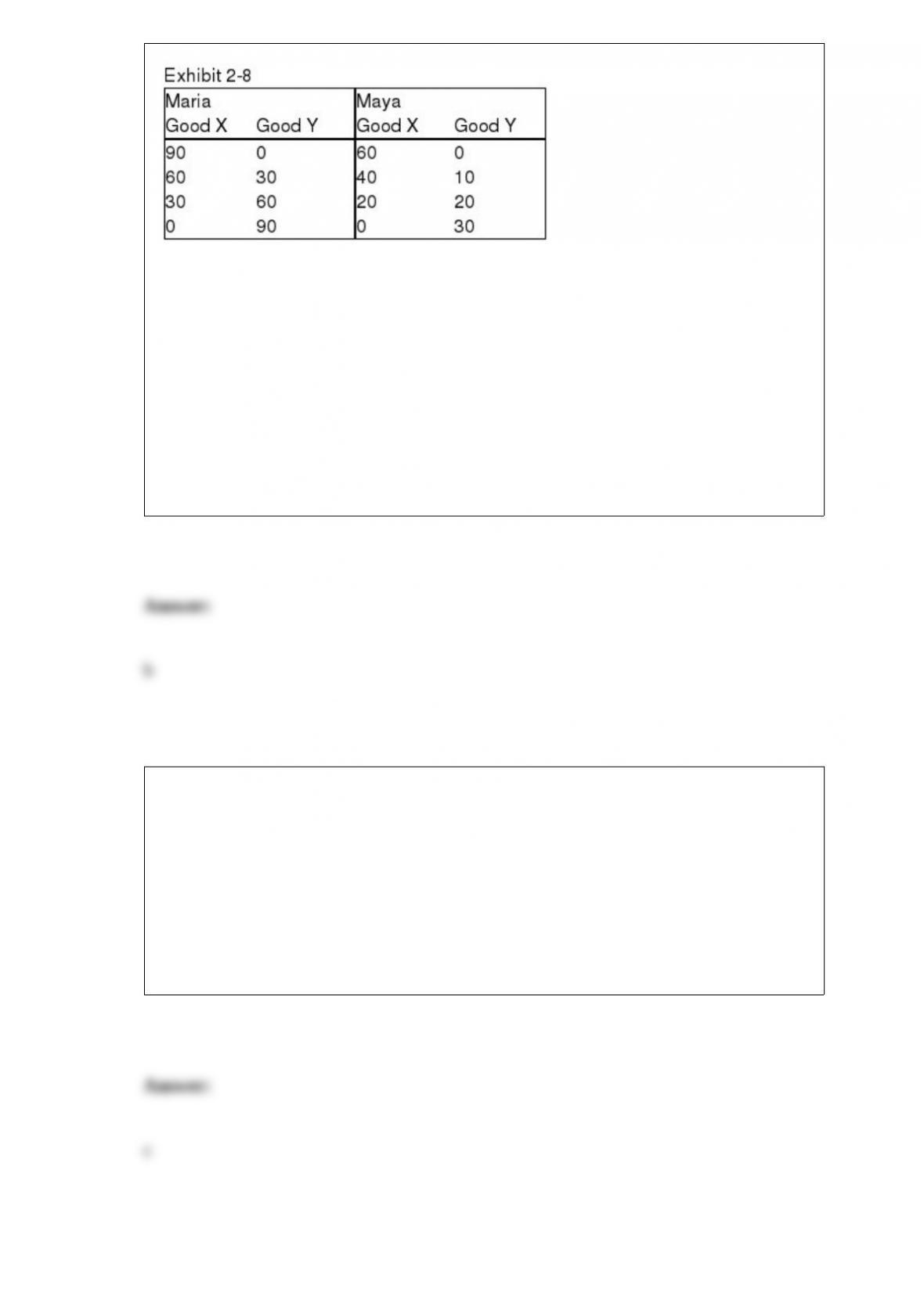
For Maria, the opportunity cost of producing one unit of good X is ___________ unit(s)
of good Y.
a. 2.00
b. 1.00
c. 10.00
d. 0.50
Which of the following is not an argument for trade restrictions?
a. the national defense argument
b. the infant industry argument
c. the comparative advantage argument
d. the antidumping argument
In all cases, positive economics deals with
a. what is.
b. what should be.
c. relatively small units in the economy.
d. aggregates or the entire economy.
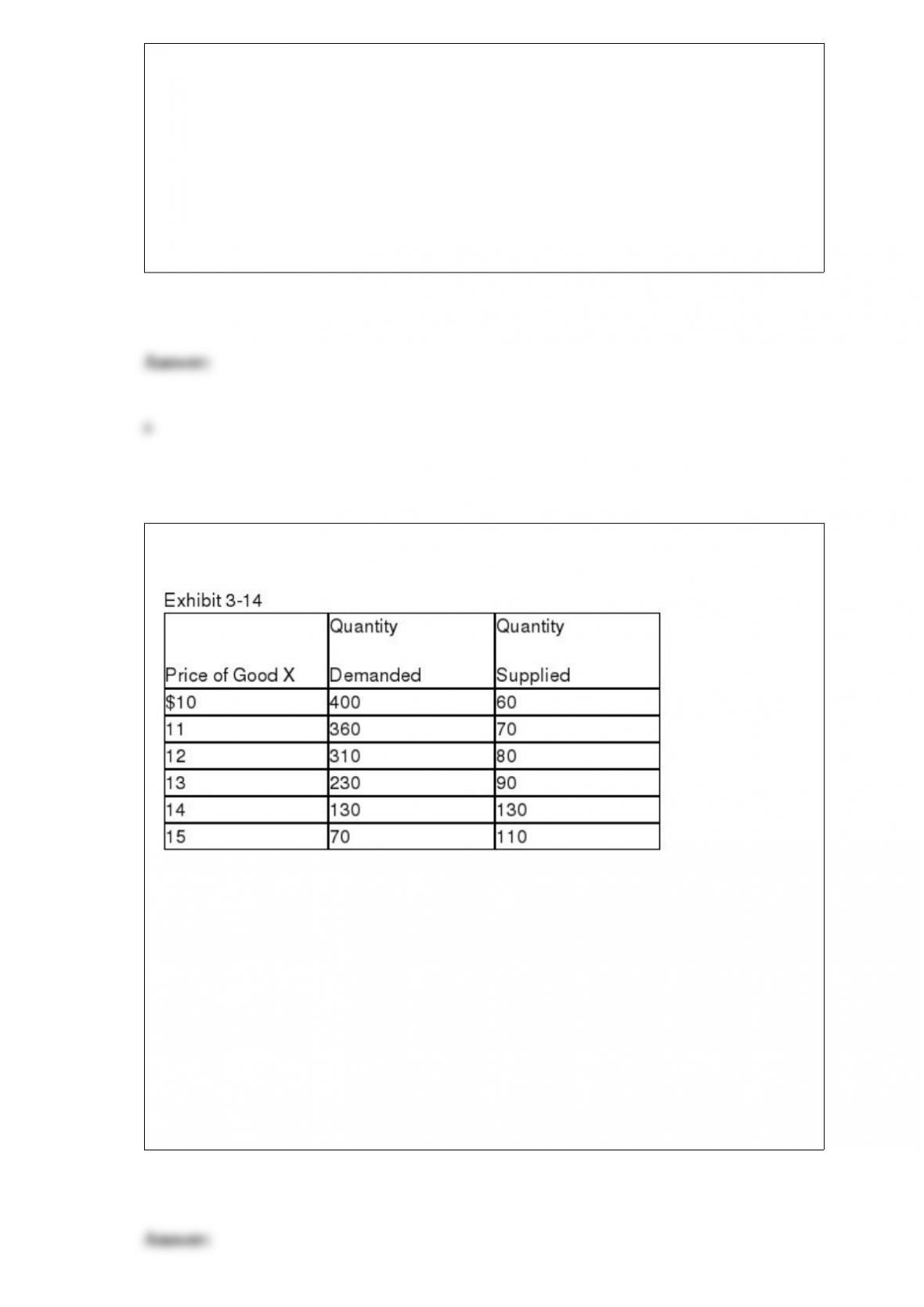
At a price of $11, there is a ____________ unit____________ of good X.
a. 290; shortage
b. 215; shortage
c. 40; surplus
d. 290; surplus
e. 230; shortage

Suppose Johnny, seven years old, is selling lemonade to his neighbors and he sells each
of his buyers the refreshment for the maximum price that each buyer is willing to pay.
Johnny is practicing
a. perfect competition.
b. perfect price discrimination.
c. second-degree price discrimination.
d. third-degree price discrimination.
One of the assumptions upon which the theory of perfect competition is built is that
each firm produces and sells a heterogeneous product.
a. True
b. False
Without savers, there would be no supply of loanable funds.
a. True
b. False

The MPP/Price ratio for labor is 25/$5 and the MPP/Price ratio for capital is 30/$6. A
firm that employs both labor and capital will likely
a. buy more labor and less capital because labor is cheaper.
b. buy more capital and less labor because capital is more productive.
c. maintain the current combination of capital and labor.
d. buy more capital and less labor because capital is cheaper.
e. There is not enough information to answer the question.
Suppose the economy goes from a point on its production possibilities frontier (PPF) to
a point below that PPF. Assuming that the PPF has not shifted, this could be due to
a. a gain of resources.
b. a loss of resources.
c. technological improvement in the production of both goods.
d. an increase in unemployment of some resources.

Profits differ from the other factor payments in that they
a. are a residual payment.
b. can be negative.
c. are a transfer payment.
d. a and b
e. all of the above