A period of economic expansion ends with a business cycle trough.
If inflation is anticipated, some effects of inflation on the redistribution of income can
be avoided.
Government spending on transfer payments is included in government purchases when
calculating GDP because it results in the production of new goods and services.
If the price elasticity of demand is unit-elastic, a 10 percent increase in price will result
in a 10 percent increase in revenue.
If the market for a product begins as perfectly competitive and then becomes a
monopoly, there will be a reduction in economic efficiency and a deadweight loss.
If a country is producing efficiently and is on the production possibilities frontier, the
only way to produce more of one good is to produce less of the other.
If a country has an absolute advantage in producing a product, it must also have a
comparative advantage in producing that product.
Potential GDP is the maximum output a firm is capable of producing.
Expansionary monetary policy refers to the Fed’s increasing the money supply and
increasing interest rates to increase real GDP.
If consumption is defined as C = 4,500 + 0.75Y, then the marginal propensity to save is
0.25.
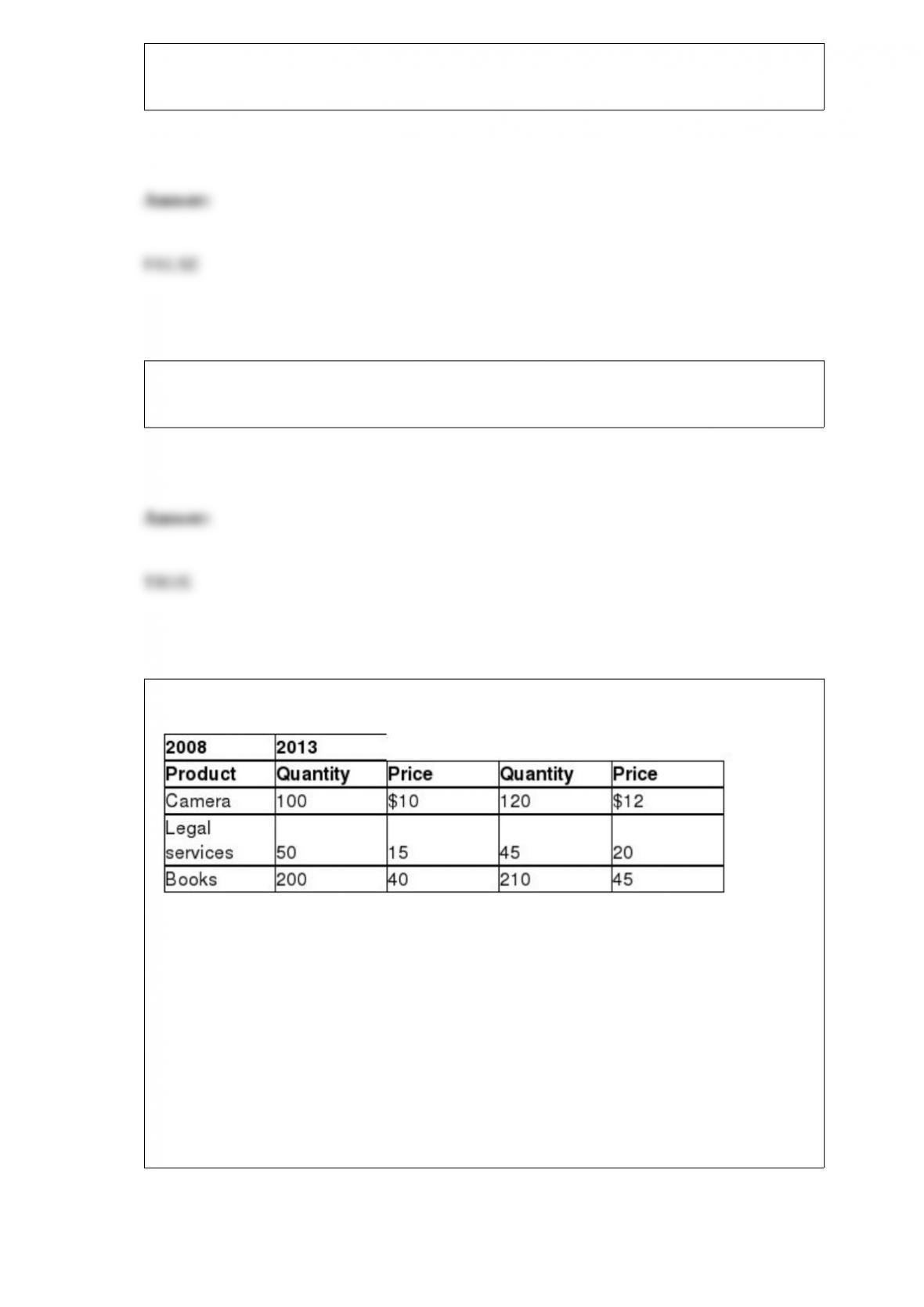
Table 19-18
A very simple economy produces three goods: cameras, legal services, and books. The
quantities produced and their corresponding prices for 2008 and 2013 are shown in the
table above. What is nominal GDP in 2013 when 2008 is the base year?
A) $28,885
B) $11,790
C) $11,200
D) $10,275

The public choice model assumes that government policy makers
A) must promote the public interest at the expense of their own self-interests in order to
be re-elected.
B) will pursue their self-interests in personal affairs but only if it does not conflict with
the public interest.
C) will often act irrationally in their personal affairs, but will act rationally when they
promote the public interest.
D) are likely to pursue their own self-interests, even if their self-interests conflict with
the public interest.
Credit card balances are
A) part of M1.
B) part of M2.
C) part of M3.
D) not part of the money supply.

The formula for total fixed cost is
A) TFC = TC + TVC.
B) TFC = TVC – TC.
C) TFC = TC/TVC.
D) TFC = TC – TVC.
Which of the following statements is true about competition in a market?
A) Competition forces firms to outsource the production of their labor-intensive
products.
B) Competition forces firms to undercut their selling price, thus benefiting consumers
who will be able to purchase products at the lowest price possible.
C) Competition forces firms to produce and sell products as long as the marginal benefit
to consumers exceeds the marginal cost of production.
D) Competition forces firms to add only low profit margins to their costs of production.
For the last few decades, the labor force participation rates of men have ________, and
the labor force participation rates of women have ________.
A) risen; risen
B) fallen; fallen

C) risen; fallen
D) fallen; risen
When banks gain ________, they can ________ their loans; and the money supply
________.
A) reserves; increase; contracts
B) withdrawals; increase; expands
C) withdrawals; decrease; expands
D) reserves; increase; expands
How will contractionary monetary policy in Japan affect the demand for the yen and the
supply of the yen in the foreign exchange market?
A) The demand for the yen will fall, and the supply of the yen will increase.
B) The demand for the yen will increase, and the supply of the yen will fall.
C) The demand for the yen will fall, and the supply of the yen will fall.
D) The demand for the yen will increase, and the supply of the yen will increase.

Horatio can produce either a combination of 15 bird houses and 25 wind chimes or a
combination of 30 bird houses and 15 wind chimes. If he now produces 30 bird houses
and 15 wind chimes, what is the opportunity cost of producing an additional 10 wind
chimes?
A) 2 bird houses
B) 15 bird houses
C) 30 bird houses
D) 45 bird houses
Governments grant patents to encourage
A) research and development on new products.
B) competition.
C) low prices.
D) firms to form public enterprises.
Why do most firms in monopolistic competition typically make zero profit in the long

run?
A) because firms produce differentiated products
B) because the lack of entry barriers would compete away profits
C) because firms do not produce at their minimum efficient scale
D) because the total market is not large enough to accommodate so many firms
How would a decrease in the U.S. budget deficit affect the exchange rate in the market
for dollars?
A) The exchange rate will increase.
B) The exchange rate will decrease.
C) The exchange rate will not be affected by a change in the budget deficit.
D) The impact of the decrease in the budget deficit on the exchange rate cannot be
predicted.
Examples of comparative advantage often begin with two countries that each produce
the same two goods. Each country is then shown to have a comparative advantage in
producing the good it can produce at a lower opportunity cost, and specializes in the
production of the good for which it has a comparative advantage. How do these
examples prove that both nations are made better off as a result of trade than they would
be without trade?
In the dynamic aggregate demand and aggregate supply model, what is the result of
aggregate demand increasing faster than potential real GDP?
What determined the exchange rates among currencies under the gold standard, and
what caused the gold standard to collapse?
Cole was discussing the market for cocoa beans with his friend John Schmidt. Cole
said, “Ever since Venezuela announced that its cocoa harvest was its lowest ever in
fifteen years, the price of cocoa beans has been rising and rising and people are buying
more and more. I think the demand for cocoa beans must be upward sloping.” Is Cole
right? Briefly explain why or why not.
C = 2,550 + (MPC)Y
I = 800
G = 1,100
NX = 50 If the equilibrium level of GDP is $11,250, using the equations for C, I, G, and
NX shown above, find the value of the marginal propensity to consume.
The Bureau of Economic Analysis divides it’s statistics on GDP into four major
categories. List the categories of expenditures and define each.
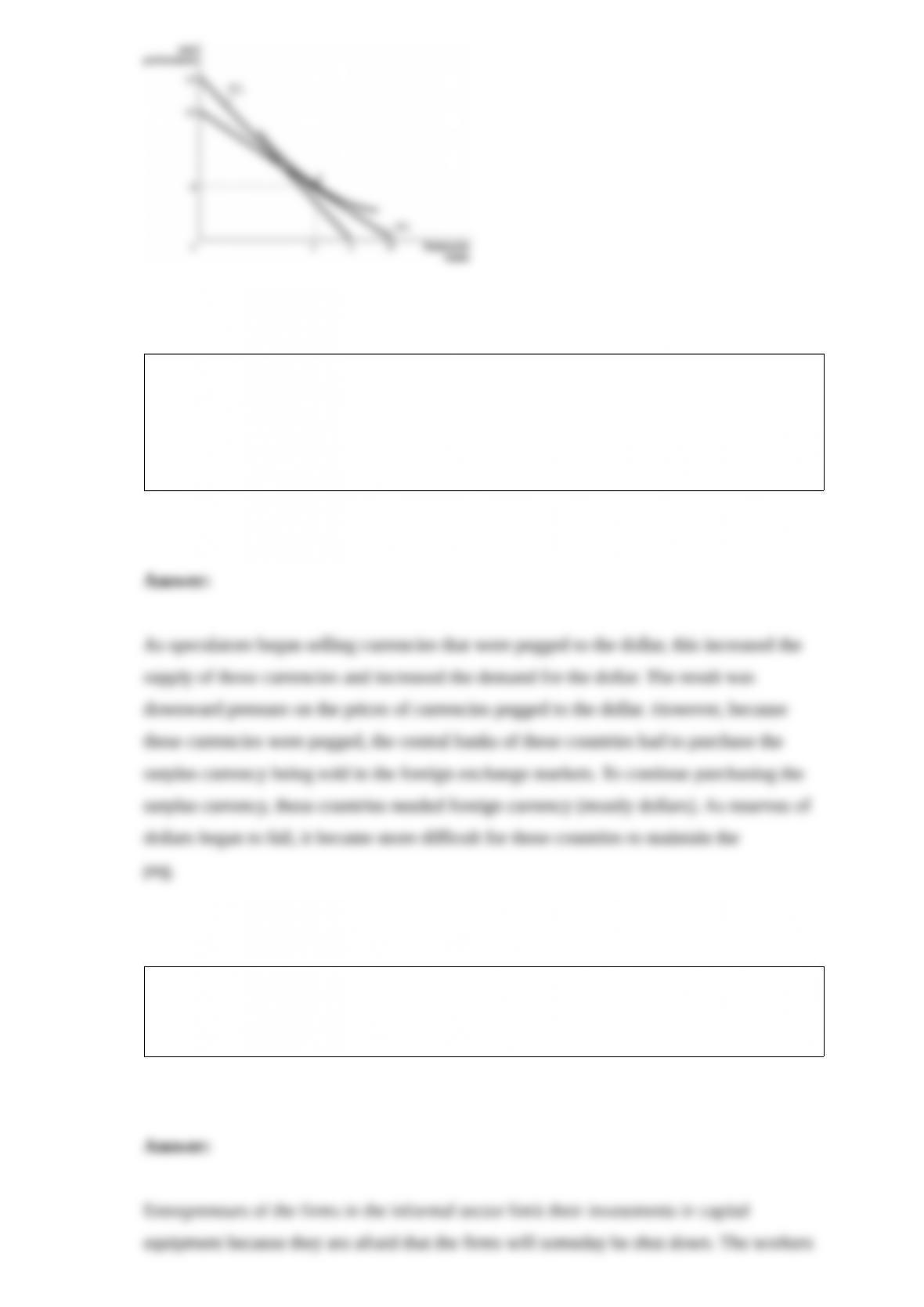
Grant has $200 to spend each month on restaurant meals and jazz performances at his
neighborhood jazz club. The price of a typical restaurant meal is $20 and the price of a
jazz performance ticket is $10. Grant is maximizing his utility by consuming 6
restaurant meals and attending 8 jazz performances. Suppose Grant still has $200 to
spend, but the price of restaurant meal rises to $25, while the price of jazz performance
ticket drops to $8. Is Grant better off or worse off than he was before the price change?
Use a budget constraint/indifference curve graph to illustrate your answer.
South Korea, Indonesia, Malaysia, and Thailand all pegged their currencies to the dollar
at one point in time. Because some of these currencies were overvalued at the pegged
rate, speculators anticipated these countries would abandon the peg and speculators
began selling those currencies. Explain how this speculation would affect the ability of
a country to maintain a pegged exchange rate.
The underground economy – the informal sector – can be a significant drag on the
economies of developing countries. Why are firms in the informal sector often less
efficient than firms in the formal sector?