
1) As the banking system in the United States evolves, it is expected that
A) the number and importance of small banks will increase
B) the number and importance of large banks will decrease
C) small banks will grow at the expense of large banks
D) the number and importance of large banks will increase
2) Suppose that from a new checkable deposit, First National Bank holds two million
dollars in vault cash, eight million dollars on deposit with the Federal Reserve, and one
million dollars in required reserves. Given this information, we can say First National
Bank has ________ million dollars in excess reserves.
A) three
B) nine
C) ten
D) eleven
3) An expansionary monetary policy lowers the real interest rate, causing the domestic
currency to ________, thereby ________ net exports.
A) appreciate; raising
B) appreciate; lowering
C) depreciate; raising
D) depreciate; lowering
4) The risk that interest payments will not be made, or that the face value of a bond is
not repaid when a bond matures is
A) interest rate risk
B) inflation risk
C) moral hazard
D) default risk
5) After 2003, The Federal Reserve usually keeps the discount rate
A) above the target federal funds rate

B) equal to the target federal funds rate
C) below the target federal funds rate
D) equal to zero
6) The Federal Open Market Committee’s “balance of risks” is an assessment of
whether, in the future, its primary concern will be
A) higher exchange rates or higher unemployment
B) higher inflation or a stronger economy
C) higher inflation or a weaker economy
D) lower inflation or a stronger economy
7) If the Brazilian demand for American exports rises at the same time that U.S.
productivity rises relative to Brazilian productivity, then, in the long run, ________,
everything else held constant.
A) the Brazilian real will appreciate relative to the U.S. dollar
B) the Brazilian real will depreciate relative to the U.S. dollar
C) the Brazilian real will either appreciate, depreciate, or remain constant relative to the
U.S. dollar
D) there is no effect on the Brazilian real relative to the U.S. dollar
8) Of the four factors that influence asset demand, which factor will cause the demand
for all assets to increase when it increases, everything else held constant?
A) wealth
B) expected returns
C) risk
D) liquidity
9) The reduction in transactions costs per dollar of investment as the size of transactions
increases is
A) discounting
B) economies of scale
C) economies of trade
D) diversification

10) When a $10 check written on the First National Bank of Chicago is deposited in an
account at Citibank, then
A) the liabilities of the First National Bank increase by $10
B) the reserves of the First National Bank increase by $10
C) the liabilities of Citibank increase by $10
D) the assets of Citibank fall by $10
11) Property promised to the lender as compensation if the borrower defaults is called
A) collateral
B) deductibles
C) restrictive covenants
D) contingencies
12) If expectations are formed adaptively, then people
A) use more information than just past data on a single variable to form their
expectations of that variable
B) often change their expectations quickly when faced with new information
C) use only the information from past data on a single variable to form their
expectations of that variable
D) never change their expectations once they have been made
13) The revenue a government gains from issuing money is
A) interest
B) rent
C) seignorage
D) the national dividend
E) the inflation tax
14) The bond supply curve is ________ sloping, indicating a(n) ________ relationship

between the price and quantity supplied of bonds.
A) downward; inverse
B) downward; direct
C) upward; inverse
D) upward; direct
15) If, for a $1000 premium, you buy a $100,000 put option on bond futures with a
strike price of 114, and at the expiration date the price is 110, your ________ is
________.
A) profit; $4000
B) loss; $4000
C) profit; $3000
D) loss; $3000
16) A contract that requires the investor to buy securities on a future date is called a
A) short contract
B) long contract
C) hedge
D) cross
17) Which of the following can be described as involving indirect finance?
A) You make a loan to your neighbor
B) A corporation buys a share of common stock issued by another corporation in the
primary market
C) You buy a U.S. Treasury bill from the U.S. Treasury
D) You make a deposit at a bank
18) Nationwide banking might reduce bank failures due to
A) reduced competition
B) reduced lending to small businesses
C) diversification of loan portfolios across state lines
D) elimination of community banks

19) In the generalized dividend model, a future sales price far in the future does not
affect the current stock price because
A) the present value cannot be computed
B) the present value is almost zero
C) the sales price does not affect the current price
D) the stock may never be sold
20) An increase in the liquidity of corporate bonds will ________ the price of corporate
bonds and ________ the yield of Treasury bonds, everything else held constant.
A) increase; increase
B) reduce; reduce
C) increase; reduce
D) reduce; increase
21) Everything else held constant, an increase in interest rates on student loans
A) increases the cost of a college education
B) reduces the cost of a college education
C) has no effect on educational costs
D) increases costs for students with no loans
22) Suppose, while cleaning out its closets, a worker at the Federal Reserve bank
branch in Memphis discovers a painting of Elvis (medium: acrylic on velvet) that used
to grace the walls of the conference room. Suppose further that, at a public auction, the
bank sells the painting for $19.95. This sale will cause ________ in the monetary base,
everything else held constant.
A) an increase of $19.95
B) an increase of more than $19.95
C) a decrease of $19.95
D) a decrease of more than $19.95

23) Both ________ and ________ are monetary liabilities of the Fed.
A) securities; loans to financial institutions
B) currency in circulation; reserves
C) securities; reserves
D) currency in circulation; loans to financial institutions
24) Rising interest-rate risk
A) increased the cost of financial innovation
B) increased the demand for financial innovation
C) reduced the cost of financial innovation
D) reduced the demand for financial innovation
25) A clause in a mortgage loan contract requiring the borrower to purchase
homeowner’s insurance is an example of a
A) proscriptive covenant
B) prescriptive covenant
C) restrictive covenant
D) constraint-imposed covenant
26) The spectacular growth in international banking can be explained by
A) the rapid growth in international trade
B) the 1988 Basel Agreement
C) the desire for U.S. banks to escape burdensome domestic regulations
D) the creation of the World Trade Organization
27) The purpose of the commitment by the Fed to keep the federal funds rate at zero for
a long period of time is to
A) lower the long term interest rates
B) lower the short term interest rates
C) increase the long term interest rates
D) increase the short term interest rates

28) High net worth helps to diminish the problem of moral hazard problem by
A) requiring the state to verify the debt contract
B) collateralizing the debt contract
C) making the debt contract incentive compatible
D) giving the debt contract characteristics of equity contracts
29) Suppose that the latest Consumer Price Index (CPI) release shows a higher inflation
rate in the U.S. than was expected. Everything else held constant, the release of the CPI
report would immediately cause the demand for U.S. assets to ________ and the U.S.
dollar would ________.
A) increase; appreciate
B) increase; depreciate
C) decrease; appreciate
D) decrease; depreciate
30) In the market for reserves, if the federal funds rate is between the discount rate and
the interest rate paid on excess reserves, an increase in the reserve requirement
________ the demand for reserves, ________ the federal funds rate, everything else
held constant.
A) decreases; lowering
B) increases; lowering
C) increases; raising
D) decreases; raising
31) The evidence from banking crises in other countries indicates that
A) deposit insurance is to blame in each country
B) a government safety net for depositors need not increase moral hazard
C) regulatory forbearance never leads to problems
D) deregulation combined with poor regulatory supervision raises moral hazard
incentives

32) Assume that the following are the predicted inflation rates in these countries for the
year: 2% for the United States, 3% for Canada; 4% for Mexico, and 5% for Brazil.
According to the purchasing power parity and everything else held constant, which of
the following would we expect to happen?
A) The Brazilian real will depreciate against the U.S. dollar
B) The Mexican peso will depreciate against the Brazilian real
C) The Canadian dollar will depreciate against the Mexican peso
D) The U.S. dollar will depreciate against the Canadian dollar
33) Since it does not have to be converted into anything else to make purchases,
________ is the most liquid asset.
A) money
B) stock
C) artwork
D) gold
34) The classical economists’ contention that prices double when the money supply
doubles is predicated on the belief that in the short run velocity is ________ and real
GDP is ________.
A) constant; constant
B) constant; variable
C) variable; variable
D) variable; constant
35) The bond markets are important because they are
A) easily the most widely followed financial markets in the United States
B) the markets where foreign exchange rates are determined
C) the markets where interest rates are determined
D) the markets where all borrowers get their funds
36) Which of the following is not a requirement in selecting a policy instrument?
A) Measurability
B) Controllability

C) Flexibility
D) Predictability
37) Complete Milton Friedman’s famous statement, “Inflation is always and everywhere
a ________ phenomenon.”
A) recessionary
B) discretionary
C) repressionary
D) monetary
38) Banking crises have occurred throughout the world. What similarities do we find
when we look at the different countries?
39) If a corporation announces that it expects quarterly earnings to increase by 25% and
it actually sees an increase of 22%, what should happen to the price of the corporation’s
stock if the efficient markets hypothesis holds, everything else held constant?
40) What is the impact on interest rates when the Federal Reserve decreases the money
supply by selling bonds to the public?
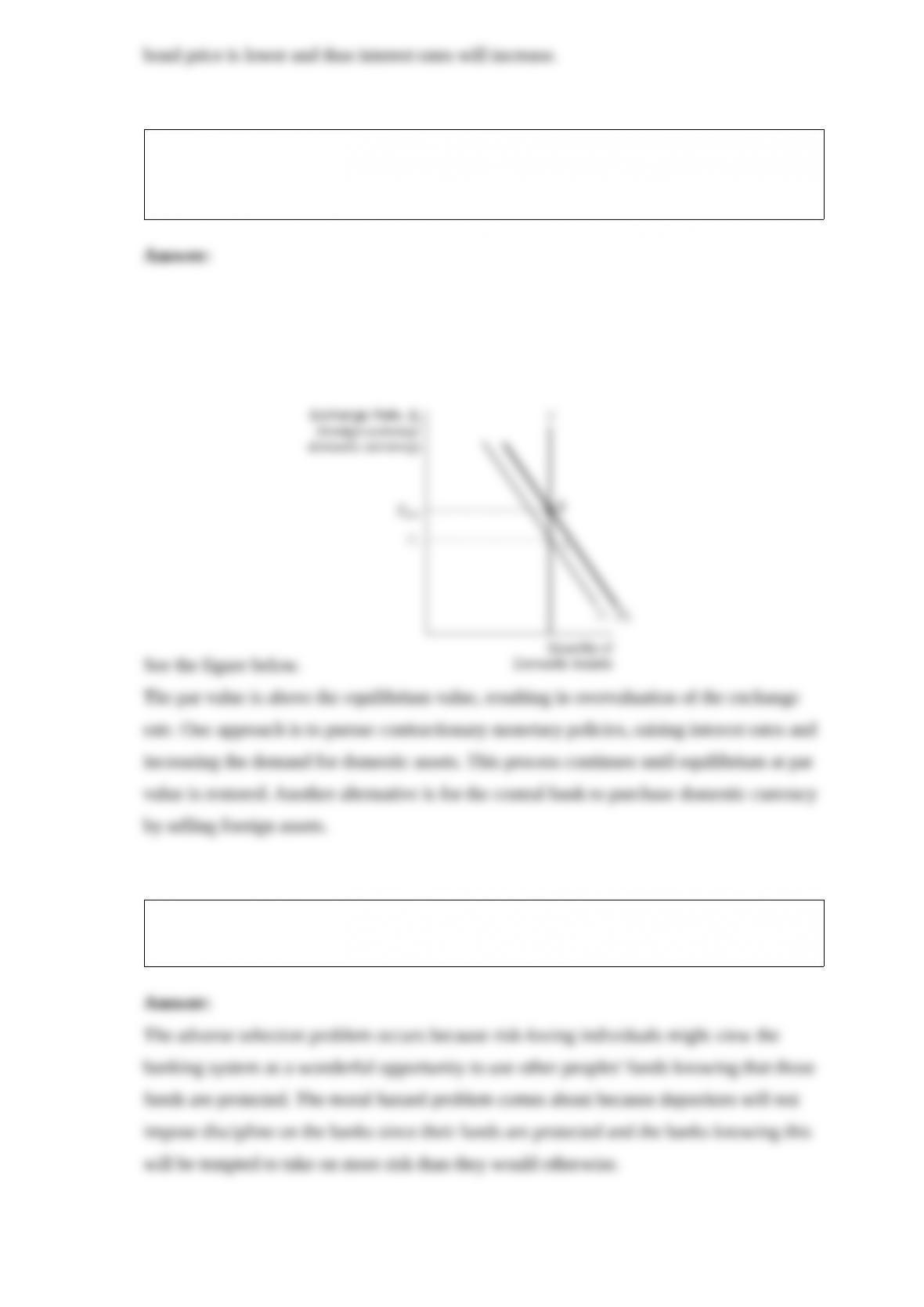
41) Explain and demonstrate graphically the situation of an overvalued exchange rate in
a fixed exchange rate system. What alternative policies are available to eliminate the
overvaluation of the exchange rate?
42) The government safety net creates both an adverse selection problem and a moral
hazard problem. Explain.