1) Draw a graph that illustrates the dilemma of regulation for a natural monopoly. On
the graph, show the: (a) socially optimal price; (b) fair-return price; and (c)
profit-maximizing price for the unregulated monopolist.
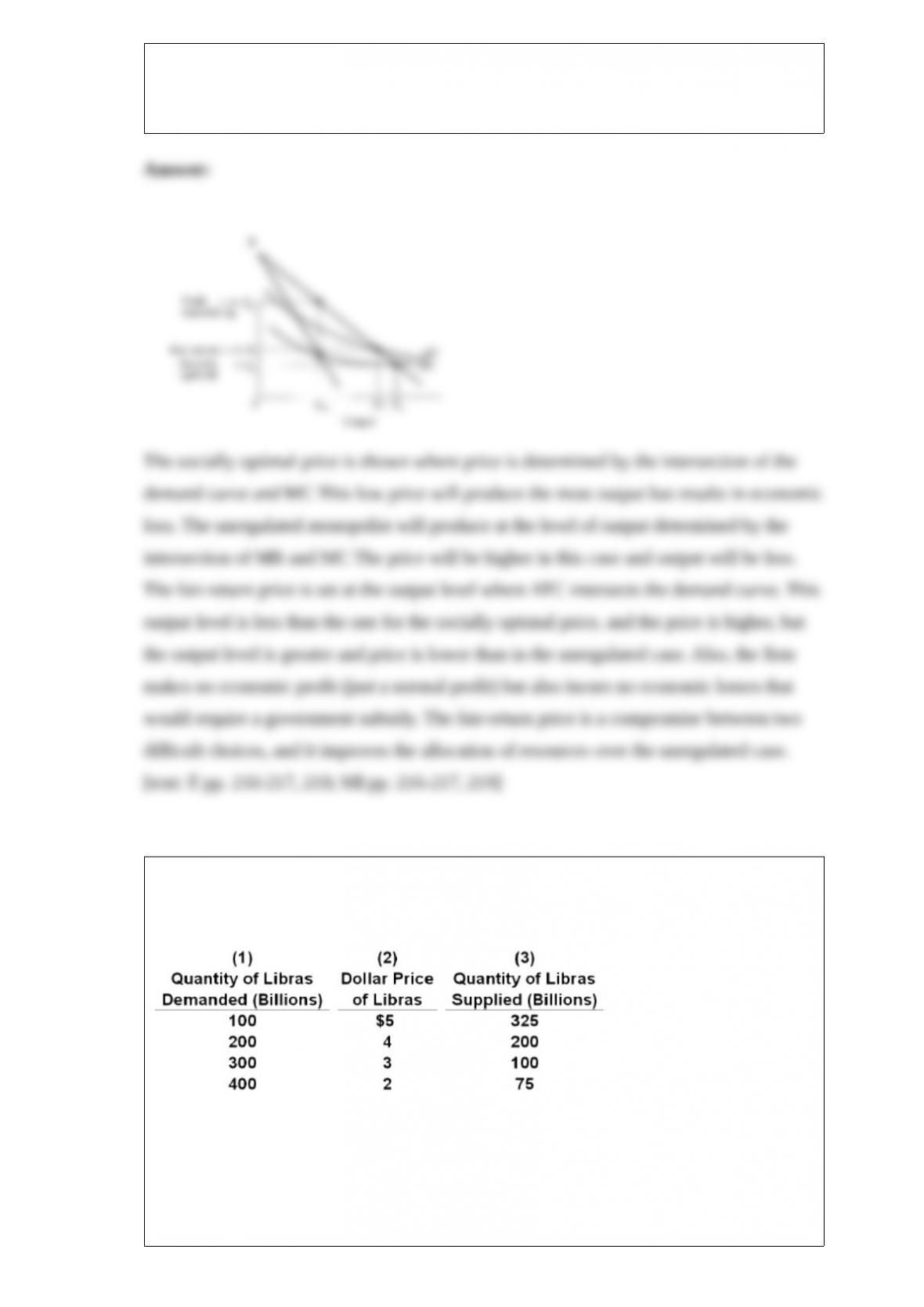
2) The following table which indicates the dollar price of libras, the currency used in
the hypothetical nation of Libra. Assume that a system of freely floating exchange rates
is in place.
Refer to the above table. Suppose that Libra decided to import more U.S. products. We
would expect the quantity of libras:
A.demanded at each dollar price to rise and the dollar to depreciate relative to the libra.
B.demanded at each dollar price to fall and the dollar to appreciate relative to the libra.
C.supplied at each dollar price to rise and the dollar to appreciate relative to the libra.
D.supplied at each dollar price to fall and the dollar to depreciate relative to the libra.

3) The exchange rate system currently used by the industrially advanced nations is:
A.the gold standard.
B.the Bretton Woods system.
C.the managed float.
D.a fixed rate system.
4) The greater the area between the Lorenz curve and the diagonal in the Lorenz Curve
diagram, the:
A.smaller is the Gini ratio and the greater is the degree of income inequality.
B.larger is the Gini ratio and the greater is the degree of income inequality.
C.smaller is the Gini ratio and the greater is the percentage of the population in poverty.
D.larger is the Gini ratio and the greater is the percentage of the population in poverty.
5) If firms are paying efficiency wages, they:
A.may be reluctant to increase nominal wages when aggregate demand increases.
B.are highly vulnerable to import competition.
C.may be targeted for takeover by firms paying market wages.
D.may be reluctant to cut wages when aggregate demand declines.
6) Unions might support a higher minimum wage because:
A.their constitutions obligate them to do so.
B.they feel a higher minimum wage will lower labor’s tax payments for welfare
programs.
C.a higher minimum wage makes less-skilled workers less substitutable for union
workers.
D.the minimum wage is better targeted than are alternative income-maintenance
programs.
7) the following table showing the demand schedule facing a nondiscriminating

monopolist:
refer to the above table. the monopolist will select its profit-maximizing level of output
somewhere within the:
a.3-5 unit range of output.
b.1-3 unit range of output.
c.1-4 unit range of output.
d.2-4 unit range of output.
8) The concept of investment in human capital indicates that:
A.union workers are better educated and more productive than nonunion workers.
B.expenditures on education can be explained in essentially the same way as
expenditures on machinery and equipment.
C.worker productivity correlates negatively with annual earnings.
D.the level of education is unrelated to the level of one’s income.
9) One of the potential negative side-effects of pay in the form of sales commissions is:
A.a greater incentive for sales people to engage in unethical or fraudulent sales
practices that may eventually cause legal problems for the firm.
B.increased volatility of sales revenue for the firm.
C.the potential that pay levels may get so high that they will increase a firm’s marginal
wage cost more than its marginal revenue product.
D.an increased likelihood of shirking by workers.
10) An increase in the legal reserve ratio:
A.increases the money supply by increasing excess reserves and increasing the
monetary multiplier.
B.decreases the money supply by decreasing excess reserves and decreasing the
monetary multiplier.
C.increases the money supply by decreasing excess reserves and decreasing the
monetary multiplier.

D.decreases the money supply by increasing excess reserves and decreasing the
monetary multiplier.
11) Discrimination:
A.affects the distribution of domestic output and income, but not its total size.
B.is shown as some point outside of an economy’s production possibilities curve.
C.places the economy at some point inside of its production possibilities curve.
D.affects the total size of domestic output and income, but not its distribution.
12) What will be the effect of an excess of planned investment over saving in a private
closed economy with unemployed resources?
A.a decline in the rate of interest
B.an unintended accumulation of inventories by businesses
C.a rise in the real GDP
D.the Federal budget will automatically move toward a deficit
13) Unintended changes in inventories:
A.cause the economy to move away from the equilibrium GDP.
B.are treated as components of consumption.
C.bring actual investment and saving into equality only at the equilibrium level of GDP.
D.bring actual investment and saving into equality at all levels of GDP.
14) which of the following is not a barrier to entry?
a.patents
b.x-inefficiency
c.economies of scale
d.ownership of essential resources

15) the law of diminishing returns indicates that:
a.as extra units of a variable resource are added to a fixed resource, marginal product
will decline beyond some point.
b.because of economies and diseconomies of scale a competitive firm’s long-run
average total cost curve will be u-shaped.
c.the demand for goods produced by purely competitive industries is downsloping.
d.beyond some point the extra utility derived from additional units of a product will
yield the consumer smaller and smaller extra amounts of satisfaction.