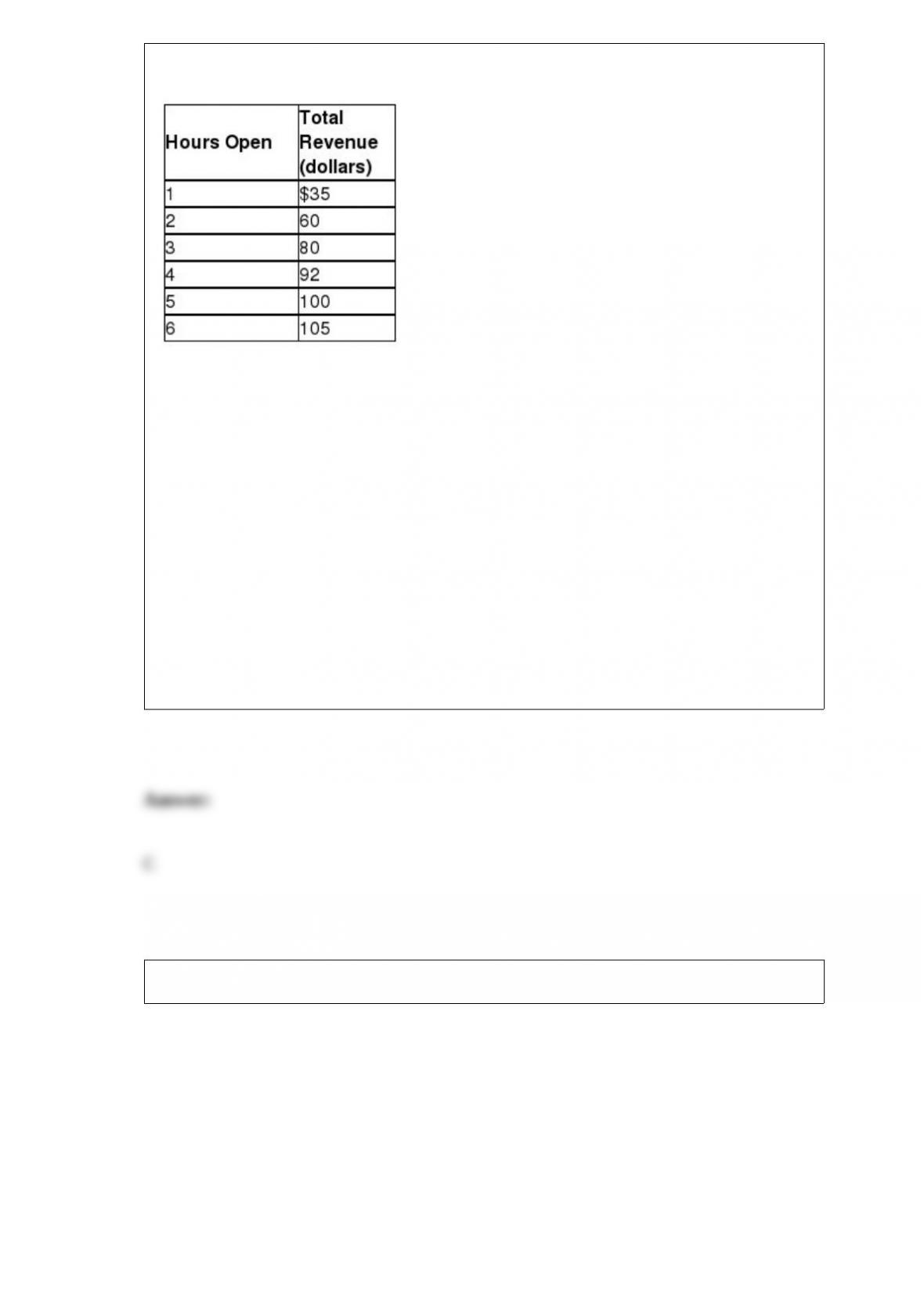
Table 1-1
Eva runs a small bakery in the village of Roggerli. She is debating whether she should
extend her hours of operation. Eva figures that her sales revenue will depend on the
number of hours the bakery is open as shown in the table above. She would have to hire
a worker for those hours at a wage rate of $12 per hour. Using marginal analysis,
determine how many hours should Eva extend her bakery’s hours of operations?
A) 2 hours
B) 3 hours
C) 4 hours
D) 5 hours
E) 6 hours
Table 15-4
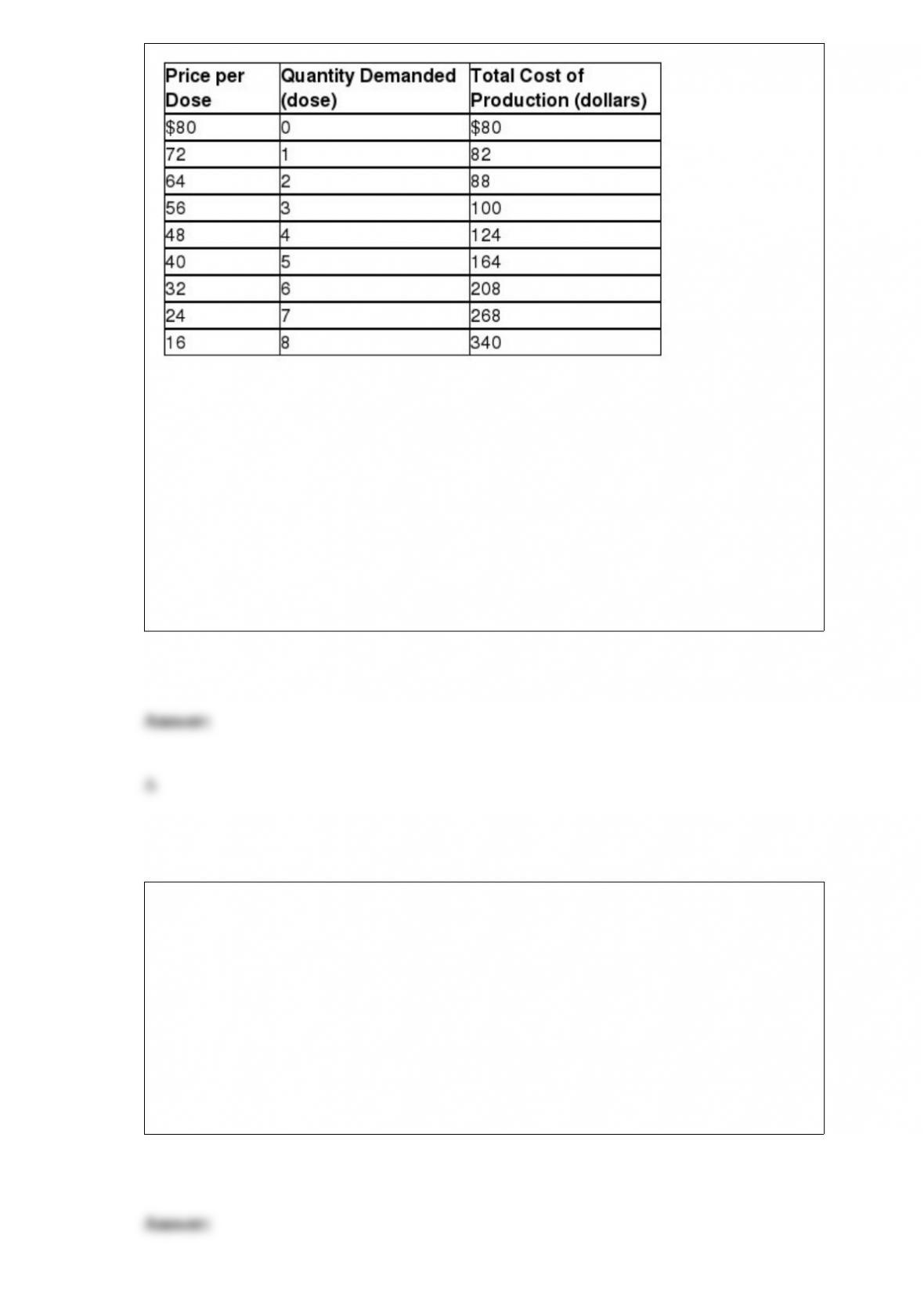
Shakti Inc. has been granted a patent for its Arnica toothache balm. Table 15-4 shows
the demand and the total cost schedule for the firm. What is the economically efficient
output level?
A) 5 units
B) 6 units
C) 7 units
D) 8 units
Using a broad definition, a firm would have a monopoly if
A) it produced a product that has no close substitutes.
B) it does not have to collude with any other producer to earn an economic profit.
C) there is no other firm selling a substitute for its product close enough that its
economic profits are competed away in the long run.
D) it can make decisions regarding price and output without violating antitrust laws.
A typical consumer of health care in the United States
A) pays the full price of his or her health care.
B) pays more than the full price of his or her health care.
C) does not pay any of the price of his or her health care.
D) does not pay the full price of his or her health care.
Which of the following is not a consequence of hyperinflation?
A) Money’s function as a medium of exchange is enhanced.
B) Money loses value so rapidly that firms and individuals stop holding it.
C) It causes an economy to suffer slow growth.
D) The price level grows in excess of hundreds of percentage points per year.
In many corporations, there is ‘separation of ownership from control.” What does this
mean?
A) The shareholders control the corporation, although the board of directors owns the
corporation.
B) The managers of the corporation run the corporation, although the shareholders own
the corporation.
C) The board of directors controls corporate operations, although the managers of the
corporation own the corporation.
D) Top corporate managers only make decisions that have been approved unanimously
by shareholders.
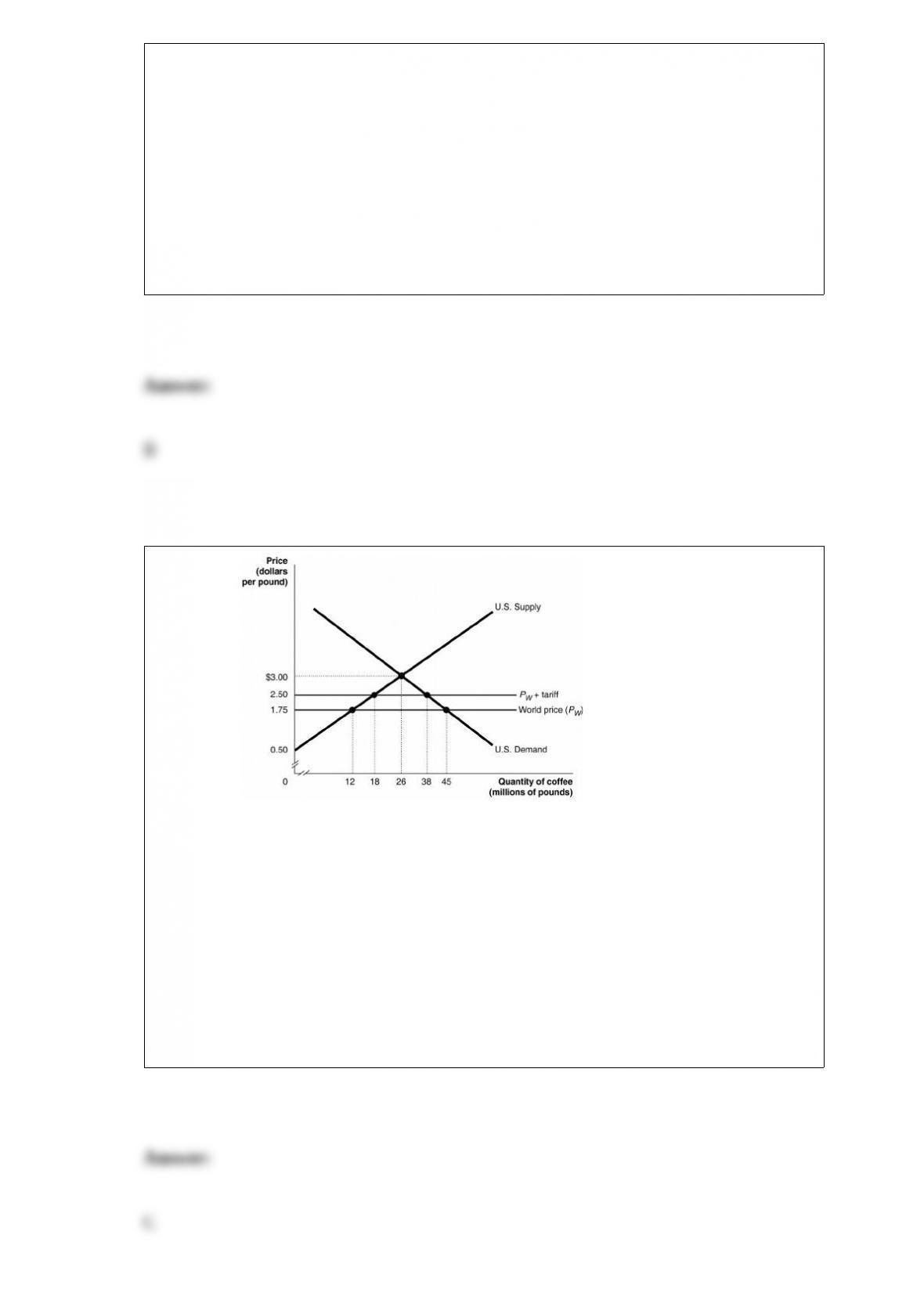
Figure 7-2 Suppose the U.S. government
imposes a $0.75 per pound tariff on coffee imports. Figure 7-2 shows the impact of this
tariff. If the tariff was replaced by a quota which limited coffee imports to 20 million
pounds, the amount of revenue received by coffee importers would equal
A) $5 million.
B) $15 million.
C) $50 million.
D) $78 million.

Recent changes occurring within the U.S. health care system, including lower insurance
reimbursement rates, have resulted in
A) a growing number of doctors choosing to open private practices.
B) more medical practices being owned by hospitals than by individual doctors.
C) a majority of hospitals closing routine medical practices in order to focus only on
emergency care facilities.
D) a majority of doctors working directly for insurance companies.
If workers and firms raise their inflation expectations,
A) unemployment will fall.
B) actual inflation will fall to match expected inflation.
C) the short-run Phillips curve will be vertical.
D) the short-run Phillips curve will shift upward.
Some consumer electronic products such as plasma TVs, DVD players and digital
cameras, are introduced at very high prices but over time, their prices start falling
(beyond what could be attributed to falling costs as companies take advantage of
economies of scale and cheaper technologies). Which of the following is the best
explanation for this observation?
A) More firms are likely to enter the consumer electronic market over time, forcing
market prices down.
B) Early adopters of these new products typically have a higher demand and higher
income compared to those who are willing to wait.
C) Early adopters are more quality conscious and are willing to pay higher prices for
the initial production of these goods.
D) After satisfying the demand for early adopters, firms lower price to attract the more
price sensitive consumers.
A decrease in the price level results in a(n) ________ in the quantity of real GDP
demanded because a lower price level ________ consumption, investment, and net
exports.
A) decrease; increases
B) increase; increases
C) decrease; decreases
D) increase; decreases
Game theory was developed in the 1940s by John von Neuman, a mathematician, and
an economist named
A) John Nash.
B) John Maynard Keynes.
C) Oskar Morgenstern.
D) Milton Friedman.
The period between a business cycle peak and a business cycle trough is called
A) expansion.
B) recession.
C) diffusion.
D) recalculation.
Compared to perfect competition, the consumer surplus in a monopoly
A) is unchanged because price and output are the same.
B) is lower because price is higher and output is lower.
C) is higher because price is higher and output is the same.
D) is eliminated.

Which of the following is an objective of fiscal policy?
A) energy independence from Middle East oil
B) health care coverage for all Americans
C) discovering a cure for AIDs
D) high rates of economic growth
E) homeland security
Which of the following factors help to explain the sustained increases in health care
spending in the United States, and which do not?
a. the additional paperwork, duplication, and waste generated in the U.S. health care
system compared to systems in other countries
b. the increasing costs of malpractice insurance and malpractice lawsuit settlements
c. the number of uninsured patients receiving hospital treatment that could have been
preformed at a lower cost in doctors’ offices
d. the slow growth in labor productivity in health care compared to that in the economy
as a whole
e. the aging population
f. increases in the cost of providing health care
Open market operations refer to the purchase or sale of ________ to control the money
supply.
A) corporate bonds and stocks by the Federal Reserve
B) U.S. Treasury securities by the Federal Reserve
C) corporate bonds and stocks by the U.S. Treasury
D) U.S. Treasury securities by the U.S. Treasury
If Mort’s House of Flowers sells one dozen roses to different customers at different
prices, economists would consider this an example of
A) price gouging.
B) rational ignorance.
C) arbitrage.
D) price discrimination.
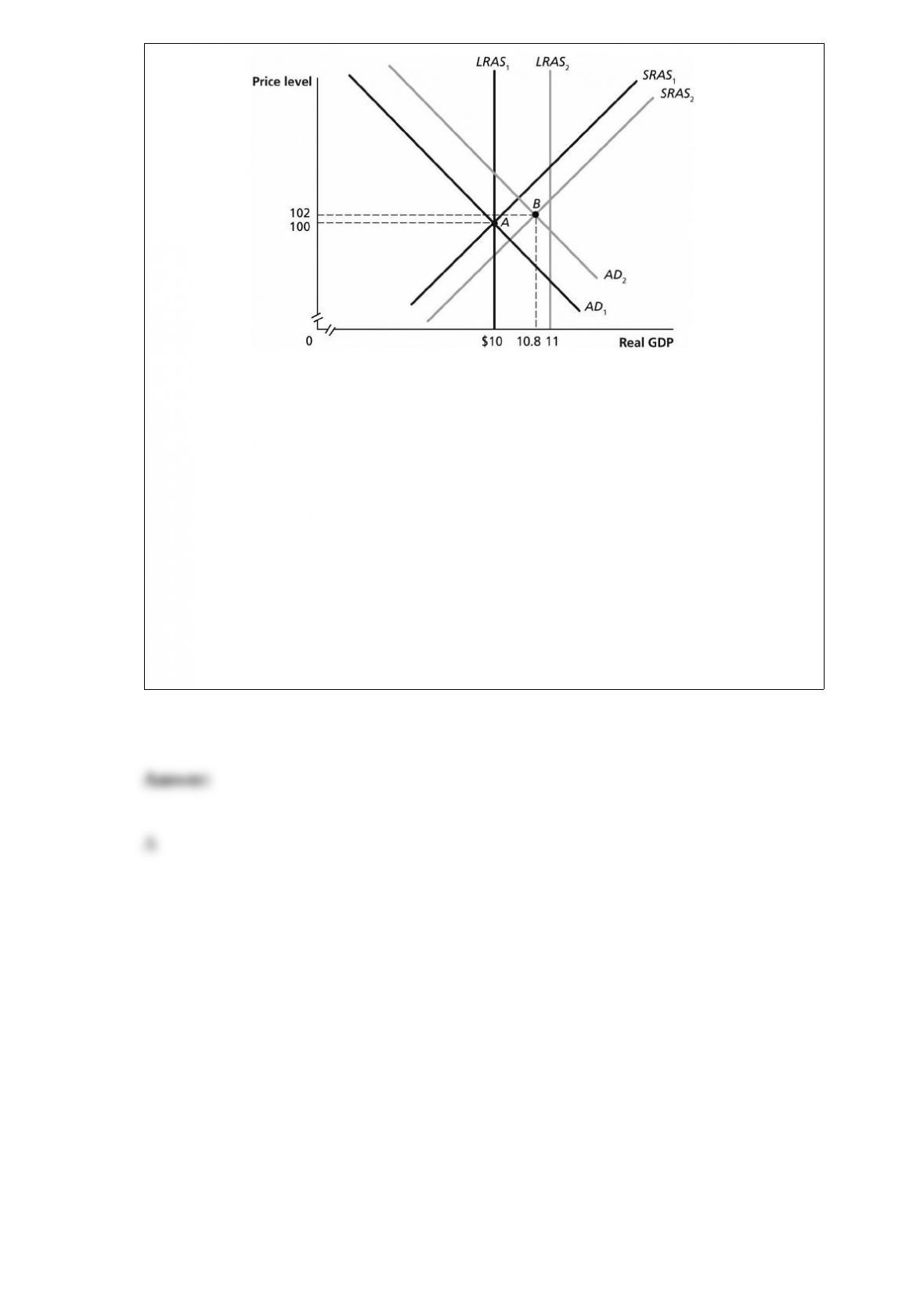
Figure 27-5
In the dynamic model of AD–AS in the figure above, if the economy is at point A in year
1 and is expected to go to point B in year 2, Congress and the president would most
likely pursue
A) expansionary fiscal policy.
B) contractionary fiscal policy.
C) expansionary monetary policy.
D) contractionary monetary policy.
E) contractionary automatic stabilizers.