
Bank reserves include
A) vault cash and deposits with the Federal Reserve.
B) loans to bank customers and deposits with the Federal Reserve.
C) vault cash and loans to bank customers.
D) customer checking accounts and vault cash.
E) deposits with the Federal Reserve and holdings of securities.
Consider the following economic agents:
a. the government
b. consumers
c. producers Who, in a market economy, decides what goods and services will be
produced with the scarce resources available in that economy?
A) the government
B) producers
C) consumers
D) consumers and producers
E) the government, consumers and producers
The income effect of an increase in the price of salmon
A) is the change in the demand for salmon when income increases.
B) refers to the relative price effect – salmon is more expensive compared to other types
of fish – which causes the consumer to buy less salmon.
C) refers to the effect on a consumer’s purchasing power which causes the consumer to
buy less salmon, holding all other factors constant.
D) is the change in the demand for other types of fish, say trout, that result from a
decrease in purchasing power.
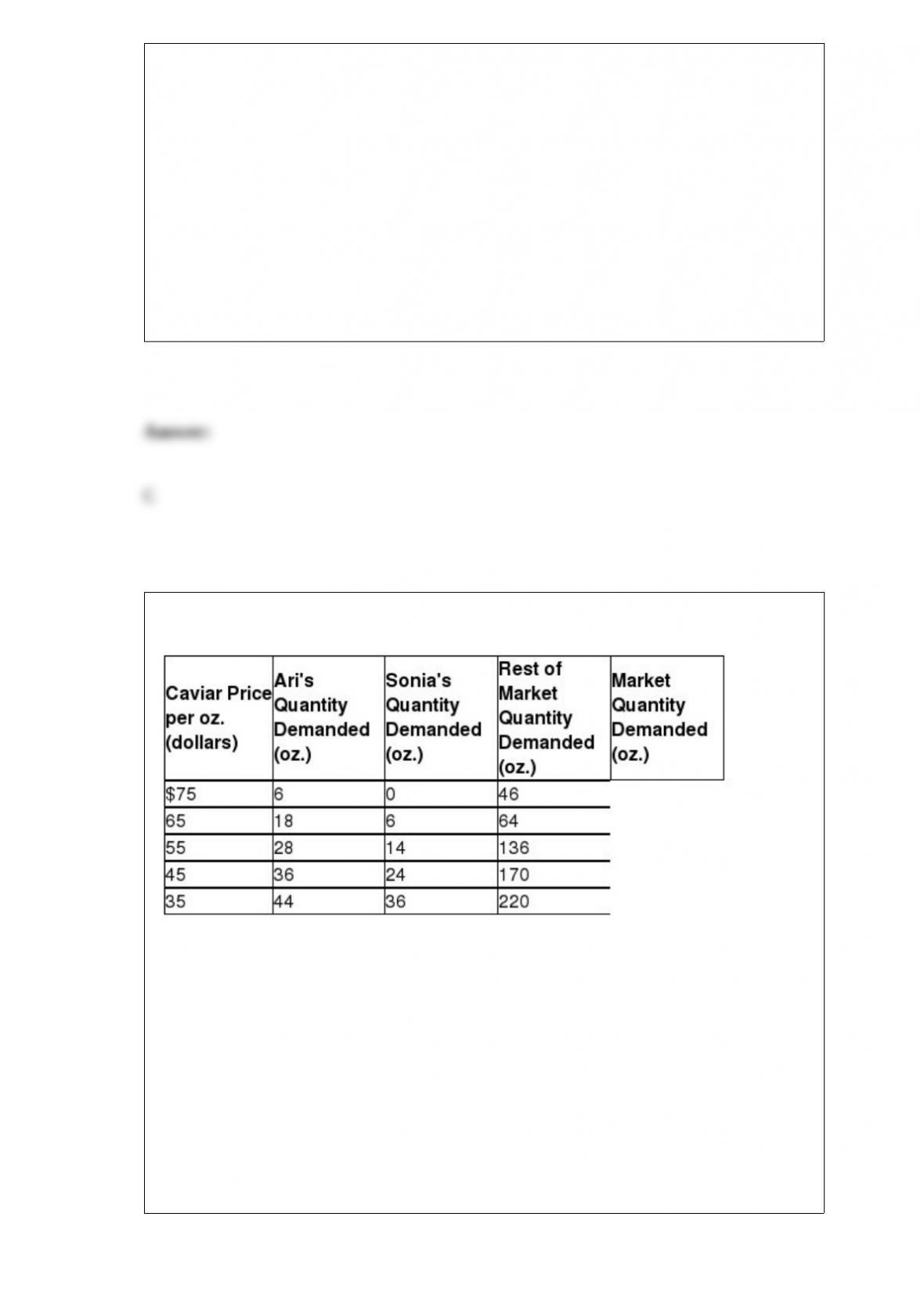
Table 3-2
The table above shows the demand schedules for caviar of two individuals (Ari and
Sonia) and the rest of the market. If the price of caviar falls from $45 to $35, the market
quantity demanded would
A) decrease by 50 oz.
B) increase by 70 oz.
C) increase by 50 oz.
D) decrease by 70 oz.

With perfect price discrimination there is
A) no deadweight loss.
B) no producer surplus.
C) one single price.
D) an increase in consumer surplus.
The area above the market supply curve and below the market price
A) is equal to the total amount of producer surplus in a market.
B) is equal to the marginal cost of the last unit produced.
C) is equal to the total amount of economic surplus in a market.
D) is equal to the total cost of production.
Article Summary. In 2012, Colorado and Washington legalized marijuana for
recreational use, and one of the major selling points in each state’s pro-marijuana
campaign was the possibility of generating millions of dollars in tax revenue from
sales which could be used for funding general education. The Colorado legislature
was weighing a proposal to tax marijuana at 30 percent, of which 15 percent would
be a sales tax on consumers and 15 percent an excise tax on growers. Washington
has set a tax rate of 44 percent on consumers and 25 percent each for growers and
retailers. Since the legalization of marijuana is relatively new, projecting the
economic impact of its sale is difficult, leading to many questions as to the
quantities that will be produced and sold and what actual tax revenues will be
generated.
Source: Elizabeth Dwoskin, “Colorado and Washington Try to Figure Out How to
Tax Marijuana,” Bloomberg Businessweek, April 26, 2013.
Suppose the sale of marijuana is legalized in Florida, and the state decides to charge a
tax of $50 per ounce on each sale, with the state claiming that retailers will bear the
entire burden of this tax. Draw a graph illustrating the situation where retail outlets
would bear the entire tax burden of $50 per ounce of marijuana. Explain what would
need to be true about the demand for marijuana for retailers to bear the entire burden of
this tax, and if this would likely occur if marijuana sales were legalized.
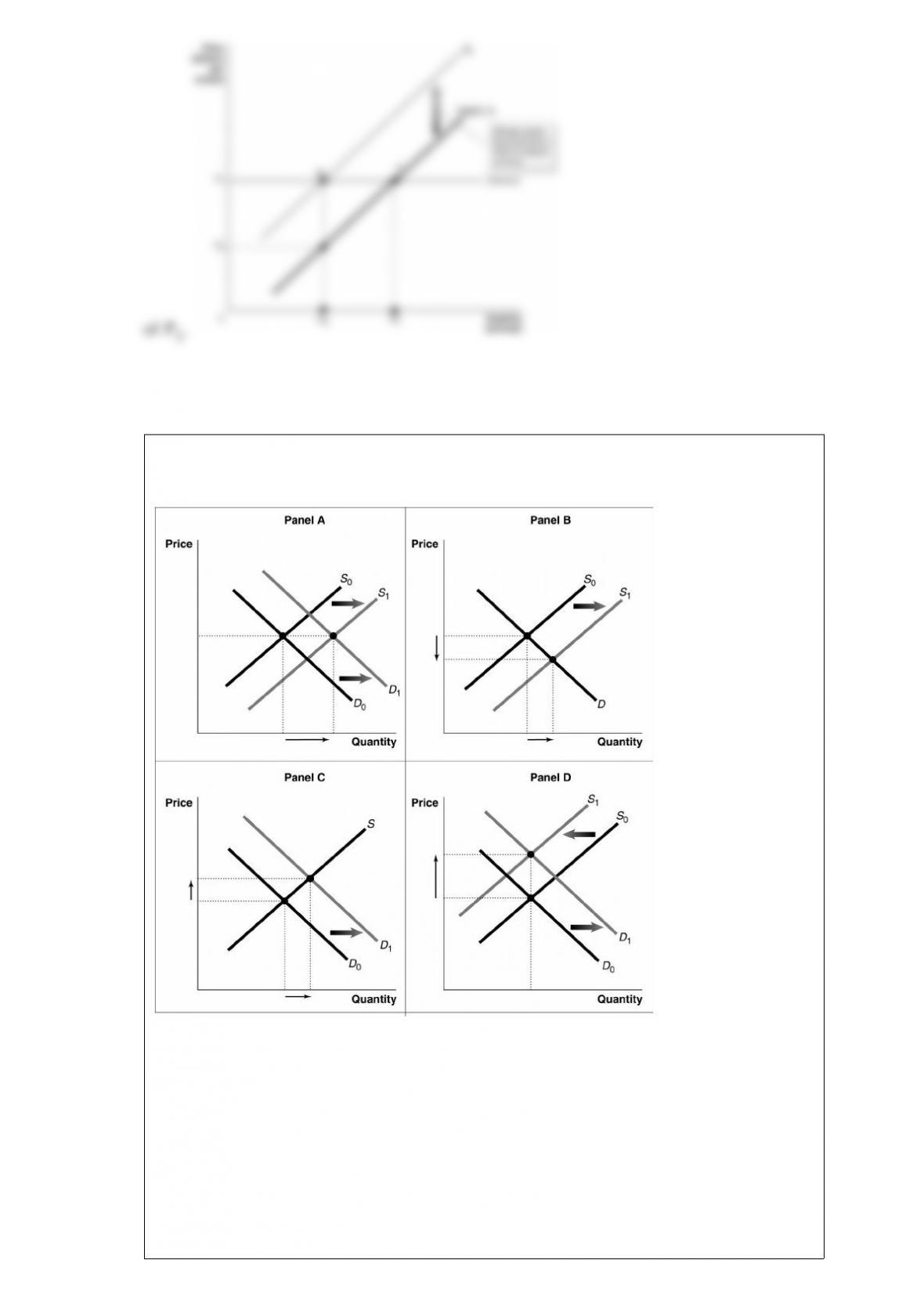
Figure 12-15
Suppose a typical firm in a perfectly competitive market is earning economic profits in
the short run. Which of the diagrams in the figure depicts what happens to in the
industry as it transitions to along run equilibrium?
A) Panel A
B) Panel B
C) Panel C

D) Panel D
The Fed can increase the federal funds rate by
A) selling Treasury bills, which increases bank reserves.
B) buying Treasury bills, which increases bank reserves.
C) selling Treasury bills, which decreases bank reserves.
D) buying Treasury bills, which decreases bank reserves.
Which of the following factors will not cause the labor demand curve to shift?
A) increases in human capital
B) changes in technology
C) change in the price of the product produced with labor
D) the wage rate
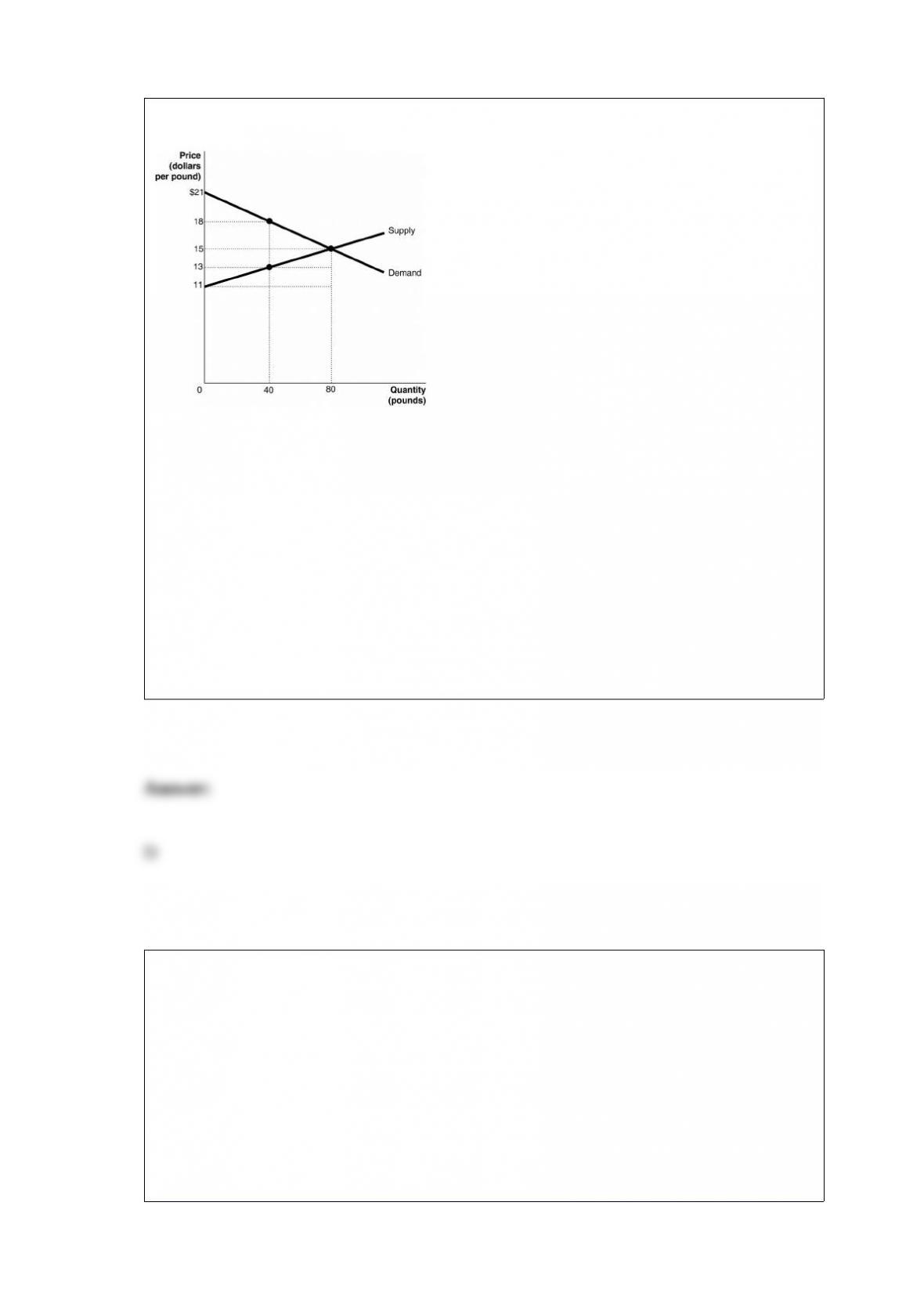
Figure 4-3
Figure 4-3 shows the market for tiger shrimp. The
market is initially in equilibrium at a price of $15 and a quantity of 80. Now suppose
producers decide to cut output to 40in order to raise the price to $18.
What is the value of consumer surplus at the equilibrium price of $15?
A) $60
B) $120
C) $180
D) $240
In the United States, health care spending on people ________ is six times greater than
on people ________.
A) under age 3; over age 65
B) aged 18 to 24; aged 25 to 44
C) over age 65; aged 18 to 24
D) over age 65; aged 25 to 44
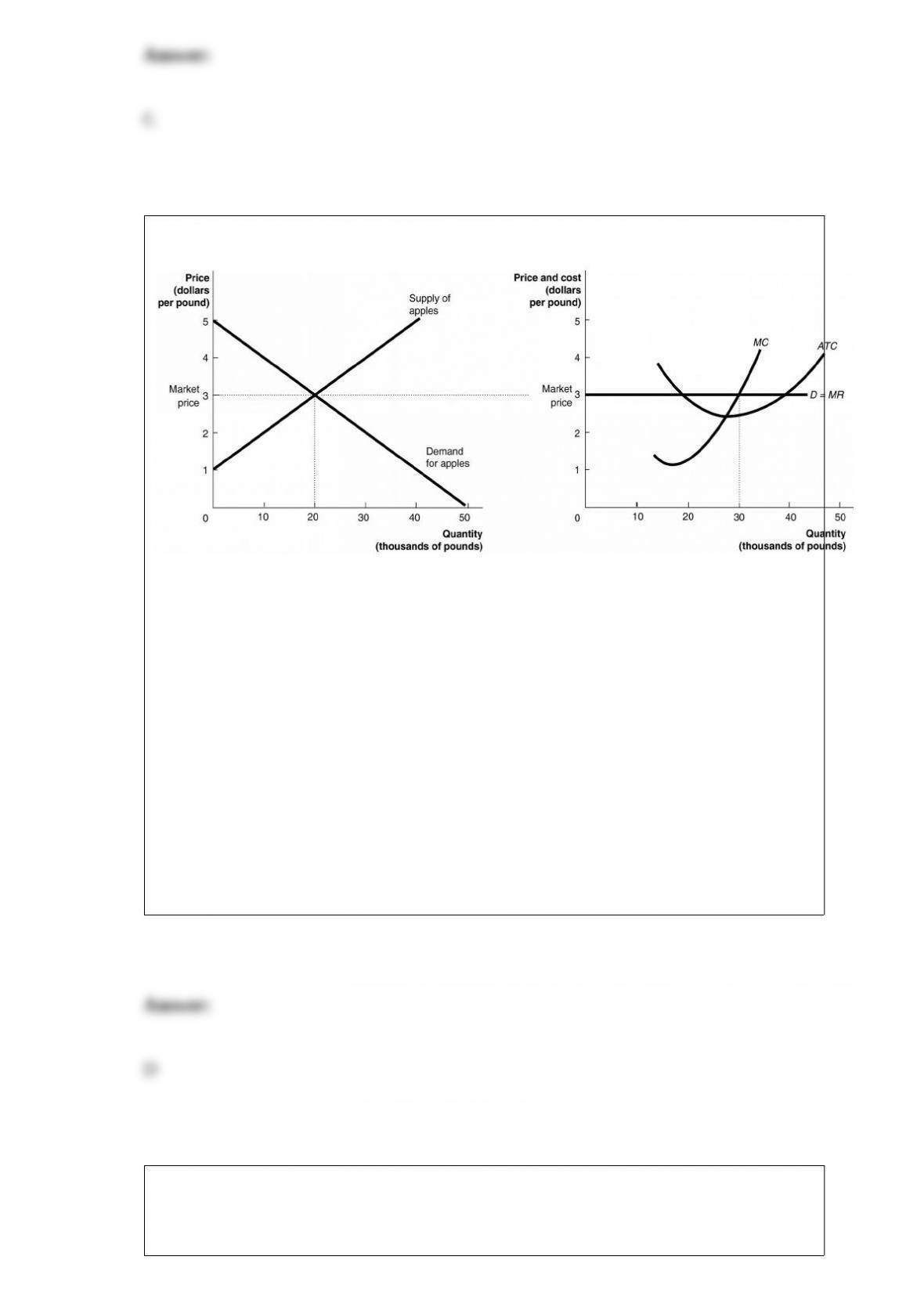
Figure 12-17
The graphs in Figure 12-17 represent the perfectly competitive market demand and
supply curves for the apple industry and demand and cost curves for a typical firm in
the industry.
The graphs depict a short-run equilibrium. How will this differ from the long-run
equilibrium? (Assume this is a constant-cost industry.)
A) Fewer firms will be in the market in the long run than in the short run.
B) The price will be higher in the long run than in the short run.
C) The market supply curve will be further to the left in the long run than in the short
run.
D) The firm’s profit will be lower in the long run than in the short run.
If weak aggregate demand is pushing the economy into recession, which of the
following must be true?
A) The economy is at an equilibrium that is on the long-run aggregate supply curve.
B) The economy is at an equilibrium that is on the long-run Phillips curve.
C) The economy is at an equilibrium that is not on the long-run Phillips curve.
D) Contractionary monetary policies will push the economy back to the long-run
Phillips curve.
A recession begins with a(n) ________ in spending by firms on capital goods and a(n)
________ in spending on durable goods by households.
A) increase; decrease
B) increase; increase
C) decrease; increase
D) decrease; decrease
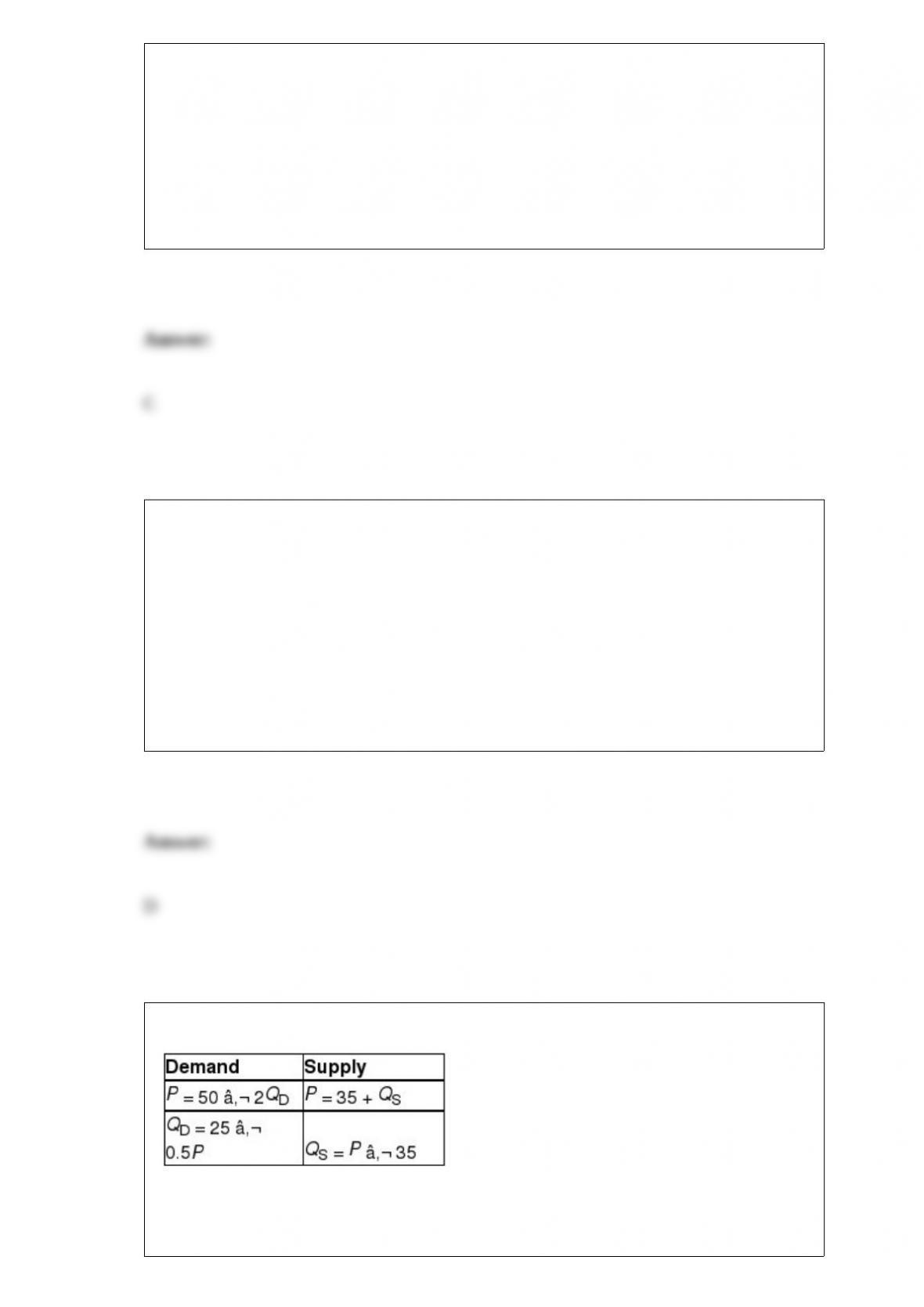
Table 4-12
The equations above describe the demand and supply for Bubba’s Fried Jellybeans. The
equilibrium price and quantity for Bubba’s Fried Jellybeans are $40 and 5 thousand

units. What is the value of economic surplus in this market?
A) $5 thousand
B) $12.5 thousand
C) $25 thousand
D) $37.5 thousand
In the long run, if price is less than average cost,
A) there is an incentive for firms to exit the market.
B) there is profit incentive for firms to enter the market.
C) the market must be in long-run equilibrium.
D) there is no incentive for the number of firms in the market to change.
Technological improvements are more likely to occur if
A) the economy is centrally planned.
B) entrepreneurs are compensated with higher profits for taking risks.
C) economic decisions are made by politicians rather than entrepreneurs.
D) companies face little competition in their markets.

A bank is legally required to hold a fraction of its ________ as ________.
A) deposits; required reserves
B) deposits; excess reserves
C) loans; excess reserves
D) loans; required reserves