1) the economic perspective refers to:
a.macroeconomic phenomena, but not microeconomic phenomena.
b.microeconomic phenomena, but not macroeconomic phenomena.
c.the making of purposeful decisions in a context of marginal costs and marginal
benefits.
d.unlimited resources in a context of limited economic wants.
2) Global resource demand has:
A.remained relatively constant because increases in population have been offset by
declining consumption per person.
B.declined because of technological progress.
C.remained constant because population growth and increased consumption per person
have been offset by technological progress.
D.increased because population growth and increased consumption per person have
more than offset reduced demand due to technological progress.
3) an industry comprised of a very large number of sellers producing a standardized
product is known as:
a.monopolistic competition.
b.oligopoly.
c.pure monopoly.
d.pure competition.
4) Which of the following fiscal policy actions is most likely to increase aggregate
supply?
A.An increase in personal income tax rates.
B.A reduction in interest rates that encourages consumers to purchase more durable
goods.
C.An increase in transfer payments to unemployed workers.
D.An increase in government spending on infrastructure that increases private sector
productivity.
5)
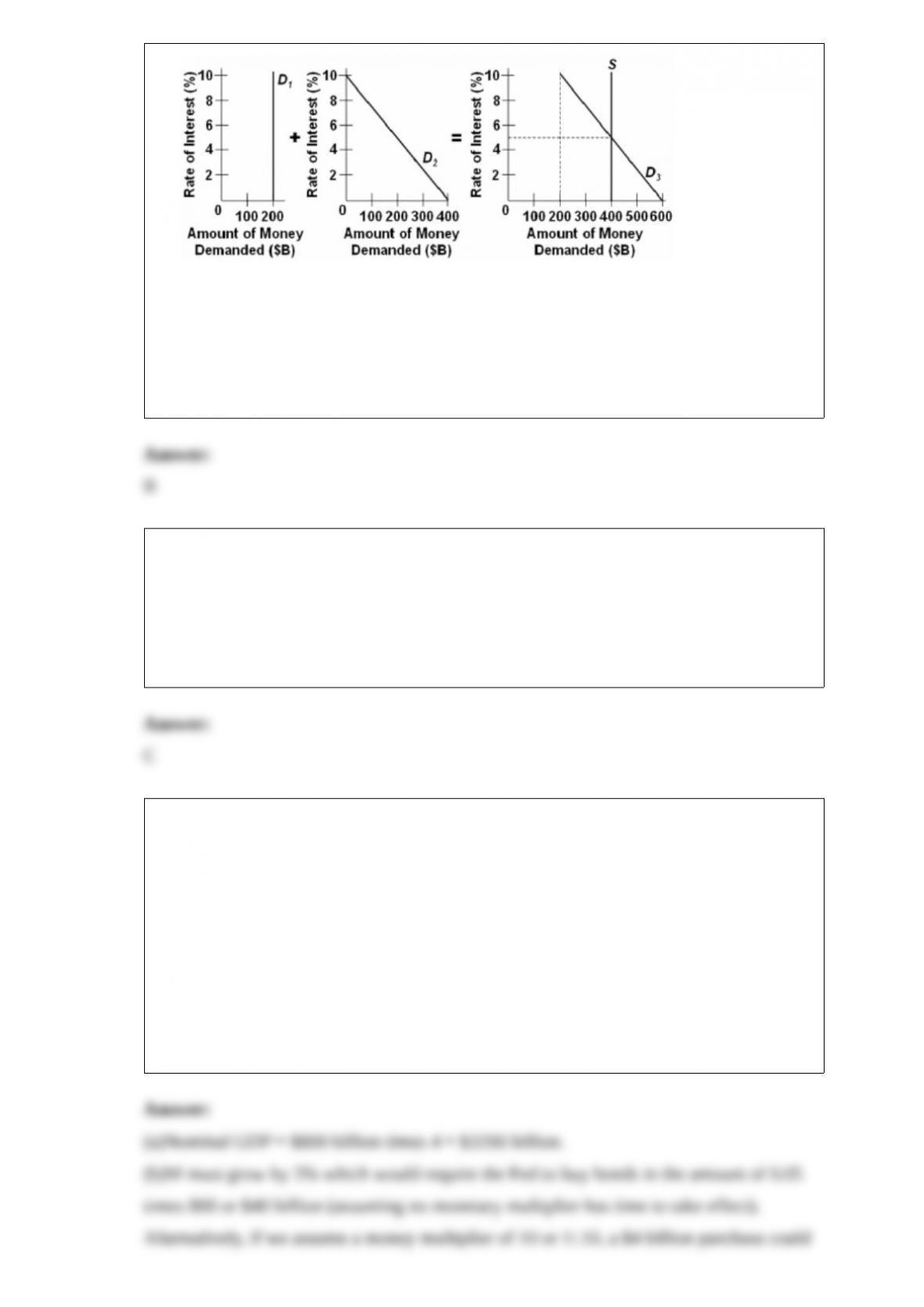
Refer to the above market for money diagrams. If each dollar held for transactions is
spent four times per year on the average, we can infer that the:
A.real GDP is $800.
B.nominal GDP is $800.
C.money supply must be $800.
D.nominal GDP is $1200.
6) Negative net exports in the United States in 2007:
A.resulted in a recessionary expenditure gap.
B.resulted in an inflationary expenditure gap.
C.were offset by sufficiently large expenditures by households, businesses, and
government.
D.prompted the government to raise tariffs on all imported goods.
7) Answer the following questions for a hypothetical economy whose situation in year 1
was as follows: M = $800 billion; long-term annual growth of real GDP = 3%; V = 4.
The banking system has no excess reserves and the reserve requirement is 10%.
Assume that V is constant and the economy is at full employment.
(a)What is the nominal GDP in year 1?
(b)If the Federal Reserve adheres to the monetarist rule of increasing the money supply
by a constant 5% using open-market operations, explain whether it will have to buy or
sell bonds and by how much between years 1 and 2 in order to meet the rule.
(c)Based on the information given above and calculated in (b) above, what will be the
nominal GDP in year 2?
(d)Is this change greater or less than the change in real GDP? Explain.
8) answer the next question(s) on the basis of the following information: only three
goods are produced in an economy in the following amounts: a = 10, b = 30, c = 5. the
current year per unit prices of these three goods are a = $2, b = $3, and c = $1.
refer to the above information. nominal gdp in the current year is:
a.$110.
b.$115.
c.$45.
d.$90.
9) Which of the following is correct?
A.The Federal government can delay any strike for eighty days.
B.About 3 percent of total work-time is lost in the United States because of strikes.
C.Work-time lost may overstate the cost of a strike if the work stoppage disrupts
production in related industries.
D.Work-time lost may overstate the cost of a strike if nonstruck firms increase their
production.
10) the smallest component of aggregate spending in the united states is:
a.net exports.
b.government purchases.
c.investment.
d.consumption.
11) What are the two basic ways of deriving real GDP from nominal GDP?
12) What are types of firms that exemplify monopolistic competition?
13) Discuss the issue of climate change. Define the problem, explain the proposed
solutions, and describe the views of economists on the issue.
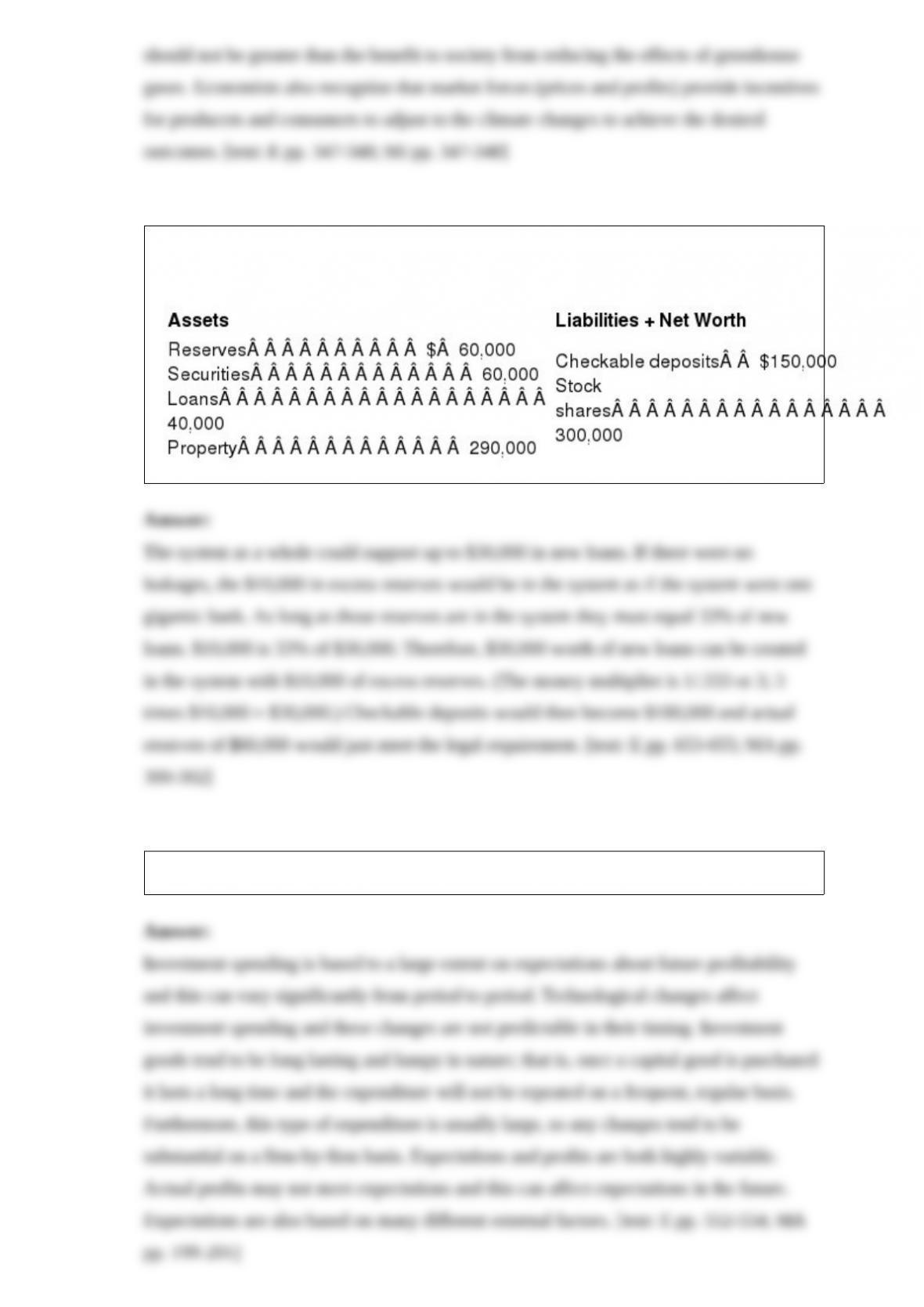
14) If the balance sheet below were for the entire banking system instead of just a
single bank, by how much could loans be expanded? Assume a reserve ratio of 33%.
15) State four factors that explain why investment spending tends to be unstable.
16) Fill in the table below. Describe your result.
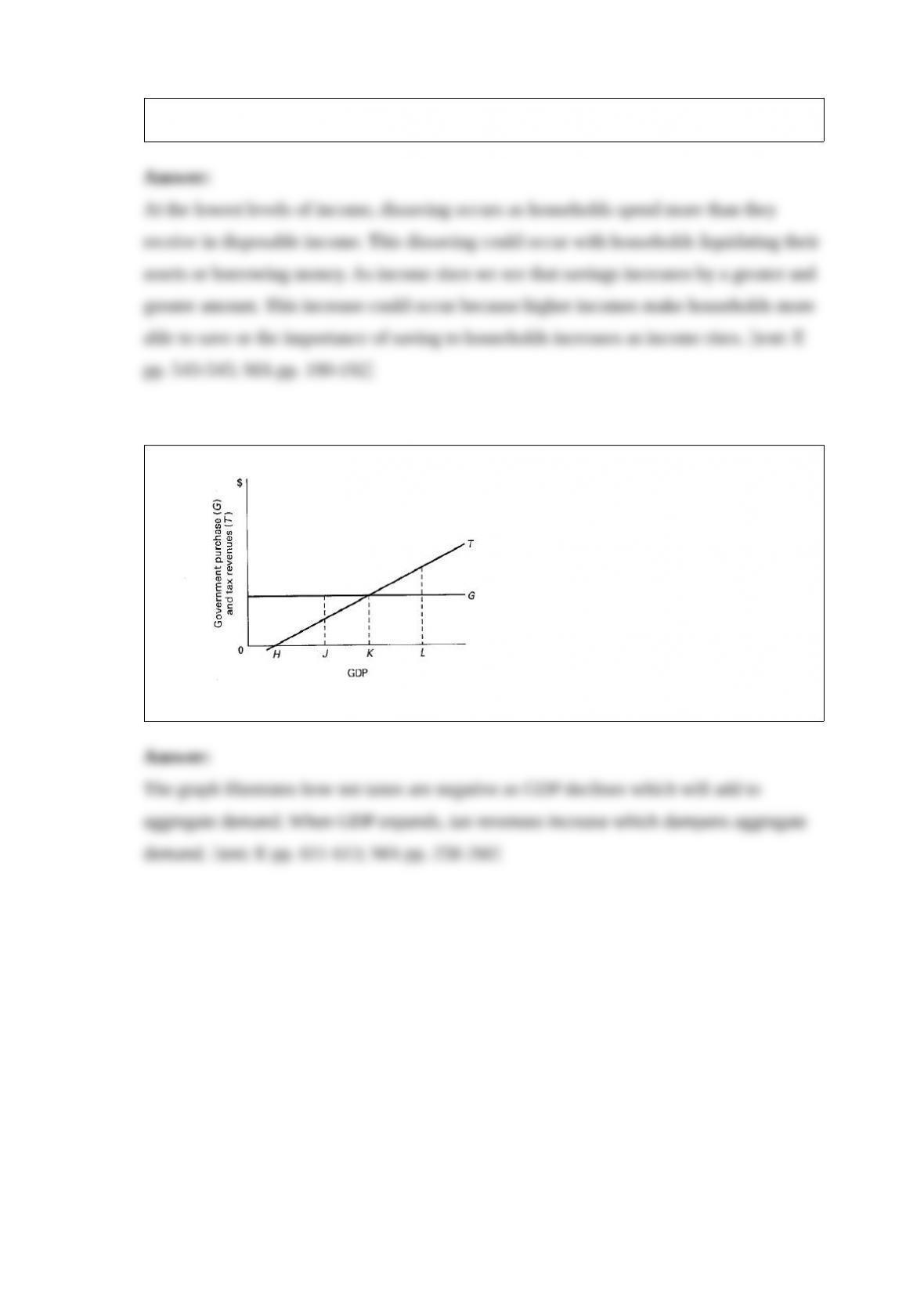
17) Explain how the below graph illustrates
the built-in stability of a progressive tax structure.