
The demand for reserves depends on income and the price level.
a. True
b. False
The negative slope of a production possibilities frontier is a graphic representation of
opportunity cost.
a. True
b. False
All of the following are possible characteristics of oligopoly except
a. free entry into the industry.
b. significant economies of scale.
c. interdependence among sellers.
d. homogeneous product.

In a free-market system, producers will react to an increase in demand when
a. the price goes up.
b. the government announces the increased demand.
c. their costs increase.
d. the free press publishes news of the increased demand.
Profit per unit can be expressed as price – cost per unit.
a. True
b. False
Concentration increases in an industry
a. if the larger firms gain control of important resources, squeezing out smaller firms.

b. if some firms become technologically superior over time.
c. if innovation increases plant size of some firms and lowers their cost.
d. All of the above are correct.
What is the long-run effect on the demand curve of a monopolistically competitive firm
when more firms enter the market?
a. Demand curve shifts to left.
b. Demand curve remains the same.
c. Demand curve shifts to right.
d. Demand curve become flatter.
Changes in relative prices usually lead to increases in real income because prices have
changed.
a. True
b. False

The principal objective of the Federal Reserve System is to
a. circulate coins and paper Federal Reserve Notes.
b. subsidize the income of member banks.
c. help stabilize the economy through monetary policy.
d. make profits to remit to the Treasury Department.
Do policy makers know the exact value of the fiscal multiplier?
a. No, economists have almost no idea of the value of fiscal multipliers.
b. No, they are not known with complete accuracy.
c. Yes, economists know the precise value of the multiplier.
d. Yes, although there is a very small range of uncertainty in the value.

How do the wages in the United States compare to those in northern Europe?
a. U.S. wage rates are higher than those of all northern European nations.
b. Northern Europe’s average wage rates are higher.
c. U.S. wage rates are higher than those in Germany and the Netherlands.
d. they are similar.
The theory of land rent holds that
a. capital invested on any plot of land must yield the same return as capital invested on
any other plot of land.
b. the difference between the costs of producing on any two pieces of land must equal
the difference between their rents.
c. marginal land earns no rent.
d. All of the above are correct.
A firm that decides to make a price cut assumes that marginal profit is negative.
a. True
b. False

When aggregate demand decreases rapidly, the economy is likely to experience
a. inflation.
b. an economic boom.
c. economic growth.
d. recession.
Which of the following is one source of disagreement between economists?
a. Some facts about the economy are unknown.
b. Economists differ in their political persuasions.
c. Economic theory may not always give an unambiguous answer to a question.
d. Solving one problem may make another problem worse.
e. All of the above are correct.

One of the primary functions of markets could be labeled
a. stimulation.
b. coordination.
c. planification.
d. decentralization.
In long-run equilibrium in perfect competition, every firm is producing at minimum
average cost.
a. True
b. False
Because it is a market economy, in the United States all research and development is
done by private business firms.
a. True

b. False
Capital is a(n) ____ variable and investment is a(n) ____ variable.
a. physical, financial
b. stock, flow
c. asset, liability
d. flow, stock
Perfectly inelastic demand curves are vertical.
a. True
b. False

The prices of most services have risen much faster than inflation in recent years
because
a. wages and salaries of service providers have risen much faster than inflation.
b. wages and salaries of service providers have risen but their productivity has not.
c. the productivity of service providers has risen dramatically.
d. the demand for services has risen.
Compared to other countries, the U.S. federal government relies
a. more heavily on direct taxes than do governments of other countries.
b. less heavily on direct taxes than do governments of other countries.
c. more heavily on indirect taxes than do governments of other countries.
d. on direct taxes about as heavily as do governments of other countries.
In 2015, you buy a beautiful vintage 1965 Thunderbird convertible. This purchase
would
a. be included in the GDP for 2015.
b. not be included in the GDP for 2015.
c. be included in both the GDP for 1965 and 2015.
d. be in the GDP for 2015 at a depreciated value.
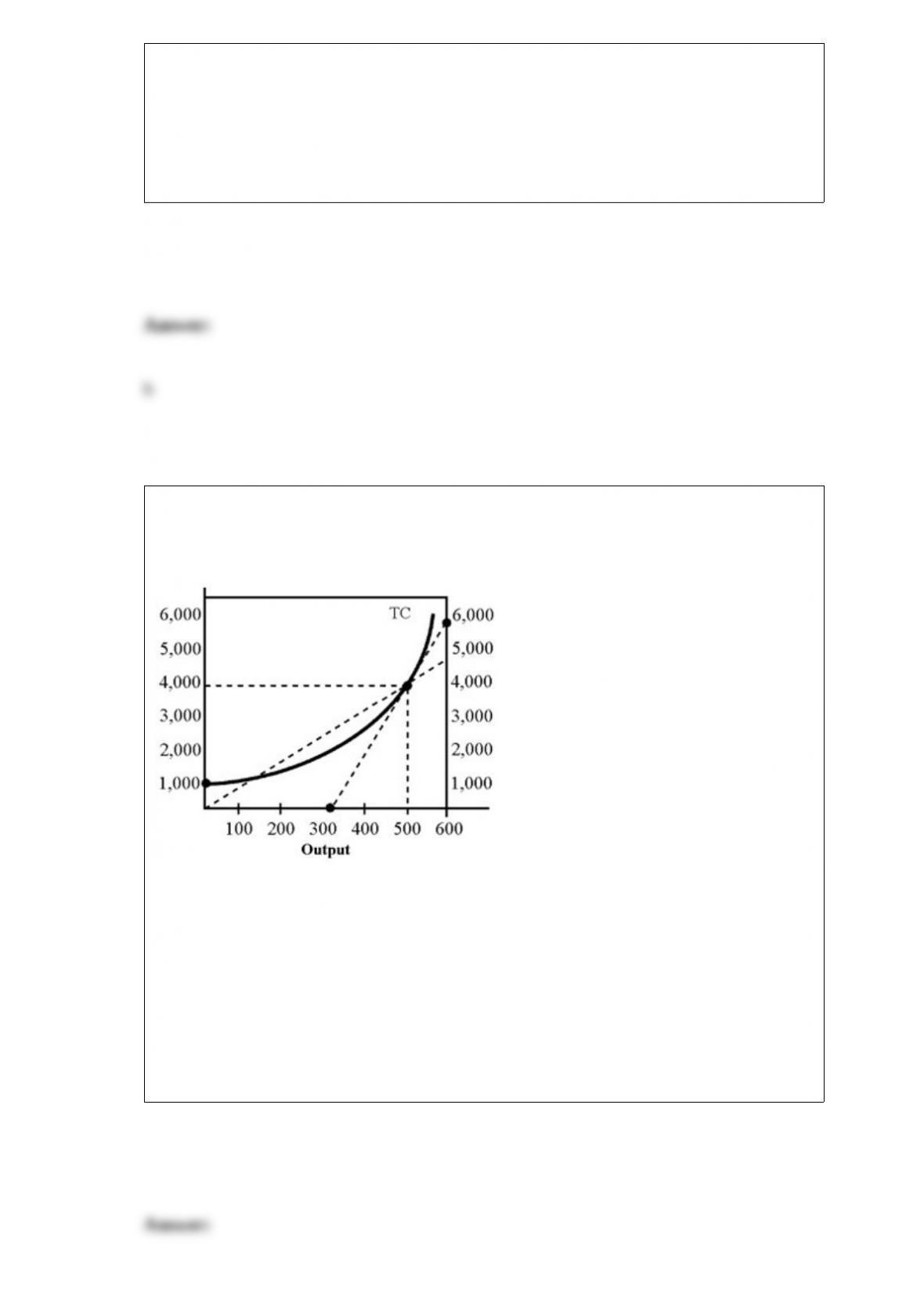
Figure 7-2
In Figure 7-2, average cost at 500 units of output equals
a. 4,000.
b. 200.
c. 8.
d. 6.

Which of the following assets is most liquid?
a. short-term government bonds
b. savings accounts
c. checking accounts
d. currency and coins
If inflation is expected by both borrowers and lenders, then we would expect
a. real rates to be higher than nominal rates of interest.
b. real rates to be equal to nominal rates of interest.
c. real rates to be lower than nominal rates of interest.
d. nominal rates of interest to be less than the expected inflation rate.
The presence of large sunk costs often serves as a naturally imposed barrier to entry.

a. True
b. False
Government purchases and income taxes have the same effect on the multiplier.
a. True
b. False
Statistical studies in the United States have reached the conclusion that for low-income
workers
a. the substitution effect is greater than the income effect.
b. the income effect is greater than the substitution effect.
c. the income effect is about equal to the substitution effect.
d. the substitution effect is of the “wrong” sign.

A federal budget deficit places a genuine burden on future generations when the
a. crowding-out effect is stronger than the crowding-in effect.
b. crowding-in effect is stronger than the crowding-out effect.
c. crowding-out and crowding-in effects work in opposite directions.
d. crowding-out and crowding-in effects operate in the same direction.
Sharon buys some common stock in 1990 for $10,000 and sells it in 2000 for $15,000.
During the same period, prices have risen by 75 percent. The net result of Sharon’s
stock purchases is that she will
a. pay no taxes because she earned negative real capital gains.
b. lose purchasing power and have to pay taxes anyway.
c. earn a real capital gain of $5,000 plus 75 percent.
d. earn a real capital gain of $15,000 minus 75 percent.

The concept of vertical equity is that
a. income should be taxed instead of property.
b. property should be taxed instead of income.
c. there should be little movement up or down the social scale.
d. persons who are unequal should be treated unequally.
If the federal government wishes to move the economy out of a recessionary gap, the
appropriate fiscal policy is a(n)
a. increase in taxes.
b. decrease in government purchases.
c. decrease in transfer payments.
d. None of the above are correct.
What are the implications of the law of conservation of matter and energy for recycling
and waste disposal?
The Antitrust Division of the Department of Justice carefully scrutinizes mergers. Why?
Why is the total profit curve shaped like a hill?

How does the United States compare to other nations on a per capita scale as far as
government production and taxation?
In the 1970s, why did the short-run Phillips curve fail to depict the
unemployment-inflation trade-off?
What are the three coordination tasks which markets resolve?
Economists tend to be concerned about entry barriers. Why are entry barriers so
important?
Draw a graph using production indifference curves and budget lines showing a firm
initially minimizing cost with its inputs of A and B. Then illustrate a new optimal
combination of inputs when the prices of the inputs change.
Distinguish between a movement along the aggregate supply curve and a shift of the
entire aggregate supply curve. What factors cause each to occur?
What is aggregate demand? What are its major components?

Explain why Adam Smith believed that competitive markets are a key component of
achieving the gains from the invisible hand.
Explain the circumstances under which some component of labor income is economic
rent.
If Polaroid wanted damages against Kodak for infringing on its instant development
film process, and the courts found a high positive cross elasticity between purchases of
Polaroid instant film and 35mm regular film, would that have strengthened or weakened
Polaroid’s claim against Kodak?
What do you mean by Coase theorem?
In 2007, as stock prices in general were falling, many investors began switching their
funds into purchasing bonds. Surveys suggest that many of these investors did not
understand the basic relationship between bond prices and interest rates. Using a
numerical example, illustrate how an increase in the demand for bonds would affect the
interest rate paid on bonds.

Why do economists insist on emphasizing the difference between money and income?
Why is this difference important in macroeconomics?
Discuss the opposing points of view on U.S. trade deficit.
Specifically, what might cause the quantity demanded of a particular good to double at
a particular price?
Compare and contrast the effects of a quota and a tariff on imports. Be sure to include
both short-run and long-run effects in your answer.