
In a closed economy,
A) I = Y – C – G.
B) I = Y + C – G.
C) I = Y – C + G.
D) I = Y + C + G.
If the growth rate of real GDP rises from 3% to 4% per year, then the number of years
required to double real GDP will decrease from
A) 23.3 years to 17.5 years.
B) 28.0 years to 21.0 years.
C) 11.2 years to 10.8 years.
D) 23.3 years to 20.6 years.
Which of the following is a normative economic statement?
A) Falling global demand for pesticides has led to decreases in the price of pesticides.
B) With falling mortgage rates and falling unemployment rates, the number of new
homes being built has increased.
C) The state of Florida’s unemployment rate dropped when several large companies
relocated to the Miami area.
D) Global warming should be at the top of every economic agenda.
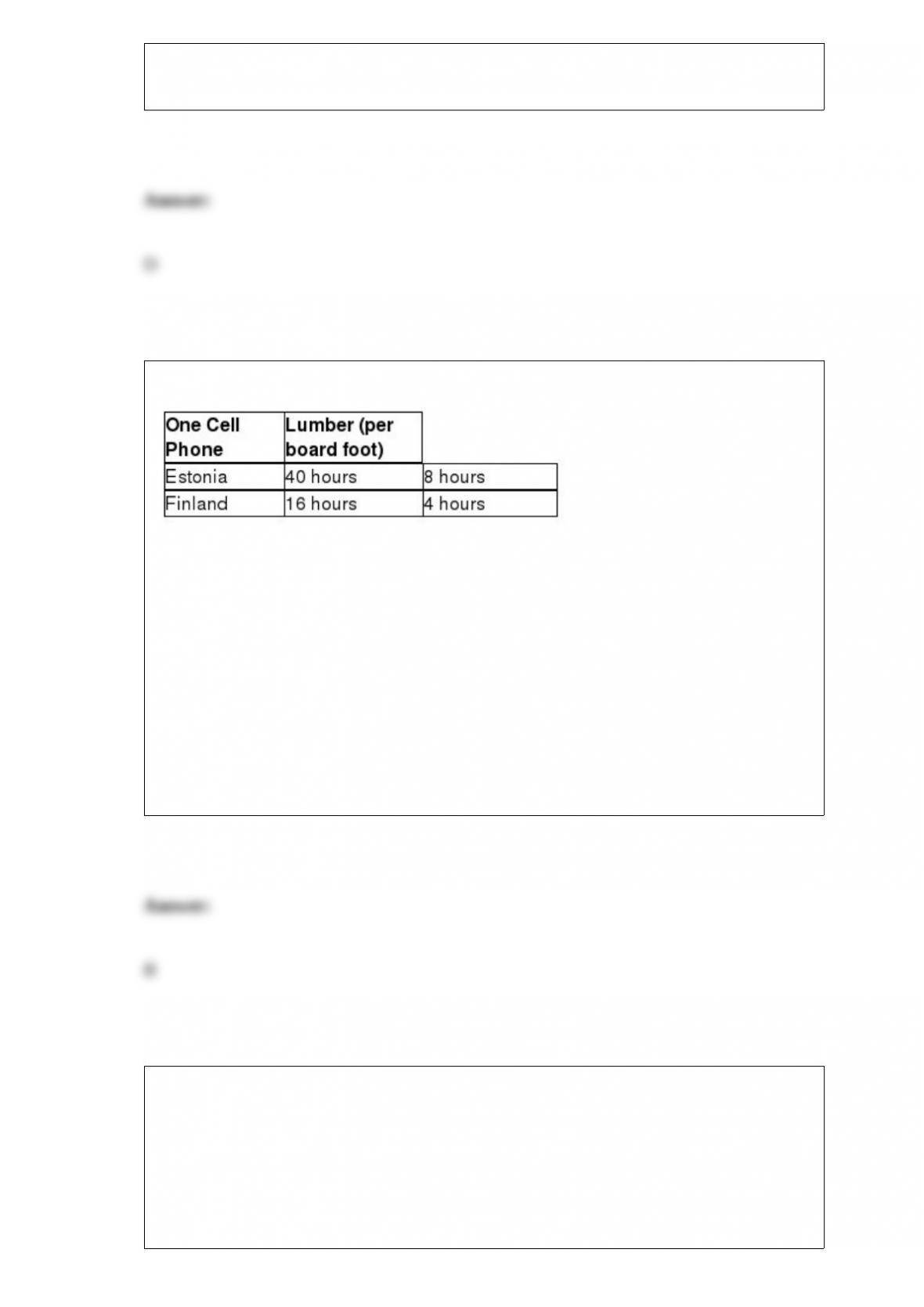
Table 2-5
Table 2-5 shows the number of labor hours required to produce a cell phone and a board
foot of lumber in Estonia and Finland.
Refer to Table 2-5. What is Finland’s opportunity cost of producing one cell phone?
A) 0.25 board feet of lumber
B) 4 board feet of lumber
C) 12 board feet of lumber
D) 16 board feet of lumber
Which of the following is the best example of a tariff?
A) a subsidy from the U.S. government to domestic manufacturers of residential air
conditioners to enable them to compete more effectively with foreign producers
B) a limit on the quantity of residential air conditioners that can be imported from a
foreign country

C) a $150 fee imposed on all imported residential air conditioners
D) a tax placed on all residential air conditioners sold in the domestic market to help
offset the impact of emissions on the environment
An increase in the money supply will
A) increase the interest rate.
B) decrease the interest rate.
C) have no affect on the interest rate.
D) decrease the equilibrium quantity of money in the economy.
When foreign investors in Thailand began to realize that Thailand could not maintain its
peg to the dollar indefinitely, they began to sell off their investments in Thailand and
exchange the baht they received for dollars. This reduction in investment by foreigners
is termed
A) foreign direct investment.
B) capital flight.
C) capital inflow.
D) stabilizing capitalization.

An economic expansion tends to cause the federal budget deficit to ________ because
tax revenues ________ and government spending on transfer payments ________.
A) increase; rise; falls
B) increase; fall; rises
C) decrease; rise; falls
D) decrease; fall; rises
In 1995, the General Agreement on Tariffs and Trade (GATT), which was established in
1948, was replaced by the World Trade Organization (WTO). Why did members of the
GATT push for the establishment of the WTO?
A) The GATT agreement only covered trade in goods. The WTO was created to cover
trade in goods, services and intellectual property.
B) The charter of the GATT had run out and a new organization was needed to promote
international trade.
C) The creation of the European Union (EU) made the GATT obsolete. The WTO was
formed to regulate trade between the EU and other nations.
D) By 1995 tariffs had been eliminated. The WTO was created to reduce non-tariff
trade barriers.
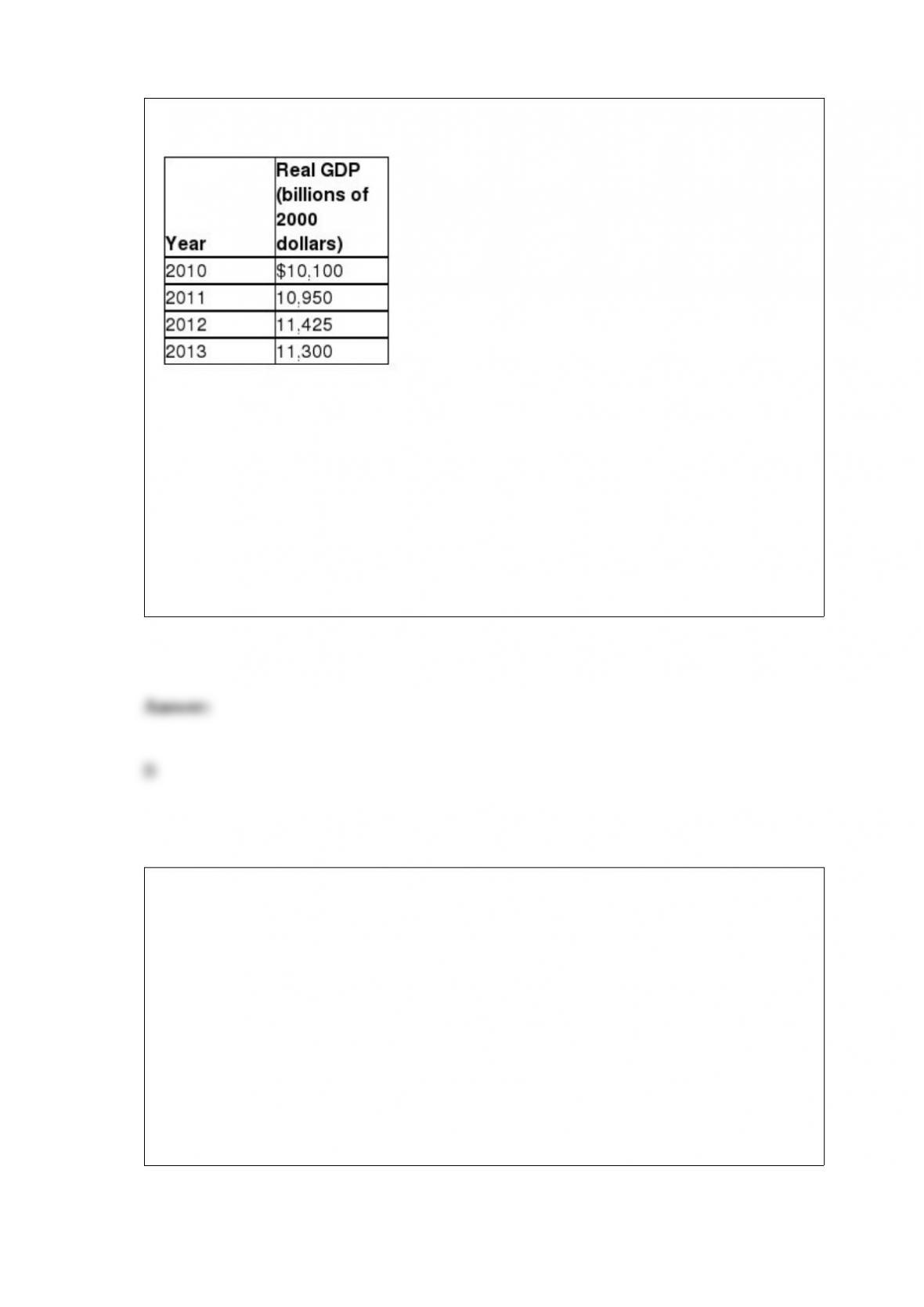
Table 10-2
Refer to Table 10-2. Using the table above, what is the approximate growth rate of real
GDP from 2012 to 2013?
A) -2%
B) -1%
C) 1%
D) 2%
Which of the following statements best describes the concept of consumer surplus?
A) “I paid $89 for a microwave oven last week. This week the same store is selling the
same microwave oven for $69.”
B) “I sold my hard copy of Harry Potter and the Half-Blood Prince to a used book
store for $10 even though I was willing to sell it for $5.”
C) “Target was having a sale on tube socks so I bought 5 pairs.”
D) “I was going to pay $200 for new sunglasses that I had seen at the Oakley store but I
ended up paying only $140 for the same sunglasses.”

Because of asymmetric information, most used cars that are offered for sale will be sold
for prices that are greater than their true value. Because of this fact, the used car market
falls victim to
A) the free rider problem.
B) deadweight loss and economic inefficiency.
C) a surplus of used cars.
D) adverse selection.
Firms in a small economy anticipated that inventories would grow over the past year by
$500,000. Over that year, inventories actually grew by only $400,000. This implies that
A) aggregate expenditure that year was greater than GDP that year.
B) there was an unplanned increase in inventories that year.
C) there was a planned increase in inventories that year.
D) aggregate expenditure that year was equal to GDP that year.