
Refer to Exhibit 21-1. The marginal utility of the fourth plum is
Exhibit 21-1
a. 8 utils.
b. 2 utils.
c. 10 utils.
d. 13.5 utils.
e. 50 utils.
Suppose that on Monday, a Big Mac cost $3.00 in the United States and 320 Japanese
yen in Japan. On Monday, the exchange rate was $1 = 90 yen. According to the
purchasing power parity theory, the yen was __________ by approximately
__________ percent.
a. overvalued; 22
b. undervalued; 40
c. overvalued; 29
d. undervalued; 19
e. overvalued; 19

In the prisoner’s dilemma, each prisoner would be better off if neither one confesses.
a. True
b. False
The change in total cost that results from a change in output is __________ cost.
a. average fixed
b. average variable
c. average total
d. marginal
Jerry has $50,000 in his savings account and the average new car price is $23,000. Does
Jerry have a demand for a new car?
a. Yes, since Jerry can afford a new car.

b. Not necessarily. Jerry has the ability to buy a new car, but we don’t know if he also
has the willingness to buy a new car.
c. Yes, since Jerry’s savings is more than double the average new car price.
d. none of the above
A monopolistic competitive firm maximizes profits by producing at the point where
a. total revenue is at a maximum.
b. marginal revenue equals average cost.
c. marginal revenue equals marginal cost.
d. price equals marginal revenue.
e. b and d
Refer to Exhibit 38-1. The coupon rate for bond E is

a. 37.5 percent.
b. 0.38 percent.
c. 0.45 percent.
d. 9.0 percent.
e. none of the above
The branch of economics that studies the decisions of individuals and firms is called
a. macroeconomics.
b. microeconomics.
c. microeconomics and macroeconomics.
d. positive economics.
e. normative economics.

Refer to Exhibit 34-5. Country 1 has a comparative advantage in the production of
__________, and country 2 has a comparative advantage in the production of
__________.
a. good A; good B
b. good B; good A
c. both goods; neither good
d. neither good; both goods
e. neither good; neither good
Which of the following statements about a perfectly competitive firm is necessarily
false?
a. There are few substitutes for the firm’s product.
b. There are few complements to the firm’s product.
c. The firm produces the quantity at which marginal revenue equals marginal cost.
d. The firm sells a product that is identical in the eyes of buyers to any other product
sold in the industry.
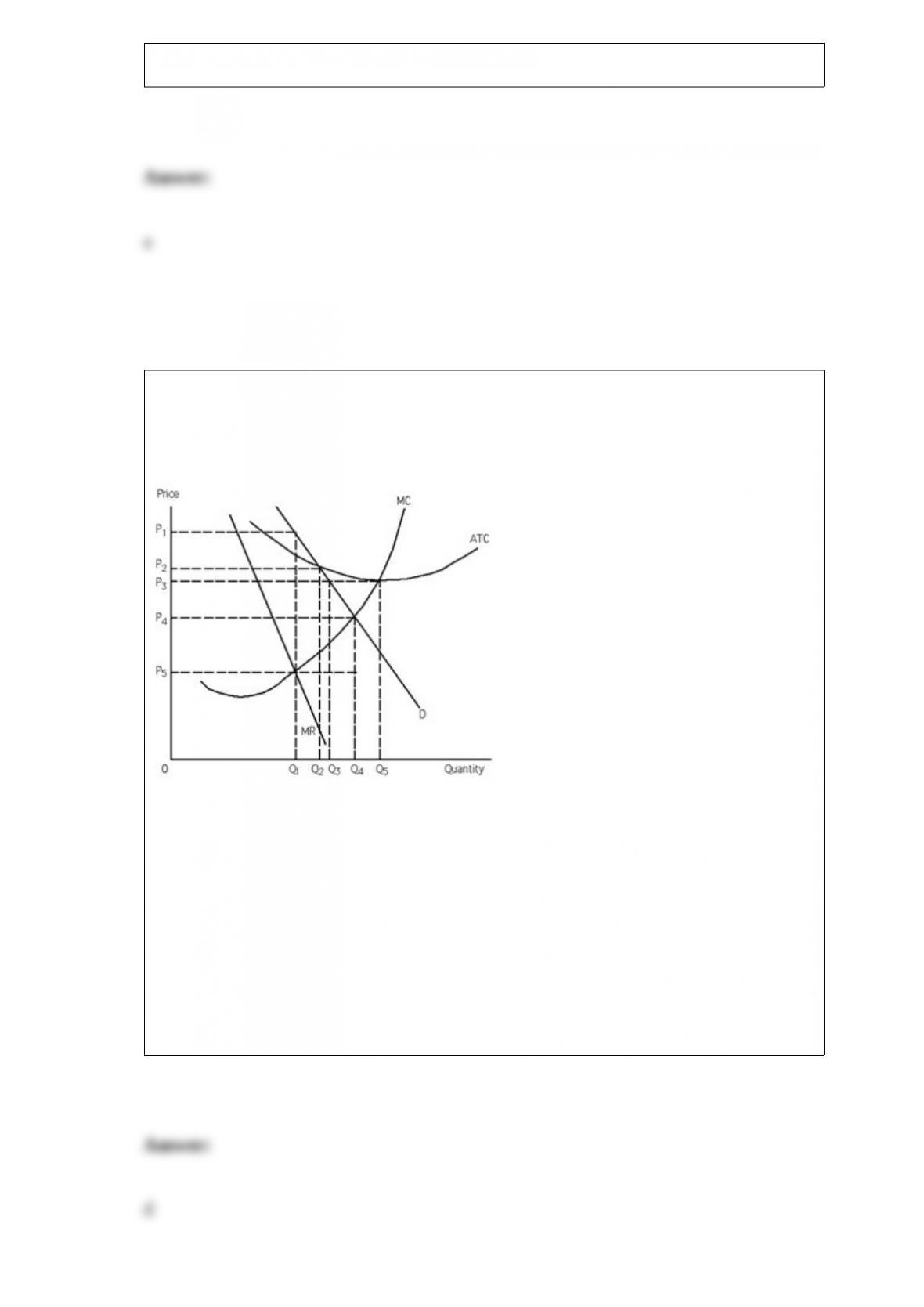
Refer to Exhibit 26-4. If marginal-cost pricing regulation were imposed, the firm would
be forced to set price at the level of
Exhibit 26-40
a. P1.
b. P2.
c. P3.
d. P4.
e. P5.

Economists David Zizzo and Andrew Oswald found that the majority of their study
participants made themselves worse off in order to make someone else worse off.
a. True
b. False
Farmers as a group generally prefer bad weather to good weather because bad weather
shifts the demand curve for their product rightward and raises the price of their product.
a. True
b. False
Refer to Exhibit 22-13.What dollar amounts go in blanks (R) and (S), respectively?
Exhibit 22-13 Quantity of Output (Q) Total Fixed Cost (TFC) Average Fixed Cost
(AFC) Total Variable Cost
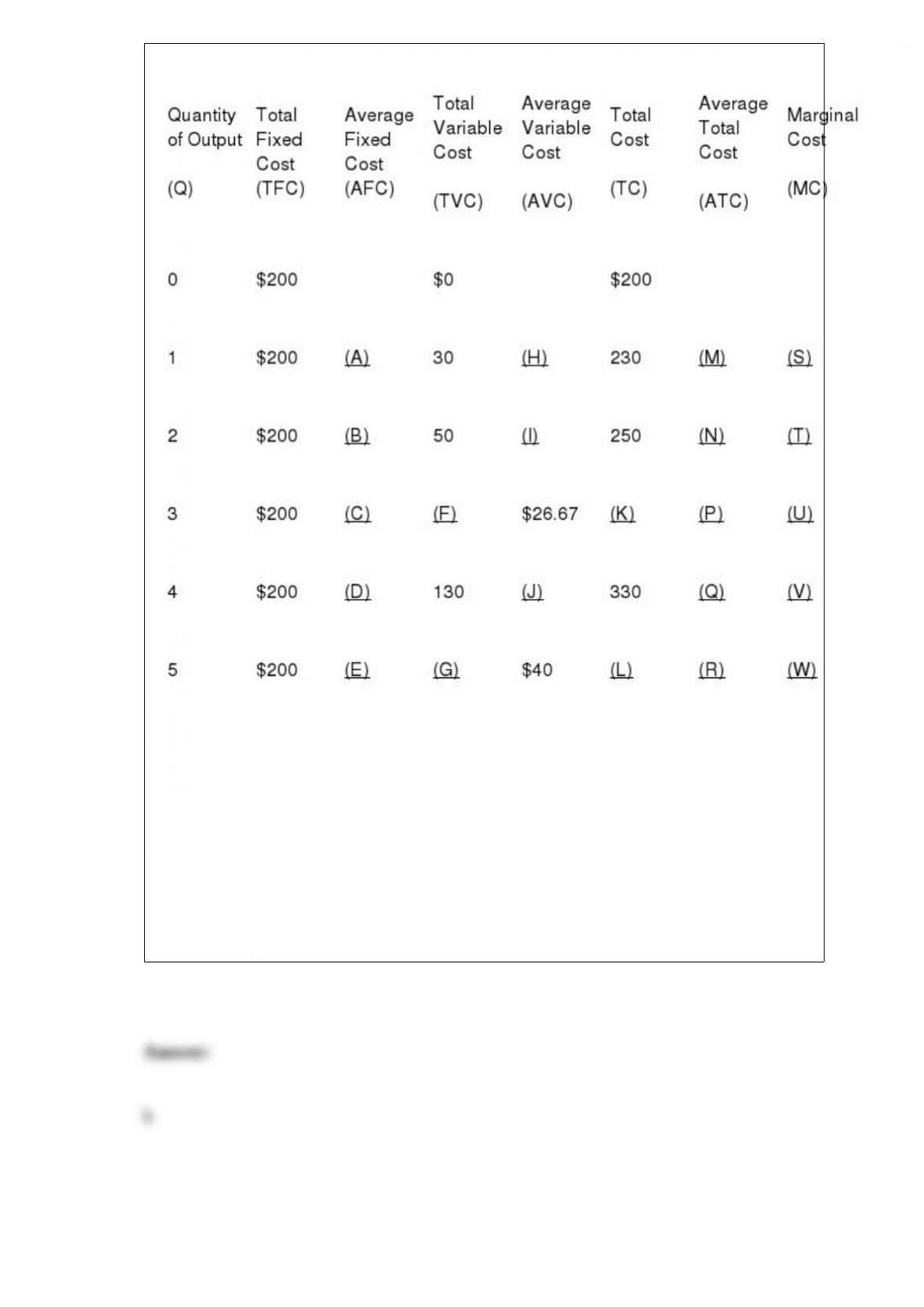
a. $80; $20
b. $80; $30
c. $30; $30
d. $130; $50
e. There is not enough information to answer this question.
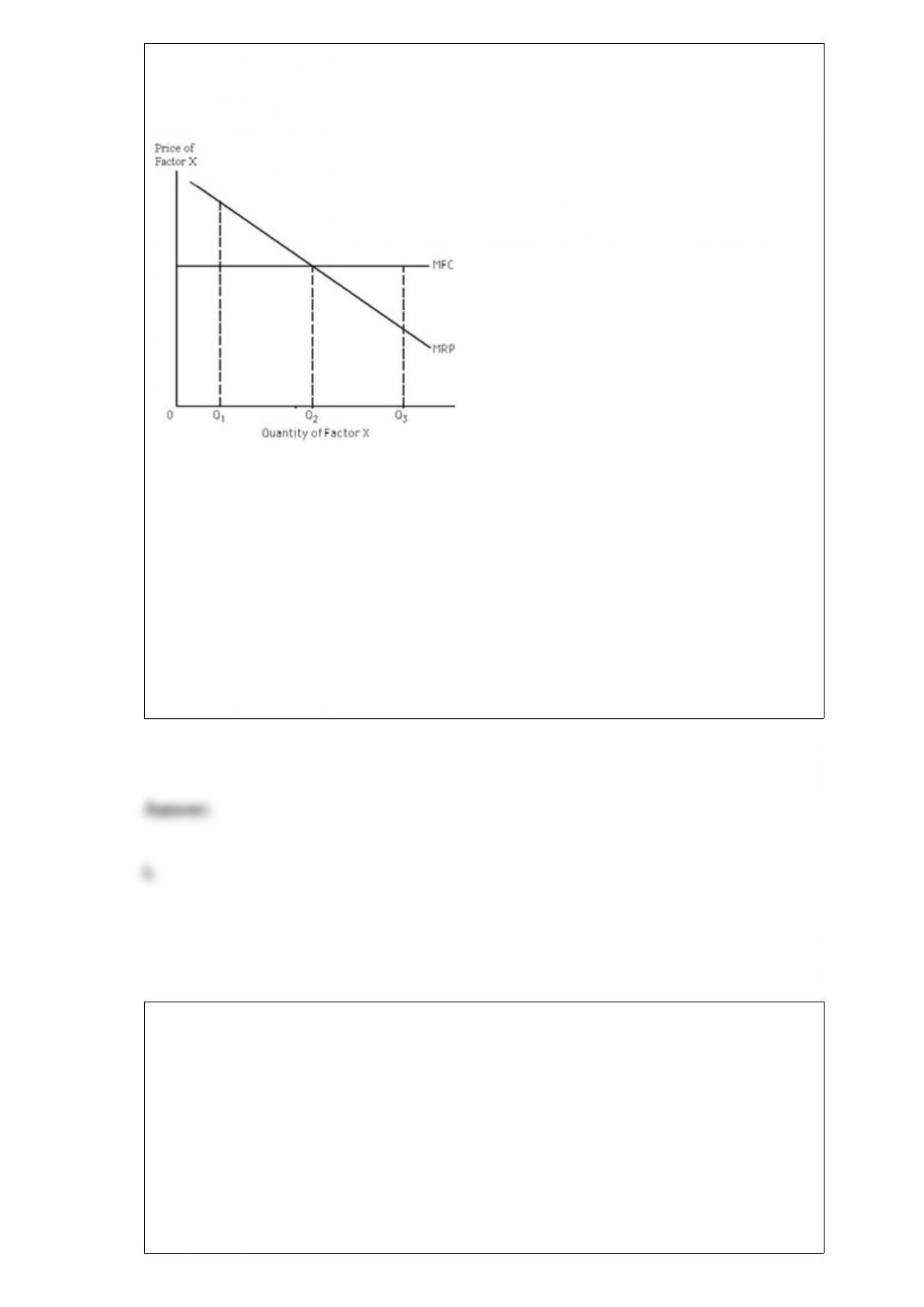
Refer to Exhibit 27-2. What factor quantity should the firm purchase?
Exhibit 27-2
a. Q1
b. Q2
c. Q1 + Q2
d. Q3
e. Q3 – Q1
Suppose a producer decides that if the price of her product is $32, the quantity supplied
will be 1,000 units, and if the price is $35, the quantity supplied will be 1,300. The price
elasticity of supply for the good is approximately
a. +1.91.
b. -2.91.
c. +0.34.

d. -0.34.
e. +2.91.
Individuals who spend resources to influence public policy in a way that will
redistribute income to themselves are
a. stabilizing the economy.
b. rent seeking.
c. engaging in collusion.
d. minimizing explicit costs.
The diamond-water paradox is illustrated by which of the following statements?
a. Water, a necessity, has a relatively low price whereas diamonds, usually a luxury,
have a relatively high price.
b. Although water appears to have a relatively low price when compared to diamonds,
in reality, it has a relatively higher price.
c. Although water appears to have a relatively low price when compared to diamonds,
in reality, the prices are equal.
d. Although water appears to have a relatively low price when compared to diamonds,

at the margin, water has the relatively higher price.
e. Although water appears to have a relatively low price when compared to diamonds,
at the margin, the prices are equal.
Diamonds are more expensive than water because
a. markets do not always reflect value.
b. they have fewer uses.
c. they are relatively scarce and they yield higher marginal utility.
d. they yield higher total utility.
e. all of the above
Arguments made against free trade include all of the following except
a. national defense considerations justify producing certain goods domestically whether
the country has a comparative advantage in their production or not.
b. infant industries should be protected from free trade so that they may have time to
develop and compete on an even basis with older, more established foreign industries.
c. dumping is an unfair trade practice that puts domestic producers of substitute goods
at a disadvantage that they should be protected against.

d. free trade is inflationary and should be restricted in the domestic interest.
e. if foreign governments subsidize their exports, foreign firms that export are given an
unfair advantage that domestic producers should be protected against.
The law of increasing opportunity cost results from the varying ability of resources to
adapt to the production of different goods and it helps to explain why production
possibilities curves are typically bowed outward.
a. True
b. False
If the price for loanable funds is less than the return on capital, then firms will
a. borrow in the loanable funds market and invest in capital goods, and as this happens,
the quantity of capital decreases and its return rises.
b. borrow in the loanable funds market and invest in capital goods, and as this happens,
the quantity of capital increases and its return falls.
c. not borrow in the loanable funds market, and over time the capital stock will decrease
and the return on capital will fall.
d. not borrow in the loanable funds market, and over time the capital stock will decrease
and the return on capital will rise.