The deadweight loss from taxing a good will be smaller for goods:
A. whose supply and demand curves are more inelastic.
B. whose supply and demand curves are more elastic.
C. that are relatively expensive.
D. that are consumed by a large fraction of the population.
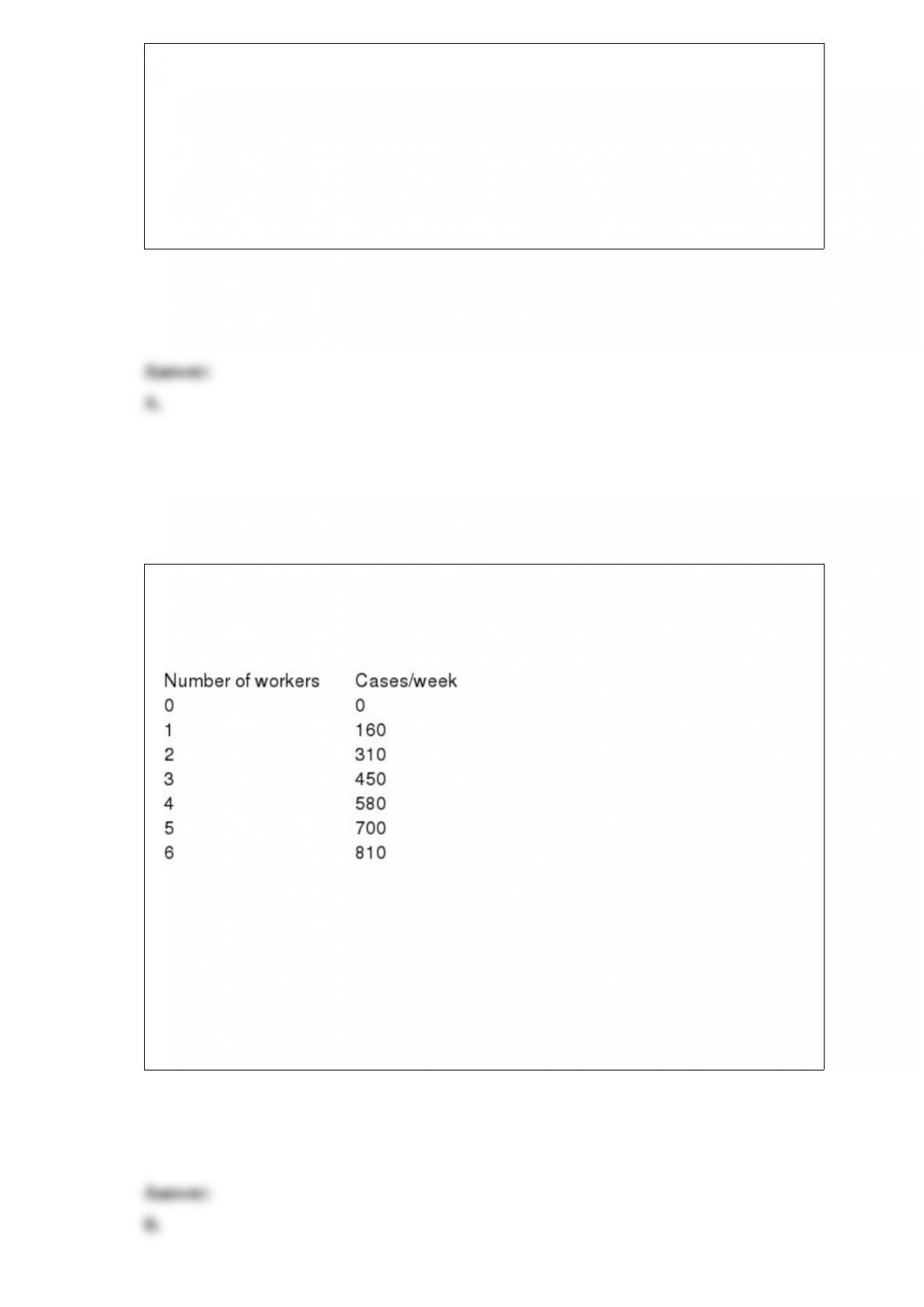
Sam owns a candy factory and hires workers in a competitive labor market to pack
cases of candy. The company’s weekly output of cases of candy varies with the number
of workers hired, as shown in the following table:
The marginal product of the fourth worker is _______ cases per week.
A. 110
B. 130
C. 140
D. 145

The demand for money is:
A. unlimited, since people want to hold as much money as possible.
B. limited by the amount of currency printed by the government.
C. the amount of wealth an individual chooses to hold in the form of money.
D. the amount of income an individual chooses to hold in the form of money.
Income lost by the unemployed is an example of the ______ cost of unemployment,
while the additional spending to control crime is an example of the _____ cost of
unemployment.
A. social; psychological
B. economic; social
C. economic; psychological
D. psychological; economic
Contrary to behavior that would be required to eliminate output gaps, many firms in the
economy:

A. intentionally set prices below equilibrium prices in order to create shortages.
B. adjust their prices only periodically.
C. have fully-flexible prices that change constantly.
D. only change the amount of output they produce in the long run, not in the short run.
Due to the fact that Curly used his frequent flyer miles to fly to visit Moe, Curly told
Moe that it didn’t cost him anything to visit. Is Curly correct?
A. Yes, because Curly’s frequent flyer miles made the trip free.
B. Yes, because Curly could stay at Moe’s house for free.
C. No, because Curly could have used his frequent flyer miles to go somewhere else
instead.
D. No, because Curly had to pay for earlier trips in order to earn the frequent flyer
miles.
Refer to the figure below.

Based on the Keynesian cross diagram, at short-run equilibrium output autonomous
expenditure equals ______ and induced expenditure equals ______.
A. 1,000; 3,000
B. 1,000; 4,000
C. 3,000; 4,000
D. 4,000; 2,000
Suppose a small island nation imports sugar for its population at the world price of
$1,500 per ton. The domestic market for sugar is shown below.
If the government provides a subsidy of $500 per ton, then consumer surplus will be
______ per day.
A. $1,000
B. $4,000
C. $8,000
D. $9,000

According to the text, everyone shouts at a party in order to be heard. If instead
everyone spoke at a normal volume people would still be heard, but people continue to
shout because:
A. shouting is a dominated strategy.
B. shouting is a dominant strategy.
C. shouting can be sustained using a tit-for-tat strategy.
D. the payoff matrix is unknown to the people at a party.
If the market equilibrium quantity is less than the socially optimal quantity, one can
infer that:
A. the private supply curve for the activity is below the socially optimal supply curve.
B. the private demand curve for the activity is above the socially optimal demand.
C. there is a positive externality associated with this good.
D. there is a negative externality associated with this good.

The fact that many primary and secondary school teachers enjoy work schedules that
coincide with their children’s school schedules:
A. implies that teachers will earn less than workers with similar qualifications in other
jobs.
B. implies that teachers will earn more than workers with similar qualifications in other
jobs.
C. has no bearing on the wages of teachers relative to the wages of workers in other
jobs.
D. arises because the market for teachers is a winner-take-all market.
P-TV and QRS-TV are trying to decide whether to air a sit-com or a reality show in a
given time slot. Viewers like both sit-coms and reality shows, but sitcoms are more
expensive to produce than reality shows since real actors need to be hired. QRS-TV
makes its decision first, and then P-TV observes that choice before making its decision.
Both stations know all of the information in the decision tree below.
In the equilibrium of this game:
A. both stations will air reality shows.
B. both stations will air sit-coms.
C. QRS-TV will air a sit-com and P-TV will air a reality show.
D. QRS-TV will air a reality show and P-TV will air a sit-com.
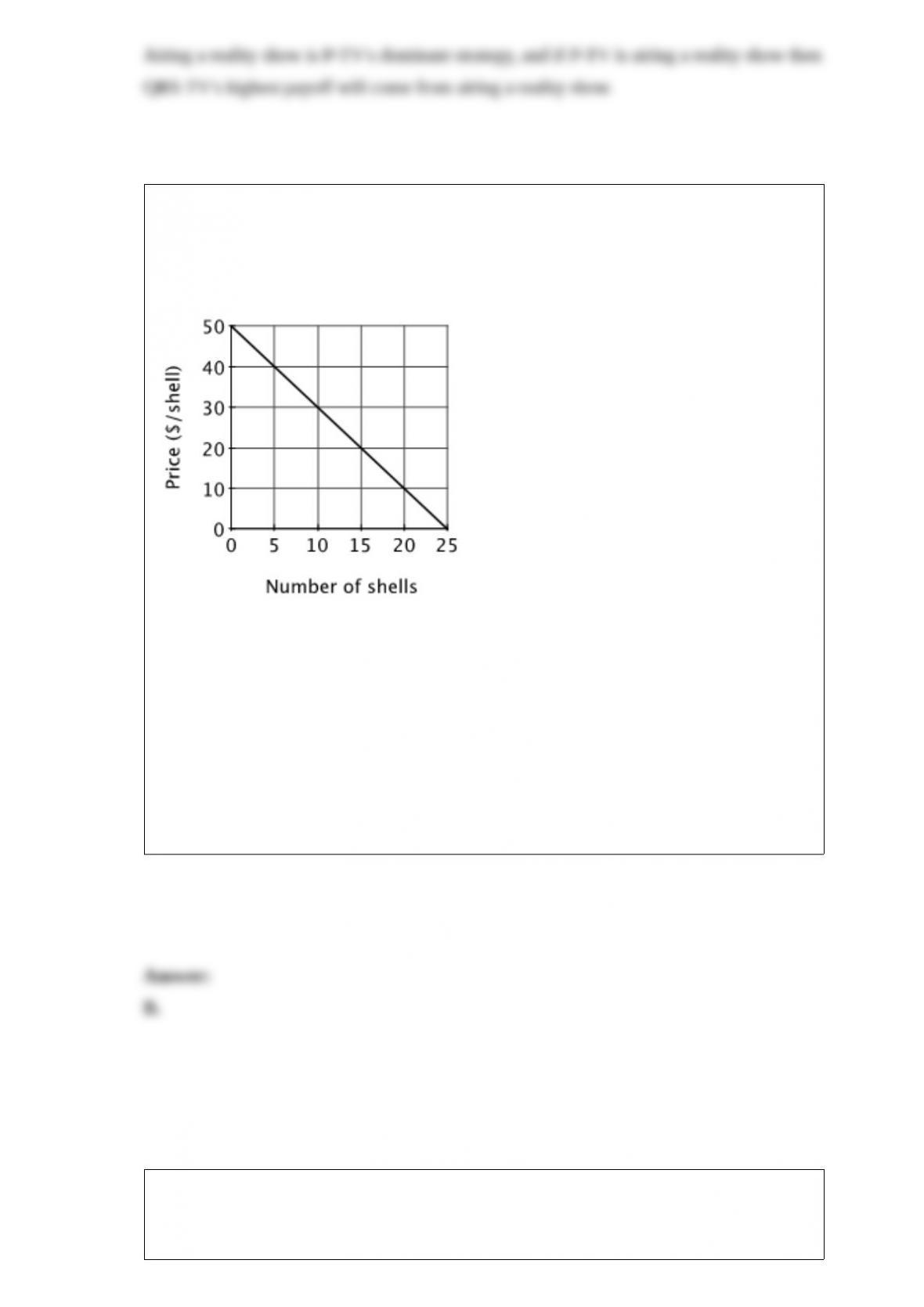
There are 20 residents in the village of Towneburg. The size of the village’s annual
fireworks display depends upon the number of shells that are fired off. Each resident’s
demand for fireworks is shown below. The total cost of the fireworks display is $1,000
plus $10 per shell.
Collectively, the residents of Towneburg would be willing to pay ______ for the 25th
shell, and the marginal cost of the 25th shell is ______.
A. $10; $2500
B. $0; $10
C. $20; $10
D. $0; $3500
If the actual rate of unemployment equals the natural rate of unemployment, then:
A. potential output is greater than real GDP.

B. potential output equals real GDP.
C. potential output is less than real GDP.
D. there is a recessionary gap.
Skill-biased technological change increases wage inequality by altering the ______
high-skilled workers relative to low-skilled workers.
A. reservation price of
B. mobility of
C. supply of
D. demand for
Periods of unusually low production in an economy result in ______ unemployment.
A. cyclical
B. environmental
C. structural
D. frictional

Economic rent is:
A. the amount people pay for an apartment in a perfectly competitive market.
B. the payment made to the owner of a factor of production, which is usually equal to
the owner’s reservation price.
C. the difference between the payment made to the owner of a factor of production and
the owner’s reservation price.
D. sometimes higher and sometimes lower than the owner’s reservation price.
A nation’s standard of living, as measured by real GDP per person, increases:
A. only if average labor productivity increases.
B. only if the share of population employed increases.
C. only if both average labor productivity and the share of population employed
increase.
D. if either average labor productivity and/or the share of population employed
increase.

The opportunity cost of capital investment is the:
A. value of the marginal product of capital.
B. value of the marginal product of labor.
C. real interest rate.
D. price of new capital goods.
In the short run, with predetermined prices, when output is greater than planned
aggregate expenditure, firms will:
A. reduce production.
B. increase production.
C. increase planned aggregate expenditure.
D. decrease planned aggregate expenditure.

When the interest rate in the U.S. falls, U.S. financial assets:
A. become more attractive to foreign buyers.
B. become less attractive to both foreign and domestic buyers.
C. become more attractive to both foreign and domestic buyers.
D. become less attractive to domestic buyers and more attractive to foreign buyers.
Any combination of goods that can be produced with currently available resources is
an:
A. attainable point.
B. efficient point.
C. inefficient point.
D. attainable and efficient point.

Two explanations for increasing wage inequality are ______ and ________.
A. technological progress; a modernized capital stock
B. increased labor supply; a slowdown in productivity growth
C. increased worker mobility; transition aid
D. globalization; skill-biased technological change
A worldwide slowdown in productivity growth occurred:
A. before 1950.
B. in the 1950s and 1960s.
C. in the 1960s and 1970s.
D. in the 1970s and 1980s.
If short-run equilibrium output equals 10,000, the income-expenditure multiplier equals
10, the mpc equals 0.9, and potential output (Y*) equals 9,000, then transfers must be
decreased by approximately ______ to eliminate any output gap.
A. 90

B. 100
C. 111
D. 1,000
According to the quantity equation, if velocity and real GDP are constant, and the
Federal Reserve increases the money supply by 5 percent, then the price level:
A. decreases by 5 percent.
B. decreases by more than 5 percent.
C. increases by more than 5 percent.
D. increases by 5 percent.
An economy produces only 500,000 tables valued at $100 each. Of these, 100,000 are
sold to consumers, 200,000 are sold to businesses, 100,000 are sold to the government,
and 50,000 are sold abroad. No tables are imported. At the end of the year, the table
manufacturers hold the unsold tables in inventory. What is the value of GDP?
A. $5 million
B. $40 million

C. $45 million
D. $50 million
In the basic Keynesian model, a tax increase:
A. reduces short-run equilibrium output.
B. increases short-run equilibrium output.
C. reduces potential output.
D. increases potential output.
Suppose Chris is a potter who makes mugs. His total costs depend on the number of
mugs he makes each day, as shown in the table below.
If the market for mugs is perfectly competitive, and mugs sell for $7.50 each, then
Chris should make ______ mugs per day.
A. 0
B. 4

C. 5
D. 6
The introduction of new technologies ______ the real interest rate and ______ the
equilibrium quantity of national saving.
A. increases; increases
B. increases; decreases
C. decreases; decreases
D. decreases; increases
Which of the following jobs is least likely to be outsourced?
A. Flipping hamburgers
B. Technical assistance over the phone for your computer
C. Transcription of physicians’ records
D. Software design