
Suppose Belgium produces only two goods, chocolate and lace. If Belgium has a
comparative advantage in lace, a move toward free trade will:
A) benefit chocolate workers, harm lace workers in the short run, but benefit the nation
as a whole.
B) harm chocolate workers in the short run, benefit lace workers, but benefit the nation
as a whole.
C) harm chocolate workers in the short run, harm lace workers, but benefit the nation as
a whole.
D) benefit chocolate workers, harm lace workers in the short run, but harm the nation as
a whole.
Marginal cost is equal to:
A) variable cost divided by output.
B) output divided by variable cost.
C) the change in output divided by the change in variable cost.
D) the change in variable cost divided by the change in output.
Economics is the study of:

A) how to invest in the stock market.
B) how society uses limited resources.
C) the role of money in markets.
D) how government officials decide which goods and services are produced.
If an increase in income results in a decrease in the demand for Honda Civics, then
Honda Civics are considered:
A) normal goods.
B) inferior goods.
C) substitute goods.
D) complementary goods.
Diminishing returns occurs because:
A) not enough people have jobs.
B) one of the inputs to the production process is fixed.
C) consumers don’t buy enough of the products produced.

D) two people have not satisfied their self-interests.
A perfectly inelastic supply is represented by a ________ supply curve.
A) vertical
B) downward sloping
C) horizontal
D) upward sloping
Paul is consuming X and Y so that / = 18 and / = 14. Using the
equimarginal rule, Paul should:
A) continue to consume the same amount of X and Y, as he is already maximizing
utility.
B) consume less of both X and Y.
C) consume more X and less Y.
D) consume less X and more Y.
Recall the Application. In a comparison of weights of candy bars in 1943 and 1939, a
Consumer Reports study stated that the change in size of candy bars is an example of:
A) “hidden price increases.”
B) “an illegal price ceiling.”
C) “deadweight loss.”
D) “negative producer surplus.”
Table 3.1 illustrates Willy and Blythe’s hourly production for apples and carrots. From
the table, we can conclude that:
Table 3.1
A) Willy has a comparative advantage in producing apples but not carrots.
B) Willy has a comparative advantage in producing carrots but not apples.
C) Willy has a comparative advantage in producing both goods.
D) Willy does not have a comparative advantage in producing either good.
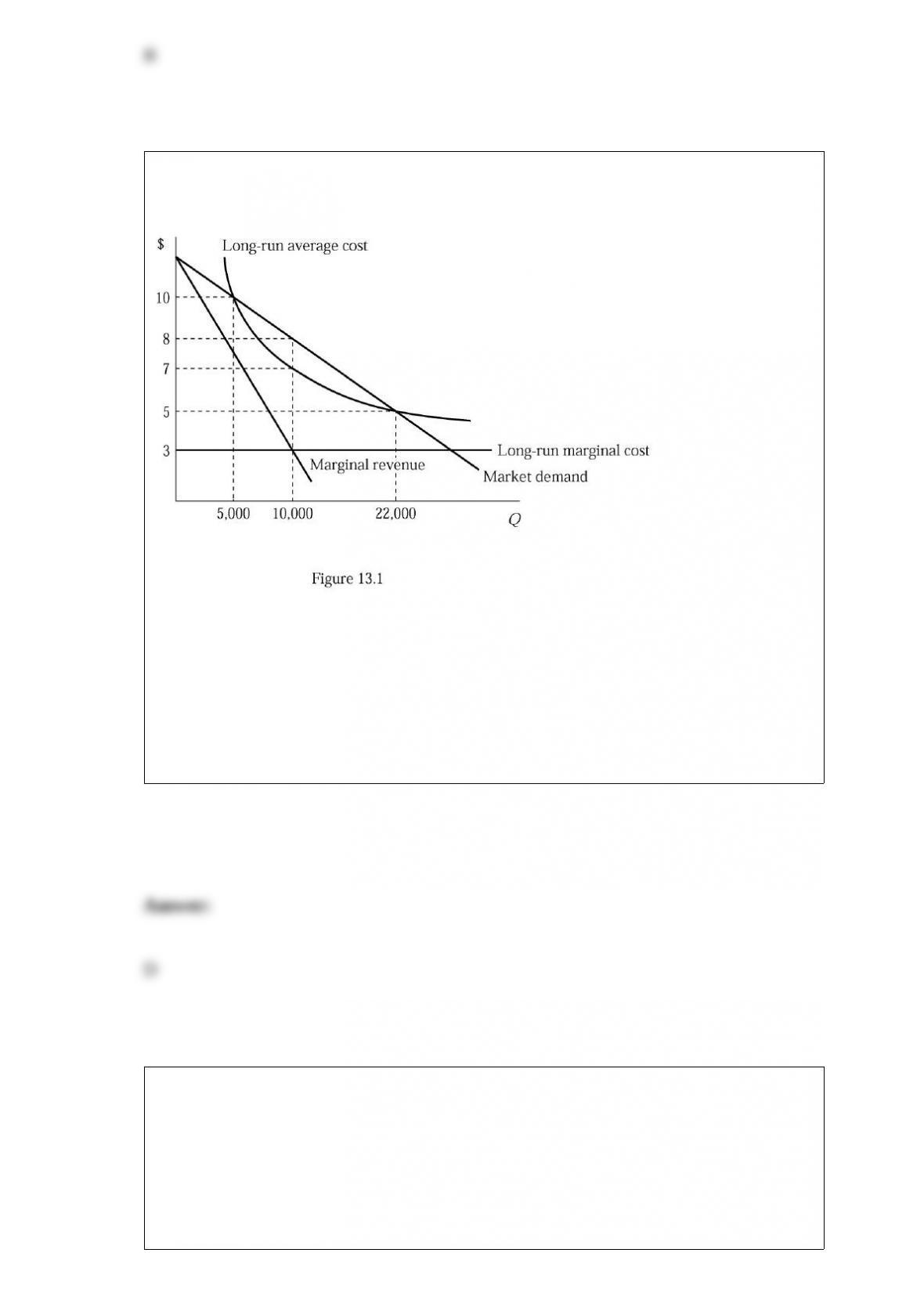
Figure 13.1 shows a demand and costs of an unregulated monopoly. At the output level
of 22,000 units:
A) the firm’s marginal revenue is smaller than its marginal cost.
B) the firm is earning a zero economic profit.
C) the firm is producing more than its profit maximizing level of output.
D) All of the above are correct.
Which of the following is a possible benefit of labor unions?
A) It may help firms to retain a more experienced workforce.
B) It may help firms reduce training costs of new employees.
C) It may facilitate communications between workers and managers.

D) all of the above
Suppose that the income elasticity of demand for good X is greater than 1. Other things
being equal, which of the following statements is INCORRECT?
A) Good X is a normal good.
B) The quantity demanded of good X decreases as a consumer’s income declines.
C) A consumer buys more X as income rises, but the share of income spent on good X
falls.
D) A consumer buys more X as income rises and the share of income spent on good X
also rises.
In perfect competition, the marginal revenue curve:
A) and the demand curve facing the firm are identical.
B) is always above the demand curve facing the firm.
C) is always below the demand curve facing the firm.
D) intersects the demand curve when marginal revenue is minimized.
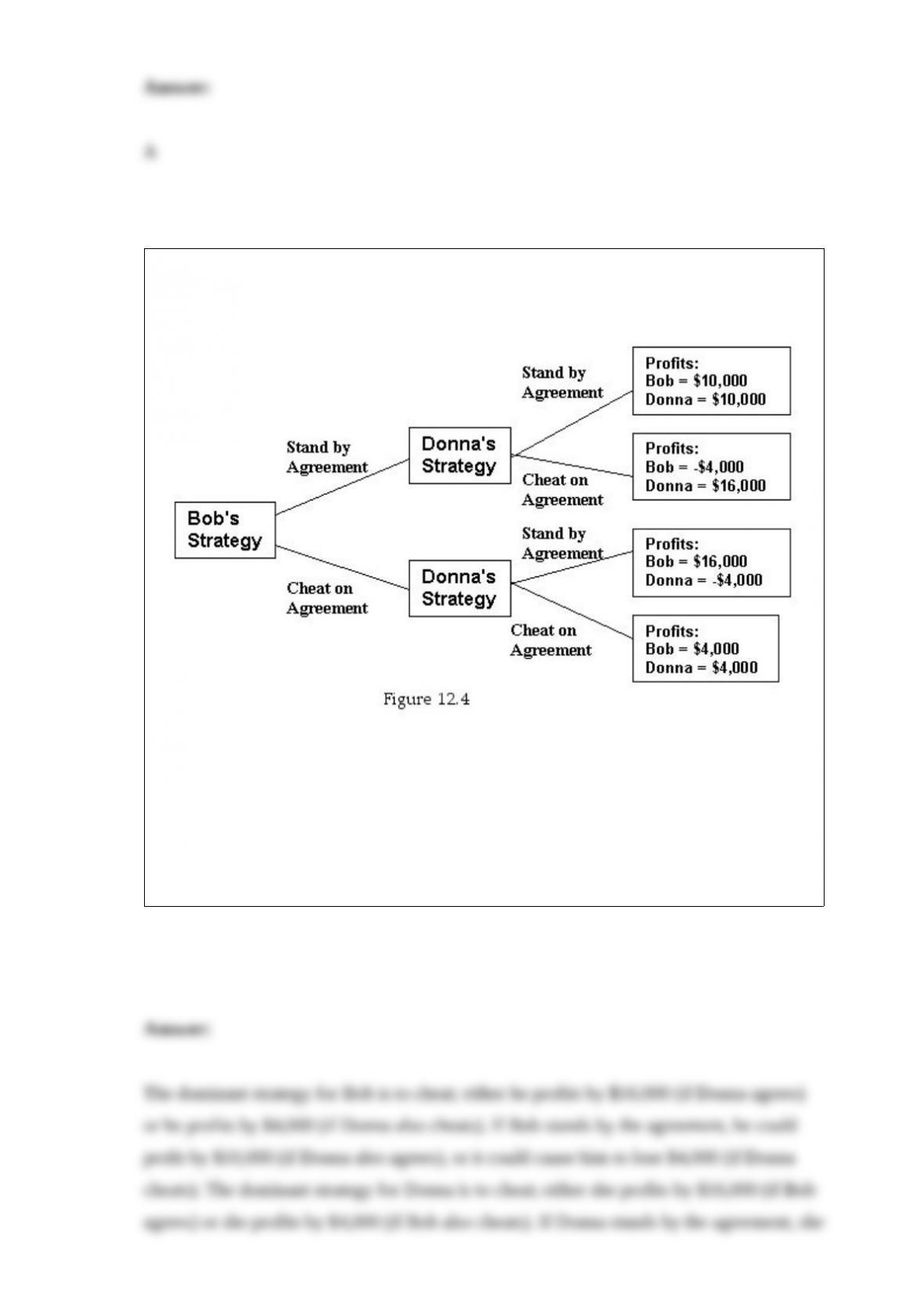
Consider the decision tree depicted in Figure 12.4 concerning a collusive agreement
between firms owned by Bob and Donna. Each participant has the option of following
the terms of the agreement or cheating on the terms of the agreement, but neither knows
what the other will do. What is the dominant strategy for Bob? For Donna? Which
strategy should player, Bob and Donna, choose to maximize the potential gain? What
do you think the outcome of this game will be? Carefully explain your answers.

Mark quit his job as a salesman where he made $43,000 per year to start his own t-shirt
making business. His business expenses are $6,000 per year on rent, $12,000 per year
on supplies, and $4,000 per year on part-time help. As for his personal expenses, his
apartment costs him $4,800 per year and his personal bills are an extra $1,200 per year.
Which of the following is NOT part of the opportunity cost of running his business?
A) his apartment costs
B) his personal bills
C) his part-time labor costs
D) his apartment costs and his personal bills
The marginal principle ________ to the determination of the optimal level of pollution
abatement because ________.
A) applies; there are tradeoffs in terms of the costs and benefits of pollution abatement
B) applies; pollution abatement causes greater harm than benefits
C) does not apply; it is immoral to trade a dirtier environment for material wealth
D) does not apply; the costs and benefits of pollution abatement cannot be measured

If a firm suffers an economic loss, its:
A) price is less than its marginal cost.
B) price is less than its marginal revenue.
C) price is less than its average total cost.
D) none of the above
In the short run, the marginal-revenue product curve is ________ because of ________.
A) downward sloping; diminishing returns
B) upward sloping; increasing returns
C) downward sloping; increasing returns
D) upward sloping; diminishing returns

Recall the Application about the decline in honeybee colonies and its effect on the
price of ice cream to answer the following question(s). In the last few years
thousands of honeybee colonies have vanished, a result of bee colony collapse
disorder (CCD). Roughly one third of the U.S. food supply–including a wide
variety of fruits, vegetables, and nuts–depends on pollination from bees. The
decline of honeybees threatens $15 billion worth of crops in the United States.
According to this Application, the decline in honeybee colonies and its subsequent
effect on the ingredients used in the production of ice cream has ________ the
equilibrium price and ________ the equilibrium quantity of ice cream.
A) increased; increased
B) increased; decreased
C) decreased; increased
D) decreased; decreased
Suppose that consumers expect the price of a product to decrease in the future. The
result is that:
A) the current demand for the product increases.
B) the current demand for the product decreases.
C) the current supply of the product increases.
D) the current supply of the product decreases.

If technological advancements reduce the cost of pollution abatement, all else equal:
A) the price of a pollution permit will fall.
B) the price of a pollution permit will increase.
C) the government will be forced to issue more permits.
D) the government will be forced to issue fewer permits.
Suppose a product suddenly loses popularity and the firms producing the product begin
to realize large losses. As firms exit the market, the equilibrium price in the market will:
A) increase and make the remaining firms stay in business.
B) decrease and make the remaining firms stay in business.
C) decrease further and push more firms out of business.
D) decrease further while making the remaining firms realize profits again.
The unionization rate of public sector workers is about:
A) 10.3%.

B) 17.1%.
C) 24.4%.
D) 39.8%.
You have an hour between your economics and math classes. What is the opportunity
cost of that time if you use it to do math homework?
A) It depends on what you would do if you had no math homework.
B) It depends on how much you like math.
C) zero, because an hour isn’t long enough to go to a paying job
D) zero, because it doesn’t cost any money to do your math homework
The marginal revenue product curve is:
A) upward sloping when capital and labor are substitutes.
B) the firm’s short-run demand curve for labor.
C) likely to shift if the wage increases.
D) all of the above

If one side of the market, either the buyer or seller of a good or service has better
information than the other side, there is:
A) moral hazard.
B) asymmetric information.
C) an external cost.
D) a free-rider problem.
Ceteris paribus, if the prices of the goods a consumer purchases increase, then the
consumer’s real income:
A) decreases.
B) increases.
C) remains the same.
D) might increase or decrease.

Workers who install and maintain electrical power lines are known to have high wages.
We can (in part) explain this because:
A) the job is likely to be very dull.
B) the job is likely to be very dangerous.
C) many individuals are qualified to do this job.
D) the job requires a low level of skill.
Compact discs are sold in a perfectly competitive market. The current market price of
compact discs is $15. If at the current level of production of compact discs you
calculate that the marginal cost to your company is also $15, and that AVC is rising, in
the short run your company should:
A) produce more compact discs.
B) produce fewer compact discs.
C) continue producing the current level of compact discs.
D) raise the price of its compact discs.

If the demand for tennis shoes decreases and a firm’s supply curve is upward sloping,
then:
A) producer surplus decreases.
B) producer surplus does not change.
C) producer surplus increases.
D) producer surplus may either increase or decrease.
Additional Application
Do implicit costs affect decision-making in the real world? For the first time nationwide
the number of golf courses closing in a year will exceed the number that is opening.
This can be explained by a number of reasons. One is the cost of insuring golf courses,
which has increased in many areas. Also the number of rounds played has decreased 4%
in the last six years. But another explanation is the opportunity cost of owning a golf
course. As property prices have increased, the land that golf courses are on is worth a
great deal more as housing developments. The owners must continually decide whether
the return from operating a golf course is greater than, or at least equal to, the return the
owners could get if the land was developed for another use. Furthermore, one
explanation for the decline in rounds being played is attributed to the time it takes to
play golf. As the opportunity cost of a golfer’s time increases, the fewer hours he/she is
willing to spend on the golf course. Implicit costs are real and play a role in
decision-making of both supply and demand.
“Blues on the Green: Why Golf is in Decline,” The Economist, October 14, 2006, p. 70.
Which of the following would be an implicit cost of playing a round of golf?
A) the value of meeting new friends or improving business relationships
B) the value of another activity the golfer could be doing
C) the cost of property insurance; the value of fresh air and exercise for five hours

D) the value of competition and improving your skill level