
Economists believe that people’s wants are
a. finite.
b. infinite.
c. irrational.
d. unimportant because needs are more important than wants.
Two major exports for the United States are
a. clothing and office machines.
b. soybeans and scientific instruments.
c. footwear and fish.
d. coffee and diamonds.
e. none of the above
Natural monopolies can be regulated based on price, profit, or output.
a. True
b. False

If the law of increasing opportunity costs is operable, and currently the opportunity cost
of producing the 101st unit of good X is 5Y, then the opportunity cost of producing the
201st unit of good is X is most likely to be
a. less than 5Y.
b. more than 1/5Y but less than 5Y.
c. more than 5Y
d. less than 1/5Y but more than zero.
Refer to Exhibit 27-l. What dollar value goes in blank (B)?
Exhibit 27-1
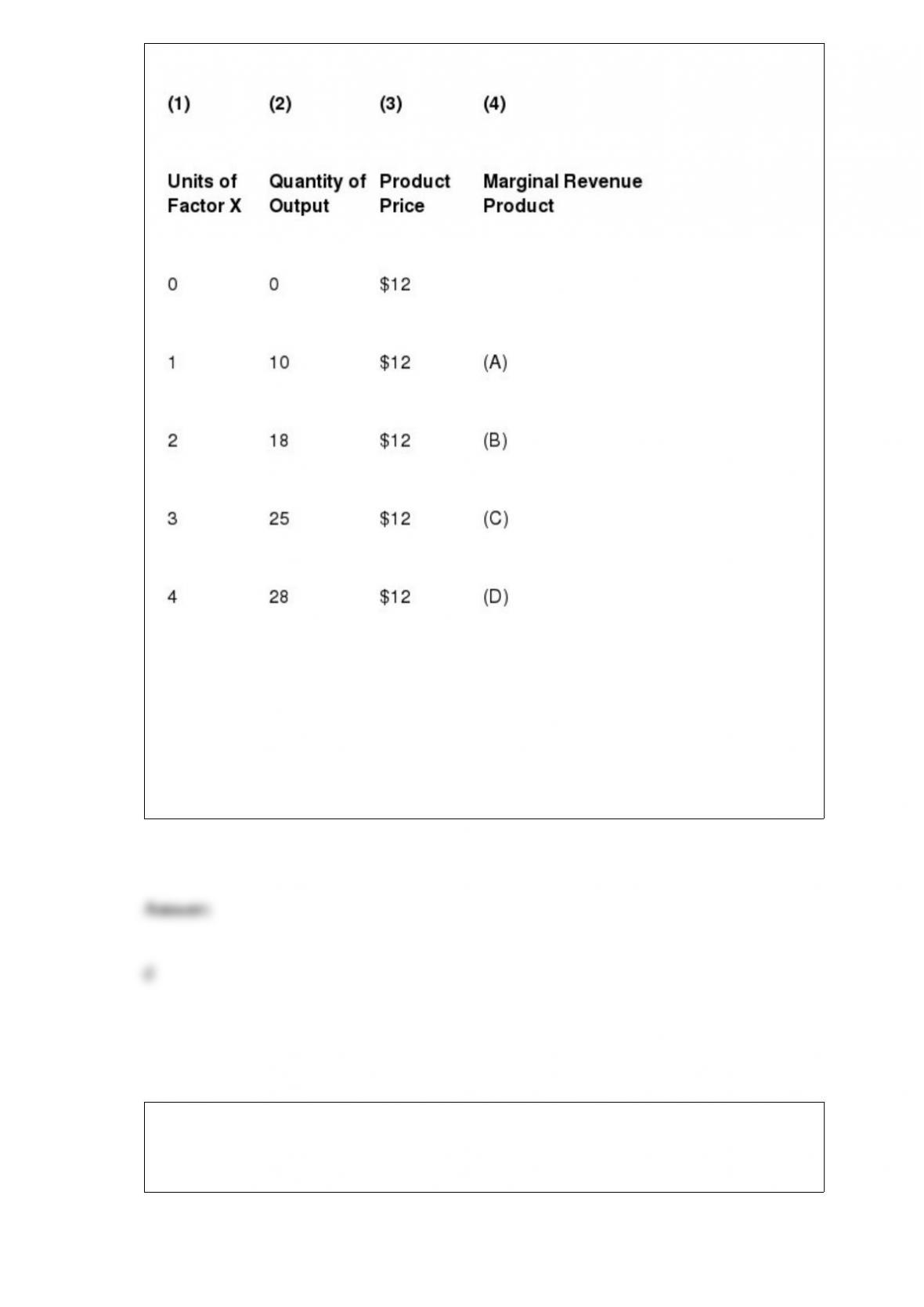
a. $12
b. $62.50
c. $144
d. $96
Refer to Exhibit 4-1. In a free market, ________ units of the good would be
exchanged.With a price ceiling, _______ units of the good would be exchanged.
Exhibit 4-1

a. 125; 75
b. 75; 125
c. 175; 125
d. 125; 175
If an economy can produce a maximum of 100 units of good X and the opportunity cost
of 1X is always 5Y, then what is the maximum number of units of good Y the economy
can produce?
a. 250
b. 100
c. 20
d. 500
e. none of the above

Increased productivity in agriculture leads to lower prices for consumers and higher
revenues for farmers.
a. True
b. False
Refer to Exhibit 22-2. What is the average variable cost of producing 90 units of
output?
Exhibit 22-2
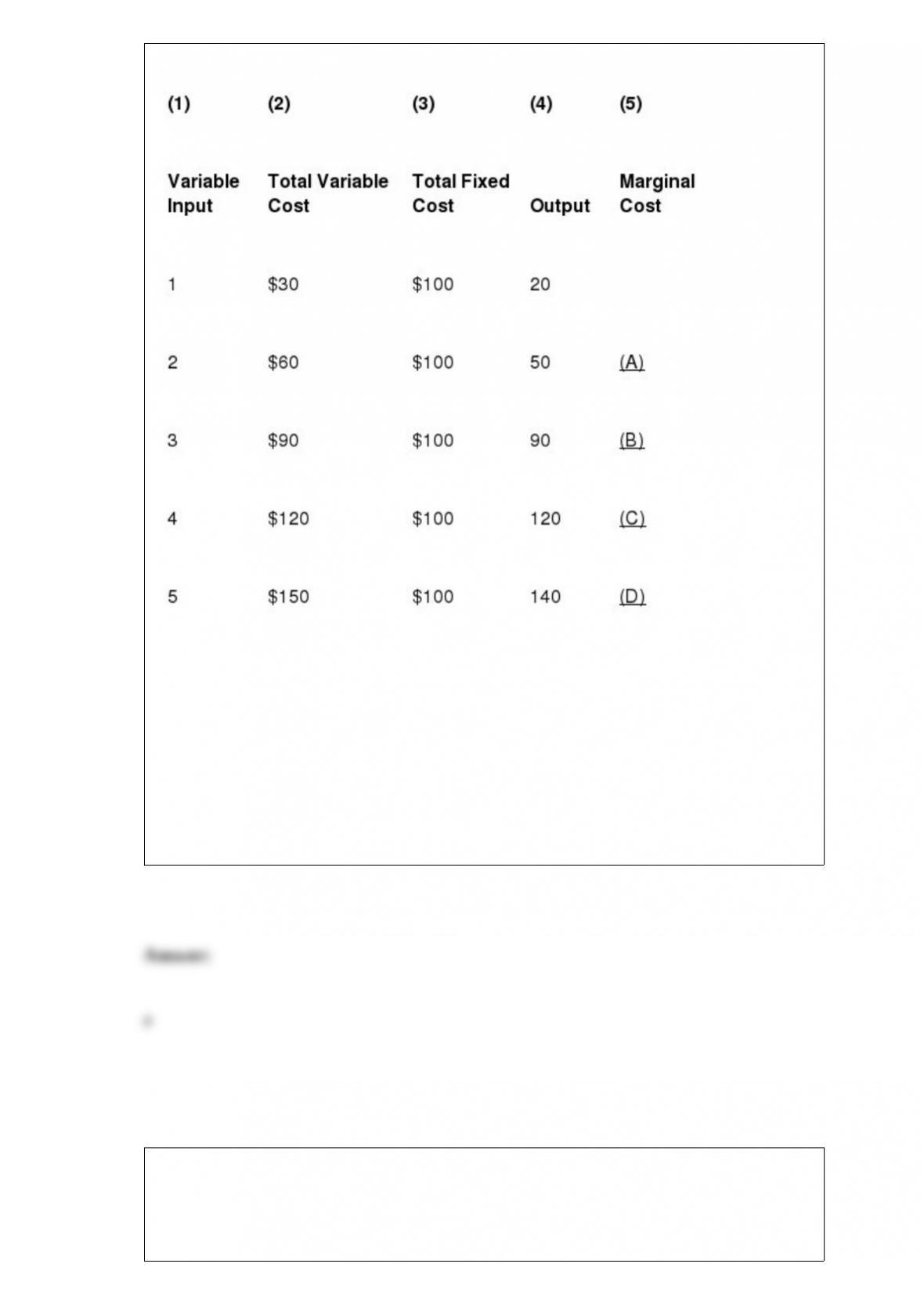
a. $1.00
b. $1.17
c. $1.59
d. $1.44
e. There is not enough information provided to answer the question.
At a price of $15 each, Marta buys 4 books per month. When the price increases to $20,
Marta buys 3 books per month. Luz says that Marta’s demand for books has decreased.
Is Luz correct?
a. Yes, Luz is correct.
b. No, Luz is incorrect. Marta’s demand has increased.
c. No, Luz is incorrect. Marta’s quantity demanded has decreased, but her demand has
stayed the same.
d. No, Luz is incorrect. Marta’s quantity demanded has increased, but her demand has
stayed the same.
e. No, Luz is incorrect. Marta’s quantity demanded has decreased and her demand has
increased.
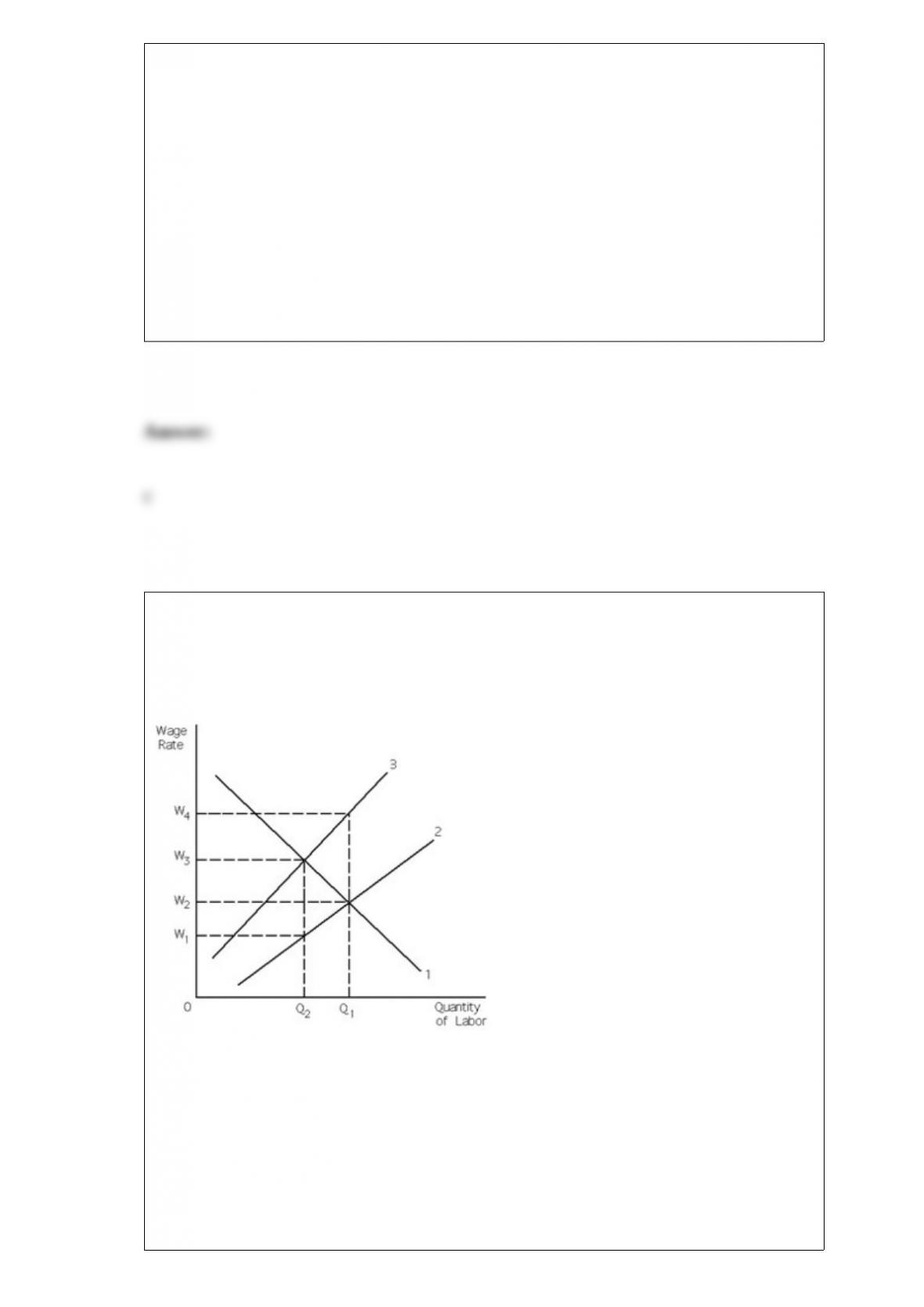
Refer to Exhibit 28-10. If the firm in the exhibit is a monopsony, then the curve
represented by the number 1 is its
Exhibit 28-10
a. factor supply curve.
b. marginal factor cost curve.
c. marginal revenue product curve.
d. marginal cost curve.

e. average fixed cost curve.
An agricultural price support is an example of a price ceiling.
a. True
b. False
In the prisoner’s dilemma setting for producing and stealing, a tax imposed on
participants could end up changing the payoff matrix so that
a. one participant is better off, and one participant is worse off.
b. both participants are worse off.
c. both participants are better off.
d. all of the above are possible

Excess capacity results from a
a. downward-sloping demand curve and a U-shaped ATC curve.
b. downward-sloping demand curve and no fixed costs.
c. horizontal demand curve and an upward-sloping marginal cost curve.
d. perfectly inelastic demand curve and a downward-sloping ATC curve.
e. none of the above
Which of the following statements is false?
a. The Lorenz curve expresses the relationship between cumulative percentage of
households and cumulative percentage of income.
b. If there were perfect income equality, the Lorenz curve would be a 45-degree line.
c. The Gini coefficient is a measurement of the degree of inequality in the income
distribution.
d. The Gini coefficient is a number between 0 and 100.
Economists generally agree that land rents are
a. price determining, not price determined.

b. price determined, not price determining.
c. too high.
d. too low.
e. Economists generally do not agree on anything.
Refer to Exhibit 22-3. The average fixed cost of producing 10 units of output is
Exhibit 22-3
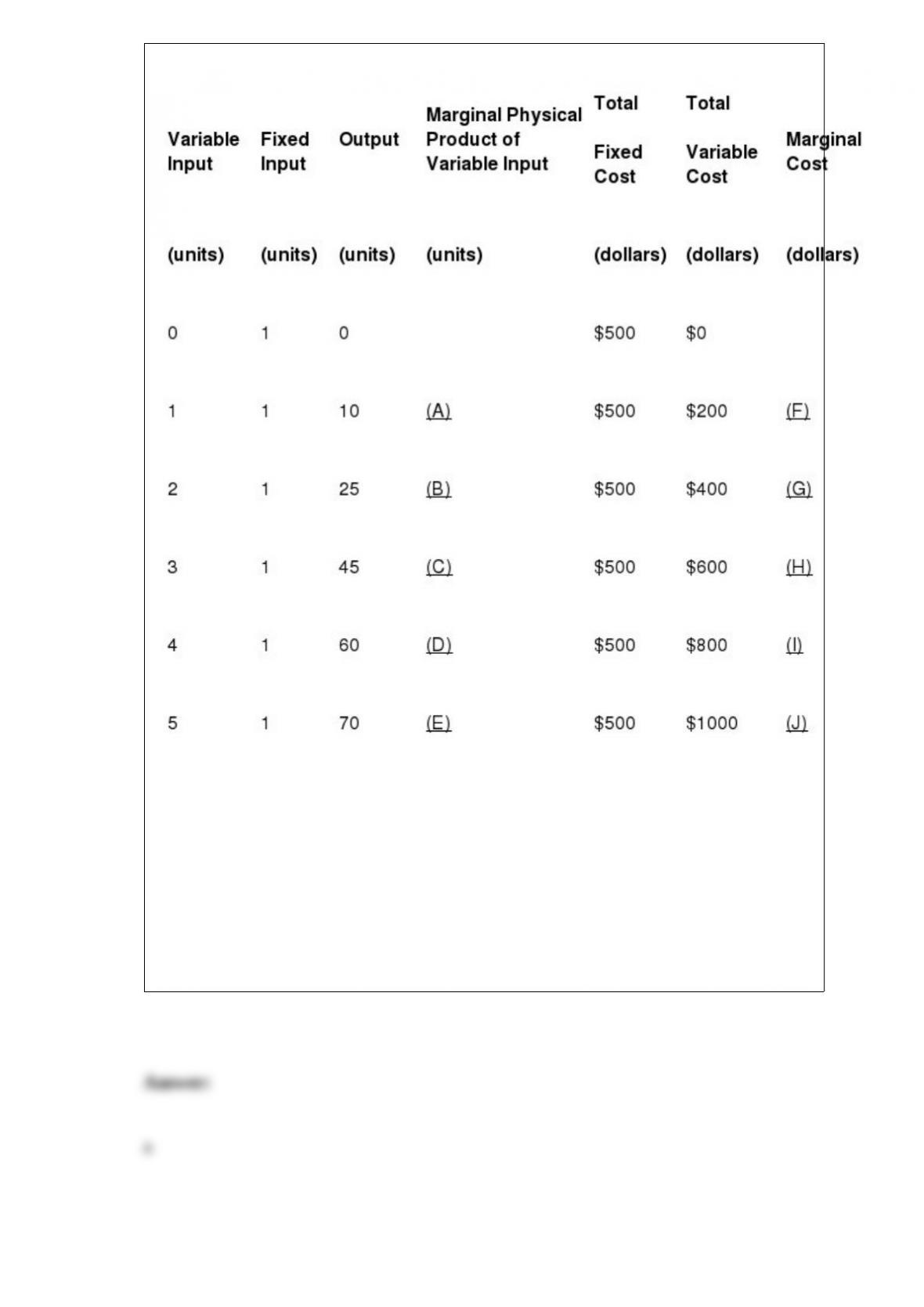
a. $50.00.
b. $10.00.
c. $2.50.
d. $1.00.
e. $500.00.

Which of the following statements represents a correct sequence of events?
a. Productivity rises in the agriculture sector, the supply curve of foodstuffs shifts to the
left, price rises, and total revenue rises assuming demand is inelastic.
b. Productivity rises in the agriculture sector, the supply curve of foodstuffs shifts to the
right, price rises, and total revenue rises assuming demand is inelastic.
c. Productivity rises in the agriculture sector, the supply curve of foodstuffs shifts to the
right, price falls, and total revenue falls assuming demand is elastic.
d. Productivity rises in the agriculture sector, the supply curve of foodstuffs shifts to the
left, price falls, and total revenue rises assuming demand is elastic.
e. none of the above
A political candidate running in a two-person race is likely to occupy
a. an extreme end of the political spectrum and hope that his or her opponent will
gravitate toward the middle so that he or she can then claim that his or her opponent has
flip-flopped.
b. the middle of the political spectrum and label his or her opponent as an extremist
(either liberal or conservative).
c. a position somewhere between the middle of the political spectrum and an extreme
end so that he or she can move either way shortly before the election.
d. one extreme end of the political spectrum early in the race and the other extreme end
near the end of the race.
If an asymmetry of information is removed and laborers’ preferences change against
employment in a labor market, it would __________ employment and __________ the
wage at the equilibrium in the market.
a. increase; raise
b. increase; lower
c. decrease; raise
d. decrease; lower
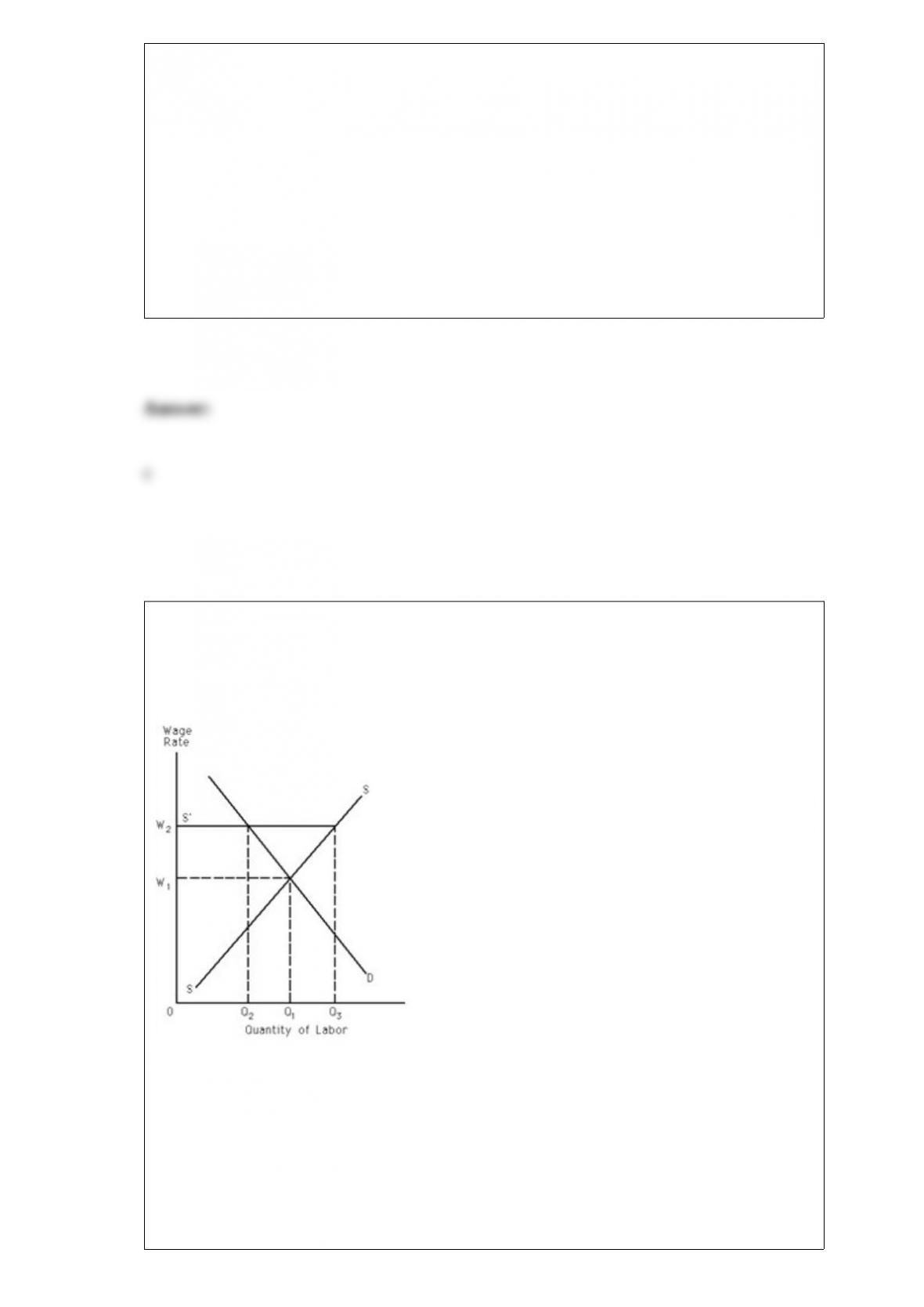
Refer to Exhibit 28-2. The union wants management to believe the supply curve of
labor is S’S instead of SS. What does supply curve S’S represent?
Exhibit 28-2
a. It represents a situation where management cannot
hire workers for less than W2, and if the firm wants to hire more workers than it hires at
equilibrium, it will have to pay a wage between W1 and W2.
b. It represents a situation where management cannot hire workers for more than W2,
and if the firm wants to hire more workers than Q2 it will have to pay more than W1.
c. It represents a situation where management cannot hire workers for less than W2, and
if the firm wants to hire more than Q3 workers it will have to pay more than W2.
d. It represents a situation where management cannot hire Q1 – Q2 workers for less than
W2, but that Q3 – Q1 workers can be hired for less.
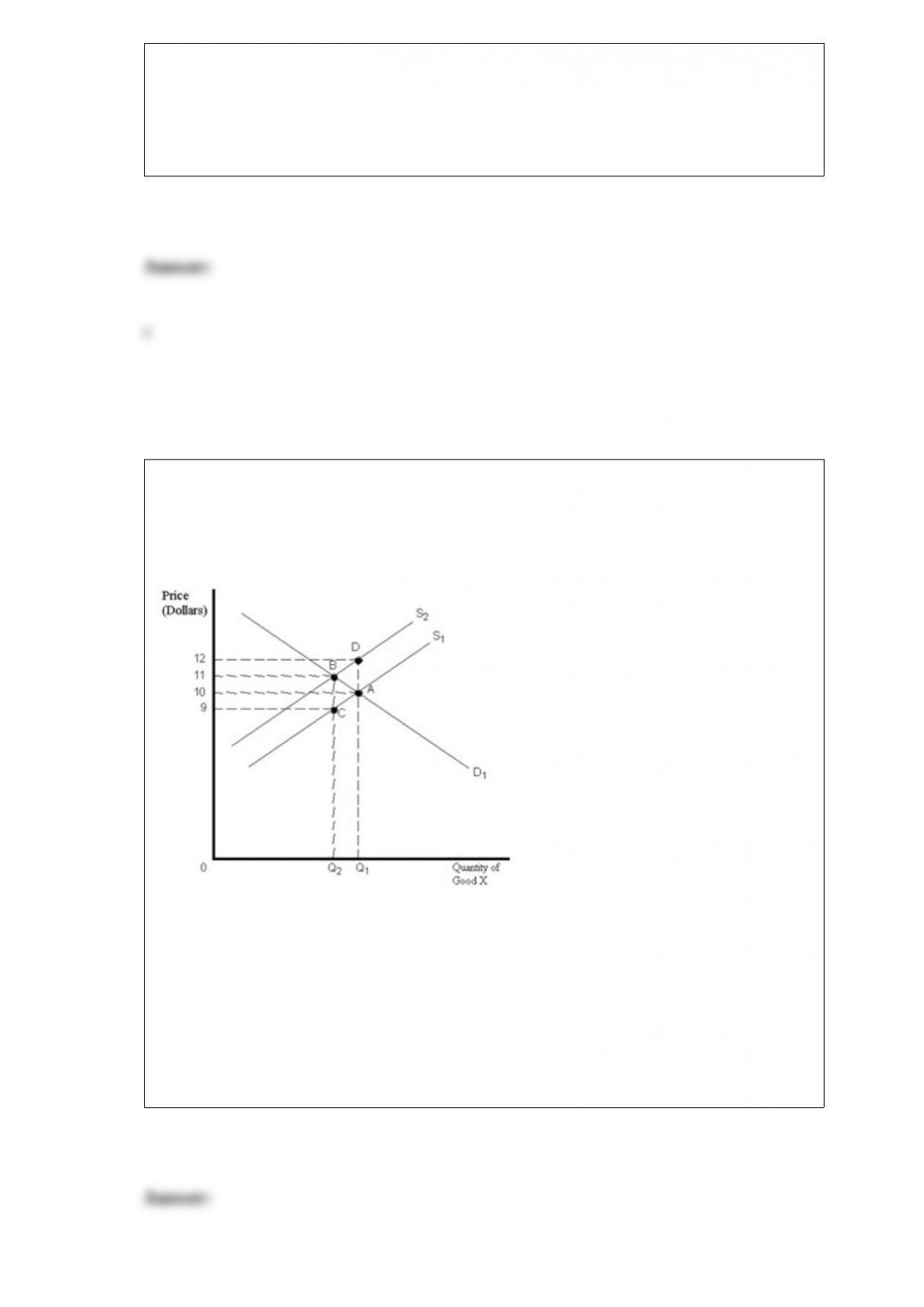
Refer to Exhibit 20-8. The market for good X is initially at point A. A tax is then placed
on the production of good X. At the new equilibrium, point __________, buyers end up
paying __________ of the tax and sellers end up paying __________ of the tax.
Exhibit 20-8
a. B; one-half; one-half
b. D; one-half; one-half
c. C; one-half; one-half
d. B; one-quarter; three-quarters
e. none of the above
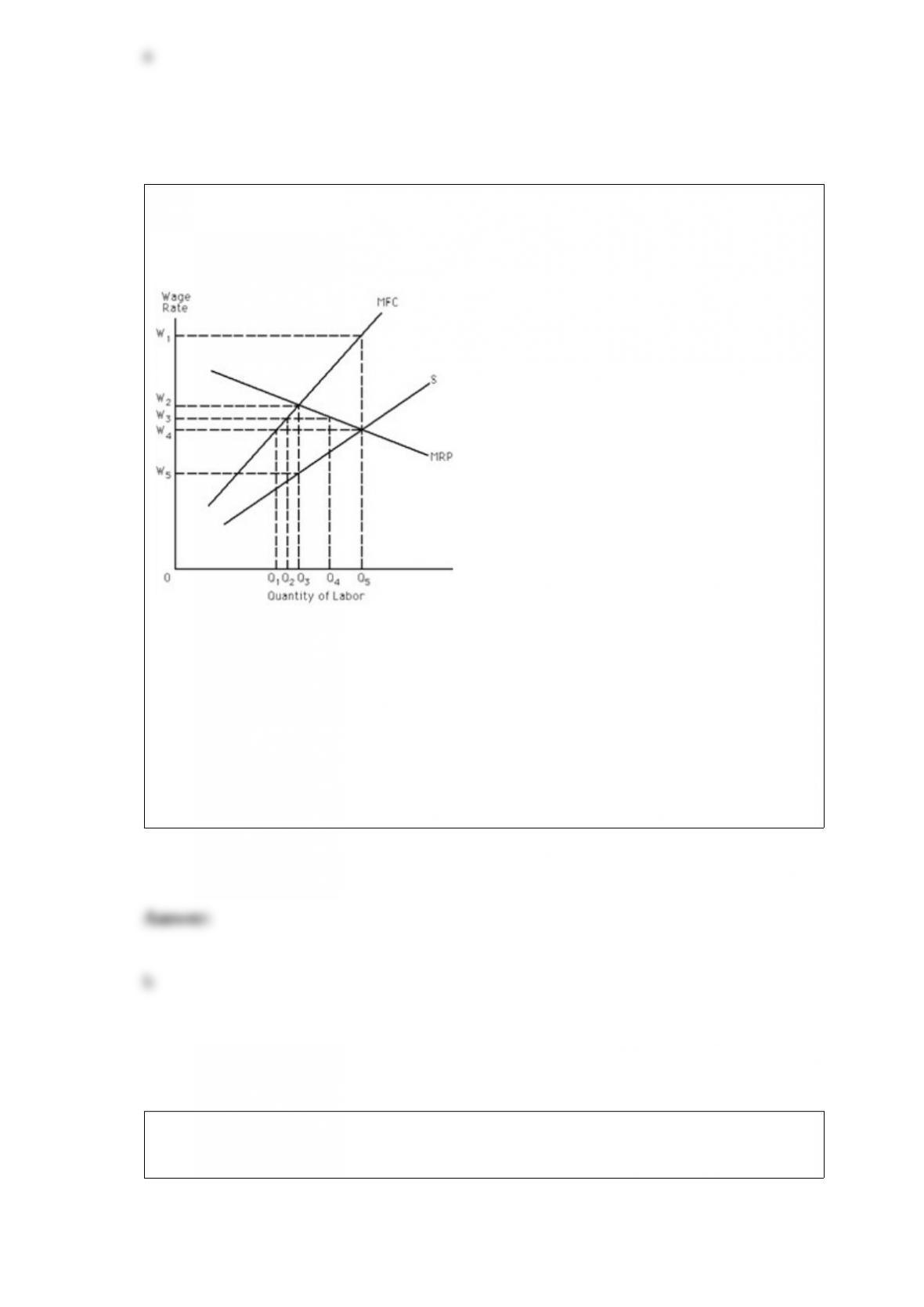
Refer to Exhibit 28-8. An effective price floor set at W3 would
Exhibit 28-8
a. increase employment from Q1 to Q2.
b. increase employment from Q3 to Q4.
c. decrease employment from Q5 to Q2.
d. decrease employment from Q5 to Q4.
What is the difference between a union shop and a closed shop?Are either (or both)
legal in the United States?

What is the median voter model?Describe four different ways in which this theory is
predicted to impact the behavior of political candidates.
Explain the difference between a change in demand and a change in quantity
demanded.Be sure to specify what causes each to change and how they differ when
graphed.

Explain why it is important to differentiate between the “number of unskilled workers”
and the “number of unskilled labor hours” when evaluating the impact on the market for
unskilled labor of an increase in minimum wage.
Assume that two products are being produced: benches and chairs.Create a table that
illustrates constant opportunity costs in the production of these two goods.Draw a
production possibilities frontier (PPF) based on the data in your table and explain the
condition necessary for a PPF to exhibit constant opportunity costs.

What is the difference between a vertical merger and a horizontal merger?Which one is
the Justice Department more likely to look at more carefully and why?