1) Landowners will not receive any rent so long as:
A.there is any tax on land.
B.the supply and demand curves for land intersect.
C.the supply curve of land is perfectly inelastic.
D.the supply curve lies entirely to the right of the demand curve.
2) A single commercial bank must meet a 25 percent reserve requirement. If the bank
has no excess reserves initially and $5,000 of cash is deposited in the bank, it can
increase its loans by a maximum of:
A.$1,250.
B.$120,000.
C.$5,000.
D.$3,750.
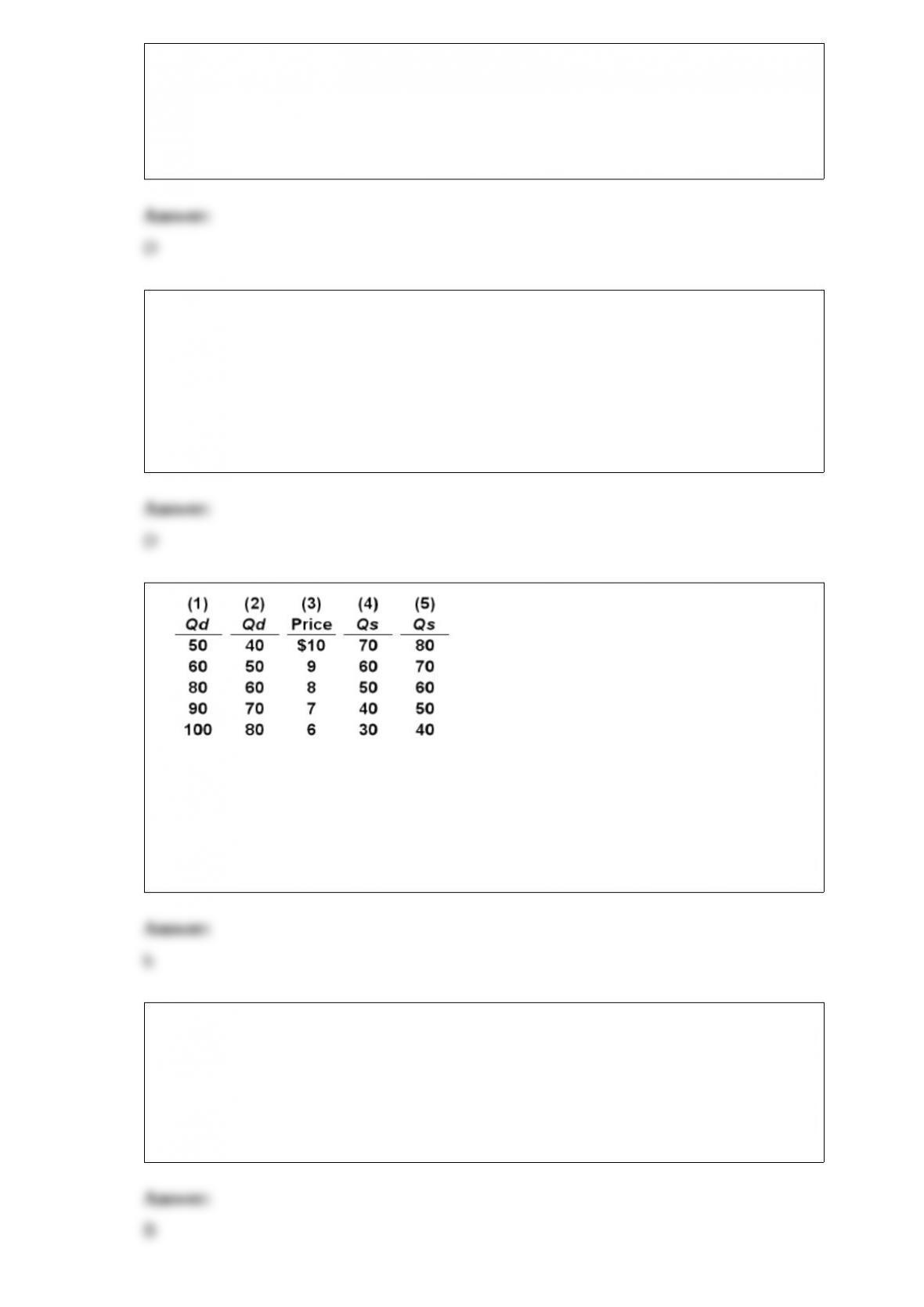
3)
refer to the above table. suppose that demand is represented by columns (3) and (2) and
supply is represented by columns (3) and (5). if the price were artificially set at $9, a:
a.the market would clear.
b.a surplus of 20 units would occur.
c.a shortage of 20 units would occur.
d.demand would change from columns (3) and (2) to columns (3) and (1).
4) The first discovery of the water-soluble material used in contact lens is an example
of:
A.innovation.
B.invention.
C.creative destruction.
D.diffusion.
5) In recent years, the Federal Reserve has:
A.paid closer attention to M1 than M2 in setting monetary targets.
B.relied more on changes in the discount rate than open-market operations in
establishing monetary policy.
C.has increased M2 at a fixed annual rate, regardless of the health of the economy.
D.taken an activist, pragmatic approach to monetary policy, paying close attention to
interest rates.
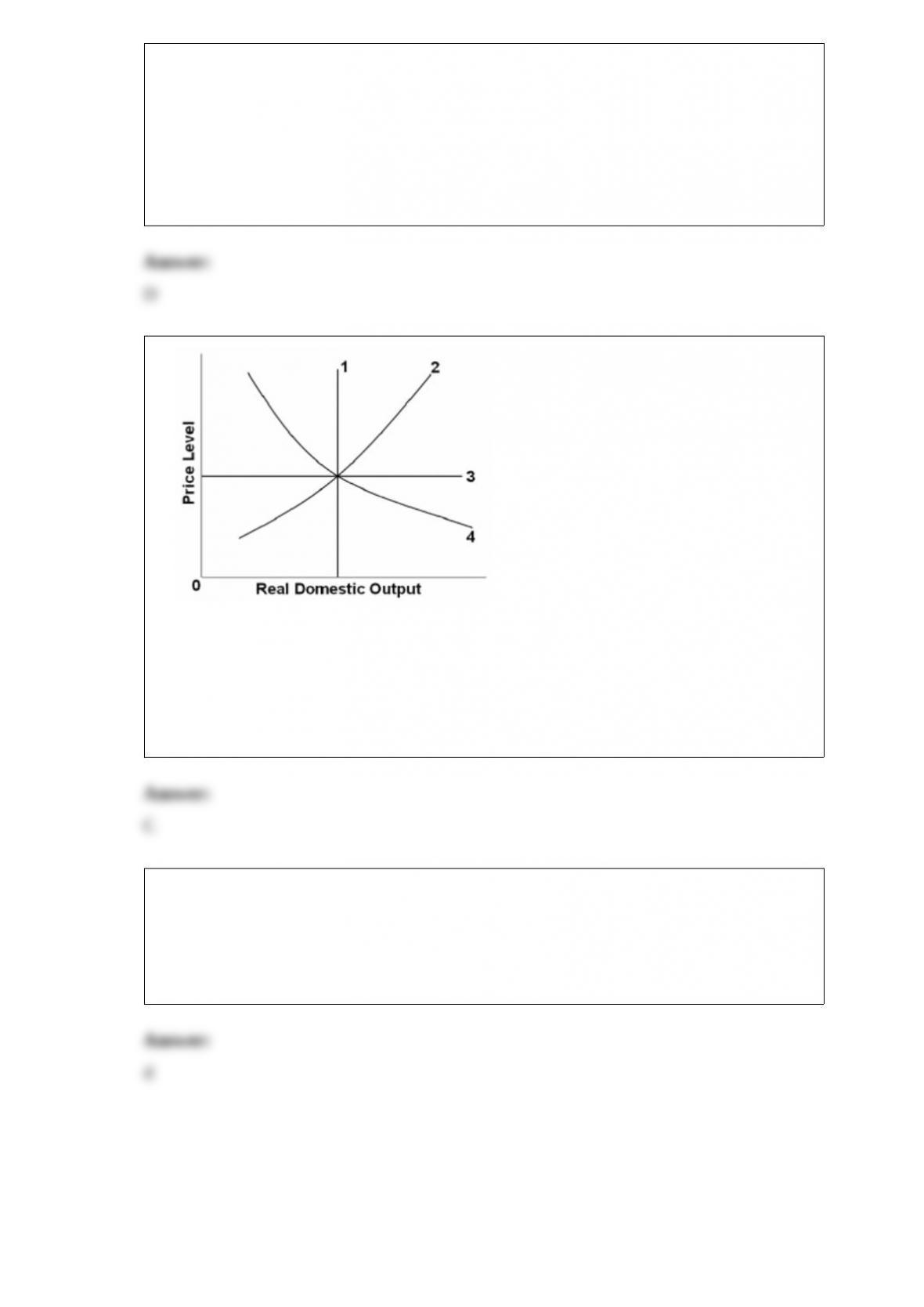
6)
In the above diagram, the economy’s immediate-short-run aggregate supply curve is
shown by line:
A.1.
B.2.
C.3.
D.4.
7) elasticity can be thought of as degree of relative:
a.video brightness.
b.price bounce.
c.audio volume.
d.quantity stretch.
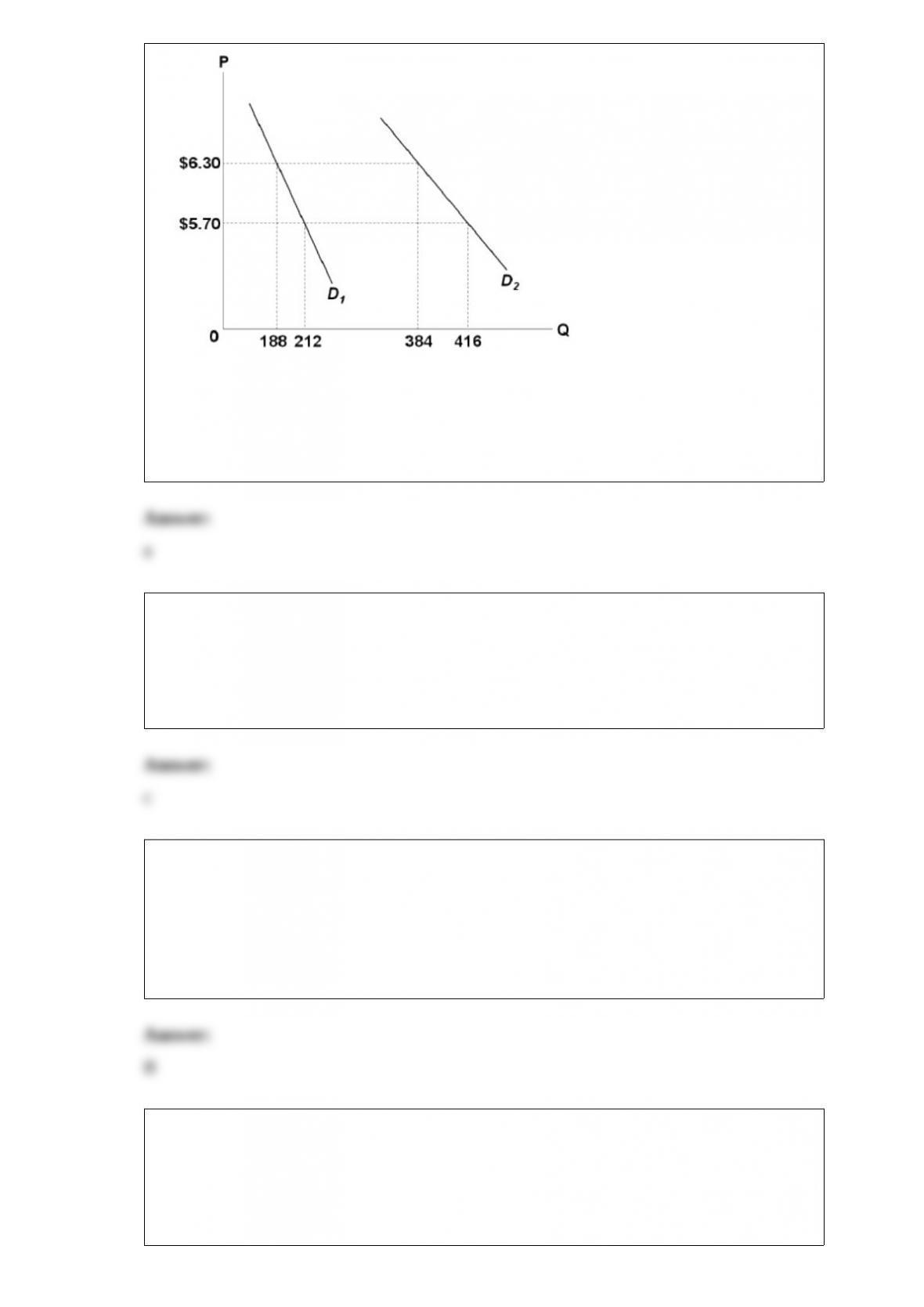
8)
refer to the above diagram. between prices of $5.70 and $6.30:
a.d1is more elastic than d2.
b.d2is an inferior good and d1is a normal good.
c.d1andd2have identical elasticities.
d.d2is more elastic than d1.
9) which one of the following expressions best states the idea of opportunity cost?
a.”a penny saved is a penny earned.”
b.”he who hesitates is lost.”
c.”there is no such thing as a free lunch.”
d.”all that glitters is not gold.”
10) The efficiency loss of a tax is the idea that:
A.in addition to taking income from the citizenry, taxes also increase the rate of
inflation.
B.taxes cause a decline in output for which marginal benefit exceeds marginal cost.
C.taxes diminish incentives to work.
D.government spends dollars less efficiently than do households and businesses.
11) the supply of product x is perfectly inelastic if the price of x rises by:
a.5 percent and quantity supplied rises by 7 percent.
b.8 percent and quantity supplied rises by 8 percent.
c.10 percent and quantity supplied stays the same.
d.7 percent and quantity supplied rises by 5 percent.
12) The real-balances effect indicates that:
A.an increase in the price level will increase the demand for money, increase interest
rates, and reduce consumption and investment spending.
B.a lower price level will decrease the real value of many financial assets and therefore
reduce spending.
C.a higher price level will increase the real value of many financial assets and therefore
increase spending.
D.a higher price level will decrease the real value of many financial assets and therefore
reduce spending.
13) well-defined property rights:
a.discourage investment and growth.
b.discourage hard work.
c.impede exchange.
d.encourage owners to maintain or improve their property.
14) Assume that the short run cost and demand data given in the table below confront a
monopolistic competitor selling a given product and engaged in a given amount of
product promotion. Compute the marginal cost and marginal revenue of each unit of
output and enter these figures in the table.
(a)At what output level and at what price will the firm produce in the short run? What
will be the total profit?
(b)What will happen to demand, price, and profit in the long run?
15) Which of the following is the best example of a fishery?
A.all marine life along the Great Barrier Reef.
B.Pacific Halibut.
C.U.S. Department of Fish and Game.
D.Crab.
16) tennis rackets and ballpoint pens are:
a.substitute goods.
b.complementary goods.
c.inferior goods.
d.independent goods.
17) which of the following outcomes is consistent with a purely competitive market in
long-run equilibrium?
a.consumer and producer surplus will be maximized.
b.p = mc = lowest avc.
c.the minimum willingness to pay equals the maximum acceptable price.
d.we would expect all of these to occur in the long run in a purely competitive market.